What is entity resolution?
You have a company in your CRM called "Acme Inc." A contract comes in signed by "Acme Incorporated." Your finance team has "ACME, Inc." in the billing system.
Same company? Probably. But which record is right? And what's the actual legal name registered with the government?
That's entity resolution. Figuring out which records refer to the same real-world company — and linking them to an authoritative source.
Get it wrong and you end up with duplicate vendors, failed compliance checks, and sales reps pitching companies that already bought from you last year.
Get it wrong at scale — across 50 countries, thousands of vendors, millions of transactions — and you're building on sand.
Why global entity matching is broken
Two ways companies try to solve this today.
Manual matching. Someone eyeballs the records and makes a call. Works until it doesn't. Doesn't scale. No audit trail. Your compliance team hates it.
Third-party data. You buy a database from a vendor and use their identifiers to match. Sounds reasonable until you ask where that data actually comes from.
Most providers aggregate from other vendors, scrape websites, pull from self-reported databases, and blend it with outdated government filings. By the time the data reaches you, it's been copied, reformatted, merged with conflicting records, and stripped of any provenance.
You're matching against a copy of a copy. When two records conflict — and they will — you have no way to know which one is true.
This is why enterprise compliance teams push back on third-party data. They need to prove to regulators that the company they onboarded is actually the legal entity they think it is. Aggregated data can't do that. There's no trail back to the source.
What bad entity data actually costs
Nobody budgets for bad entity resolution. It doesn't show up as a line item. It shows up as friction everywhere else.
Compliance blowback. A customer fails KYB because your data says they're dissolved when they're actually active. Now you've blocked a good customer and your ops team spends two days sorting it out. Multiply that by a hundred.
Or worse — you onboard a company you shouldn't have. Sanctions violation. Regulatory fine. Your compliance officer's name on the enforcement action.Operational drag. Duplicate vendor records mean duplicate payments. Your finance team catches some of them. Not all. Reconciliation becomes a recurring nightmare.
Dirty CRM data means your sales team wastes cycles on companies that don't exist, already churned, or are actually the same account under three different names.The real cost isn't the data. It's every decision downstream that gets made on bad information.
A European bank paid €50 million in fines because they couldn't demonstrate adequate KYB on a subset of corporate customers. The data existed somewhere. They just couldn't trace it back to a source regulators would accept.
Five reasons entity matching fails across borders
Matching companies within a single country is manageable. Matching across 200 countries is a different problem entirely.
No universal identifier. There's no global equivalent of a company ID. The U.S. uses EINs. The UK uses Company Registration Numbers. Germany uses Handelsregisternummer. France uses SIREN. Some companies have LEIs, most don't. If you're matching across borders, you need to handle dozens of identifier formats — and know which ones actually mean something.
Legal names aren't standardized. The same company can appear as "Siemens Aktiengesellschaft" in the German registry, "Siemens AG" in a contract, and "Siemens" in your CRM. The Japanese subsidiary is "シーメンス株式会社" — a different legal entity entirely. Fuzzy matching helps, but without the official name from the registry, you're guessing.
Corporate structures are messy. A single multinational might have a holding company in the Netherlands, operating subsidiaries in 40 countries, SPVs for specific transactions, and joint ventures with shared ownership. When someone says "Unilever," which legal entity do they mean?
Data goes stale fast. About 20% of company records change every year. Names change. Addresses change. Directors resign. Companies merge, dissolve, re-register. If your data source refreshes quarterly, you're working with a snapshot that's already wrong.
Every jurisdiction has different rules. Different legal entity types. Different registration requirements. Different disclosure rules. Different languages and character sets. There's no shortcut. You either handle the complexity or your matching breaks outside the U.S. and Western Europe.
Deterministic vs. probabilistic matching
Two approaches to entity resolution. Each has tradeoffs.
Deterministic matching links records based on exact identifier matches. If two records share the same UK Company Number, they're the same entity. High precision, very few false positives. But it only works when you have clean identifiers — and falls apart with typos or missing data.
Probabilistic matching uses algorithms to score similarity across multiple fields — name, address, directors — and returns a confidence score. More flexible, handles messy data. But harder to audit. When a regulator asks "why did you match these two records?" a confidence score isn't always a satisfying answer.
The right approach is both.
First pass: deterministic match on registration numbers. High confidence, instant result.
Second pass: probabilistic match on remaining records. Score candidates, surface the best matches.
Validation: verify everything against authoritative registry data.
The algorithm isn't the bottleneck. The data quality is. Probabilistic matching against scraped web data produces garbage. Deterministic matching against official registries produces results you can defend.
The data fields that actually matter
Not every field in a company record is useful for matching. Some are unique and stable. Others are noise.
Primary identifiers — highest confidence:
Field | Why it matters |
|---|---|
Registration number | Unique within a jurisdiction. The closest thing to a company SSN. |
LEI | Global standard, but only ~2.5M companies have one. |
Tax ID / VAT number | Useful in EU especially. |
If you have a clean registration number and know the jurisdiction, you can match with near-perfect accuracy.
Supporting fields — medium confidence:
Field | Why it matters |
|---|---|
Legal name | Required, but watch for abbreviations and translations. |
Registered address | Stable, though many companies use registered agents. |
Incorporation date | Helps disambiguate similar names. |
Legal form | GmbH, Ltd, S.A. — filters out false positives. |
Supplementary fields — useful for scoring, not matching:
Directors, UBOs, industry codes, website domains. Helpful for probabilistic matching but too volatile to rely on alone.
The point: if your data provider can't give you primary identifiers with jurisdiction context, you're building on a weak foundation.
Why registry data changes everything
Here's what most data providers don't want to explain.
There's only one authoritative source for legal entity information: the government registry where that company is incorporated.
When a company registers in the UK, Companies House creates the official record. Legal name, company number, registered address, directors, filing history, status. That's the source of truth. Every other database — including the big ones — is copying from it.
The question is how many times the data has been copied, reformatted, and blended before it reaches you.
Most providers don't connect directly to registries. They buy from other aggregators, scrape public sites, collect self-reported information, and merge it all together. The result: you can't trace the data back to its origin. When something looks wrong, you have no way to verify it.
For internal analytics, this might be fine. For compliance — where you need to prove to regulators exactly who you're doing business with — it's a liability.
Global Database works differently.
We connect directly to 200+ official government registries. When you query a company, you get data from the source. Not a copy of a copy. Full audit trail showing exactly where the record came from and when it was last updated.
Capability | Aggregated data | Registry-sourced (Global Database) |
|---|---|---|
Data origin | Unknown or blended | Traceable to specific registry |
Identifiers | Often missing | Official registration numbers |
Update frequency | Quarterly or annual | Real-time or near-real-time |
Legal name accuracy | Inconsistent | Exact name as registered |
Audit trail | None | Full provenance for compliance |
We cover 195 countries and 600M+ company profiles. That includes the jurisdictions most providers skip — Eastern Europe, Southeast Asia, Latin America, Africa. When you need to verify a supplier in Vietnam or a subsidiary in Estonia, the data exists. And it's traceable.
How Global Database resolves entities
Here's what happens when you send us a company to match.
Input normalization. You give us what you have — company name, country, registration number, address, or any combination. We normalize the input: standardize legal form abbreviations, handle character sets (Cyrillic, Mandarin, Arabic), parse jurisdiction from address or country code.
Registry matching. We match against official registry data.
If you provide a registration number and jurisdiction, we do a deterministic match. High confidence, instant result.
If you provide only a company name and country, we run a probabilistic match against the registry and return the top candidates with confidence scores.
If you provide minimal data — just a name — we search across relevant jurisdictions and return a candidate list for review or automated filtering.Enrichment. Once matched, you get the full profile: legal name, registration number, status, registered address, directors, UBOs (where disclosed), filing history, and corporate linkages.
Ongoing monitoring. Companies change. Directors resign. Entities get struck off. Our Signals product monitors your matched entities and alerts you to changes before they become compliance gaps.
Everything is available via API.
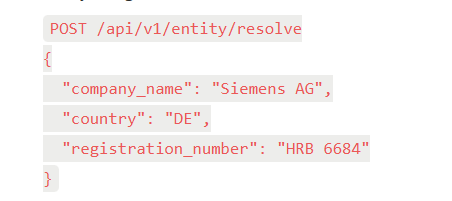
Bulk resolution, webhook notifications, batch processing — all supported.
Entity resolution in practice
Abstract capabilities don't mean much. Here's how this applies to real workflows.
KYB verification. A fintech onboarding a new business customer. They submit "ABC Trading Ltd" with a UK address. Your compliance team needs to verify this is a real, active company and identify who owns it.
With registry data: query the company name and jurisdiction, match to the Companies House record, confirm status is active, pull directors and PSC data, screen against sanctions, store the evidence. Done in seconds. Audit-ready.AML transaction monitoring. A payment processor flags a transaction to "Omega Holdings" in Cyprus. Is it legitimate? Who owns it? Is it connected to sanctioned entities?
With registry data: resolve to the Cyprus registry, pull UBO information, map the ownership structure, check for sanctions or PEP exposure. Risk decision backed by source data, not guesswork.Vendor onboarding. A manufacturer adding a new supplier in Poland. An invoice arrives from "Novatech Sp. z o.o." — but is this the same company they negotiated with?
With registry data: match to the Polish KRS, verify the registration number on the invoice matches, check for negative events like liquidation or court judgments. Fraud risk reduced. Vendor verified at source.
Building a scalable entity resolution workflow
Most companies bolt entity resolution onto existing processes — a manual check here, a vendor lookup there. It works until it doesn't.
Here's how to build it properly.
Step 1: Pick your authority source. You need a single source of truth for legal entity data. You can build direct registry connections yourself (expensive, high maintenance), buy from an aggregator (faster but provenance problems), or use a registry-sourced provider like Global Database (API access to 200+ registries with full audit trail). The choice determines everything downstream.
Step 2: Standardize inbound data. Every system that touches company data — CRM, ERP, procurement, compliance — should capture company name, country, registration number if known, and address. Enforce consistent formatting. Garbage in, garbage out.
Step 3: Match at point of entry. Don't wait until dirty data is already in your system. Resolve entities when they first appear. Sales rep enters a new company in the CRM — API call to resolve and enrich. Vendor submits onboarding paperwork — automatic registry verification. Customer signs up — real-time KYB check. This prevents duplicates and bad data from ever getting in.
Step 4: Clean up existing records. For legacy data, run batch resolution. Export company records, bulk match against registry data, merge duplicates based on registration number, flag unresolved records for manual review.
Step 5: Monitor for changes. Resolution isn't a one-time event. Set up ongoing monitoring for status changes, director changes, address changes, UBO changes, and negative events like insolvency filings. Global Database Signals delivers these updates via webhook or dashboard.
How to evaluate entity resolution providers
If you're comparing vendors, here's what to ask.
Data sourcing:
Question | What you want to hear | Red flag |
|---|---|---|
Where does your data come from? | Direct registry connections with clear provenance | "Multiple sources" without specifics |
How many registries do you cover? | 150+ with specific list available | Only U.S. and Western Europe |
Can you provide an audit trail? | Yes, traceable to source registry | "We don't track data lineage" |
Data quality:
Question | What you want to hear | Red flag |
|---|---|---|
How often is data updated? | Real-time or daily for most registries | Quarterly or annual refreshes |
How do you handle conflicts? | Source registry takes precedence | "We merge everything together" |
Resolution capabilities:
Question | What you want to hear | Red flag |
|---|---|---|
Do you support deterministic and probabilistic matching? | Yes, hybrid approach | Fuzzy matching only |
Can I match on registration numbers? | Yes, primary matching method | "We primarily match on name" |
Is there an API? | Yes, full REST API with bulk support | Batch-only or manual lookups |
Compliance readiness:
Question | What you want to hear | Red flag |
|---|---|---|
Can this data be used for KYB/AML? | Yes, regulator-accepted | "Our data is for marketing" |
Do you provide UBO data? | Yes, where registries disclose it | No UBO coverage |
Commercial terms:
Question | What you want to hear | Red flag |
|---|---|---|
Pricing model? | Transparent, usage-based or flat | Opaque or penalty-heavy |
Reseller rights? | Flexible | Restrictive licensing |
Can I run a pilot? | Yes | No trial option |
Frequently asked questions
What's entity resolution in simple terms?
Matching multiple records to confirm they refer to the same company. Confirming that "Acme Inc." in your CRM and "Acme Incorporated" on a contract are the same legal entity.Why does compliance care about this?
Regulators require you to prove who you're doing business with. If you can't demonstrate the legal identity of customers, vendors, or counterparties with an audit trail, you risk fines, failed audits, and reputational damage.What's the difference between entity resolution and deduplication?
Deduplication removes duplicate records within a single database. Entity resolution matches records to a real-world entity — usually against an external authoritative source like a government registry.What's an LEI?
Legal Entity Identifier. A 20-character code that uniquely identifies companies in financial transactions. Global standard, but only about 2.5 million entities have one. Useful but not comprehensive.How do you handle non-Latin characters?
We normalize company names across character sets — Cyrillic, Mandarin, Japanese, Korean, Arabic, Greek. Matching works regardless of language.Can I use this for automated KYB?
Yes. Our KYB API provides real-time verification, UBO lookup, and sanctions screening, all sourced from official registries.What jurisdictions do you cover?
195 countries and 200+ registries. Includes commonly needed markets and hard-to-access regions like Southeast Asia, Africa, Latin America, and Eastern Europe.How fresh is the data?
Depends on the registry. Many provide real-time or daily updates. We refresh continuously — not quarterly.Is there an API?
Yes. REST API with endpoints for entity resolution, company search, profile retrieval, UBO lookup, and change monitoring.