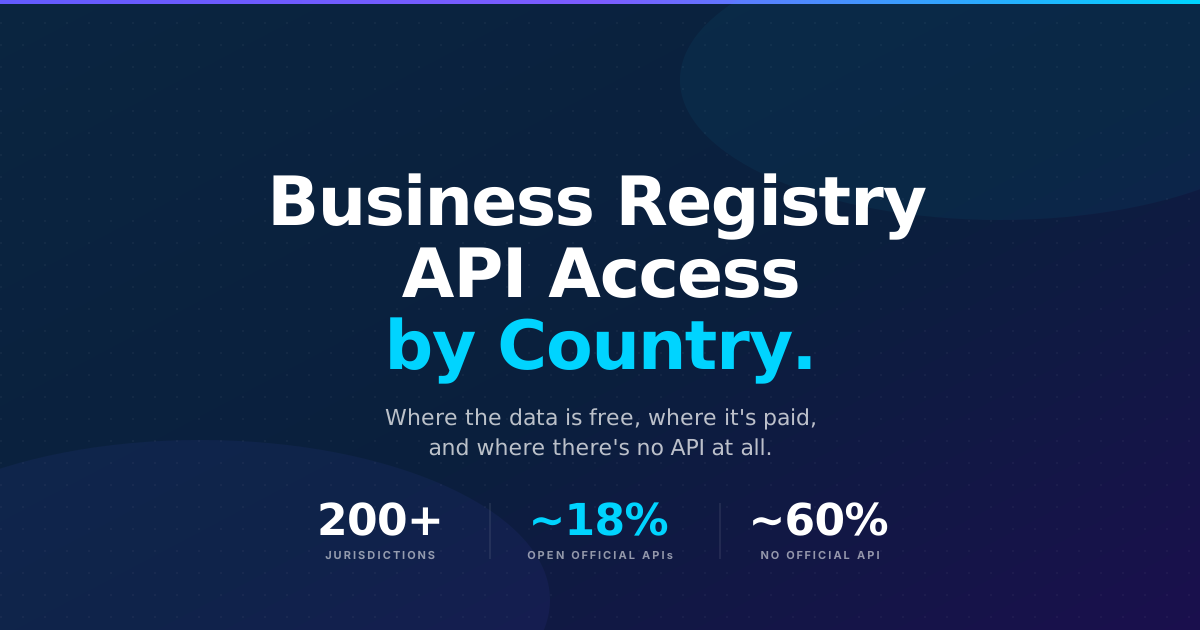
If you've ever tried to build cross-border company verification in-house, you already know the punchline: every registry is different. Some hand you a clean REST API for free. Some make you pay €10 per company. Some have no API at all and rate-limit their web portal at 60 lookups an hour. A few don't even publish the data online.
This article maps the entire landscape — what's available, what it costs, and where the real friction sits. The table below is built from official registry documentation, our own production integrations, and recent firsthand work by KYB providers and registry-data researchers. Every row reflects the situation as of May 2026.
What This Article Covers
- API availability for 190+ countries, scored on a clean three-way scale
- What "permission only" actually means — and who can get past the gate
- Free vs. paid access, plus typical per-call or per-document pricing
- Real-world quirks: rate limits, latency, language barriers, file formats
The honest global picture
The headline number that gets quoted in industry decks — "200+ countries have business registries" — is true, but it hides almost everything that matters. Having a registry is not the same as having an API. And having an API is not the same as having an API you'd want to put in production.
We grade every jurisdiction on a simple three-way scale. Either the registry runs an API or it doesn't — and where it does, we separate the ones anyone can sign up for from the ones that gate access behind credentials you may not be able to obtain.
The Three Categories
- Yes — An official API exists, anyone can sign up and use it (free or paid).
- Permission only — An official API exists, but access requires gated credentials: a national digital ID, an in-country legal entity, obliged-entity status, or accreditation as a registry reseller.
- No — No official API. The data lives behind a web portal, paid PDF extracts, or in-person counter access only.
A note on commercial aggregators. Most countries without an official API still have well-established private aggregators that operate paid APIs — Informa D&B in Spain, Cerved and CRIF in Italy, Bisnode and Creditreform in Germany, Altares in France, Experian and Equifax in the UK and US. These aren't government APIs; they're commercial intermediaries that license registry data, normalize it, and resell it. The categorization in the tables below scores official government APIs only. Where a major commercial aggregator is the practical access route, we name it in the comments column — that distinction matters when data provenance, audit trails, and update freshness are at stake.
A few things to internalize before you read the tables:
"API available" rarely means production-ready. Plenty of registries have an API in the technical sense — a JSON endpoint exists somewhere — but rate limits, authentication friction (national digital IDs, in-person KYC of the API user), or missing fields make it unusable at scale. Where we know about these traps, the comments column flags them.
Free is not the same as free-to-use commercially. The UK Companies House API is genuinely free with no commercial restrictions. France's Sirene is free and reusable. But several "free" registries restrict commercial reuse, require attribution, or limit downloads to non-automated traffic.
Most of the value is in coverage, not single-country depth. If you only need UK data, Companies House is excellent and you should use it directly. The moment you need three or more jurisdictions, the integration tax — different schemas, different IDs, different languages, different status taxonomies — becomes the largest line item in your project.
Europe
Europe is the most uneven region. The UK runs one of the cleanest open registry APIs in the world. France gives free open-data access. Estonia, Latvia, and the Nordics generally lead on transparency. Germany — the largest economy in the EU — has no official API at all and caps its web portal at 60 lookups per hour. Italian and Spanish data sits behind pay-per-document walls.
The Business Registers Interconnection System (BRIS), accessed via the European e-Justice Portal, connects all 27 EU member registries for cross-border search, but it only returns basic harmonised existence-and-status data — not financials, not ownership, not filings. It is a discovery tool, not a data API.
| Country | API available? | Free or paid? | Comments |
|---|---|---|---|
| United Kingdom | Yes | Free | Companies House REST + streaming API. JSON, no commercial restrictions. ~600 requests / 5 min. No SLA. PSC register included; ~60% of accounts still scanned PDFs. |
| France | Yes | Free | INSEE Sirene (statistical) + INPI RNE (legal entity) — both free, open-data, commercially reusable. Fragmented across INSEE, INPI, Infogreffe. |
| Germany | No | Paid docs | No official API. Handelsregister portal capped at 60 requests/hour. Extracts €4.50–€10. Fragmented across ~150 local courts; no national company ID. Transparenzregister separate. Commercial aggregators (Creditreform, Bisnode/Dun & Bradstreet, Schufa) operate paid APIs at scale. |
| Italy | Permission only | Paid | InfoCamere offers API access — reseller accreditation required. Per-document costs typical (€3–€5). 30-day expiry on downloaded documents. |
| Spain | Yes | Mixed | Two access paths: data.boe.es provides BORME gazette in JSON/XML (open, free, no auth). For structured profiles, financials, and ownership across the 52 provincial Mercantile Registries — annual accounts are scanned PDFs upstream — the practical route is Informa D&B (Equifax Spain) or AXESOR, both of which run paid REST APIs that aggregate and normalize the registry data. Typical pricing USD 8–60 per query depending on depth. |
| Netherlands | Permission only | Paid | KVK has an official paid API, but access requires a Dutch subsidiary or registered entity. Foreign organisations cannot subscribe directly. UBO API restricted to obliged entities (banks, notaries). |
| Belgium | Yes | Free | KBO/CBE public search has open data downloads. NBB (National Bank of Belgium) holds annual accounts — separate paid service. |
| Luxembourg | No | Paid | LBR (Luxembourg Business Registers) is web-only with document ordering. Extracts ~€10. RBE beneficial-ownership register no longer publicly searchable post-CJEU 2022. |
| Ireland | No | Paid | CRO operates CORE/online services but no public structured API. Structured data resold via Vision-net and similar. Documents typically €2.50–€5 each. |
| Switzerland | Yes | Free | Zefix is a federated portal across 26 cantonal registers — free search and structured JSON endpoints exist. Full registry extracts are cantonal and paid. |
| Norway | Yes | Free | Brønnøysund (Brreg) operates a well-documented open API. Shareholders held separately by Skatteetaten (tax). UBO register live since Oct 2024 — restricted access. |
| Sweden | Permission only | Paid | Bolagsverket has APIs but commercial pricing and SE-BankID auth required for most endpoints. Annual accounts in machine-readable XBRL. |
| Denmark | Yes | Free | CVR is genuinely open. Free bulk data via the Danish Business Authority. Most permissive registry in continental Europe. |
| Finland | Yes | Mixed | BIS / Patent and Registration Office offers structured data via API; basic info free, deeper extracts paid. Trilingual (FI/SV/EN). |
| Iceland | No | Paid | RSK runs the company register; no public API. Extracts available for a fee. |
| Estonia | Yes | Free | e-Business Register is one of the most developer-friendly in Europe. Free X-Road services, real-time updates. Best-in-class digital infrastructure. |
| Latvia | Yes | Free | Lursoft and the Enterprise Register provide open data. Public UBO maintained post-CJEU. |
| Lithuania | Yes | Paid | Registrų Centras offers e-services and APIs; document fees apply. UBO access restricted. |
| Poland | Yes | Free | KRS provides free open data and a public REST API (api-krs.ms.gov.pl). Wide commercial reuse permitted. |
| Czech Republic | Yes | Free | Justice.cz ARES provides open structured data. Czech-language only but well-formed XML. |
| Slovakia | Yes | Free | Structured access via data.gov.sk open data. ORSR commercial register portal for direct search. No high-throughput SLA. |
| Hungary | No | Paid | e-cégjegyzék (court-registry portal) is web-only. Extracts purchased per company. Heavy reliance on third-party data providers. |
| Romania | Permission only | Paid | ONRC RECOM Online — structured-data subscriptions require account and contract with ONRC. Basic name/CUI lookup is free on the portal; full reports paid. |
| Bulgaria | Yes | Free | BRRA (Commercial Register) offers open search and bulk downloads. Open-data lag of 12+ months frequently reported. |
| Croatia | No | Paid | Sudski registar is web-searchable; no formal commercial API. Document fees apply. |
| Slovenia | Yes | Free | AJPES PRS / ePRS provides reasonable open access; bulk downloads available. |
| Greece | No | Paid | GEMI (General Commercial Registry) is web-only. Extracts purchased. No structured API for non-credentialed third parties. |
| Portugal | No | Paid | Portal da Justiça / RNPC web portal. Certidão permanente costs ~€25/year. No public API. |
| Austria | Permission only | Paid | Firmenbuch accessed via authorised channels — banks, notaries, paid resellers (Compass-Verlag). No open public API for general developers. |
| Malta | No | Paid | MBR (Malta Business Registry) offers online search and document purchase. No public API. |
| Cyprus | No | Paid | Department of Registrar of Companies has search portal and paid certificates. No public API. |
| Liechtenstein | No | Paid | HRA register is web-only. Manual extract orders. UBO access tightly restricted. |
| Monaco | No | Paid | RCI extracts via Monegasque administration. No API. |
| San Marino | No | Paid | Manual extracts only. |
| Andorra | No | Paid | Manual extracts via Govern d'Andorra. |
| Gibraltar | No | Paid | Companies House Gibraltar — web search, paid extracts. |
| Isle of Man | No | Paid | Companies Registry — web portal, paid extracts. No public API. |
| Jersey | No | Paid | JFSC — paid extracts. UBO data not public. |
| Guernsey | No | Paid | Guernsey Registry — paid extracts. |
| Russia | Yes | Free | EGRUL (FNS) provides open data APIs. Post-2022 sanctions complicate practical use by Western firms. |
| Ukraine | Yes | Free | USR (Unified State Register) provides open data via Diia.gov.ua. Free bulk downloads. |
| Belarus | No | Paid | Unified State Register — paid extracts. |
| Moldova | No | Paid | ASP / Public Services Agency — web portal, structured extracts via paid subscriptions. No public API. |
| Serbia | Yes | Free | APR offers open search and bulk downloads in CSV. |
| North Macedonia | No | Paid | Central Registry — paid extracts. |
| Albania | No | Free search | NBC (QKB) offers free portal search; documents paid. No public API. |
| Bosnia and Herzegovina | No | Paid | Multiple cantonal registers. No unified API. |
| Montenegro | No | Paid | CRPS — web portal, paid extracts. |
| Kosovo | No | Free | KBRA / ARBK — basic info free online. No public API. |
| Turkey | No | Paid | MERSİS centralised registry — no public API. Chambers issue extracts. |
Americas
North America is structurally fragmented. The United States has no federal company register — there are 50 separate state Secretary of State (or equivalent) systems plus DC. A handful of states have unofficial JSON endpoints; most do not. Canada is split between a federal register and provincial registers. Latin America's most populous markets (Brazil, Mexico) have no nationwide API and require state-by-state or local navigation, often gated by citizen-only authentication.
For a deeper US-only breakdown, see our Secretary of State business search guide.
| Country | API available? | Free or paid? | Comments |
|---|---|---|---|
| United States (federal) | No | — | No federal company register. Registration is state-level. SEC EDGAR covers public filers only. FinCEN BOI database is law-enforcement-only as of 2026. |
| US — California | No | Free | No official API. An unofficial JSON endpoint exists behind the bizfile portal; cleanest of any state but undocumented, no SLA, can change without notice. Officer data not in free search. |
| US — Delaware | No | Paid | Premium-priced bulk feed via Division of Corporations. Free search returns minimal fields — no officers, no addresses. |
| US — New York | No | Free search | DOS portal returns HTML tables only. Bulk data via NY Open Data. Officers not in free results. |
| US — Texas | No | Paid | SOSDirect uses ASP.NET ViewState — no public API. Comptroller franchise tax data is searchable separately. |
| US — Florida | No | Free | Sunbiz publishes weekly bulk SFTP; no real-time API. Officer data publicly available. |
| US — other 45 states + DC | No | Mixed | Coverage is uneven: most states are web-portal-only. Officer data, formation dates, statuses, and fee structures vary by state. Bulk data agreements available in ~12 states. |
| Canada (federal) | Yes | Free | Corporations Canada (ISED) provides open data and search APIs. Federal ISC beneficial-ownership register live since 2024 — public access. |
| Canada — Ontario, BC, Alberta, Quebec | No | Mixed | Each province operates its own register. No public APIs; some offer paid bulk data agreements. No standardised cross-province ID. |
| Mexico | No | Paid | RUG (Registro Único de Garantías Mobiliarias) and state-level Registros Públicos de Comercio. No national API. Folio mercantil unique per state. |
| Brazil (federal) | Yes | Free | Receita Federal CNPJ open data — bulk downloads available. State Juntas Comerciais largely require Brazilian-citizen authentication to access full filings. |
| Argentina | No | Paid | IGJ (federal) plus provincial registers. Paid extracts. No public API. |
| Chile | Yes | Free | Registro de Empresas y Sociedades — open search and extracts for "tu empresa en un día" entities. CMF for public companies. |
| Colombia | No | Mixed | RUES (Confecámaras) aggregates Chambers of Commerce data. Portal-based access; full reports paid. No public API. |
| Peru | No | Free search | SUNARP and SUNAT — RUC lookup is free via portal. Detailed registral extracts paid. No public API. |
| Uruguay | No | Paid | DGR — paid extracts. No public API. |
| Paraguay | No | Paid | Manual extracts. |
| Bolivia | No | Paid | Fundempresa — paid extracts. |
| Ecuador | Yes | Free | Superintendencia de Compañías has open data — directors and shareholders with percentages are public. |
| Venezuela | No | Paid | SAREN — extracts via in-person/paid channels. |
| Costa Rica | No | Mixed | Registro Nacional — web portal, paid certifications. No public API. |
| Panama | No | Paid | Public Registry of Panama — web portal, paid extracts. Offshore use makes data important for due diligence. |
| Guatemala, Honduras, El Salvador, Nicaragua | No | Paid | Manual extracts via national registries. |
| Dominican Republic | No | Mixed | CCPSD chambers operate the registers. No public API. Paid extracts standard. |
| Cuba | No | Paid | State-managed register; manual extracts only. |
| Cayman Islands | No | Paid | CIMA / Registrar of Companies — limited public data. UBO not public. |
| BVI | No | Paid | BVI Financial Services Commission — limited public search. BOSS UBO system access law-enforcement-only. |
| Bermuda | No | Paid | Registrar of Companies — paid extracts. Limited transparency. |
| Bahamas | No | Paid | Registrar General — paid extracts. |
| Barbados, Jamaica, Trinidad & Tobago | No | Paid | Companies registries with online portals and paid extracts. No public APIs. |
One API call — every registry above, normalised.
We connect directly to 400+ government registries across 200+ countries and territories. Where the registry has an official API, we use it. Where it doesn't, we operate the integration so you don't have to. Every record is timestamped, source-attributed, and returned in a single, consistent JSON schema — so a German GmbH and a Brazilian CNPJ look the same on your side of the wire.
Asia & Pacific
Asia is bimodal. Singapore, Hong Kong, Australia and New Zealand operate well-maintained registries with structured data access (paid in most cases). Japan, South Korea, and Taiwan have official portals but limited or no public APIs. India is exceptional: large, federal, and with the MCA21 system that has historically supported document downloads but no clean third-party API. The bulk of Southeast Asia and Central Asia is web-portal-only.
| Country | API available? | Free or paid? | Comments |
|---|---|---|---|
| Singapore | Permission only | Mixed | ACRA BizFile is one of the best registries in Asia. Some open data on data.gov.sg (free). Full business profiles paid (S$5.50) — document download requires SingPass or EU/EEA digital ID. |
| Hong Kong | No | Paid | Companies Registry CR e-Services. Per-search and per-document fees. No public API; structured access via paid resellers only. |
| Japan | Yes | Free | National Tax Agency corporate number (Houjin Bangou) lookup API — free, basic identity data only. Full commercial register data is paid and portal-based. Documents in Japanese. |
| South Korea | No | Paid | Supreme Court iros.go.kr operates the register. Web-portal access; document fees. No public API. |
| Taiwan | Yes | Free | MOEA Department of Commerce — public access to directors and shareholders with amounts. One of the more transparent registries in Asia. |
| China | No | Paid | National Enterprise Credit Information Publicity System (NECIPS) — Chinese-language portal. No public API. Commercial providers (Qichacha, Tianyancha) aggregate locally. |
| India | No | Paid | MCA21 / MCA portal — document download fees (₹100/document typical). No public API. Bulk data agreements via MCA on request. |
| Pakistan | No | Mixed | SECP eServices — web portal, some open data. No public API. |
| Bangladesh | No | Paid | RJSC — paid extracts. No API. |
| Sri Lanka | No | Paid | Department of Registrar of Companies — paid extracts. |
| Nepal | No | Paid | OCR — manual access. |
| Malaysia | Permission only | Paid | SSM (Suruhanjaya Syarikat Malaysia) MyData SSM offers paid data products via subscription contract. Per-report pricing. |
| Indonesia | No | Paid | AHU Online — web portal. OSS for business licensing. No public API; aggregators handle this. |
| Thailand | Yes | Mixed | DBD (Department of Business Development) data.go.th feeds available. Bulk and per-report paid services. Documents in Thai. |
| Vietnam | No | Paid | National Business Registration Portal — web only. Vietnamese language. No public API. |
| Philippines | No | Paid | SEC Express System — paid digital documents. No public real-time API. |
| Cambodia | No | Paid | Ministry of Commerce Business Registration — web portal, limited online access. |
| Laos, Myanmar, Brunei | No | Paid | Manual extracts via national registries. |
| Mongolia | No | Paid | General Authority for State Registration — web portal only. |
| Kazakhstan | Yes | Free | e-government.kz — open business lookup; structured data via stat.gov.kz open data. |
| Uzbekistan | No | Free search | my.gov.uz business registry — open portal search. No public API. |
| Kyrgyzstan, Tajikistan, Turkmenistan | No | Paid | Manual extracts. |
| Georgia | Yes | Free | National Agency of Public Registry (napr.gov.ge) — well-structured open data with English support. |
| Armenia | No | Free | e-Register operated by Ministry of Justice — free portal search. No public API. |
| Azerbaijan | No | Paid | Ministry of Taxes portal. Web only. |
| Australia | Yes | Paid | ASIC has structured data services; per-search/per-document fees. ABN Lookup is free. Modernising Business Registers programme ongoing. |
| New Zealand | Yes | Free | NZ Companies Office offers a free public API. One of the cleanest registries globally. |
| Fiji, PNG, Pacific islands | No | Paid | Manual extracts. |
Middle East & North Africa
The Gulf has modernised quickly. The UAE has multiple jurisdictions (mainland and free zones — DIFC, ADGM, JAFZA, RAKEZ, DMCC and dozens more) with separate registers; programmatic access is generally paid and reseller-mediated. Saudi Arabia's Ministry of Commerce has opened structured data via the National Information Centre, but reliable English-language API documentation is limited. The Levant and North Africa lean heavily web-portal or in-person.
| Country | API available? | Free or paid? | Comments |
|---|---|---|---|
| UAE — Mainland (DED) | No | Paid | Each emirate has its own Department of Economic Development. Dubai (DED) offers digital services and paid trade-licence verification. No public API. |
| UAE — DIFC | No | Paid | DIFC Public Register searchable online. Paid certificate downloads. No public API. |
| UAE — ADGM | No | Paid | ADGM Registration Authority public search. Paid extracts. No public API. |
| UAE — Free zones (other) | No | Paid | ~45+ free zones, each with its own register. Mostly manual extracts via the free-zone authority. |
| Saudi Arabia | Permission only | Mixed | Ministry of Commerce (MoC) National Business Center — public portal search. Structured B2G/B2B feeds available via authorised channels and contractual access. |
| Qatar | No | Paid | MoCI commercial register. Web portal. Paid extracts. QFC separate register. No public API. |
| Bahrain | No | Paid | Sijilat (MOICT) is one of the more modern Gulf registries. Online services, paid extracts. No public API. |
| Kuwait | No | Paid | MOCI commercial register — paid extracts. |
| Oman | No | Paid | Invest Easy portal. Paid extracts. No public API. |
| Jordan | No | Paid | Companies Control Department — web portal, paid extracts. |
| Lebanon | No | Paid | Ministry of Justice commercial register — manual extracts. |
| Israel | Yes | Free | Israeli Corporations Authority — open data downloads via data.gov.il, paid certified extracts. |
| Iran | No | Paid | State register — paid extracts. Sanctions considerations for Western firms. |
| Iraq, Syria, Yemen | No | Paid | Manual extracts via national registries. |
| Egypt | No | Paid | GAFI investor portal; commercial register operated by Ministry of Supply. Paid extracts. No public API. |
| Morocco | No | Paid | OMPIC issues identifiant commun. Web portal, paid extracts. |
| Tunisia | No | Paid | INNORPI / Centre National du Registre des Entreprises — paid extracts. |
| Algeria | No | Paid | CNRC — paid extracts. |
| Libya | No | Paid | Limited public access. |
Sub-Saharan Africa
The African registry landscape has improved markedly in the last five years, with Nigeria, Kenya, South Africa, Rwanda, and Ghana operating modern e-services. But "modern" rarely means "API". South Africa's CIPC has structured data behind paid services. Nigeria's CAC stands out for genuinely public PSC data. Most other registries are web-portal-only and frequently rate-limited or unstable.
| Country | API available? | Free or paid? | Comments |
|---|---|---|---|
| South Africa | Permission only | Paid | CIPC (Companies and Intellectual Property Commission) offers BizPortal and paid B2B data products via contractual access. No open public API. |
| Nigeria | Permission only | Mixed | CAC — Corporate Affairs Commission. Notable for genuinely public PSC register. Structured access via licensed/accredited partners. Documents paid. |
| Kenya | No | Paid | eCitizen / BRS — online services, paid extracts. No public API. |
| Ghana | No | Paid | RGD (Registrar General's Department) — eRegistrar online. Paid extracts. No public API. |
| Rwanda | Yes | Free | RDB (Rwanda Development Board) — well-regarded open business registry. Free company search; API access via Irembo. |
| Ethiopia | No | Paid | Ministry of Trade — manual extracts. |
| Tanzania | No | Paid | BRELA — online services, paid extracts. No public API. |
| Uganda | No | Paid | URSB — online services, paid extracts. No public API. |
| Mozambique, Angola, DRC | No | Paid | Manual extracts. Limited online infrastructure. |
| Côte d'Ivoire, Senegal, Cameroon | No | Paid | OHADA-region RCCM. Some online services; mostly paid extracts. No public APIs. |
| Botswana, Namibia, Zambia, Zimbabwe | No | Paid | National registrars — online and paper extracts. No public APIs. |
| Mauritius | No | Paid | Corporate and Business Registration Department — online services, paid extracts. Significant offshore-finance use case. |
| Seychelles | No | Paid | Financial Services Authority. Limited public access. Common in offshore structures. |
| Other Sub-Saharan jurisdictions | No | Paid | Most operate manual or web-portal extracts only. Coverage from third-party providers varies widely; verify before relying. |
Open vs. closed: the regional view
Here is the same data, regrouped by the six conventional regions. For each region we show the share of jurisdictions with an open official API, a permission-only API, and no API at all. The full row count for each region is shown on the right.
Three findings jump out of this view.
Europe is the only region where "Yes" beats "No" by more than rounding. 38% of European jurisdictions run open APIs against 52% with none. Every other region is at least three-quarters closed. North America's 89% "No" rate is structural: the US has no federal register and 50 state systems with no APIs, dragging the regional average down despite Canada's federal exception.
Permission-only is concentrated in Europe and Africa. In Europe it reflects post-CJEU UBO gating and resident-entity requirements (Netherlands, Italy, Austria, Sweden). In Africa it reflects partner-accreditation regimes at the larger registries (Nigeria CAC, South Africa CIPC). North America, Latin America, and Asia barely use the model — they tend to skip the API entirely.
The Middle East and Africa look almost identical statistically at ~85% "No". But the underlying problem is different. Middle Eastern registries are well-funded but commercially gated (paid extracts, free-zone fragmentation). African registries are mostly underfunded and portal-bound. Same outcome, opposite root causes — and they require different commercial workarounds.
Throughput: not all "Yes" rows are equal
The categorical view masks a 100× operational range. Two registries can both be "Yes/Free" and differ by orders of magnitude in how many lookups you can run per hour. Here are the published rate limits for the most-integrated registries in production KYB stacks.
The 500× gap between France and Germany — neighbours in the EU, comparable economies, both with sophisticated regulatory regimes — is not a quirk. It's the consequence of a deliberate policy choice. France ran its statistical and registry data through API-first modernization in the 2010s. Germany kept paper-court infrastructure and never built a national replacement layer. If you're onboarding 50,000 entities a year, the UK ceiling is comfortable, the German one will force batching, queueing, and probably a commercial aggregator in the loop.
Data freshness: how stale is each registry, really?
A separate dimension that the "Yes/No" table doesn't capture: when changes happen at the company, how long until they're visible in the data? Real-time streams are rare. Most registries operate on filing cycles that introduce structural lag — director changes and address updates can drift 12–24 months between annual returns even in well-run jurisdictions.
The freshness chart sets up a point most KYB buyers miss: registry update cadence and data accuracy are different problems. Even the UK Companies House, which streams updates in real time, can show stale director data for a small company that hasn't filed in 11 months. Real-time means "real-time relative to the filing event" — not "real-time relative to ground truth". For ongoing monitoring this matters enormously: a counterparty can become insolvent, change controllers, or dissolve months before that information appears in any registry, anywhere.
This is the case for continuous monitoring on top of registry data, not annual re-screens. We unpack the workflow design in KYB vs. KYC in 2026.
Two patterns are worth calling out beyond the regional split.
Open-data Europe is still the global outlier. The UK, France, Norway, Denmark, Estonia, Latvia, Poland and the Czech Republic all run free, structured, commercially-usable APIs. That is a small club, and it doesn't include any of the world's three largest economies (US, China, Japan beyond the basic tax-ID lookup).
"No API" is not the same as "no data". Most jurisdictions without an official API still have a public web portal, paid extracts, or a commercial aggregator. The cost of using them at scale isn't licence fees — it's engineering. You're building and maintaining scrapers across changing HTML, CAPTCHAs, language barriers, and rate limits. The total cost of ownership of that approach is what drives most teams towards a single registry-data API in the first place.
What the data actually tells us
When we read the table end-to-end, eight patterns repeat. Most of them contradict the conventional wisdom about where company data is easiest to get.
1. The G7 has one open registry. Only one.
Across all seven of the world's largest advanced economies, only the United Kingdom offers a free, open, comprehensive business registry API. France comes close with INSEE Sirene, but Sirene is the statistical register — the legal-entity record sits in INPI's RNE, also free but operationally separate. Germany has no API. Italy is permission-only via reseller. Japan publishes a basic tax-ID lookup but the actual commercial register is paid and portal-bound. Canada's federal API exists but only covers federally-incorporated entities (about 10% of Canadian companies; the rest are provincial and have no API). And the United States has no federal register at all.
If you only consume the financial press, you'd think the UK was a regulatory laggard with messy filings and a Companies House that's been hauled over the coals by ECCTA. That's true on the quality dimension. On the access dimension, the UK runs circles around everyone else.
2. Eastern Europe quietly leads the open-data game
If we count free, anyone-can-sign-up registry APIs as the gold standard, 10 of the 28 globally come from former Eastern Bloc countries: Estonia, Latvia, Poland, Czech Republic, Slovakia, Slovenia, Bulgaria, Serbia, Ukraine, plus Russia (operationally complicated by sanctions). Add the Baltics' open UBO posture and you have a region that — counterintuitively — is more digitally open than France, Germany and Italy combined.
The reason is structural. Eastern European registries were largely digitized after 2000, after the late-90s wave of EU accession candidate reforms, and built on modern web stacks from the start. They didn't have to retire paper-court infrastructure the way Germany still does. Estonia's X-Road is the canonical example, but Poland's KRS, Czech ARES, and Slovenia's AJPES all follow the same logic.
3. The richer the country, the more likely the data is paid
Singapore (S$5.50 per profile), Hong Kong (per-search fees), Switzerland (cantonal paid extracts), Luxembourg (€10), Ireland (€2.50–€5), Netherlands (subscription + per-query), Sweden (paid APIs), and the entire Gulf (paid across the board) — wealthy jurisdictions consistently price registry data as a commercial product, not a public good. The opposite pattern shows up where you'd least expect it: Rwanda is free. Kazakhstan is free. Ukraine is free. Ecuador is free.
This isn't a values judgment — it's a budgeting one. Wealthy registries treat company-data licensing as a cost-recovery revenue line. Emerging-market registries that are still building digital infrastructure tend to publish openly because that's what the donor-funded modernization programs require.
4. The Gulf wealth bloc has zero open APIs
UAE, Saudi Arabia, Qatar, Kuwait, Bahrain, Oman — six economies, hundreds of billions in cross-border transactions, and not one open business registry API. Saudi Arabia comes closest with the Ministry of Commerce's National Business Center publishing structured data, but access is via authorized channels under contract. The UAE is the most extreme: each emirate's Department of Economic Development runs a separate licence register, and the country also has 45+ free zones (DIFC, ADGM, JAFZA, DMCC, RAKEZ, and dozens more), each operating its own register with its own access rules.
For compliance teams onboarding Gulf entities, this is the single largest hidden cost in any global KYB rollout. There's no shortcut. You either pay per-document via each emirate and free-zone authority, or you use a data provider that has aggregated them.
5. Africa is one country wide
Across roughly 48 sub-Saharan African jurisdictions, exactly one offers a free, open registry API: Rwanda's RDB. Nigeria's CAC and South Africa's CIPC offer permission-gated access. Every other African registry sits behind a web portal or paid extracts. The OHADA-region countries (17 West and Central African states sharing a unified commercial-law framework via the Common Court of Justice and Arbitration) all use the RCCM register format but expose data only through national portals — no shared API, no unified search.
6. The CJEU 2022 ruling created the "Permission only" category
Before November 2022, the Permission-only bucket was much smaller. The CJEU ruling that mandatory public access to UBO registers violated EU fundamental rights forced every EU member state to introduce legitimate-interest gating. Most never restored the open access that the 4th and 5th AMLDs had originally established. Several EU states (Austria, Italy, Netherlands among them) shifted further still — gating not just UBO data but core registry APIs behind obliged-entity status or in-country presence requirements.
The result, three and a half years on: AMLD6 obligations have stayed stringent, the data needed to satisfy them has become harder to access, and the burden of bridging that gap has shifted onto private data providers with negotiated access channels.
7. Latency and rate limits matter more than the "Yes/No" answer
Two registries can both be "Yes/Free" and still differ by an order of magnitude in production. The UK Companies House allows ~600 requests per 5-minute window per key. The German Handelsregister web portal — which is the closest thing Germany has — caps at 60 requests per hour. That's a 50× difference in throughput before you even start engineering. If you're onboarding 100,000 customers a year, the UK ceiling is generous and the German one will force batching, queueing, and probably commercial routing through a paid provider.
Even within the open tier: ARES (Czech) returns under 200ms typically. INSEE Sirene has variable latency depending on the endpoint and time of day. Companies House streams updates in real time. NZ Companies Office is fast but throttles aggressively on burst. Treat headline availability as necessary but not sufficient — instrument the upstream before committing to it.
8. The "Yes" rows are misleading without context
Look closer at any "Yes" row and you find caveats that change the production picture:
The UK has a free API — but ~60% of accounts at Companies House are still scanned PDFs as of 2026 and the API has no SLA. France has free APIs — but data is split across INSEE, INPI and Infogreffe with no single endpoint. Norway has a free API — but UBO data lives in a separate register with restricted access, and shareholders sit at the tax authority. Canada has a free federal API — but it covers only federally-incorporated entities; provincial coverage is portal-only. Japan has a free API — but it returns tax identity data, not the commercial register. Russia has a free API — but post-2022 sanctions make practical use complicated for Western firms.
There's no jurisdiction where the answer is "yes, here's everything, free, in one place, in English, with an SLA". The closest the world has come is Estonia, and Estonia has 1.3 million people.
The hidden costs people miss
API availability is one variable. Even where it exists, there are five others that usually decide whether a registry can sit inside a production KYB workflow.
1. Authentication friction
Many "open" registries require a national digital ID for full document access — SingPass for Singapore, BankID for the Nordics, NemID/MitID for Denmark, an EU/EEA equivalent for Norwegian documents. Without it, third-country institutions sit behind a permanent partial-access wall.
2. Language
The Handelsregister is in German. Registro Imprese is in Italian. NECIPS is in Chinese. Romanian, Hungarian, Czech, Greek, Bulgarian and most other Eastern European registries have only token English layers. Without machine translation and cross-language entity matching, structured data alone doesn't get you a comparable record.
3. Identifier instability
Germany has no national company number; the Handelsregister number changes when a company moves courts. The US has no federal company identifier; LLC IDs are state-specific. Brazil's CNPJ is federal but state-level Juntas Comerciais re-register entities for state purposes. Spain's NIF/CIF is stable, but the Registro Mercantil entry is provincial. Building a cross-jurisdiction graph means resolving identifiers — not just storing them.
4. Format quality
In the UK, ~60% of accounts at Companies House are still scanned PDFs. In Spain, annual accounts at the Mercantile Registry are PDF-only. In Germany, Bundesanzeiger filings vary widely. Structured XBRL filings are the exception, not the rule, outside the Nordics and a handful of leading EU jurisdictions.
5. UBO access after CJEU 2022
The November 2022 Court of Justice of the EU ruling shut down general public access to beneficial-ownership registers across the EU. Most member states now require a legitimate-interest demonstration. As of mid-2026, several states had still not transposed AMLD6, and the European Commission has opened infringement proceedings. UBO data is now harder, slower, and more lawyered-up to access than it was three years ago — even though the legal requirement to identify UBOs is stricter than ever. See our breakdown in KYB vs. KYC in 2026 for what that means for compliance design.
What this looks like at scale
If your business operates across two or three jurisdictions, you can integrate registries directly. Companies House is excellent. Sirene is excellent. ACRA is workable with the right credentials. You'll spend engineering effort, but it's manageable.
The moment you cross five or six jurisdictions — or you need any kind of UBO depth — the calculus changes. You are now maintaining:
Multiple authentication regimes. Multiple identifier systems. Multiple languages. Multiple status taxonomies (Germany alone has eight different company_status values, with free-text in-flight states layered on top). Multiple file formats. Multiple rate-limit regimes. Multiple update cadences. Multiple legal-basis regimes for the data you're holding.
And every one of those is a moving target. Companies House rolled out ECCTA identity verification through 2025 and 2026. Norway's UBO register went live in October 2024. The CJEU 2022 ruling reshaped half the EU overnight. The US Corporate Transparency Act is still tied up in litigation and policy reversals. You do not "build this once".
API, bulk feed, or web platform — same registry data, your choice of delivery.
Whether you need real-time API calls for onboarding, bulk file delivery via S3 or SFTP for data warehouses and model training, or a search-and-explore interface for compliance analysts, the underlying data is the same — pulled directly from official registries, normalised, timestamped, and source-attributed.