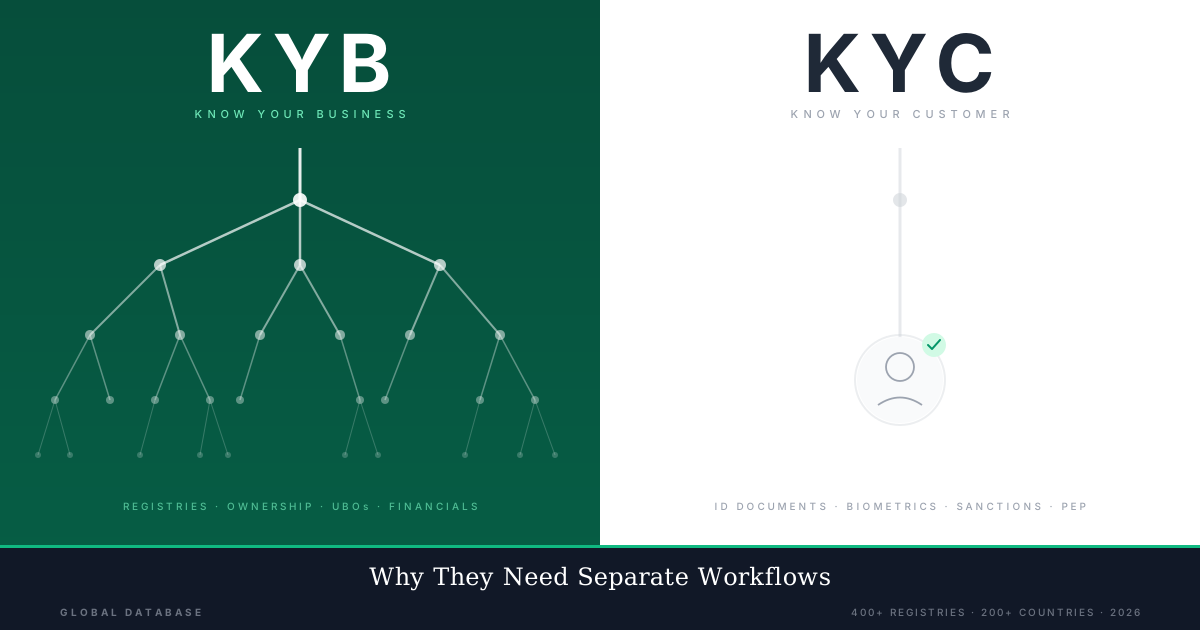
Most compliance teams treat KYB like an extension of KYC.
They use the same tools. The same workflows. The same logic built for verifying individuals — and apply it to verifying businesses.
It doesn't work.
Verifying a person means checking an ID against a name. Verifying a business means tracing a corporate structure across borders, confirming ownership through government registries, assessing financial health, and monitoring for changes — continuously.
These are fundamentally different problems. They require different data, different processes, and different infrastructure.
This guide breaks down exactly where KYB and KYC diverge, why most verification tools handle one well and the other poorly, and how to build a corporate verification workflow that actually holds up under regulatory scrutiny.
KYB vs. KYC at a Glance
Before going deeper, here's the core comparison.
KYC (Know Your Customer) | KYB (Know Your Business) | |
|---|---|---|
Who you're verifying | An individual person | A legal business entity |
What you're checking | Identity, address, PEP/sanctions status | Legal existence, ownership, UBOs, financial health |
Primary data source | Identity documents + biometrics | Government registries + corporate filings |
Complexity | One person, one identity | Multi-layered structures, cross-border entities |
Typical turnaround | Minutes to hours | Hours to days (manual) or seconds (automated via API) |
Regulatory driver | AML directives, CIP requirements | Corporate Transparency Act, 6AMLD, FATF standards |
Ongoing obligation | Periodic re-screening | Continuous registry monitoring + periodic re-verification |
The difference that matters most: data source. KYC pulls from identity documents and watchlists. KYB pulls from government registries — the only authoritative source for confirming whether a company legally exists, who owns it, and whether it's still active.
If your KYB process doesn't connect to official registries, you're not doing KYB. You're guessing.
What KYC Covers
KYC is well understood. A financial institution or regulated business verifies a customer's identity before onboarding them. The process includes collecting government-issued ID, verifying proof of address, screening against sanctions and PEP lists, and assessing individual risk.
The workflow is mature. Tools like biometric verification, liveness checks, and document authentication handle most of it. Platforms like Persona, Sumsub, and Onfido have made individual identity verification fast, reliable, and largely automated.
KYC checks rely on four pillars:
Customer Identification Program (CIP) — confirming name, date of birth, address, and ID number
Customer Due Diligence (CDD) — assessing the individual's risk profile, source of funds, and expected transaction patterns
Enhanced Due Diligence (EDD) — deeper review for high-risk individuals, PEPs, or customers tied to high-risk jurisdictions
Ongoing monitoring — periodic re-screening and transaction monitoring for suspicious activity
None of this translates to business verification. A company doesn't have a passport. It doesn't have a face. And its risk profile isn't determined by an individual's transaction history — it's determined by corporate structure, registry status, ownership chains, and financial filings.
That's where KYB begins.
What KYB Actually Requires
KYB goes far beyond checking that a company name exists somewhere in a database. It's a five-layer verification process — and most platforms only cover the first two layers.
Layer 1: Entity Resolution
Does this company legally exist? Is the name, registration number, and jurisdiction combination valid — confirmed against the official source registry?
This sounds basic. It isn't. Company names vary across registries. A single entity might appear differently in Companies House, the German Handelsregister, and the Singapore ACRA. Entity resolution means matching your input to the correct, authoritative record — not a cached copy of it.
Layer 2: Registry Verification
Once matched, you verify the company's legal status directly from the government registry. Is it active? Dissolved? In liquidation? When was it incorporated? What's the registered address?
This data must be timestamped and traceable to the source. Regulators increasingly require audit trails that show exactly where each data point came from and when it was retrieved. A screenshot of a third-party dashboard doesn't meet that standard.
Layer 3: Ownership and UBO Discovery
Who owns this company? And who owns the companies that own it?
Beneficial ownership is the hardest part of KYB. Regulations in the EU, UK, and US now require firms to identify Ultimate Beneficial Owners (UBOs) — the individuals who hold 25% or more of ownership or control. But ownership chains can span three, four, or five layers across multiple jurisdictions.
Tracing those chains requires access to shareholder data, corporate linkage databases, and cross-border registry information. A KYC platform built around passport verification simply doesn't have this infrastructure.
Layer 4: Financial Health Assessment
A company can be legally active and still be a risk. Financial statements, credit indicators, and filing histories reveal whether a company is solvent, growing, or in distress. Balance sheets, P&L statements, and credit scores provide the kind of risk intelligence that registry data alone doesn't cover.
This layer matters for supplier verification, counterparty risk, and credit decisions — not just compliance.
Layer 5: Ongoing Monitoring
KYB doesn't end at onboarding. Company structures change. Directors resign. Ownership transfers happen. Companies get dissolved.
A dedicated KYB workflow includes continuous monitoring — automated alerts when registry data changes, so your team doesn't find out about a dissolved counterparty six months too late during a periodic review.
Global Database covers all five layers through a single API — connecting directly to 400+ government registries across 200+ countries, with 600M+ company profiles, corporate linkage data for UBO mapping, and 20+ years of digitized financial statements. Each data point is timestamped and traceable to its source registry.
For a detailed look at how these layers translate into API endpoints, see Top 5 Essential APIs for Automating KYB and Compliance Workflows.
Why KYC Tools Fail at Business Verification
This is the problem nobody on page one talks about.
Compliance teams buy a KYC platform — Sumsub, Persona, Onfido, or similar — and then try to use it for business onboarding. It covers the identity verification of directors and UBOs. But it doesn't cover the company itself.
Here's where it breaks:
No direct registry connections. KYC platforms verify people against identity databases. They don't connect to company registries. When they offer KYB features, the company data is typically cached, aggregated, or sourced from third-party providers — not pulled live from the registry.
Ownership data is shallow. A KYC tool might tell you who the listed directors are. It won't trace a multi-layered ownership chain through three jurisdictions to identify the individual who actually controls the entity. UBO discovery requires dedicated corporate linkage data — not an add-on module.
No financial intelligence. KYC platforms don't provide balance sheets, credit scores, or filing histories. If your risk assessment depends on understanding whether a counterparty is financially stable, a KYC tool leaves a blind spot.
Audit trails are weak. Regulators expect you to show where your KYB data came from, when it was retrieved, and what the source was. Registry-sourced data comes with timestamps and traceable references. Aggregated or cached data often doesn't meet this standard.
No monitoring capability. KYC tools monitor individuals — transaction patterns, sanctions list updates. They don't monitor companies for registry-level changes like ownership transfers, status changes, or new filings.
The result: compliance teams end up with a KYC tool that handles half the job and a manual process to fill the gaps. That manual process is slow, expensive, and prone to errors.
The fix isn't to find a better KYC tool. It's to build a separate KYB workflow.
The Regulatory Pressure Is Increasing
2025 and 2026 have brought a wave of new requirements that make dedicated KYB workflows non-optional for regulated businesses.
EU AML Package. The EU's new Anti-Money Laundering Authority (AMLA) is now operational, and the latest AML regulations tighten beneficial ownership requirements across all member states. Central UBO registers are now mandatory, and firms are expected to verify ownership data against these registers — not just collect self-reported information from clients.
US Corporate Transparency Act. Beneficial Ownership Information (BOI) reporting is now required for millions of US entities. Companies must report their beneficial owners to FinCEN, and regulated businesses are expected to verify this information during onboarding.
FATF Updates. The Financial Action Task Force continues to emphasize beneficial ownership transparency as a global priority. Its 2024-2025 guidance pushes member countries toward real-time verification and registry-based checks rather than document-based approaches.
UK Economic Crime Act. The UK has expanded its verification obligations, including the introduction of a Register of Overseas Entities and stronger requirements for confirming UBO information.
The common thread: regulators want verification against authoritative sources. Not self-declarations. Not cached databases. Government registries.
If your KYB process doesn't source from registries, it may not meet the standard that's now being enforced.
How to Build a Dedicated KYB Workflow
A corporate verification workflow that meets current regulatory standards follows six steps. Each step requires specific data — and most of that data comes from government registries, not identity verification platforms.
Step 1: Entity Search and Resolution
Start with what you have — a company name, registration number, or domain — and match it to the correct official record. This means querying government registries to find the right entity across naming variations, jurisdictions, and registration formats.
At this stage, you're not verifying anything yet. You're resolving ambiguity. The output is a unique company identifier tied to an official source.
What you need: A search API that queries official registries across jurisdictions and returns standardized, matched results. Global Database's Company Search endpoint does this across 200+ countries — and search queries are free, so you only pay when you pull full profiles.
Step 2: Registry Verification
Pull the company's official record. Confirm legal name, registration number, jurisdiction, incorporation date, registered address, and current status — all from the source registry.
Each data point should carry a source reference and a retrieval timestamp. This is your audit trail.
What you need: Direct connections to government registries that return verified, timestamped company profiles.
Step 3: Ownership and UBO Mapping
Retrieve shareholder data. Map the corporate structure. Trace ownership through layers — from direct shareholders to intermediate holding companies to the individuals who ultimately hold 25% or more control.
This is the step where most tools fall short. Mapping multi-layered ownership across borders requires access to corporate linkage data — not just a list of shareholders.
What you need: Ownership and shareholding data from registries, plus corporate linkage intelligence that traces ownership across jurisdictions. Global Database provides 378M+ corporate linkages and is building the Global Ownership Graph — a fully searchable, visual map linking individuals to companies across borders.
Step 4: Director and Officer Screening
Identify all directors, authorized signatories, and key officers. Screen each individual against sanctions lists, PEP databases, and adverse media sources.
This is where KYC and KYB intersect. You're doing individual verification (KYC) on the people identified through the corporate verification (KYB) process.
What you need: Director and officer data from registries, combined with a KYC/AML screening tool for individual checks.
Step 5: Financial Risk Assessment
Retrieve the company's financial filings — balance sheets, profit and loss statements, credit scores, and payment behavior indicators. Assess financial health and assign a risk score.
This step goes beyond compliance. It's how procurement, credit, and risk teams evaluate whether a business relationship is commercially sound — not just legally permissible.
What you need: Digitized financial statements and credit indicators sourced from official filings and credit bureaus.
Step 6: Ongoing Monitoring
Set up automated alerts for changes in the company's registry data. Status changes, new filings, director resignations, ownership transfers, address changes — your team should know about these in real time, not during the next quarterly review.
Perpetual KYB is becoming the standard. Periodic reviews — checking companies every 6 or 12 months — are no longer sufficient for most regulators.
What you need: A monitoring service that tracks registry changes and triggers alerts when material changes occur.
When You Need Both KYB and KYC
In most B2B onboarding scenarios, you need both processes — but they serve different purposes and run on different infrastructure.
KYB verifies the company: its existence, structure, ownership, and financial health. KYC verifies the individuals associated with that company: the UBOs, directors, and authorized signatories.
The typical flow:
KYB the entity — confirm it exists, is active, and is structured as claimed
Identify UBOs and directors through the KYB process
KYC each individual — verify their identity, screen against sanctions and PEP lists
Combine both into a single risk assessment
Monitor continuously
This is why compliance teams increasingly run two parallel stacks: a KYC platform for identity verification (Sumsub, Persona, Onfido) and a KYB data provider for corporate verification and registry intelligence. Trying to handle both in one tool almost always means one side is underserved.
For identity verification platforms and their alternatives, see our guides on Sumsub alternatives, Alloy alternatives, and Middesk alternatives.
What to Look for in a KYB Solution
Not every KYB tool is built the same. When evaluating solutions, these are the criteria that separate reliable infrastructure from surface-level features:
Registry sourcing. Does the platform connect directly to government registries, or does it aggregate data from third-party sources? Direct registry connections provide higher accuracy, better freshness, and audit-ready traceability. Global Database connects to 400+ registries — each data point carries a source reference and retrieval timestamp.
Global coverage. Business structures don't stop at borders. Your KYB solution should cover the jurisdictions where your clients, suppliers, and counterparties operate — not just one or two markets. Global Database covers 200+ countries with 600M+ company profiles, from the UK's Companies House to registries across Southeast Asia, Latin America, and Africa.
UBO depth. Can the platform trace multi-layered ownership chains across jurisdictions? A flat list of shareholders isn't UBO mapping. Global Database provides 378M+ corporate linkages with multi-layer ownership traversal.
Financial data. Does it include financial statements, credit scores, and filing histories — or just registration data? Global Database offers 20+ years of digitized financial statements, credit indicators, and balance sheet data.
API architecture. For high-volume onboarding, you need a KYB API that integrates into your existing workflows — not a manual search interface. Global Database's KYB API is modular — use individual endpoints for search, verification, ownership, financials, and monitoring, or combine them into a single automated pipeline. Verification starts at $0.10 per company.
Monitoring. Does the platform support ongoing monitoring with automated alerts, or is re-verification a manual process?
These aren't nice-to-haves. They're the difference between a KYB process that meets regulatory standards and one that creates liability.
Frequently Asked Questions
What is the main difference between KYB and KYC?
KYC verifies the identity of individual customers using personal documents and biometrics. KYB verifies the legitimacy, ownership, and financial health of business entities using government registry data and corporate filings. They target different subjects and require different data sources.Is KYB required by law?
Yes. Regulations including the EU's Anti-Money Laundering Directives, the US Corporate Transparency Act, and FATF standards require businesses in regulated industries to verify corporate customers, identify beneficial owners, and conduct ongoing monitoring.Can you use the same tool for KYB and KYC?
Most KYC tools handle individual identity verification well but lack the registry connections, ownership mapping, and financial data needed for thorough KYB. The most effective approach is to use a dedicated KYB data provider like Global Database alongside a KYC verification platform like Persona or Sumsub.What documents are needed for KYB verification?
Traditionally, KYB required manually collecting incorporation certificates, articles of association, shareholder registers, and financial statements. Modern KYB workflows replace document collection with automated registry lookups — pulling verified data directly from official sources.How long does KYB verification take?
Manual KYB can take days or weeks depending on the company's complexity and jurisdiction. Automated KYB via API — pulling data directly from registries — can complete basic verification in seconds and full due diligence including ownership mapping in under a minute. Global Database's API returns verified company profiles in under 2 seconds, even for multi-field lookups.What is a corporate verification workflow?
A corporate verification workflow is a structured process for verifying business entities during onboarding and throughout the business relationship. It typically includes entity resolution, registry verification, ownership and UBO mapping, director screening, financial assessment, and ongoing monitoring.