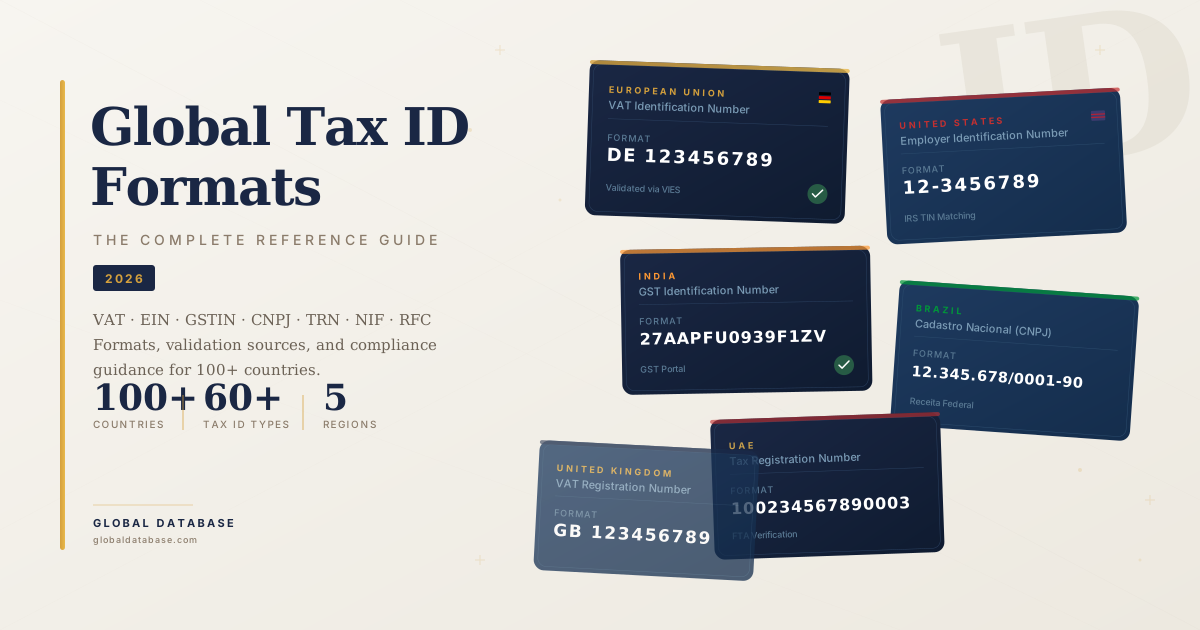
Every country identifies businesses differently. Some use a single number for everything. Others issue separate identifiers for corporate tax, VAT, payroll, and cross-border trade. For compliance teams, KYB engineers, and procurement officers working across jurisdictions, understanding which identifier does what — and how to validate it — is the difference between smooth onboarding and blocked transactions.
This guide covers business tax identification formats across 100+ countries, explains how each system works, and shows how to validate them at scale.
What Is a Business Tax Identification Number (And Why There Are So Many)
A Tax Identification Number (TIN) is a unique code assigned by a government authority to identify a business for tax purposes. Simple concept. Complex reality.
The problem is that “TIN” is an umbrella term. Depending on where a business is registered, its tax ID might be called a VAT number, EIN, GSTIN, NIF, CNPJ, or a dozen other acronyms. Some countries issue one number that covers everything. Others issue two, three, or more — each serving a different purpose.
This matters because when you’re onboarding a supplier in Germany, verifying a customer in Brazil, or running due diligence on a partner in Singapore, you need to know exactly which identifier to request, what format to expect, and where to validate it.
Key Identifier Types at a Glance
Identifier | Full Name | Issued By | Primary Use |
|---|---|---|---|
TIN | Tax Identification Number | National tax authority | Umbrella term for any tax-related ID |
VAT ID | Value Added Tax Identification Number | Tax authority (EU: via VIES) | Cross-border trade, invoicing, input tax recovery |
EIN | Employer Identification Number | US Internal Revenue Service (IRS) | Federal tax filing, payroll, banking in the US |
GSTIN | Goods and Services Tax ID Number | India’s GST Network | GST compliance, invoicing, input credit claims |
CRN | Company Registration Number | National business registry | Legal incorporation proof (not a tax ID) |
UBO ID | Ultimate Beneficial Owner Identifier | Varies by jurisdiction | AML/KYB ownership transparency |
Critical distinction: A Company Registration Number (CRN) proves a business exists legally. A Tax ID proves it’s registered to pay taxes. A VAT number proves it’s registered for value-added tax. In some countries (Belgium, for example), all three are the same number with a different prefix. In others (UK, Germany), they are entirely separate. Never assume they’re interchangeable.
Why Tax ID Formats Matter for Compliance and KYB
Tax IDs are not just accounting data. In 2026, they are a frontline compliance signal.
Regulatory frameworks like the EU’s Anti-Money Laundering Directive (AMLD6), the OECD’s Common Reporting Standard (CRS 2.0), and the Crypto-Asset Reporting Framework (CARF) all require verified tax identifiers as part of business onboarding. If you can’t validate a counterparty’s tax ID, your compliance workflow breaks.
What goes wrong when tax IDs are invalid or unverified:
Scenario | Business Impact |
|---|---|
Invalid VAT number on a B2B invoice | Zero-rate exemption disallowed. You absorb the VAT cost. |
Wrong TIN format submitted during onboarding | Automated KYB checks fail. Manual review delays onboarding by days. |
Expired or deregistered tax ID | Payments blocked. Supplier flagged for enhanced due diligence. |
Domestic TIN used instead of intra-EU VAT ID | VIES validation fails. Transaction flagged. |
Tax ID mismatch with entity name | AML red flag. Potential regulatory investigation. |
For compliance teams running onboarding flows at scale, format-level validation — checking that a submitted tax ID matches the expected structure before hitting an external API — catches 30–40% of errors upfront. That’s before you even check whether the number is active.
How Tax IDs Work Across Different Systems
Not all tax systems are built the same. Understanding the underlying architecture helps explain why validation is complicated.
VAT-Based Systems
Used across the EU, UK, GCC states, and parts of APAC. Businesses collect VAT on sales and reclaim VAT on purchases. Each VAT-registered entity gets a unique VAT identification number. In the EU, these are validated through VIES (VAT Information Exchange System), which queries member state databases in real time.
Key nuance: Some EU countries issue separate domestic and intra-community VAT numbers. Germany, for instance, has both a Steuernummer (domestic tax number, format varies by federal state) and an USt-IdNr (EU VAT ID, format: DE followed by 9 digits). The domestic number won’t validate on VIES.
GST-Based Systems
Used in India, Australia, Canada, New Zealand, and Singapore. Similar to VAT in concept (multi-stage consumption tax), but often with different structures. India’s GSTIN, for example, is a 15-character alphanumeric code that embeds the state code, PAN number, and entity type — meaning you can extract jurisdiction information directly from the ID itself.
Federal Tax ID Systems
The US does not have a national VAT. Instead, businesses use an Employer Identification Number (EIN) for federal tax purposes and register separately for state-level sales tax. Brazil uses CNPJ, Mexico uses RFC — both serving as universal business identifiers across all tax types.
Unified Identifier Systems
Most Latin American countries issue a single identifier for all tax purposes. Argentina’s CUIT, Colombia’s NIT, Chile’s RUT — one number, one authority, one validation path. This simplifies cross-border verification significantly compared to multi-identifier systems.
Dual/Multi-Identifier Systems
Countries like Germany, the Netherlands, and Italy issue multiple identifiers depending on the tax context. The Netherlands, for example, uses KvK number (Chamber of Commerce registration), RSIN (legal entities tax number), and BTW-id (VAT number) — all for the same business. Compliance teams must know which one to request for which purpose.
Tax ID Formats by Region
Below are the primary business tax identifiers for major jurisdictions, including format, local name, and the official source for validation.
4.1 Europe (EU, EEA, UK, Switzerland)
EU member states assign VAT IDs with a two-letter country prefix. Most are verifiable through VIES, though domestic-only TINs require direct validation with national tax authorities.
Country | Tax ID Name | Format | Validation Source |
|---|---|---|---|
Austria | UID-Nummer | ATU + 8 digits | VIES |
Belgium | BTW / TVA | BE + 10 digits | VIES (same as enterprise number) |
Bulgaria | EIK / ЕИК | BG + 9 or 10 digits | VIES |
Croatia | OIB | HR + 11 digits | VIES |
Cyprus | FPA | CY + 8 digits + 1 letter | VIES |
Czech Republic | DIČ | CZ + 8–10 digits | VIES |
Denmark | CVR / SE | DK + 8 digits | VIES |
Estonia | KMKR | EE + 9 digits | VIES |
Finland | ALV nro | FI + 8 digits | VIES |
France | TVA | FR + 2 chars + 9 digits | VIES |
Germany | USt-IdNr | DE + 9 digits | VIES |
Greece | AFM / ΑΦΜ | EL + 9 digits | VIES |
Hungary | Adószám | HU + 8 digits | VIES |
Ireland | VAT reg. | IE + 7 digits + 1–2 letters | VIES |
Italy | P.IVA | IT + 11 digits | VIES |
Latvia | PVN | LV + 11 digits | VIES |
Lithuania | PVM | LT + 9 or 12 digits | VIES |
Luxembourg | TVA | LU + 8 digits | VIES |
Malta | VAT | MT + 8 digits | VIES |
Netherlands | BTW-id | NL + 9 digits + B + 2 digits | VIES |
Poland | NIP | PL + 10 digits | VIES |
Portugal | NIF | PT + 9 digits | VIES |
Romania | CIF | RO + 2–10 digits | VIES |
Slovakia | IČ DPH | SK + 10 digits | VIES |
Slovenia | DDV | SI + 8 digits | VIES |
Spain | NIF / CIF | ES + 1 letter + 7 digits + 1 char | VIES |
Sweden | Momsreg | SE + 12 digits | VIES |
UK | VAT reg. | GB + 9 digits | HMRC VAT Checker |
Switzerland | UID / MWST | CHE + 9 digits + MWST/TVA/IVA | UID Register |
Norway | MVA | NO + 9 digits + MVA | Brønnøysund Register |
4.2 North America
Country | Tax ID Name | Format | Validation Source |
|---|---|---|---|
United States | EIN | XX-XXXXXXX (9 digits) | IRS TIN Matching Program |
Canada | BN / GST | 9 digits + RT + 4 digits | CRA Business Number search |
Mexico | RFC | 3–4 letters + 6 digits + 3 chars | SAT portal |
US note: The US does not have a VAT system. An EIN cannot be used for VAT validation in the EU or elsewhere. When international partners request a “VAT number” from a US company, the EIN is typically provided as the closest equivalent — but it serves a fundamentally different purpose.
4.3 Latin America
Country | Tax ID Name | Format | Validation Source |
|---|---|---|---|
Argentina | CUIT | XX-XXXXXXXX-X (11 digits) | AFIP online lookup |
Brazil | CNPJ | XX.XXX.XXX/XXXX-XX (14 digits) | Receita Federal |
Chile | RUT | XX.XXX.XXX-X (8–9 digits + check) | SII portal |
Colombia | NIT | XXX.XXX.XXX-X (9 digits + check) | DIAN portal |
Peru | RUC | 11 digits | SUNAT portal |
Ecuador | RUC | 13 digits | SRI portal |
Uruguay | RUT | 12 digits | DGI portal |
4.4 Asia-Pacific
Country | Tax ID Name | Format | Validation Source |
|---|---|---|---|
India | GSTIN | 2 digits (state) + 10 chars (PAN) + 1 + Z + 1 check | GST Portal |
Australia | ABN | 11 digits | Australian Business Register |
New Zealand | IRD / GST | 8–9 digits | IRD online services |
Singapore | UEN | 9–10 chars (varies by entity type) | ACRA BizFile+ |
Japan | 法人番号 (Corporate No.) | T + 13 digits | National Tax Agency |
South Korea | 사업자등록번호 (BRN) | XXX-XX-XXXXX (10 digits) | Hometax portal |
Hong Kong | BRN / IRD File No. | 8 digits | IRD / Companies Registry |
Malaysia | SST ID | Varies | MySST portal |
Thailand | TIN | 13 digits | Revenue Department |
Indonesia | NPWP | XX.XXX.XXX.X-XXX.XXX (15–16 digits) | DJP Online |
Philippines | TIN | XXX-XXX-XXX-XXX (12 digits) | BIR eServices |
4.5 Middle East & Africa
Country | Tax ID Name | Format | Validation Source |
|---|---|---|---|
UAE | TRN | 15 digits | FTA TRN Verification |
Saudi Arabia | TIN / VAT | 15 digits | ZATCA portal |
Qatar | TIN | Varies | General Tax Authority |
Bahrain | VAT | 15 digits (TIN-prefixed) | NBR VAT Payer Lookup |
Oman | VAT TIN | Varies | Tax Authority portal |
South Africa | Tax Ref / VAT | 10 digits / 10 digits | SARS eFiling |
Nigeria | TIN / FIRS | 10–15 digits | FIRS JTB portal |
Kenya | PIN | 11 chars (letter + 9 digits + letter) | KRA iTax |
Egypt | Tax Card No. | 9 digits | ETA portal |
How to Validate Tax IDs: Official Sources vs. API Solutions
Knowing the format is step one. Confirming that a tax ID is active, correctly formatted, and matched to the right entity is where the real work begins.
Official Validation Sources
System | Coverage | Method | Limitations |
|---|---|---|---|
VIES | 27 EU member states + Northern Ireland | Web form or SOAP API | Frequent downtime, no batch processing, no enrichment data |
HMRC Check a VAT Number | UK only | Web form or API | UK-only scope, limited to valid/invalid response |
IRS TIN Matching | US (EIN, SSN, ITIN) | Bulk upload or API (authorized users only) | Requires IRS authorization, limited to name/TIN match |
GST Portal | India | Web form | One-at-a-time lookup, frequent portal issues |
ABR | Australia | Web or API | ABN only, no cross-referencing with other jurisdictions |
The Problem with Official Sources at Scale
Every official validation tool shares the same core limitations:
Single-query processing. Most government portals allow one lookup at a time. If you’re onboarding 500 suppliers per quarter, manual validation is not viable.
No enrichment. VIES tells you if a VAT number is valid. It doesn’t tell you who owns the company, whether it’s active, or what its financial standing is.
Downtime. VIES depends on member state databases. When one goes offline (common with Germany and Italy), validation for that country stops entirely.
No cross-jurisdiction coverage. There is no single government system that validates tax IDs globally. You need separate integrations for each country or region.
API-Based Validation: The Enterprise Alternative
Companies that verify tax IDs at scale use API solutions that connect to official registries behind the scenes, adding format validation, entity enrichment, and batch processing on top.
Global Database’s VAT and Tax ID Validation API connects directly to government registries across 150+ countries. Unlike VIES or standalone government portals, it provides:
Real-time validation against official sources, with response times under 50ms.
Entity enrichment: each validated tax ID returns the associated company name, status, registered address, directors, ownership structure, and financial indicators.
Batch processing: validate hundreds of tax IDs in a single API call.
Fallback coverage: when an official source goes offline, cached registry data ensures validation doesn’t stop.
Reverse lookup: find a company’s tax ID from its name or registration number, and vice versa.
Common Tax ID Validation Errors (And How to Fix Them)
Even with the right tools, tax ID validation fails for predictable reasons. These are the most common errors compliance teams encounter.
Error | Root Cause | Fix |
|---|---|---|
Format rejected before submission | Submitted ID doesn’t match expected pattern (wrong prefix, wrong digit count) | Implement client-side regex validation using the format tables in Section 4 |
VIES returns “Invalid” for a known-active company | Domestic TIN submitted instead of intra-EU VAT number | Request the company’s EU VAT ID specifically (e.g., DE prefix for Germany, not Steuernummer) |
Name mismatch on validation | Legal entity name on tax ID differs from trading name | Cross-reference with the official company registry in that jurisdiction |
Number was valid last month, now fails | Company deregistered, dissolved, or changed VAT status | Implement continuous monitoring, not one-time checks |
Timeout or “Service unavailable” | Government portal downtime (especially common with VIES) | Use an API with fallback caching or retry logic |
Duplicate tax IDs in CRM | Same company entered with different formatting (spaces, dashes, prefixes) | Normalize all tax IDs to a canonical format on input (strip spaces, standardize prefix) |
Tax ID Verification in Automated KYB Workflows
Tax ID validation should not be a standalone step. In a modern KYB workflow, it’s the entry point to a deeper verification chain.
Where Tax ID Fits in the Onboarding Flow
The most effective compliance architectures use tax ID validation as the first filter, then progressively enrich and verify:
Step 1: Tax ID Format Check
Validate structure client-side before making any API calls. Catches typos, wrong identifier types, and formatting errors immediately. This alone eliminates 30–40% of validation failures.Step 2: Tax ID Registry Validation
Confirm the ID is active and registered with the issuing authority. Returns entity name, status, and jurisdiction for cross-referencing.Step 3: Entity Enrichment
Pull full company data: registered address, directors, financial indicators, industry codes. This turns a tax ID from a “yes/no” signal into a full risk profile.Step 4: Ownership and UBO Discovery
Map the shareholder chain. Identify the natural persons who ultimately control the entity. Flag politically exposed persons (PEPs) and sanctioned individuals.Step 5: Continuous Monitoring
Tax IDs can become invalid. Companies get dissolved, change status, or get flagged. Continuous monitoring catches changes post-onboarding.
Building This with Global Database
Global Database’s KYB API is designed around this exact flow. A single company ID (returned from the initial tax ID lookup) unlocks endpoints for:
Company verification — confirm legal name, status, registration number, and jurisdiction.
Director and shareholder data — retrieve officers, percentage ownership, and control structures.
UBO mapping — trace ownership across multi-layered corporate structures, across borders.
Financial intelligence — access filed accounts, credit indicators, and financial health signals.
Monitoring alerts — get notified when any data point changes on a tracked entity.
The result: tax ID validation becomes the entry point to a full compliance intelligence layer, not a checkbox on a form.
Frequently Asked Questions
What is the difference between a VAT number and a tax identification number?
A Tax Identification Number (TIN) is a broad category that includes any government-issued number used for tax purposes. A VAT number is a specific type of TIN used for Value Added Tax transactions. All VAT numbers are TINs, but not all TINs are VAT numbers. For example, the US EIN is a TIN but not a VAT number, because the US doesn’t have a VAT system.How do I verify a company’s tax ID number in another country?
For EU companies, use the VIES system. For UK companies, use HMRC’s online checker. For US companies, the IRS TIN Matching Program is available to authorized users. For other countries, check the national tax authority’s website. For cross-border verification at scale, use an API like Global Database that connects to 150+ country registries through a single integration.What is an EIN and is it the same as a VAT number?
No. An Employer Identification Number (EIN) is a US federal tax ID issued by the IRS. It identifies businesses for income tax, payroll, and banking purposes. It cannot be used for VAT validation because the US does not operate a VAT system. When international partners request a “VAT number” from a US company, the EIN is typically provided as the closest equivalent, but it serves a different function.Do all countries use VAT numbers?
No. Over 170 countries have a VAT or GST system, but not all issue specific VAT identification numbers. The United States uses sales tax (not VAT) and issues EINs instead. Some countries use a single identifier for all tax types (like Brazil’s CNPJ or Argentina’s CUIT), while others issue separate numbers for different taxes.What happens if a VAT number is invalid on an invoice?
If you apply a zero-rate VAT exemption on an intra-EU B2B sale and the buyer’s VAT number turns out to be invalid, the tax authority can disallow the exemption. You then owe the full VAT amount from your own margin. This is why validating VAT numbers before invoicing is a financial risk control measure, not just an administrative step.How do I validate EU VAT numbers in bulk?
The official VIES system does not support batch validation. It processes one number at a time through a web form or a rate-limited SOAP API. For bulk validation, organizations use commercial APIs like Global Database that batch-process hundreds of VAT numbers per call, enriching each result with entity data from official registries.What is VIES and why does it go offline?
VIES (VAT Information Exchange System) is the European Commission’s online service for validating EU VAT numbers. It queries individual member state databases in real time. When a national database goes down for maintenance or experiences technical issues, VIES cannot validate numbers from that country. Germany and Italy are particularly prone to downtime. There is no built-in fallback within VIES.Can I use a company registration number to find a VAT number?
In some countries, the company registration number and VAT number are derived from each other. In Belgium, they share the same base number. In the UK, they are completely separate (CRN is 8 characters from Companies House, VAT number is 9 digits from HMRC). To find a VAT number from a registration number, search the relevant national registry or use a business intelligence API that cross-references both identifiers.What tax ID do I need to verify a business in the US, UK, and EU?
For the US: request the EIN (9-digit federal tax ID). For the UK: request the VAT registration number (9 digits, GB prefix) and/or the company number (8 characters, from Companies House). For the EU: request the intra-community VAT ID (country prefix + digits), which can be validated through VIES. Always specify which identifier you need to avoid receiving the wrong one.How do tax IDs fit into KYB and AML compliance workflows?
Tax ID validation is typically the first automated check in a KYB workflow. It confirms a business is registered and active with its tax authority. From there, the tax ID links to deeper data: company officers, shareholders, beneficial ownership, financial filings, and sanctions screening. Under AMLD6 and FATF guidelines, verified tax identifiers are a required component of customer due diligence for regulated entities.