What Is the Italy Company Register?
Italy's official company register is called the Registro delle Imprese (Italian Business Register). It is the public database that records every business with a headquarters or local branch operating in Italy.
The register was established in 1993 and became operational in 1996. It is maintained by Italy's network of local Chambers of Commerce (Camera di Commercio), with the technology infrastructure run by Infocamere, a consortium owned by the chambers.
Think of it as Italy's equivalent of the UK's Companies House or Germany's Handelsregister — but with one major difference. The Italian system is decentralized. Each province has its own Chamber of Commerce that manages local registrations. National coordination is handled by Unioncamere, the federation of Italian chambers.
The Registro Imprese serves a dual purpose. First, it is a legal advertising tool — it guarantees the timeliness and reliability of economic information for third parties under Article 2193 of the Italian Civil Code. Second, it is a compliance tool — it stores the official records that regulators, banks, and businesses rely on for due diligence.
The official Italian-language portal is registroimprese.it. The English-language portal is italianbusinessregister.it. Both are operated by Infocamere on behalf of the Chambers of Commerce.
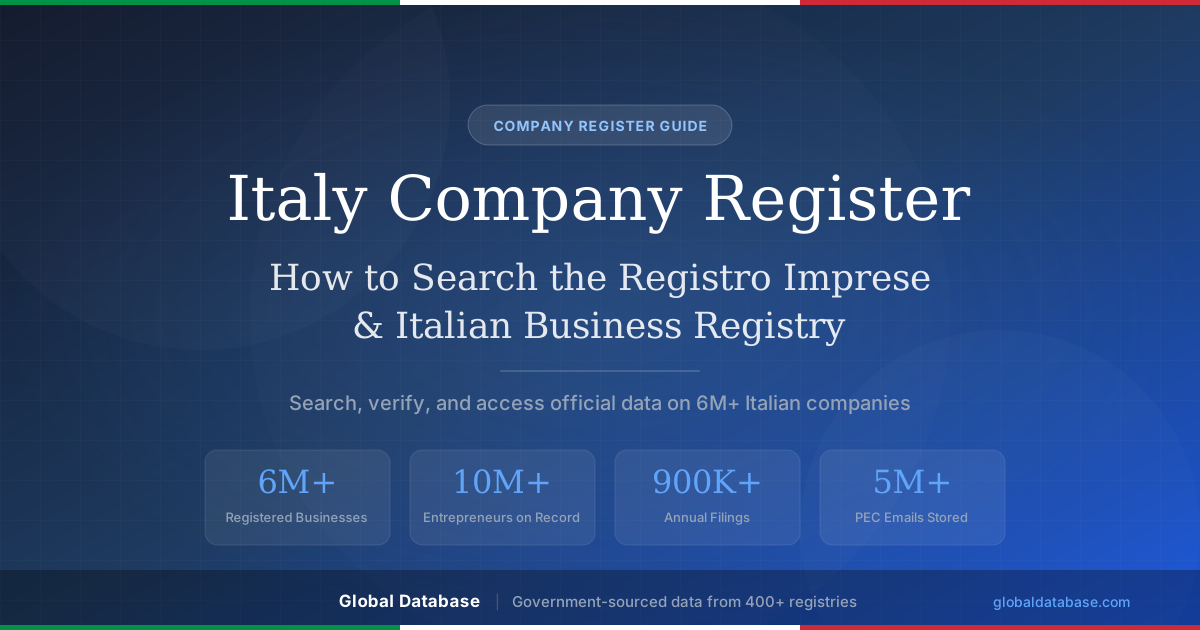
Italy Business Registry: Key Numbers
The Registro Imprese is one of the most comprehensive business registers in Europe. It covers sole proprietorships, partnerships, limited companies, cooperatives, consortiums, professional firms, and branches of foreign entities.
The register is divided into two main sections: the ordinary section (for corporations, partnerships, and cooperatives) and the special section (for small businesses, artisans, agricultural businesses, and innovative startups/SMEs).
How to Search for a Company in Italy
There are three main ways to search the Italian company register. Your choice depends on your volume, speed requirements, and whether you need the data in Italian or English.
Option 1: Registro Imprese (Official Portal — Italian)
The primary search portal is registroimprese.it. You can search by company name, tax code (Codice Fiscale), or VAT number (Partita IVA). Basic results — company name and registered address — are free. Detailed reports require payment and registration.
Option 2: Italian Business Register (English Portal)
The English-language version at italianbusinessregister.it is designed for international users. After registering and logging in, you can order a Company Registration Report for €5 or a Financial Statement for €2.50. Documents are delivered to a personal document area and are valid for 30 days.
Option 3: Third-Party Platforms & APIs
For compliance teams, financial institutions, and enterprises that need to verify hundreds or thousands of Italian companies, the manual portal approach doesn't scale. Platforms like Global Database connect directly to the Registro Imprese and deliver structured Italian company data via API — including company profiles, financial statements, ownership structures, and director information.
Go to registroimprese.it or italianbusinessregister.it
Choose the Italian portal for native data or the English portal for translated reports.
Enter search criteria
Search by company name, Codice Fiscale, Partita IVA, or REA number. You can also filter by province and legal form.
View basic information (free)
You can view the company name, registered address, and PEC (certified email) without creating an account.
Order detailed reports (paid)
Register an account, add your request to the cart, and pay via credit card. Reports are delivered to your document area.
Download and review
Reports include registration data, legal form, directors, shareholders, activities, and — for financial statements — balance sheet and P&L data.
Italian Business Entity Types Explained
Italy has a wide variety of legal business forms. Understanding these is critical for due diligence — the entity type determines liability, reporting requirements, and the data available in the register.
| Entity Type | Min. Capital | Liability | Financial Filing |
|---|---|---|---|
| S.r.l. | €1 (no minimum since 2019) | Limited to share capital | Full annual accounts |
| S.p.A. | €50,000 | Limited to share capital | Full annual accounts + audit |
| S.r.l.s. | €1–€9,999 | Limited to share capital | Full annual accounts |
| S.n.c. | None | Unlimited (all partners) | Simplified accounts |
| S.a.s. | None | Mixed (general + limited partners) | Simplified accounts |
| Impresa Individuale | None | Unlimited (owner) | Simplified tax filings |
The S.r.l. is by far the most common business form in Italy. It is the standard structure for small and medium businesses, offering limited liability with relatively simple reporting requirements. The S.p.A. is reserved for larger companies — particularly those that need to issue shares publicly or meet higher capital thresholds.
Italy Company Identifiers: Codice Fiscale, Partita IVA & REA
Italian companies use three primary identifiers. Knowing which is which will save you time when searching the register.
| Identifier | Format | Purpose | Issued By |
|---|---|---|---|
| Codice Fiscale (CF) | 16-character alphanumeric (individuals) or 11-digit numeric (companies) | Tax identification for all entities and individuals | Agenzia delle Entrate (Revenue Agency) |
| Partita IVA (P.IVA) | 11 digits (IT + 11 digits for EU VAT) | VAT registration number for business activities | Agenzia delle Entrate |
| REA Number | Province code + numeric sequence | Registration in the Economic and Administrative Directory | Chamber of Commerce |
For companies, the Codice Fiscale and Partita IVA are often the same 11-digit number. For individuals and sole proprietors, the Codice Fiscale is a unique 16-character code that encodes the person's name, date of birth, and birthplace.
What Data Is Available in the Registro Imprese?
The Italian business register contains a deep dataset for each registered entity. Here is what you can expect to find.
| Data Category | Italian Term | Details | Access |
|---|---|---|---|
| Company Name | Denominazione / Ragione Sociale | Registered business name | Free |
| Registered Address | Sede Legale | Official address on file | Free |
| Certified Email | PEC | Legal equivalent of registered mail | Free |
| Legal Form | Forma Legale | S.r.l., S.p.A., etc. | Paid |
| Registration Number | Codice Fiscale / Partita IVA | Tax and VAT identifiers | Paid |
| Date of Incorporation | Data di Registrazione | When the company was formed | Paid |
| Legal Status | Stato Legale | Attiva, In Liquidazione, Cessata, Fallita | Paid |
| Directors & Officers | Amministratori | Names, tax codes, appointment dates, roles | Paid |
| Shareholders | Soci | Names, stakes, tax codes (for S.r.l.) | Paid |
| Business Activity | Oggetto Sociale / ATECO Code | What the company does | Paid |
| Financial Statements | Bilancio | Balance sheet, P&L, cash flow, notes | Paid |
| Share Capital | Capitale Sociale | Subscribed and paid-up capital | Paid |
| Insolvency Proceedings | Procedure Concorsuali | Bankruptcy, liquidation filings | Paid |
The Registro Imprese does not include companies subject to winding-up or bankruptcy proceedings in standard data extractions. Insolvency data requires a separate search. Financial statements for micro-enterprises may be simplified and contain less detail.
Infocamere, Unioncamere & Chambers of Commerce
Italy's business register doesn't operate like a single government database. It is a distributed system with three key players.
The entire system operates under the supervision of a judge appointed by the local court and the Ministry of Enterprises and Made in Italy (formerly the Ministry of Economic Development).
This structure means that while data is comprehensive, the process of accessing it can feel bureaucratic compared to centralized registers like the UK's Companies House or Estonia's e-Business Register.
Italy UBO Register: Current Status
Italy introduced a central Register of Beneficial Ownership (Registro dei Titolari Effettivi) in October 2023, as required by EU anti-money-laundering directives.
However, the register has been effectively suspended since late 2023 due to ongoing legal challenges. Industry associations filed appeals arguing that public access to beneficial ownership data violated privacy rights. The Regional Administrative Court of Lazio initially dismissed the appeals in April 2024, but the matter was escalated.
In October 2024, the Council of State (Consiglio di Stato) referred the case to the Court of Justice of the European Union (CJEU). This referral puts Italy's UBO register in a state of indefinite legal limbo.
You cannot currently access Italy's centralized UBO register. To verify beneficial ownership of Italian companies, you need to piece together shareholder data from the Registro Imprese, cross-reference annual filings, and review financial statements. Platforms like Global Database automate this process by mapping corporate ownership structures directly from registry filings.
How to Verify an Italian Company
Whether you are onboarding a new supplier, running KYB checks, or conducting pre-deal due diligence, here is the verification workflow for Italian businesses.
Confirm the company exists
Search the Registro Imprese by company name, Codice Fiscale, or Partita IVA. Verify the legal status is "Attiva" (Active).
Verify the registration report (Visura)
Order the official Visura Camerale. This contains the company's legal form, directors, registered address, share capital, and business activity description.
Review financial statements
Access the most recent Bilancio (annual accounts). Look at revenue trends, working capital, profitability, and any going concern notes.
Map the ownership structure
Examine the shareholder list (Elenco Soci) for S.r.l. companies. For S.p.A. entities, review significant shareholdings filed with the register.
Check for insolvency or legal proceedings
Look for filings related to liquidation (In Liquidazione), cessation (Cessata), or bankruptcy (Fallita). Cross-reference with UIF (Bank of Italy) anomaly indicators if applicable.
Validate the Codice Fiscale and Partita IVA
Cross-check these numbers against the EU VIES system for VAT validation, and the Agenzia delle Entrate for tax code verification.
Italy Company Register: Access Costs
| Document / Service | Cost (approx.) | Notes |
|---|---|---|
| Basic company search | Free | Name, address, PEC email only |
| Company Registration Report (Visura) | €3 – €5 | Varies by legal form; available in English |
| Financial Statement (Bilancio) | €2.50 | Available in English on the international portal |
| Company List Extraction | Variable | Filter by location, activity, legal form |
| API Access (via Global Database) | Subscription-based | Bulk access, structured data, real-time verification |
Documents obtained from the Registro Imprese expire after 30 days. For ongoing compliance or monitoring, you need either repeated manual searches or an automated data pipeline.
Italy vs Other European Company Registers
Here is how the Registro Imprese stacks up against other major European business registers.
| Feature | Italy (Registro Imprese) | UK (Companies House) | Germany (Handelsregister) |
|---|---|---|---|
| Registered Entities | 6M+ | 5M+ | 3.5M+ |
| Basic Search | Free (limited) | Free (extensive) | Free (limited) |
| Financial Statements | €2.50 per report | Free | €4.50 per report |
| Shareholder Data | Available (paid) | Available (free) | Limited |
| UBO Register | Suspended (2024) | Active | Restricted (2022 CJEU ruling) |
| English Access | Yes (separate portal) | Native | No (German only) |
| Structure | Decentralized (Chambers) | Centralized | Decentralized (Courts) |
Accessing Italian Company Data via Global Database
If you need Italian company data for compliance, risk assessment, sales intelligence, or due diligence, searching the Registro Imprese one report at a time is not viable at scale.
Global Database connects directly to Italy's official business register and over 400 government registries worldwide. This means you get the same first-party, government-sourced data — but structured, searchable, and accessible via API.
What you get for Italian companies through Global Database: