If you’re doing business in Europe, you eventually hit the “data wall.”
You need to verify a new supplier in Italy, check the creditworthiness of a partner in Germany, or run a full corporation search on a prospect in France.
In the United States, you might turn to a Secretary of State website. In the UK, you have Companies House. But when you need to perform a broad EU company search, the process is rarely straightforward.
Europe is not a monolith; it’s a network of 27 separate national legal systems, each with its own company register, disclosure rules, language, and access model. While the European Union has tried to improve transparency with the Business Registers Interconnection System (BRIS), there is still no single, all-encompassing “European company register” that gives you deep financial and ownership data for every business on the continent.
This guide explains how EU company search really works, how BRIS and national registers fit together, what you can (and can’t) access in each country, and how to retrieve verified, registry-sourced data efficiently across all 27 EU member states.
By the end, you’ll know:
Why company information lookup is critical for sales, compliance, and risk
How European company registers are structured
The limitations of BRIS and national registers
The main challenges of searching across 27 systems
How platforms like Global Database simplify EU-wide company search and KYB
Why You Need to Look Up Company Information in Europe
Before we dive into the “how,” it’s important to clarify the “why.” A reliable EU company search process underpins several critical business functions:
1.1 Sales & Marketing
Identify and qualify new leads
Understand market size and segmentation
Enrich your CRM with accurate firmographic and registry-verified data
1.2 Compliance (KYB / AML)
Verify the legal status of a company
Understand ownership and control structures
Comply with Anti-Money Laundering (AML) and Know Your Business (KYB) regulations
1.3 Credit & Risk Management
Assess financial health and creditworthiness
Reduce exposure to non-payment and insolvency risk
Support credit decisions with audited financials and historical filings
1.4 Supply Chain & Vendor Vetting
Perform due diligence on suppliers and partners
Confirm that entities exist and are in good standing
Avoid fraud, shell companies, and unstable partners
1.5 Market & Competitive Intelligence
Analyse competitors and their structures
Track industry trends and corporate events
Identify potential investment or acquisition targets
Without a structured, reliable approach to European company information lookup, you risk:
Compliance failures
Wasted sales and onboarding efforts
Poor credit decisions and financial losses
Is There a Single EU-Wide Company Register?
This is the most common misconception in EU company search.
Short answer: No.
There is no central “Europe Company Register” that holds the official record for every company in Germany, France, Italy, Spain, and the rest of the EU.
Instead:
The European Union is a union of sovereign states.
Each member state maintains its own official business register.
Examples:
Germany: Handelsregister (Commercial Register)
France: Infogreffe / Registre du Commerce et des Sociétés (RCS)
Italy: Registro delle Imprese
Spain: Registro Mercantil
Netherlands: KVK (Kamer van Koophandel)
Poland: KRS (Krajowy Rejestr Sądowy)
To perform a direct, manual corporate search, you would typically:
Know (or guess) the company’s country of incorporation
Navigate that country’s national register
Search in the relevant language and legal context
The EU recognised that this fragmentation was a barrier to a true single market. Instead of building a brand-new mega-database, it built a bridge: BRIS.
How the European Company Register System Works
There is no single European company register. Instead, there is a network of:
27 national business registers, and
The Business Registers Interconnection System (BRIS) as a unifying layer.
3.1 What National Business Registers Typically Contain
Although each register has its own structure and interface, most national registers provide access to core legal and corporate information, such as:
Registered company name
Registration number and legal form
Company status (active, dissolved, liquidation, bankruptcy, etc.)
Registered office address
Directors and legal representatives (in many jurisdictions)
Articles of association and amendments
Annual accounts and financial statements (where required)
Historical changes (status, address, directors, etc.)
This information is official and legally authoritative, as it is filed by companies and validated or recorded by the national authority.
3.2 Why Registers Differ Across the EU
Each member state controls its own:
Registration processes
Disclosure rules
Public access levels
Pricing models
Technical infrastructure
As a result, company registers vary in:
The types of information they publish
The level of detail available to the public
Whether documents are free or fee-based
Search capabilities (language support, filters, API access)
Degree of digitalisation and document availability
Data formats and export options
For example:
Some registers publish full financial statements with good search tools
Others charge for almost everything and provide limited metadata
Some offer modern digital portals; others have outdated or clunky interfaces
This makes an EU-wide company search complex and inconsistent.
3.3 BRIS: The EU-Level “Bridge”
The Business Registers Interconnection System (BRIS) is operated by the European Commission and accessible via the European e-Justice Portal.
Key points:
BRIS does not store all company data itself
It acts as a gateway that connects national registers
It allows basic, harmonised searches across EU company registers
BRIS is useful for checking:
Whether a company exists
Which country it is registered in
Basic details like company name, registration number, and status
However, BRIS:
Does not provide financial statements
Does not provide director history or detailed filings
Does not expose ownership or UBO data
Does not replace direct access to national registers or specialised platforms
3.4 Beneficial Ownership (UBO) Information in the EU
Beneficial ownership registers were introduced across the EU under AML legislation. But after the 2022 CJEU ruling, public access changed dramatically.
Today:
UBO data is no longer publicly accessible in most cases
Access is typically limited to authorities and parties with proven legitimate interest
Many countries have restricted or removed online UBO search functions
This means that, for ownership transparency and UBO analysis, relying on national registers alone is no longer sufficient. Enhanced ownership information often requires:
Cross-referencing multiple filings
Historical analysis and group structures
Specialist platforms that reconstruct ownership where legally permissible
Official EU Company Registers Data – Overview of All 27 Member States
Below is a high-level overview of the official business registers across the EU and the general level of transparency.
Legend (simplified):
🟢 relatively high transparency / good online access
🟡 partial transparency / mixed access, often paid
List of EU company registers
Country | Official company register | Link | Transparency & Access (High Level) |
|---|---|---|---|
Austria | Firmenbuch | verzeichnisgerichte.at | 🟡 Core data + filings (paid). No public UBO. |
Belgium | Crossroads Bank for Enterprises | kbopub.economie.fgov.be | 🟡 Core data. Limited filings. No UBO access. |
Bulgaria | Commercial Register | portal.registryagency.bg | 🟢 Good transparency: filings & financials. No public UBO. |
Croatia | Court Register | sudreg.pravosudje.hr | 🟡 Basic data + filings. No public UBO. |
Cyprus | Registrar of Companies | companies.gov.cy | 🟡 Core data + filings (paid). UBO restricted. |
Czech Rep. | Commercial Register | justice.cz | 🟢 Good access to filings & documents. No public UBO. |
Denmark | CVR Business Register | datacvr.virk.dk | 🟢 High transparency: financials & filings. UBO restricted. |
Estonia | Business Register | ariregister.rik.ee | 🟢 High transparency: filings & financials (some paid). No UBO. |
Finland | Trade Register (PRH) | prh.fi | 🟡 Core data + filings. UBO restricted. |
France | RCS via INPI | inpi.fr | 🟡 Basic data + filings (paid). UBO restricted. |
Germany | Handelsregister | handelsregister.de | 🟡 Filings (paid). Limited ownership info. No public UBO. |
Greece | GEMI | businessregistry.gr | 🟡 Core data + filings. No public UBO. |
Hungary | Company Register | e-cegjegyzek.hu | 🟡 Basic data + filings. UBO access highly restricted. |
Ireland | CRO | search.cro.ie | 🟢 Good transparency: filings & documents (some paid). No UBO. |
Italy | Registro delle Imprese | registroimprese.it | 🟡 Filings & financials (paid). No public UBO. |
Latvia | Enterprise Register | ur.gov.lv | 🟢 High transparency: filings & documents. UBO restricted. |
Lithuania | Register of Legal Entities | registrucentras.lt | 🟡 Core data + filings (paid). UBO not public. |
Luxembourg | RCS Luxembourg | lbr.lu | 🟡 Filings (paid). BO access requires legitimate interest. |
Malta | Malta Business Registry | mbr.mt | 🟡 Core data + filings (paid). UBO restricted. |
Netherlands | KVK | kvk.nl | 🟡 Core data + documents (paid). No public UBO. |
Poland | KRS | gov.pl/krs | 🟢 High transparency: many docs free. No public UBO. |
Portugal | Registo Comercial | irn.mj.pt | 🟡 Core data + filings (paid). UBO restricted. |
Romania | ONRC | onrc.ro | 🟡 Filings & extracts (paid). No public UBO. |
Slovakia | Obchodný Register | orsr.sk | 🟡 Basic data + filings. No public UBO. |
Slovenia | AJPES | ajpes.si | 🟢 Good transparency: financials & filings (some paid). No UBO. |
Spain | Registro Mercantil | rmc.es | 🟡 Filings & accounts (paid). No public UBO. |
Sweden | Bolagsverket | bolagsverket.se | 🟡 Core data + filings. UBO access restricted. |
For large-scale, multi-country use cases, most organisations cannot afford to manually navigate each register repeatedly. That’s where smarter methods come in.
[[form]]
How to Search for a Company in the EU: Three Main Methods
There are three primary ways to conduct an EU company search:
BRIS – the EU-level search gateway
National business registers – direct country-by-country lookup
Registry-sourced data platforms – consolidated, multi-country solutions (e.g. Global Database)
Each method serves different needs.
5.1 Method 1: Using BRIS via the European e-Justice Portal
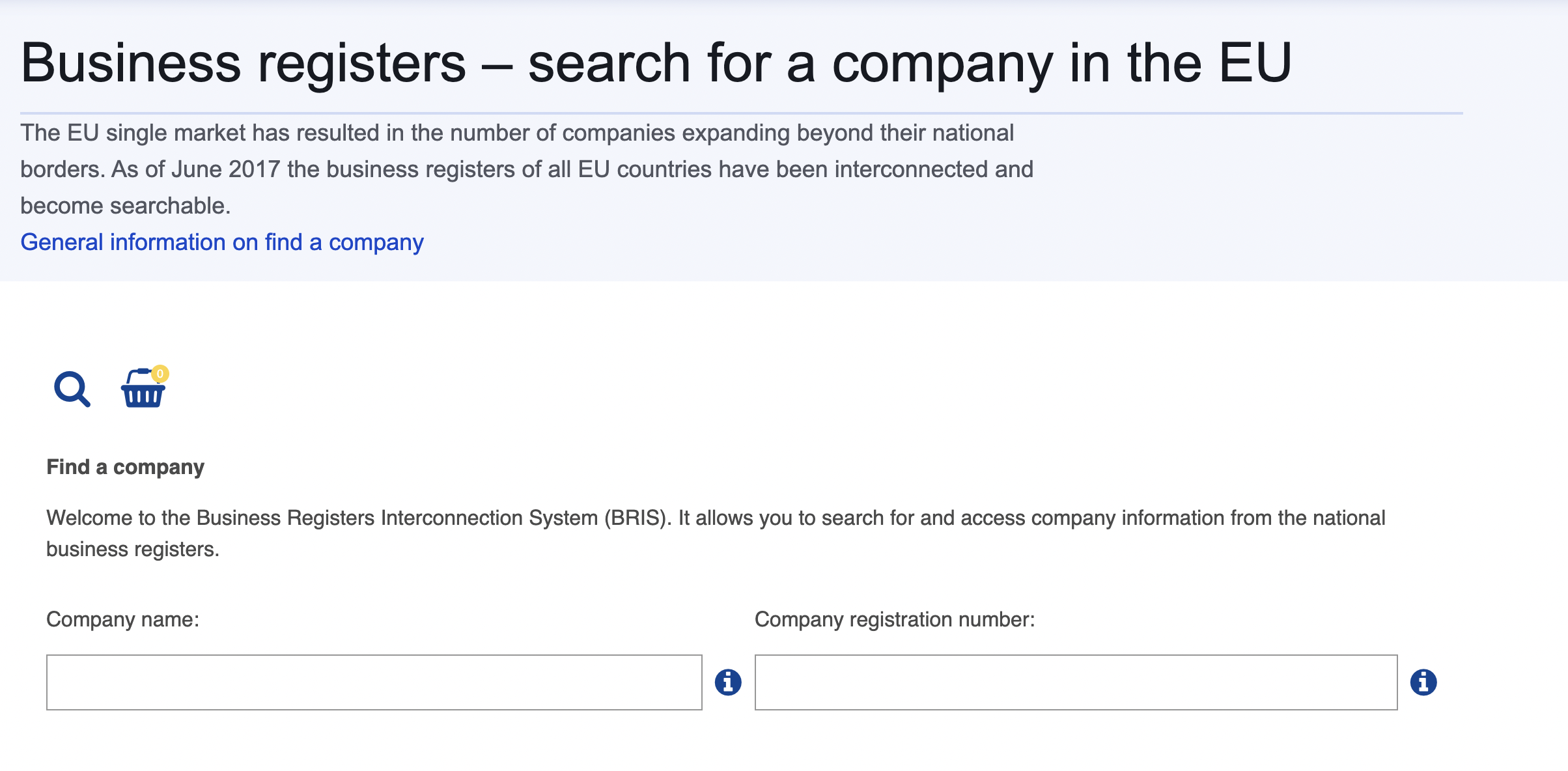 BRIS is the EU’s official “bridge” between national registers and is accessible from the European e-Justice Portal under “Find a company”.
How it works:
Visit the “Find a company” section on the European e-Justice Portal
Enter a company name and optionally select a country
BRIS queries connected national registers
You get a list of matches with basic, harmonised company details
What you typically see:
Company name
Registration number
Country of registration
Legal form
Company status (e.g., Active, Dissolved)
Pros:
Free and official
EU-wide search from a single interface
Ideal for quick existence checks
Cons:
Very limited information
No financial statements or filings
No director history or ownership
No contact data or enrichment
BRIS is a verification tool, not a full research, due diligence, or prospecting solution.
5.2 Method 2: Direct Company Search in National Registers (Country by Country)
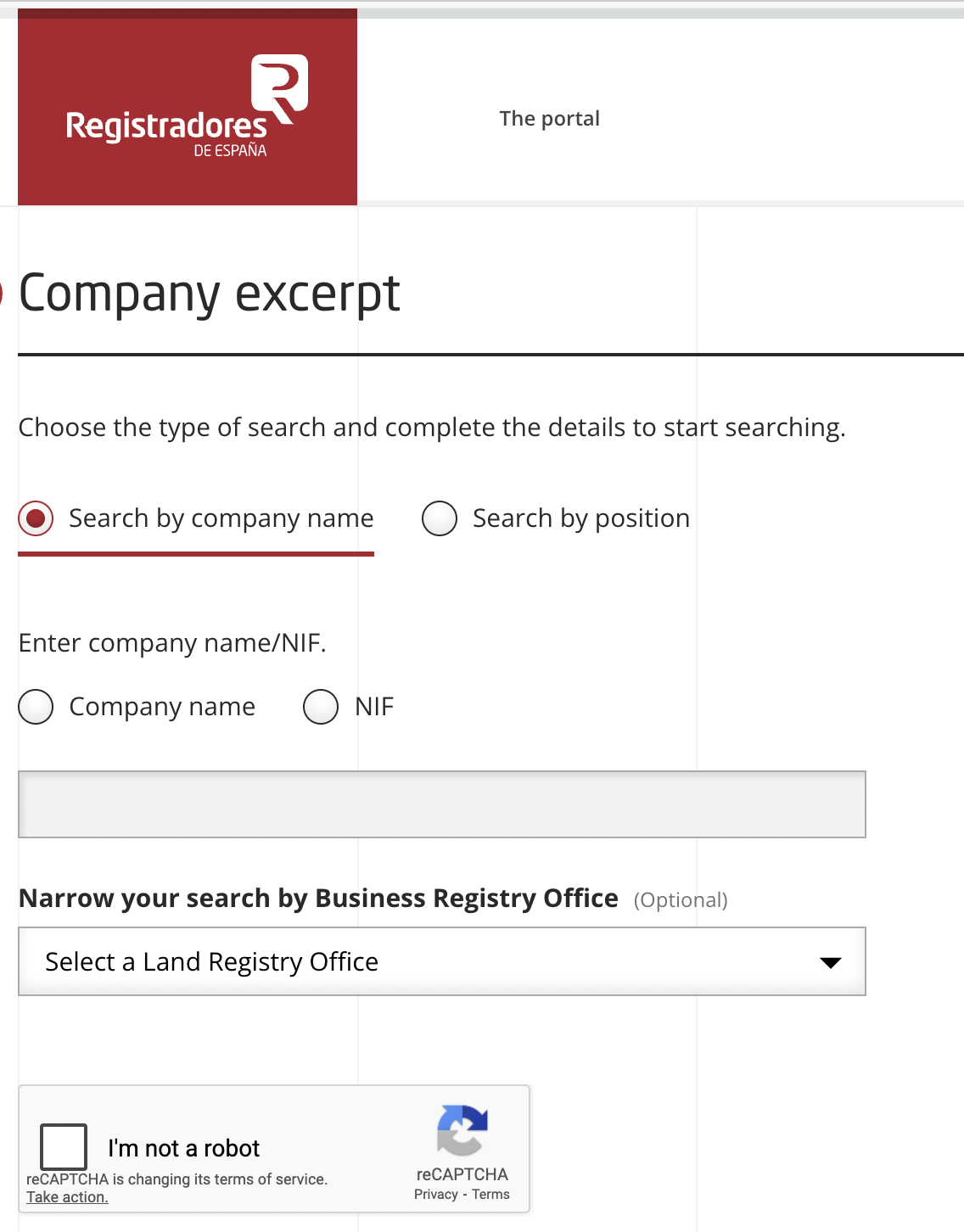 This is the most direct and legally authoritative method for specific cases.
How it works:
You know (or determine) the company’s country of incorporation
You navigate to that country’s official business register
You search using the exact legal name or registration number
You purchase or download documents and filings as needed
Pros:
100% direct from the official national source
Often the cheapest option if you just need one specific document
Ideal when you require an official extract or certified filing
Cons:
Not scalable – looking up 100+ companies can take days
Language barriers – interfaces and documents are often in the local language
Inconsistent data – disclosure rules and depth of information vary by country
Requires prior knowledge of the country of registration
For occasional, single-company checks, this method works well. For ongoing KYB, vendor onboarding, or sales targeting, it quickly becomes unmanageable.
5.3 Method 3: Using Consolidated Registry-Sourced Platforms (e.g. Global Database)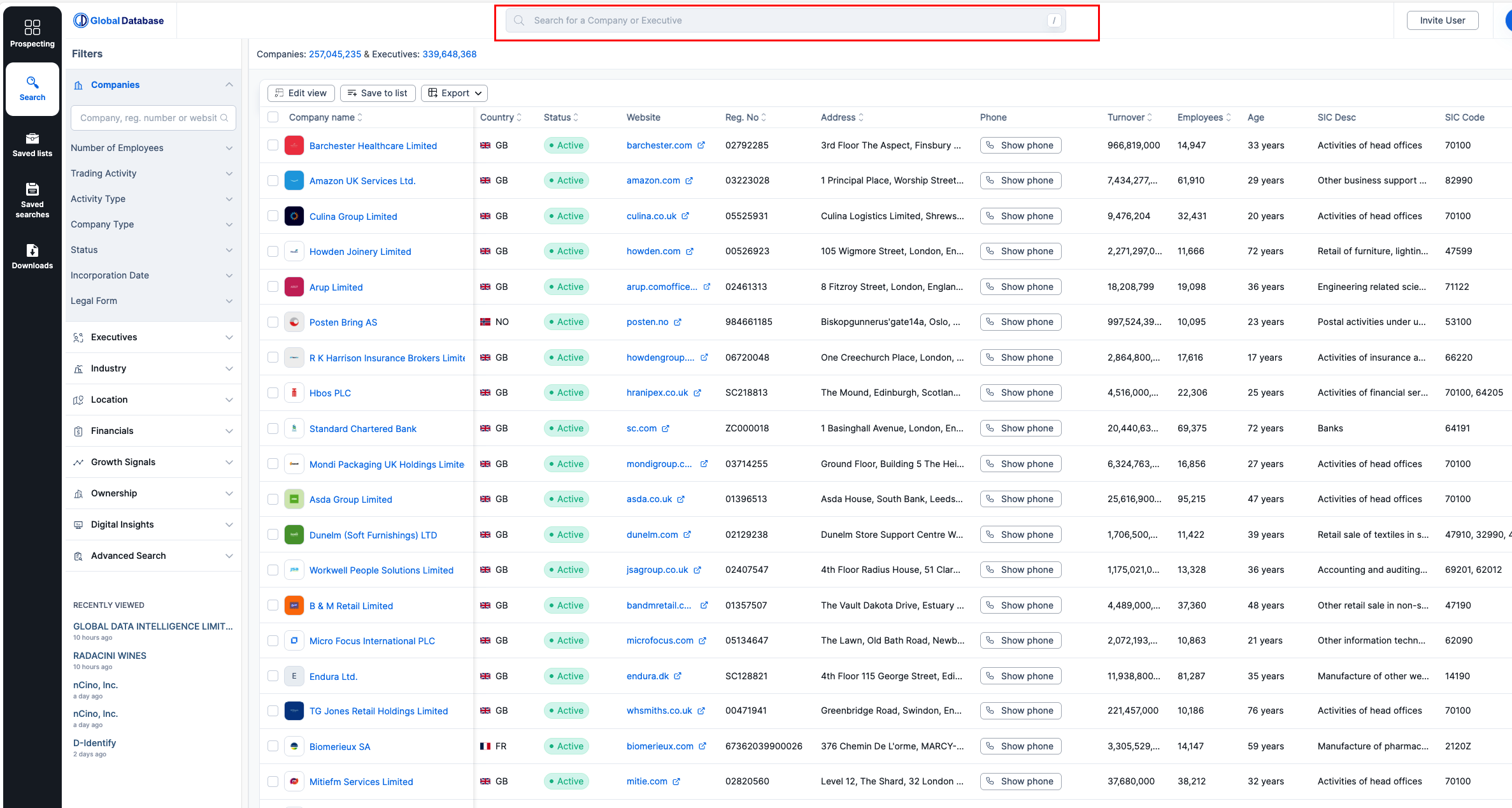 For organisations operating across multiple EU markets — or verifying companies at scale — navigating 27 separate national registers manually is simply too slow and too fragmented.
This is where registry-sourced data providers add value.
Platforms such as Global Database aggregate official information from national business registers and standardise it into a single, consistent structure.
What these platforms offer:
Standardised company profiles for all EU jurisdictions
Registry-sourced legal information (name, number, status, legal form)
Director and management details
Financial statements and filings, digitised from PDFs
Group structures and cross-border corporate linkages
Enrichment not found in registers (industry codes, contact info, web & tech data)
Advanced search (by industry, size, geography, keywords, etc.)
Historical changes and timelines
Multi-country monitoring and alerts
API access for automated KYB, onboarding, and enrichment workflows
These platforms do not replace national registers as legal sources, but they aggregate and normalise public registry data and augment it with additional intelligence, so you don’t need to stitch everything together manually.
Cons:
Commercial, subscription-based services (not free)
For sales prospecting, KYB/AML compliance, multi-market risk, and large-scale research, this is the only practical method.
What Information You Can Get from an EU Company Search
It helps to think in two layers:
Basic legal & firmographic data – from official registers
Enriched, in-depth intelligence – from commercial platforms
6.1 Basic Legal & Firmographic Data (Registers)
This is the foundational information available in almost every national register. It answers the question:
“Is this a real, legally registered company?”
Typical fields:
Official company name
Registration number / national ID (e.g., KVK number, SIREN, CVR)
Legal form (GmbH, AG, SARL, Sp. z o.o., etc.)
Company status (active, dissolved, liquidated)
Registered office address
Incorporation date
In many countries: directors or legal representatives
In some countries: financial statements and filings
6.2 In-Depth Company Information (UBOs, Financials, Credit, Group Structure)
For serious business uses — like compliance, risk, and strategic sales — basic data is not enough. You need richer intelligence, often assembled by company data platforms using registry sources and additional signals.
This can include:
Ownership & Management:
Current directors and officers
Historical directors
Reconstructed ownership and UBOs where legally permissible
Financial Data:
Annual reports and balance sheets
Profit & loss statements
Multi-year histories
Standardised financial line items and ratios
Credit & Risk Indicators:
Credit scores and credit limits
Risk flags and insolvency signals
Group Structure:
Ultimate parent company
Subsidiaries and related entities
Cross-border chains and hierarchies
Contact & Digital Data:
Business emails and phone numbers
Website and domain
Social media profiles
Technology stack and online footprint
Registers provide the legal backbone. Commercial platforms provide the intelligence layer on top.
Key Challenges of Searching EU Company Registers
Searching for company information across the EU is not as seamless as many expect. Even though every member state has an official register, those systems were not built for cross-border, large-scale corporate research.
Here are the main challenges.
7.1 Twenty-Seven Registers, Twenty-Seven Systems
There is no EU-wide unique user experience. Instead:
Each country has its own portal, logic, and terminology
Search interfaces differ
Data formats differ
Document availability differs
Anyone working cross-border must learn to navigate dozens of separate systems.
7.2 BRIS Is Limited to Existence Checks
BRIS is a helpful starting point, but:
It confirms existence and status
It identifies country of registration
It does not provide:
Financial accounts
Full corporate filings
Director history
Shareholder/UBO data
Downloadable documents
You must still go back to national registers — or a data platform — for depth.
7.3 Language Barriers
Many national registers:
Have limited or no English interface
Only partially translate search or help text
Provide filings and financials in the local language only
This creates friction when trying to:
Search accurately
Interpret legal filings
Analyse financial statements
Translation quickly becomes a recurring cost.
7.4 Uneven Levels of Digitalisation
The technological maturity of EU registers varies widely:
Some are highly digital and API-ready
Others are basic web front-ends with manual workflows
Some allow instant PDF downloads
Others require logins, credit bundles, or even manual requests
The user experience ranges from seamless to frustrating.
7.5 Inconsistent Pricing Models
There is no harmonised pricing:
Some countries offer many documents free (e.g. Denmark, Poland)
Others charge for almost everything (e.g. Italy, France, Spain)
Pricing may be per document, per extract, or via credit packages
Budgeting for large-scale onboarding or compliance via raw registers becomes complex.
7.6 UBO Information Is No Longer Public
Since the 2022 CJEU ruling:
Public access to UBO registers is largely restricted
Access often requires proof of legitimate interest or regulatory need
Ownership transparency is harder to achieve from registries alone
This is a major challenge for AML and enhanced due diligence processes.
7.7 Non-Uniform Financial Statements
Financial disclosure rules differ by country and company size:
Some publish full audited accounts
Others provide only summaries or limited extracts
Formats, languages, and structures vary
Cross-country financial comparison requires manual normalisation or a platform that does this for you.
7.8 Different Corporate Terminology
Each jurisdiction uses its own legal vocabulary (GmbH, SARL, SL, SA, NV, Oy, s.r.o., SIA, SRL, Sp. z o.o., etc.), with different:
Reporting obligations
Liability structures
Ownership rules
This complicates verification for users unfamiliar with local forms.
7.9 Lack of a Standard EU Company Identifier
There is no single, EU-wide company ID. Instead you have:
National registration numbers
VAT numbers
Tax IDs
Various local identifiers
Matching entities across systems and countries is non-trivial and error-prone.
7.10 Ongoing Monitoring Is Hard
Most national registers do not provide:
Alert services for new filings
API-based monitoring for status changes
To stay compliant, organisations must:
Revisit registers manually
Check for new documents
Track changes over time
For teams onboarding thousands of companies per year, this is unrealistic.
7.11 Compliance Demands Are Growing Faster Than Registries
Regulated industries — banks, fintechs, insurers, payment providers, KYC/KYB platforms — need:
Up-to-date, verified data
Structured audit trails
Automated workflows
Multi-country coverage
National registers provide raw data, not the tools or automation needed for modern compliance at scale.
[[form]]
Choosing the Best Tool for Your EU Company Search
The right method depends on your goal and scale:
8.1 For Quick, Free Verification of 1–2 Companies
Use BRIS via the European e-Justice Portal.
Fast, official, and free
Ideal for answering questions like:
“Is this company in France legally active?”
8.2 For a Single Official Legal Document
Go directly to the national business register.
Best choice if you need a specific extract (e.g., incorporation certificate)
Most legally recognised in local proceedings
8.3 For Sales Prospecting, KYB/AML, or Multi-Country Research
Use a registry-sourced company data platform (Method 3).
You get unified profiles, standardised financials, group structures, monitoring, and APIs
This is the only viable option when operating at scale across multiple EU markets
How Global Database Simplifies EU Company Search
Searching across EU company registers is possible, but rarely efficient. Different portals, languages, structures, and rules create operational friction and compliance risk.
Global Database removes these barriers by consolidating registry-sourced data from all 27 EU countries into one standardised platform, enriched and ready for automation.
9.1 Standardised Company Profiles for All EU Countries
Instead of learning 27 portals, users see a single, consistent profile format including:
Legal name
Registration number
Company status
Legal form
Registered address
Incorporation date
This makes cross-jurisdiction comparison straightforward.
9.2 Verified, Registry-Sourced Legal Information
Core corporate information is sourced directly from:
National business registers
Government gazettes
Official filings
This ensures traceable, audit-ready data suitable for KYB, AML, and regulated workflows.
9.3 Director & Management Information
Global Database aggregates:
Current directors
Former directors
Appointment and resignation dates
Senior management roles
No need to search multiple registers separately.
9.4 Financial Statements Digitised & Normalised
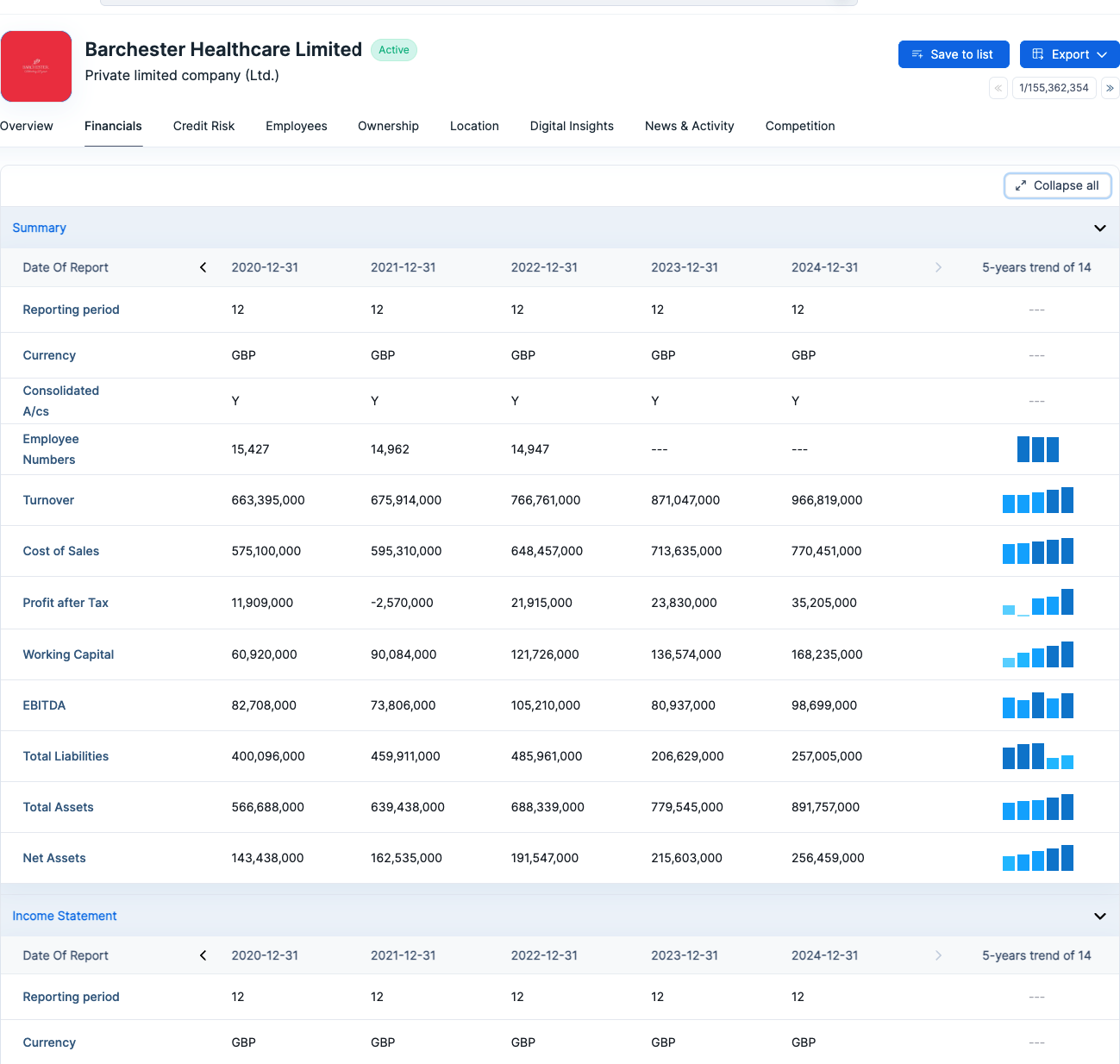 Instead of working with raw PDFs in different languages:
Financial data is extracted from documents
Line items are standardised
Historical financial timelines are built
Ratios and trends can be analysed across countries
You effectively get a comparable EU-wide financial dataset.
9.5 Cross-Border Group Structure & Corporate Linkages
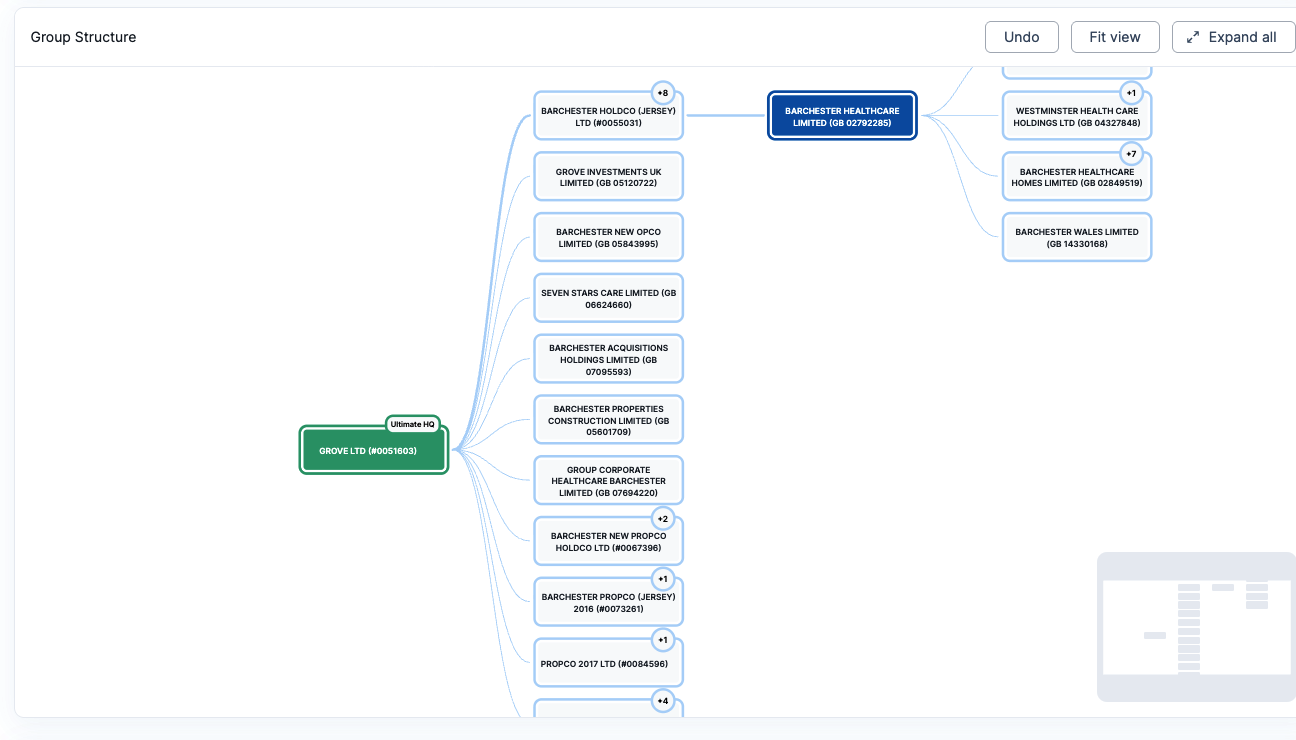 Where registers provide limited ownership data, Global Database reconstructs:
Ultimate parent companies
Subsidiaries and related entities
Cross-border corporate families
Historical ownership changes
This is crucial for AML, risk analysis, and enhanced due diligence.
9.6 Enrichment Beyond What Registers Provide
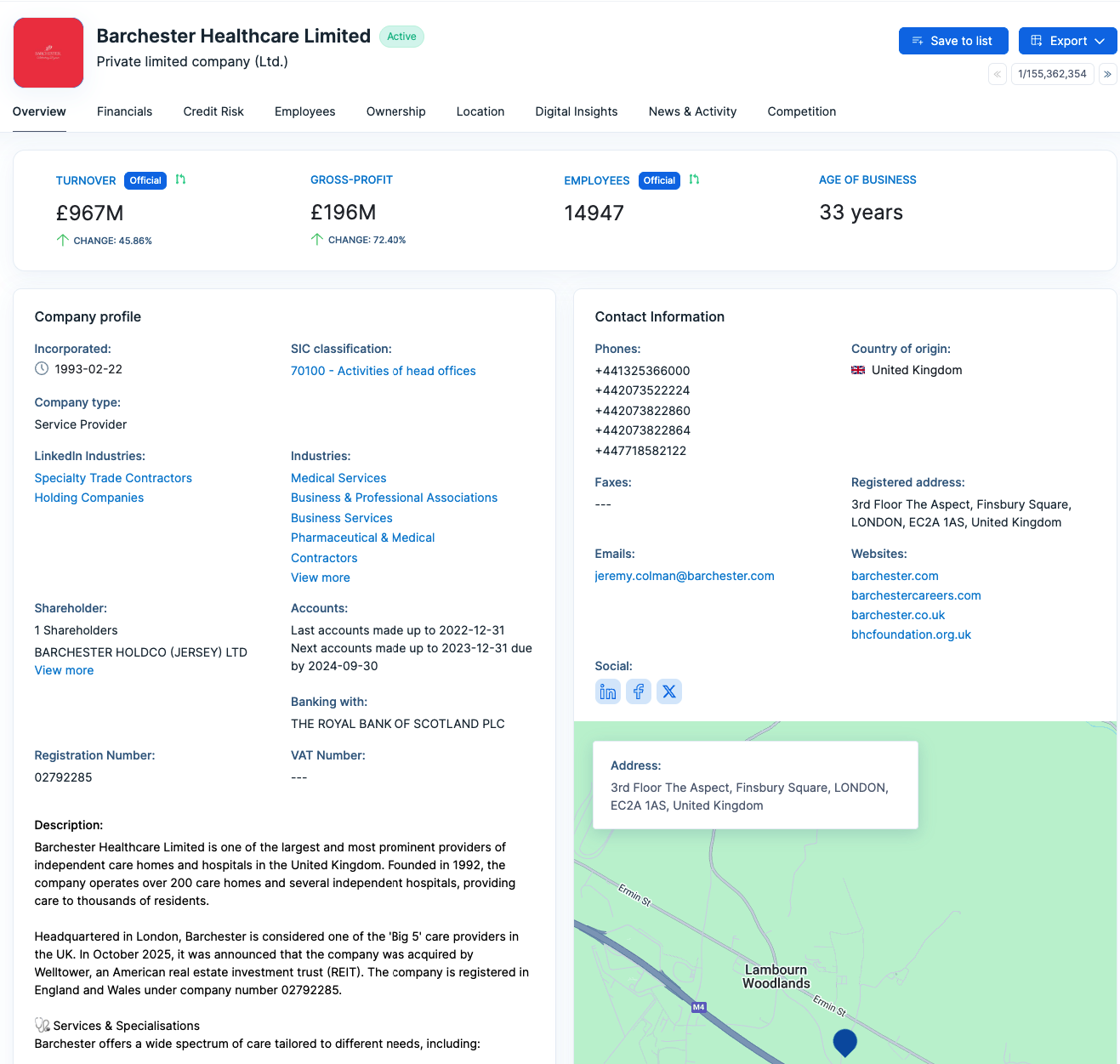 National registers focus on legal data. Global Database enriches profiles with:
Unified industry classifications (NAICS, NACE, SIC, LinkedIn industries)
Websites and domains
Social media presence
Technology stack
Activity descriptions
Coverage well beyond Europe, for global context
This turns raw registry data into actionable business intelligence.
9.7 Advanced Multi-Country Search
Unlike national registers — which are built for lookups — Global Database is built for discovery.
You can run queries such as:
“Show me all active software companies in Germany and France with more than 50 employees.”
Filter by:
Country
Revenue
Employee count
Industry
Keywords
Status
Technology stack
Perfect for market mapping, prospecting, and segmentation.
9.8 Complete Historical Records
Global Database consolidates historical information that would otherwise require piecing together from multiple registers:
Previous legal names
Former addresses
Director history
Filing timelines
Status changes
This builds a full corporate timeline for better due diligence.
9.9 Multi-Country Monitoring & Alerts
Instead of manually revisiting registers, Global Database can alert you to:
New filings
Status changes (e.g., liquidation, dissolution)
Director changes
New financial statements
Group structure updates
This is essential for ongoing vendor, customer, and portfolio monitoring.
9.10 API for Automated KYB, Onboarding & Enrichment
A single API connection provides access to registry-sourced data across all 27 EU jurisdictions (and beyond), enabling:
Instant company verification
Automated KYB checks
Bulk CRM enrichment
Real-time onboarding
Continuous monitoring at scale
No need to integrate with multiple individual registers or build your own normalisation layer.
Frequently Asked Questions About EU Company Search
1. Is there a single EU-wide company register?
No.
Each of the 27 EU member states has its own national business register. BRIS (Business Registers Interconnection System) only provides basic, harmonised company existence checks; it does not include full financials, ownership, or filings.
2. Are EU company registers free to use?
It depends on the country.
Some (e.g. Denmark, Poland) provide broad access free of charge, while others (e.g. Italy, France, Spain) require payment for most filings and financial statements.
3. Can I search for companies across multiple EU countries at once?
Not via national registers.
Each country must be searched independently.
Platforms like Global Database consolidate data from all EU countries into a single search experience.
4. Can I access beneficial ownership (UBO) information in the EU?
Public access to UBO data has been restricted since the 2022 CJEU ruling.
Most EU countries now limit access to authorities and parties with legitimate interest.
Global Database reconstructs ownership and group structures using filings, historical data, and cross-border disclosures where legally permissible.
5. Are financial statements available for all EU companies?
No.
Availability depends on country rules and company size/type. Many financials are stored in PDFs, in different formats and languages.
Global Database extracts and standardises these financials to make them comparable across jurisdictions.
6. Are all EU company registers available in English?
No.
Several registers provide only partial or no English support. Legal documents and financials are often available only in the local language.
7. What information can I usually get from EU business registers?
Commonly:
Legal name
Registration number
Company status
Legal form
Registered address
Directors (in many jurisdictions)
Financial statements (in some jurisdictions)
Various filings (often paid)
Depth and accessibility vary significantly by country.
8. Can I search by industry, size, revenue, or keywords in EU registers?
Generally, no.
Most national registers only support name or registration number lookups.
Global Database allows advanced searches such as:
“Active IT companies in Germany and the Netherlands with more than 50 employees.”
9. Can I monitor companies across the EU for changes?
National registers rarely offer automated, multi-country monitoring.
Global Database provides EU-wide alerts for:
Director changes
New filings
Updated financials
Status changes
Group structure changes
10. Why use Global Database if registry data is public?
Registry data is public, but:
It’s fragmented across 27+ systems
Formats and languages are inconsistent
UBO and financial analysis often require cross-referencing multiple sources
Global Database adds value by providing:
One standardised profile format
A single interface for all EU jurisdictions
Enriched intelligence (industries, tech stack, contacts, global coverage)
Digitised and normalised financials
Cross-border group structures
Multi-country monitoring
API access for automation
This reduces manual work dramatically and enables enterprise-grade verification and research across the EU.