London, 5 October 2026. Global Database has launched a UBO API. It finds the ultimate beneficial owners of a company: the real people who own or control it, however many holding companies sit in between.
For each company, the API returns every owner, their total stake across every route, the threshold applied, and whether the answer is conclusive. It went live on 3 October 2026 as part of the Global Database KYB API.
"Most beneficial ownership tools stop at the first layer of shareholders, or quietly hide the gaps. Our UBO API follows every route to the real people behind a company, applies the threshold each customer sets, and says plainly when registry data runs out. With the EU AMLR applying from July 2027 and more onboarding handled by AI agents, compliance teams need ownership answers they can audit, not guesses."
Nicolae Buldumac, Founder and CEO, Global Database
Why UBO verification is hard to automate
Anti-money laundering and KYB rules require banks, payment firms and other regulated businesses to identify the people who own or control each corporate customer.
The hard part is not the first layer. A company's shareholders are often other companies, which are owned by more companies, sometimes in other countries. Each layer shrinks the visible stake, so a controlling owner can look like a minor one.
How layers dilute a beneficial owner's visible stake
One person holds the same share at every level of a holding chain. Move the slider to see where their effective ownership drops below common UBO thresholds.
Tracing this by hand means pulling shareholder lists from several registries and doing the maths for every route. It takes hours on complex cases, and mistakes are easy: an owner with 30% across two routes can look like two small 15% holdings.
The rules are also getting stricter. From 10 July 2027, the EU Anti-Money Laundering Regulation (AMLR) applies in every member state. It moves the test from "more than 25%" to "25% or more", sets one way to calculate ownership, and requires a written statement whenever an owner cannot be found.
Where UBO data comes from, and where it runs out
No single register gives the full answer. Each market has its own rules, keeps the data in different places and limits who can see it.
| Market | Ownership test | Where the data sits | Where it runs out |
|---|---|---|---|
| EU | More than 25% today; 25% or more under the AMLR from 10 July 2027, and as low as 15% for higher-risk entities | National beneficial ownership registers and company registries | General public access to the registers ended in most countries after the EU Court of Justice ruling of 22 November 2022; access now depends on legitimate interest |
| UK | More than 25% | The PSC register at Companies House, free and public | Self-declared, and stops at foreign parent companies |
Global Database links shareholder, PSC and group structure data from 400+ official registries across borders. Where no registry publishes owners, as in the US or offshore, the UBO API marks the gap. See which countries are covered on our data sources page.
How the UBO API calculates ownership
The API follows every ownership chain upwards, up to 20 levels, until it reaches people. Stakes are multiplied along each chain, then added up across all chains.
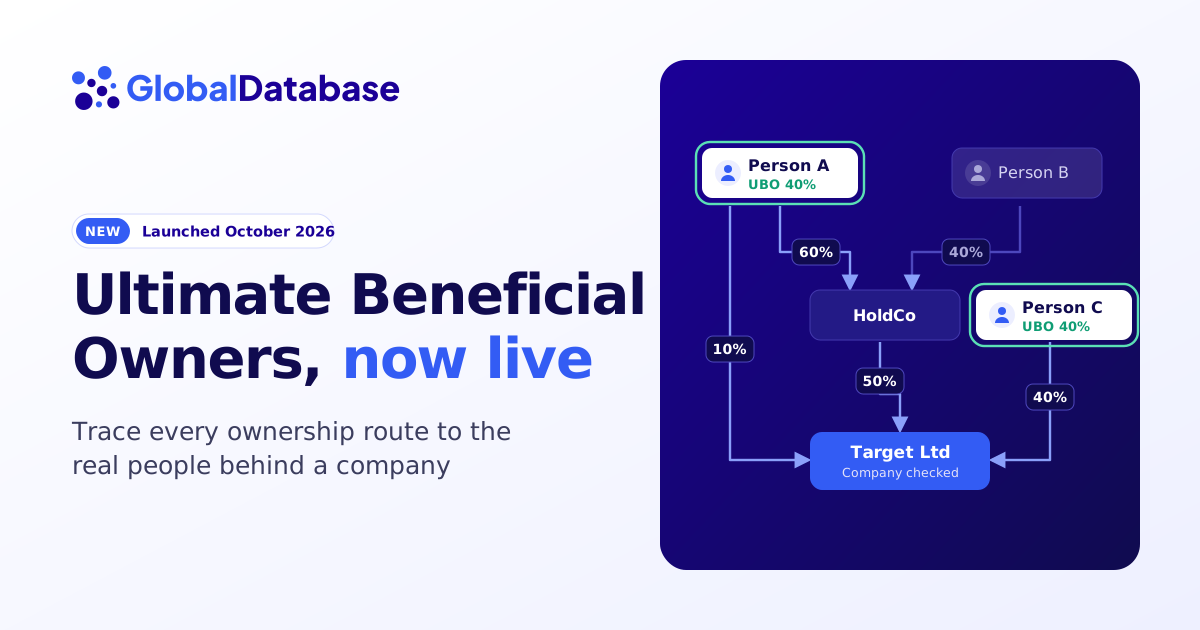
An example. A payments company is onboarding Target Ltd. The share register shows three shareholders: HoldCo 50%, Person C 40% and Person A 10%. On paper, only Person C passes the 25% test.
But Person A also owns 60% of HoldCo. Follow that route and the picture changes:
| Route to Target Ltd | Calculation | Stake |
|---|---|---|
| Person A → HoldCo → Target Ltd | 60% × 50% | 30% |
| Person A → Target Ltd | Direct | 10% |
| Person A, all routes | 30% + 10% | 40% |
Person A is a 40% owner, level with Person C. The UBO API does this for every route and every layer.
The same example shows three things a register lookup cannot do.
A threshold you choose
Person B owns the other 40% of HoldCo, which is 20% of Target Ltd. At a 25% threshold Person B is not a UBO. At 15%, a common level for higher-risk customers and the lowest the EU AMLR allows for higher-risk entities, Person B is. You set the threshold, so one integration covers every policy.
An honest answer about gaps
Now suppose Person B is replaced by an offshore company that publishes no owners. 20% of Target Ltd is now hidden.
- At 25%, the result is still conclusive: a hidden 20% cannot be another owner above 25%. The API marks the stakes as minimums, so Person A shows as at least 40%.
- At 15%, it is not conclusive: the hidden 20% could be a UBO, so the API flags a possible undisclosed owner.
Live registry data where it matters
When a gap could change the result, the API can fetch live data from official company registries, including paid ones. It only does this where it matters, and stops at the spending limit you set. Anything still open is listed with the reason.
The same check, run by an AI agent
More onboarding now runs through AI agents. Ask a general chatbot who owns Target Ltd and it answers from training data. At best, it names Person C from the register.
With the UBO API, the agent gets structured data: Person A and Person C at 40% each, and whether the answer is conclusive. If it is not, the agent knows which branch is open instead of guessing.
Agents can reach Global Database data in three ways:
- MCP server. 24 tools, including KYB registry checks, listed in the Claude, ChatGPT, Cursor and Zapier directories. Users sign in with their Global Database account, with no API key to paste.
- Regis AI. An AI agent that answers ownership questions in plain language, such as the full chain from a company up to its UBO, citing the registry behind every answer. Developers can call it through the Regis API.
- REST API. The UBO endpoints themselves, for teams building their own agents, returning structured JSON rather than text to interpret.
Keep UBO data current after onboarding
A UBO check is only true on the day it runs. Shares change hands, holding companies are restructured, and an owner below the threshold can cross it a year later.
Global Database monitoring watches for the registry changes that affect ownership: new shareholders, shareholders leaving and group structure changes. When one happens, you get an alert and can run the UBO check again.
Who the UBO API is for
- Banks and fintechs can run a UBO check during business account opening and route only inconclusive cases to an analyst.
- Payment and lending companies can confirm who stands behind a merchant or borrower before money moves.
- Procurement and supplier risk teams can identify the people behind new vendors and spot shared owners across a supplier base.
- Marketplaces can verify sellers at scale without adding manual review to every sign-up.
- Compliance software vendors can embed UBO screening in their own KYB verification products through one REST call, with resale rights available.
Existing API customers can use the UBO API with their current API key, subject to plan. Full details are in the API documentation.
Frequently asked questions about UBO verification
What is an ultimate beneficial owner (UBO)?
An ultimate beneficial owner is the natural person who ultimately owns or controls a company, directly or through other entities. Most AML rules set the ownership test at 25% of shares or voting rights, alongside a separate test for control by other means.
Can an ultimate beneficial owner be a company?
No. A UBO is always a natural person. Companies can sit in the ownership chain as shareholders, but the UBO API keeps tracing until it reaches the individuals behind them.
What is the difference between a shareholder and a beneficial owner?
A shareholder is whoever is recorded on the share register, which may be another company. A beneficial owner is the person who ultimately benefits from or controls that holding.
How does the UBO API calculate effective ownership?
It multiplies percentages along each ownership chain and adds every chain that leads to the same person. Someone holding 30% through one route and 10% through another is reported at 40%.
Can I set my own UBO threshold?
Yes. Set any threshold above 0 and up to 100%; the default is 25%. A person counts as a UBO when their effective ownership is strictly above it, so for a rule of 25% or more, set the threshold just below 25.
What does a conclusive UBO result mean?
It means nothing left unresolved could change the list of UBOs. A result can be conclusive even when part of the chain is missing, for example when an unresolved 7% cannot hide a 25% owner. The percentages are then shown as minimums.
What happens when an ownership chain cannot be resolved?
The response lists where each open branch stopped and why, such as ownership not available or an unidentified entity. Where the gap could change the result, the API can fetch live data from official company registries to resolve it.
How is a UBO check different from searching the PSC register?
A register such as the UK persons with significant control list records declared controllers in one country. A UBO check combines shareholder and group structure data across countries and calculates effective ownership through every layer.
Is UBO verification required for KYB compliance?
In most jurisdictions, yes. AML rules in the EU, UK and US require regulated firms to identify the beneficial owners of corporate customers and take reasonable steps to verify them.
How do I get access to the UBO API?
Existing customers call the /v2/kyb/{id}/ubo endpoints with their current API key, subject to plan permissions. New users can book a demo to request an API key.