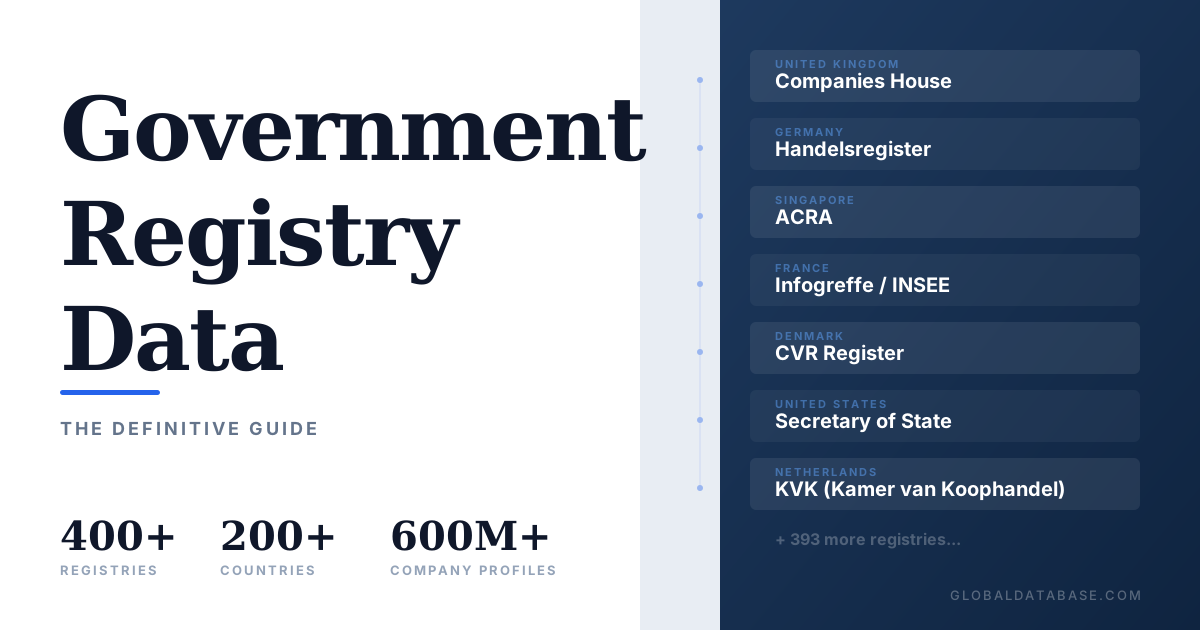
Every company in the world is registered somewhere. When a business incorporates, it files documents with a government authority. That authority stores those documents in a registry.
Government registry data is the official record of a company's existence, legal status, ownership, and filings — maintained by the government body that approved the incorporation.
This is the most authoritative source of company information available. It's the same data a court, regulator, or tax authority would reference. And it's the foundation of every KYB check, due diligence review, and compliance workflow that touches corporate identity.
Yet most businesses never access it directly. They rely on intermediaries — data vendors, aggregators, and resellers — that sit between them and the source. This creates gaps. Gaps in freshness, gaps in coverage, and gaps in audit trails that regulators are increasingly unwilling to tolerate.
This guide covers what government registry data actually contains, how registries work across jurisdictions, what access models exist, and why the data source matters as much as the data itself.
What Government Registries Actually Store
A company registry is a database maintained by a government body — typically a Ministry of Justice, Ministry of Commerce, Companies House, or Secretary of State office — that records information about legally formed entities.
The exact data varies by jurisdiction, but most registries capture a core set of fields at incorporation and update them through periodic filings.
Company identity and legal status. This is the baseline. Every registry stores the legal name, registration number, incorporation date, legal form (LLC, GmbH, S.A., Ltd), registered address, and current status (active, dissolved, in liquidation, struck off). This is the minimum viable KYB data point — proof that the entity exists and is legally recognised.
Directors and officers. Most registries record the names of individuals authorised to act on behalf of the company. This typically includes directors, managing directors, board members, and company secretaries. Some registries include dates of birth, residential addresses, and appointment/resignation dates. Others only list names.
Shareholders and ownership. This is where registries diverge. Some — like the UK's Companies House — publish full shareholder data including names, share classes, and ownership percentages. Others — like many US state registries — don't collect shareholder data at all. In the EU, beneficial ownership registers were made mandatory under AMLD4, but access rules vary wildly by member state.
Financial filings. Companies in many jurisdictions are required to file annual accounts. The UK requires it for all limited companies. Germany requires it through the Bundesanzeiger. Many EU countries publish balance sheets, profit and loss statements, and key financial ratios through their registries. In the US, only public companies file financials (via SEC EDGAR) — private company financials aren't available through state registries.
Company documents. Registries often store the founding documents themselves — articles of incorporation, memorandums of association, certificates of good standing, and annual returns. These are the primary source documents for legal verification.
How Registries Differ Across Jurisdictions
There is no global company registry. Every country — and in some cases, every province or state — maintains its own. This fragmentation is the single biggest challenge in cross-border company data.
Here's how the landscape breaks down.
Registry Access Models by Type
Access Model | How It Works | Examples |
|---|---|---|
Open access | Anyone can search for free, no account required | UK Companies House, New Zealand Companies Office |
Freemium | Basic search free; detailed data or documents cost €2–€20 per item | Italy (Registro delle Imprese), Netherlands (KVK) |
Gated | Requires account registration, identity verification, or proof of legitimate interest | Malta (identity verification), Austria (UBO register — restricted) |
Closed / Agent-only | No direct public access; searches must go through designated agents | Alberta (Canada), British Virgin Islands |
Data Depth by Jurisdiction
Not all registries are created equal in what they publish.
Transparency Level | What's Published | Example Jurisdictions |
|---|---|---|
Full | Company details, directors, shareholders, UBOs, financial filings | UK, Denmark, Norway |
Moderate | Company details and directors; ownership data fragmented across separate systems | Germany, France, Netherlands |
Limited | Basic entity info only — legal name, reg number, status, registered agent | Most US state registries |
Minimal | Entity name and status only; registries may not be digitised or publicly searchable | Some offshore jurisdictions, some developing countries |
Denmark is the only country in the world that provides company data, shareholder data, and UBO data through a single API.
In the US, shareholder data is not collected by state registries. Beneficial ownership was briefly required under the Corporate Transparency Act, but the requirement for US domestic entities was removed in March 2025.
Data Formats
Registries don't speak the same language — literally or technically.
Some offer structured APIs with JSON/XML responses (UK Companies House, Denmark's CVR, Singapore's ACRA). Others provide data only through web portals with no API access. Some still distribute data as flat CSV files or even scanned PDF documents.
For a compliance team verifying a single company, this is an inconvenience. For a data team building an automated pipeline across 50 jurisdictions, it's an engineering nightmare. It's one of the reasons providers like Global Database exist — to normalise data from hundreds of registries into a single, consistent schema.
Why the Data Source Matters
If you're buying company data from a third-party provider, you have a right to ask: where does this data actually come from?
The answer matters more than most buyers realise. Here's why.
Freshness
Government registries are updated when companies file. Depending on the jurisdiction, this happens in real-time, daily, or at filing deadlines. The registry always has the most current version of a company's official data.
When a third party copies that data into their own database, a lag is introduced. The lag might be hours, days, or months — depending on how frequently the provider refreshes its data and which registries it covers. A company could change its directors today, and a cached database might not reflect that change for weeks.
For compliance, this gap is a liability. A director who was appointed yesterday and sanctioned today won't show up in a stale dataset. Ongoing monitoring built on cached data is monitoring yesterday's reality. First-party providers that refresh directly from registries on a defined schedule — rather than buying pre-packaged feeds from intermediaries — close this gap significantly.
Provenance
Regulators care about where your data came from. Under AMLD6, EU-regulated entities must demonstrate that their customer due diligence is based on reliable, independent sources. Under the UK's Money Laundering Regulations, firms must be able to show evidence of their verification process.
A record sourced directly from Companies House, timestamped, with a filing reference — that's defensible. A record from a vendor database with no source attribution, no timestamp, and no filing reference — that's a risk.
The audit question is simple: can you trace this data point back to the registry? If the answer is no, you have a provenance gap. This is the core differentiator between first-party registry providers and aggregators — every record from a first-party source carries source attribution, filing references, and retrieval timestamps by default.
Coverage Gaps
No single aggregator covers every registry with the same depth. Many providers have strong coverage in the US and UK but limited data in Southeast Asia, Africa, or Latin America. Some claim "200+ country coverage" but only return basic entity status for half of those countries — no directors, no shareholders, no financials.
First-party registry providers face the same challenge, but the difference is transparency. A provider connected directly to registries can tell you exactly which data fields are available per jurisdiction. An aggregator may not know — because they're buying from another aggregator who bought from another aggregator.
Accuracy
Registries aren't perfect. Companies file incorrect information. Registries lag on updates. Some registries — as Kyckr's research documented — have historically acted as "librarians" that store what companies say about themselves without independent verification.
But registries are improving. The UK's Companies House introduced mandatory identity verification for directors. The Netherlands' KVK cross-references business addresses with official land registries. Singapore's ACRA uses data analytics to detect suspicious filing patterns from corporate service providers. Belgium's CBE has purged non-compliant businesses from its registry.
The point isn't that registry data is flawless. It's that the registry is the authoritative source — the version of record. Any error in the registry is also an error that the government itself recognises as the current legal position. Any deviation from the registry in a third-party database is either outdated or editorialised — neither of which is useful for compliance.
What You Can — and Can't — Get from Registries
This is the practical section for data teams evaluating registry data as a source.
Availability | Data Fields | Coverage |
|---|---|---|
Most jurisdictions (100+ countries) | Legal name, trading names, registration number, incorporation date, legal form, registered address, current status, jurisdiction | Core entity verification data |
Many jurisdictions (50–100 countries) | Director names, roles, appointment dates, industry codes (NACE, SIC, NAICS), VAT/tax IDs, annual filing history | KYB-grade identity and officer data |
Fewer jurisdictions (20–50 countries) | Shareholder names, ownership percentages, share capital, financial statements, beneficial ownership, company documents | Full due diligence data |
Rare (<20 countries) | Full corporate group structures, historical ownership changes, real-time filing alerts, financial KPIs from filings | Advanced intelligence and monitoring |
The gap between what registries publish and what compliance teams need is often filled by providers who enrich, normalise, and connect registry data across jurisdictions.
How to Access Government Registry Data
There are three models for accessing registry data. Each has trade-offs.
Access Model | Best For | Pros | Cons |
|---|---|---|---|
Direct registry access | Occasional, single-country lookups | Free or low cost. Data is current. Source is clear. | Manual. Doesn't scale. Different interface, language, and format per registry. No API in most cases. |
Bulk data downloads | Large orgs with data engineering teams — payment processors, banks, data platforms | Full dataset. Scheduled refresh. No per-query cost. | Significant engineering to parse and normalise. Very few registries offer bulk access. Formats vary. |
Third-party providers | Teams that need multi-jurisdictional data in a single schema | Normalised data. Single API. Cross-border coverage. | Cost. Provenance depends on provider. Need to verify data sourcing. |
A Note on Bulk Data
Very few registries actually offer bulk data downloads. The UK's Companies House is the most well-known — its full dataset is freely available. New York State offers bulk entity data. Canada provides bulk data at the federal level, though you won't get complete coverage — provincial registrations are separate and not included.
Most other registries — including major ones like Ireland's CRO, Hong Kong's CR, and Singapore's ACRA — do not offer bulk downloads. If a vendor claims to have "bulk data" from these jurisdictions, ask how they got it.
Third-Party Provider Types
There are two types of third-party providers:
Live registry providers connect directly to registries and pull data at the point of request. The data is fresh, timestamped, and sourced. Trade-off: dependent on registry availability.
Cached / aggregated providers maintain their own copy of registry data. They refresh it periodically. Trade-off: data may be stale. Provenance is weaker. But uptime is independent of registry infrastructure.
Some providers operate a hybrid model — they maintain a cached copy for speed and reliability, but refresh it directly from registries on a defined schedule. Global Database uses this approach: data is stored on its own infrastructure for 99.9% uptime, then refreshed from 400 government registries as new filings are published. The result is registry-grade provenance without the dependency on registry uptime at query time.
Why Compliance and Risk Teams Need Registry Data
Registry data isn't just a nice-to-have for compliance teams. It's increasingly the minimum standard regulators expect.
The Regulatory Expectation
AMLD6 requires regulated entities to verify customer identities using "reliable, independent sources." The UK's Money Laundering Regulations specify that verification must come from "a reliable and independent source." In practice, this means government registries — the only source that is both government-maintained and independently verifiable.
Self-reported data doesn't meet this standard. Neither does vendor data with no source attribution. When a regulator asks "where did you get this data?", the only answer that ends the conversation is "from the registry."
What's at Stake
Risk Area | Without Registry Data | With Registry Data |
|---|---|---|
KYB verification | Relying on self-reported or third-party data with no provenance | Verified against the government-maintained source of record |
UBO identification | Ownership data may be stale, incomplete, or unverified | Sourced from official beneficial ownership registers where available |
Ongoing monitoring | Periodic manual reviews that miss changes between review cycles | Registry-triggered alerts when directors change, status updates, or new filings appear |
Sanctions screening | Director and officer data may not match the entity's current filing | Current officer data cross-referenced against sanctions lists |
Audit defence | Cannot trace data back to the authoritative source | Every record carries source attribution, filing reference, and retrieval timestamp |
Who Needs This
Compliance teams in banks, fintechs, insurers, and payment companies use registry data for customer due diligence at onboarding and throughout the relationship. Without it, you're building compliance workflows on a foundation you can't verify.
Risk teams use registry data to assess counterparty risk — is the entity active? Has it changed directors recently? Is the ownership structure what the client claims? Material changes in registry filings are early warning signals.
Data and product teams at SaaS companies, marketplaces, and platforms use registry data to verify business customers, enrich CRM records, and power entity resolution across systems.
What to Ask Your Data Provider
Whether you're evaluating a new vendor or auditing your current one, these questions cut through the marketing.
Question | Why It Matters | Red Flag |
|---|---|---|
Where does the data come from? | You need the specific source per jurisdiction — not "government registries" but "Companies House via Streaming API, refreshed daily." | Vague answers. "Multiple sources." No per-jurisdiction breakdown. |
How often is it refreshed? | Per jurisdiction. Your provider should refresh at least as often as the registry publishes. | Single global refresh claim. No per-country detail. |
What happens when a registry goes offline? | Registries have downtime. Know if your provider fails silently or serves the most recent verified record. | "We always return data" with no explanation of fallback behaviour. |
Can I trace a data point back to the filing? | Every record should carry source attribution: which registry, which filing, when retrieved. | No timestamps. No filing references. No audit trail. |
What fields are available per country? | Don't accept a single global coverage number. Ask for a country-by-country breakdown. | "200+ countries" with no field-level detail. |
Is the data normalised? | Data from 50 jurisdictions needs a consistent schema. Director data from the UK shouldn't arrive in a different format than Germany. | Per-country parsing required on your side. |
API, bulk, or both? | Some use cases need real-time API calls (onboarding). Others need bulk feeds (data warehousing). | Only one delivery model available. |
How Global Database Handles Government Registry Data
Global Database is a first-party data provider that connects directly to 400 official government registries worldwide. The platform covers 600M+ company profiles across 200+ countries and delivers registry-sourced data via API, web platform, and bulk data feeds.
Here's how it addresses the challenges covered in this guide.
Direct registry connections. Data comes from the official government source in each jurisdiction — not from intermediaries, aggregators, or resold datasets. Every record carries source attribution and timestamps for audit compliance.
Cached for reliability, refreshed from source. Company data is stored on Global Database's own infrastructure (hosted on Hetzner in Germany), not retrieved through live calls to registries at query time. This means 99.9% uptime regardless of whether a specific registry is online. When a registry publishes new filings, the data is refreshed from source.
Normalised across jurisdictions. Whether you're querying a GmbH in Germany, a Société Anonyme in France, or a Pty Ltd in Australia, the API returns data in a single, consistent schema. No per-country parsing. No format surprises.
Full data depth where registries allow. The platform delivers structured data across seven categories, each available via REST API:
Data Category | What's Returned |
|---|---|
Search | Match companies by name, registration number, or VAT/tax ID across all covered jurisdictions |
Company Profile | Legal name, registration data, legal form, status, address, incorporation date, industry, website |
Directors & Officers | Names, dates of birth, addresses, gender, appointment dates, current status |
Shareholders & UBOs | Names, share types, share values, ownership percentages, UBO flags, DOB, addresses |
Ultimate Parent | Top-of-tree entity with name, registration/VAT ID, country, and revenue |
Group Structure | Parent companies, subsidiaries, corporate hierarchy, cross-border linkages |
Financial Statements | Up to 20 years of balance sheets, P&L, cash flow, and financial KPIs/ratios |
Bulk and API delivery. High-volume environments — payment processors, large fintechs, data platforms — can receive registry data via bulk feeds (daily, weekly, or monthly). This eliminates external API dependencies entirely. Lower-volume use cases connect via REST API with per-call pricing.
Regulations Driving Demand for Registry Data
Several regulatory developments are making registry-sourced data a harder requirement — not a nice-to-have.
Regulation | Jurisdiction | Impact on Registry Data Demand |
|---|---|---|
AMLD6 | EU | Tightens CDD and UBO verification. Regulated entities must use "reliable, independent sources" — registry data is the standard. |
Corporate Transparency Act | US | US domestic BOI removed (March 2025), but foreign entities must still report. NY LLC Transparency Act (Jan 2026) adds state-level requirements. |
AML/CTF Reforms | Australia | Effective March 31, 2026. Expands scope of entities subject to due diligence and UBO verification. |
Economic Crime Act | UK | Mandatory ID verification for directors at Companies House. Increased powers to query or remove suspicious filings. |
MiCA | EU | Crypto-asset service providers must conduct KYB checks including UBO identification — new demand from a sector with limited prior compliance obligations. |
For compliance teams, the pattern is clear: regulators want to see registry-sourced evidence. Self-reported data, cached profiles from unknown sources, and vendor data with no provenance trail are increasingly insufficient.
Frequently Asked Questions
What is the difference between government registry data and business intelligence data?
Government registry data is the official record filed with and maintained by a government authority. Business intelligence data typically combines registry data with other sources — web scraping, self-reported surveys, credit data, news, and proprietary models. Registry data is the authoritative baseline; business intelligence is the enriched layer on top.Is government registry data free?
It depends on the jurisdiction. The UK's Companies House is free. Many EU registries charge per document or per search (€2–€20). Some require subscriptions or agent access. Bulk data downloads are available from very few registries (UK, New York State, Canada at federal level). Third-party providers that normalise and deliver registry data charge for the service.How often is registry data updated?
This varies by jurisdiction and filing type. In the UK, director changes must be filed within 14 days. In some US states, companies only file updates every 12–24 months. Annual accounts have jurisdiction-specific filing deadlines. The registry is always the most current source of filed data — the question is how often companies are required to file.Can I access registry data via API?
Some registries offer public APIs (UK Companies House, Denmark CVR, Singapore ACRA, New Zealand Companies Office). Most do not. Third-party providers like Global Database aggregate multiple registries behind a single API, eliminating the need to build separate integrations for each jurisdiction.What is the difference between a company registry and a beneficial ownership register?
A company registry records the legal existence and structure of a company — its name, status, directors, and shareholders. A beneficial ownership register specifically records the natural persons who ultimately own or control the entity. In many countries, these are separate databases with different access rules. Some countries combine them. Some have no beneficial ownership register at all.Is registry data sufficient for KYB compliance?
Registry data is necessary but not always sufficient. It provides company verification, ownership data, and director information. But a complete KYB process also requires AML screening (sanctions, PEPs, adverse media), risk scoring, and ongoing monitoring — which are typically layered on top of the registry data by compliance platforms or additional data sources.What happens if the registry data is wrong?
Registries contain what companies file. If a company files incorrect information, the registry reflects that. However, the registry is still the version of record — it's the data a court or regulator would reference. Providers who enrich or edit registry data without disclosure introduce a different kind of risk: you lose the ability to trace back to the authoritative source.How does government registry data support ongoing monitoring?
When companies file changes — new directors, ownership transfers, status changes — those filings appear in the registry. By monitoring registries for new filings related to your client portfolio, you can detect material changes in near real-time. This is what AMLD6 and other regulations mean by "ongoing due diligence" — not annual file reviews, but continuous awareness of changes in your counterparties.