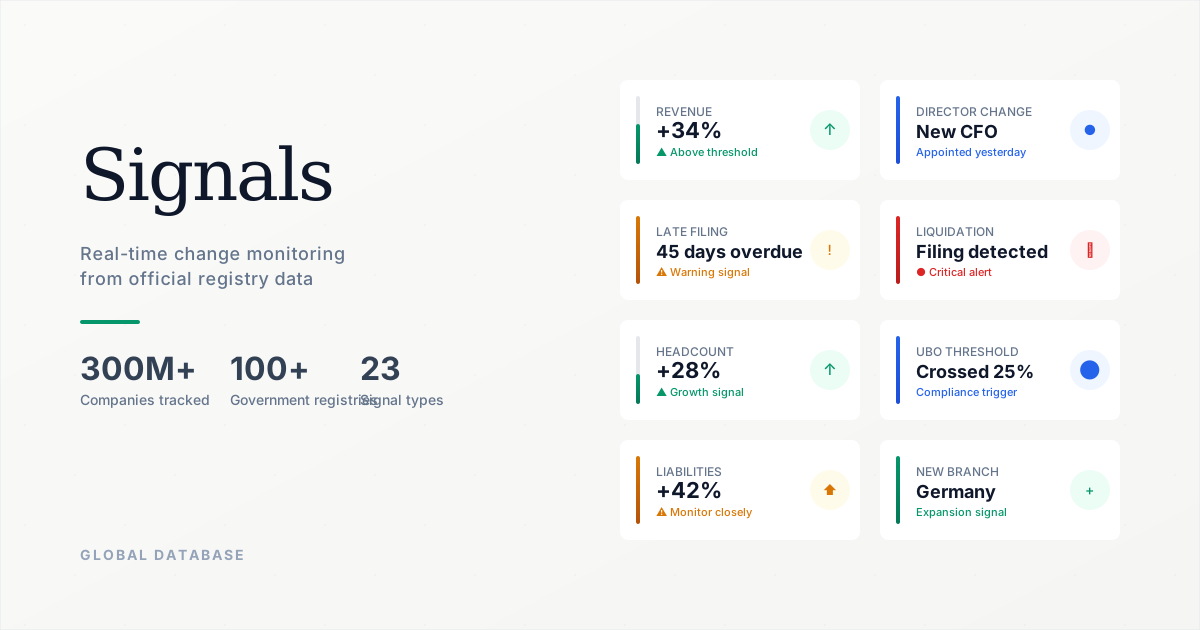
A company you're monitoring just changed CFOs.
A prospect you've been chasing just posted record revenue.
A client you extended credit to just filed for liquidation.
Did you know?
Probably not. Because you're still relying on data that updates quarterly. Or annually. Or whenever someone remembers to check.
Meanwhile, government registries update daily. The information is there. Filed. Timestamped. Public record.
You just weren't watching.
Today, we're changing that.
What is Signals?
Signals is real-time change monitoring for company data. We track over 300 million companies across 100+ official government registries worldwide. When something changes, you know about it. Not next month. Not next quarter. Now.
Here's what makes it different.
First, the data comes directly from official sources. Companies House. SEC filings. Handelsregister. Registre du Commerce. The same registries that lawyers, auditors, and regulators use. Not aggregated. Not scraped. Not secondhand. First-party data from authoritative sources.
Second, you control what triggers an alert. Generic notifications are noise. You need precision. With Signals, you define the thresholds. Revenue up 25%? Alert. Director resigned? Alert. Liabilities exceed £500K? Alert. Your rules. Your parameters. Your business logic.
Third, it works continuously. No manual checks. No periodic reviews. The system watches your portfolio around the clock. When a relevant change hits the registry, you're notified.
The result: you act on information while it's still actionable. Before your competitors. Before the situation escalates. Before the opportunity passes.
The two pillars: source of truth + materiality
Pillar 1: Official registry data
Signals is grounded in statutory updates: filings, status changes, governance updates, ownership disclosures (where available), and corporate linkage information.
Pillar 2: Materiality rules
You define what matters. That means:
thresholds (e.g., revenue ±X%, liabilities +Z%)
conditions (e.g., UBO crosses 25%, accounts overdue)
combinations (e.g., liabilities up + overdraft appears)
time windows (e.g., within 90 days)
severity tiers (critical vs informational)
This is the difference between “monitoring” and “decision support.”
What You Can Track
Signals monitors four categories of company changes. Each serves different teams and use cases.
Growth and Expansion Signals
These indicate momentum. Companies showing these patterns are often in buying mode.
Revenue increase: Year-over-year growth in filed accounts
Headcount growth: Employee numbers rising, signaling expansion
EBITDA improvement: Operational profitability increasing
Net profit growth: Bottom-line improvement
New branch opened: Geographic or operational expansion
New annual accounts filed: Fresh financial data available
Sales teams use these to time outreach. A company posting strong results and adding headcount is allocating budget. That's the moment to be in front of them.
Financial Health and Credit Risk Signals
These help assess stability. Essential for anyone with financial exposure.
Revenue decline: Shrinking top line in filed accounts
Net profit decline: Profitability dropping
Total liabilities increase: Debt levels rising
Total assets decrease: Asset base shrinking
Bank overdraft appears: Liquidity constraints showing in filings
EBITDA decline: Operational profitability falling
Credit teams use these to manage risk proactively. Spot warning signs when accounts are filed, not when payments are missed.
Ownership and Control Signals
These track who controls a company. Critical for compliance and often valuable for sales.
Director change: Appointments or resignations at leadership level
Shareholder change: Ownership stakes transferred
UBO threshold crossed: Beneficial ownership crosses regulatory thresholds
Ownership concentration change: Control becoming more or less concentrated
New shareholder type: PE, VC, or institutional investor entering
Corporate linkage changes: Parent-subsidiary relationships shifting
Jurisdiction shift in group: Corporate structure moving across borders
Compliance teams use these to maintain accurate KYB records. Ownership changes can trigger due diligence requirements. Without real-time monitoring, you're non-compliant and don't know it.
Risk and Warning Signals
These indicate distress. They require immediate attention.
Status change: Active to dormant, dissolved, or struck off
New liquidation or bankruptcy filing: Formal insolvency proceedings initiated
CCJ filed: County Court Judgment registered, indicating unpaid debts
Late filing: Accounts overdue, often an early warning sign
Branch closed: Subsidiary or branch shuttered
Late filing deserves special attention. Companies that can't file accounts on time are often struggling with more than paperwork. It's one of the most reliable early indicators of trouble.
Administrative and Identity Signals
These track identifiers and administrative details. Less dramatic but essential for data quality.
Registered address change: Company relocated
Registration number, VAT, or tax ID changed: Official identifiers updated
Data ops teams use these to keep systems current. An outdated address seems minor until invoices bounce or site visits go wrong.
Complete Trigger Reference
The table below shows all available triggers, organized by category.
Trigger | What It Detects | Best For |
|---|---|---|
Growth & Expansion | ||
Revenue increase | YoY revenue growth above threshold | Sales |
Headcount growth | Employee numbers increasing | Sales |
EBITDA improvement | Operational profitability rising | Sales, Credit |
Net profit growth | Bottom-line profitability increasing | Sales, Credit |
New branch opened | New subsidiary or branch registered | Sales, Compliance |
New accounts filed | Fresh financial data available | All teams |
Financial Health & Credit Risk | ||
Revenue decline | YoY revenue drop below threshold | Credit |
Net profit decline | Profitability dropping or turning negative | Credit |
Total liabilities increase | Debt levels rising above threshold | Credit |
Total assets decrease | Asset base shrinking | Credit |
Bank overdraft appears | Overdraft facility reported in filings | Credit |
EBITDA decline | Operational profitability falling | Credit |
Ownership & Control | ||
Director change | Director appointed or resigned | Sales, Compliance |
Shareholder change | Ownership stakes transferred | Compliance |
UBO threshold crossed | Beneficial ownership crosses 10%, 25%, 50% | Compliance |
Ownership concentration | Control becoming more/less concentrated | Compliance |
New shareholder type | PE, VC, or institutional investor entering | Sales, Compliance |
Corporate linkage change | Parent-subsidiary relationship changed | Compliance |
Jurisdiction shift | Corporate structure moved across borders | Compliance |
Risk & Warning | ||
Status change | Active to dormant, dissolved, struck off | Credit, Compliance |
Liquidation/bankruptcy | Insolvency proceedings initiated | Credit, Legal |
CCJ filed | County Court Judgment registered | Credit |
Late filing | Accounts overdue at registry | Credit |
Branch closed | Subsidiary or branch shuttered | Credit, Compliance |
Administrative & Identity | ||
Address change | Registered address updated | Data Ops |
VAT/Tax ID change | Official identifiers added or changed | Data Ops, Finance |
How to configure “material change” (to avoid noise)
Generic alerts are noise. Custom triggers are intelligence.
Below are ready-to-use configurations for Sales, Compliance, and Credit Risk teams. Copy these directly or adjust thresholds to match your business.
Sales & Business Development
Goal: Find companies ready to buy. Time outreach to budget cycles and leadership changes.
Goal | Trigger | Condition | Threshold |
|---|---|---|---|
Find fast-growing companies | Revenue | Increases by | >25% YoY |
Spot hiring companies | Headcount | Increases by | >20% |
Find profitable targets | Net profit | Increases by | >30% YoY |
Catch new decision-makers | Director change | New appointment | CEO, CFO, CTO roles |
Spot expansion | New branch | Opened | Any new subsidiary |
Find PE-backed targets | Shareholder type | New entry | PE or VC investor |
Refresh prospect data | Accounts filed | New filing | Any annual accounts |
Compliance & KYB
Goal: Maintain accurate records. Catch ownership and control changes that trigger due diligence.
Goal | Trigger | Condition | Threshold |
|---|---|---|---|
Track leadership changes | Director change | Any change | Appointment or resignation |
Monitor ownership changes | Shareholder change | Any transfer | Any stake change |
Catch UBO threshold | UBO threshold | Crosses | 10%, 25%, or 50% |
Detect control shifts | Ownership concentration | Changes | Any concentration change |
Track group structure | Corporate linkage | Changes | Parent or subsidiary change |
Flag jurisdiction shifts | Jurisdiction shift | Any move | Cross-border structure change |
Monitor company status | Status change | Changes to | Dormant, dissolved, struck off |
Keep addresses current | Address change | Any change | Registered address update |
Credit Risk & Lending
Goal: Spot deterioration early. Catch warning signs before defaults.
Goal | Trigger | Condition | Threshold |
|---|---|---|---|
Flag revenue decline | Revenue | Decreases by | >15% YoY |
Catch profit deterioration | Net profit | Turns negative | Loss reported |
Monitor debt levels | Total liabilities | Increases by | >25% or exceeds £1M |
Track asset erosion | Total assets | Decreases by | >20% YoY |
Spot liquidity issues | Bank overdraft | Appears | Any overdraft reported |
Flag legal action | CCJ | Filed | Any CCJ registered |
Early warning: late filing | Late filing | Overdue | Accounts >30 days late |
Critical: insolvency | Liquidation | Filed | Any insolvency event |
Monitor contraction | Branch closed | Closed | Any subsidiary closure |
Track headcount drops | Headcount | Decreases by | >25% |
Use Cases
Sales and Business Development
Sales teams use Signals to time outreach and prioritize accounts.
When a company posts strong financials and starts hiring, they're in growth mode. Budgets are being set. Initiatives are being funded. Vendors are being evaluated. That's when you want to be in front of decision-makers.
When a new executive joins, priorities shift. The new CFO may renegotiate vendor contracts. The new CTO may evaluate new platforms. Being first to reach new decision-makers creates advantage.
Key triggers: revenue growth, headcount increases, C-level appointments, new branches, fresh annual accounts.
Compliance and KYB
Compliance teams use Signals to maintain accurate, current records.
Regulations require knowing who you're doing business with. That knowledge has a shelf life. Ownership changes. Directors change. Corporate structures change. Without real-time monitoring, your records decay.
A shareholder change might trigger enhanced due diligence. A UBO threshold crossing might create reporting obligations. A jurisdiction shift might affect regulatory status. You need to know when these happen, not discover them during your next periodic review.
Key triggers: director changes, shareholder changes, UBO threshold crossings, ownership concentration, corporate linkage changes, jurisdiction shifts.
Credit Risk and Lending
Credit teams use Signals to manage portfolio risk proactively.
When a borrower's financials deteriorate, you want to know immediately. Not at the next annual review. Not when they miss a payment. When the filed accounts first show decline.
When legal actions appear—CCJs, charges, late filings—these are indicators of distress. Companies don't get CCJs because they're flush with cash. These signals often precede more serious problems.
Key triggers: revenue decline, net profit decline, liability increases, asset decreases, overdrafts, CCJs, late filings, status changes, liquidation filings.
Why Official Registry Data
The source matters.
Official registry data is filed under legal obligation. Directors face personal liability for false information. Companies face penalties for non-compliance. There are real consequences for inaccuracy. This creates strong incentives for correctness.
Official registry data is timestamped and auditable. You can trace exactly when information was filed and by whom. There's a chain of custody.
Official registry data is comprehensive. Financial statements. Director appointments. Shareholder structures. Charges. Legal actions. It's the full official record, not a curated subset.
Compare this to alternatives. Self-reported information on company websites has no verification. Social media is selective and speculative. Third-party databases introduce lag and potential errors with every step in the chain.
When you're making credit decisions, compliance assessments, or sales investments, you need data you can trust. Official registry data is that foundation.
Global Coverage
Global Database monitors over 100 official government registries worldwide. Direct integration with local authoritative sources in each jurisdiction.
This matters because requirements vary by country. UK filings differ from German filings differ from US filings. A useful global solution needs to understand these variations and normalize them into a consistent format.
Our coverage spans 300+ million company profiles. Publicly traded multinationals. Privately held SMEs. Established Western markets. Emerging economies.
Your supply chain doesn't stop at borders. Your customer base doesn't stop at borders. Your risk exposure doesn't stop at borders. Your monitoring shouldn't either.
Getting Started
Implementation is straightforward.
Define your monitoring universe. Which companies do you want to track? Customers, prospects, suppliers, or any combination. Upload lists or integrate with existing systems.
Configure your triggers. What changes matter? What thresholds are meaningful? Use pre-built templates or create custom configurations.
Connect your workflows. Email, webhook, API, or direct CRM integration. Signals fits into your existing processes.
From there, the system works continuously. Registry updates flow through. Changes are detected. Triggers are evaluated. Alerts are delivered.
The Bottom Line
Every day, government registries publish thousands of updates. Director changes. Financial filings. Ownership transfers. Liquidations. Some of those updates are about companies you care about. Companies you sell to. Companies you lend to. Companies you're required to monitor. Right now, you're not seeing them. Signals changes that. Request a demo to learm more.
Frequently Asked Questions About Real-Time Company Monitoring
What is real-time company monitoring?
Real-time company monitoring is a system that tracks changes to business information as they happen, rather than through periodic updates. Signals monitors over 300 million companies across 100+ official government registries worldwide, alerting you when relevant changes occur—such as director appointments, financial filings, ownership transfers, or liquidation events. This allows sales, compliance, and credit teams to act on fresh data instead of information that's months old.What types of company changes can I track with Signals?
Signals tracks 23 types of company changes across five categories: growth signals (revenue increase, headcount growth, new branches), financial health signals (profit decline, liability increases, bank overdrafts), ownership signals (director changes, shareholder transfers, UBO threshold crossings), risk signals (liquidation filings, CCJs, late filings), and administrative updates (address changes, VAT number updates). You can set custom thresholds for any trigger.Where does Signals get its company data?
Signals sources data directly from official government registries—the same authoritative sources used by lawyers, auditors, and regulators. This includes Companies House (UK), SEC filings (US), Handelsregister (Germany), Registre du Commerce (France), and 100+ other registries worldwide. This first-party registry data is filed under legal obligation, timestamped, and auditable.How is real-time registry monitoring different from traditional company databases?
Traditional company databases update periodically—monthly, quarterly, or annually. By the time data reaches your dashboard, it can be weeks or months old. Signals monitors government registries continuously and delivers alerts as changes are published. This means you can act on a director change or financial filing within days of it happening, not months later.How do custom triggers work in Signals?
Custom triggers let you define exactly what changes matter to your business. Instead of receiving generic alerts for every update, you set specific thresholds—for example, "alert me when revenue increases by more than 25%" or "notify me when a C-level executive changes at companies with revenue above £10M." This eliminates noise and ensures every alert is relevant to your workflow.Who uses company change monitoring software?
Three primary teams use Signals. Sales and business development teams use it to time outreach around growth signals and leadership changes. Compliance and KYB teams use it to maintain accurate records and catch ownership changes that trigger due diligence requirements. Credit risk and lending teams use it to monitor portfolio health and spot early warning signs like late filings, CCJs, or deteriorating financials.What is a UBO threshold alert?
A UBO (Ultimate Beneficial Owner) threshold alert notifies you when beneficial ownership of a company crosses regulatory thresholds—typically 10%, 25%, or 50%. These crossings often trigger compliance obligations such as enhanced due diligence or regulatory reporting. Signals automatically detects when UBO percentages change and alerts your compliance team in real time.Can Signals help with KYB (Know Your Business) compliance?
Yes. Signals is designed to support ongoing KYB monitoring by tracking the changes that affect your compliance obligations—director appointments and resignations, shareholder transfers, UBO threshold crossings, corporate structure changes, jurisdiction shifts, and company status changes. Real-time alerts ensure your records stay current between periodic reviews, reducing compliance gaps.What are early warning signals for company financial distress?
Key early warning signals include: late filing of accounts (often the first indicator of trouble), CCJs (County Court Judgments) registered against the company, bank overdrafts appearing in filings, declining revenue or net profit, increasing liabilities, shrinking assets, and EBITDA deterioration. Signals can alert you to any of these changes based on your custom thresholds.How do I get started with Signals?
Getting started takes three steps. First, define your monitoring universe—upload a list of companies you want to track (customers, prospects, suppliers) or integrate with your existing systems. Second, configure your triggers—choose which changes matter and set your thresholds using pre-built templates or custom configurations. Third, connect your workflows—receive alerts via email, webhook, API, or direct CRM integration. The system then monitors continuously and delivers alerts as changes occur.