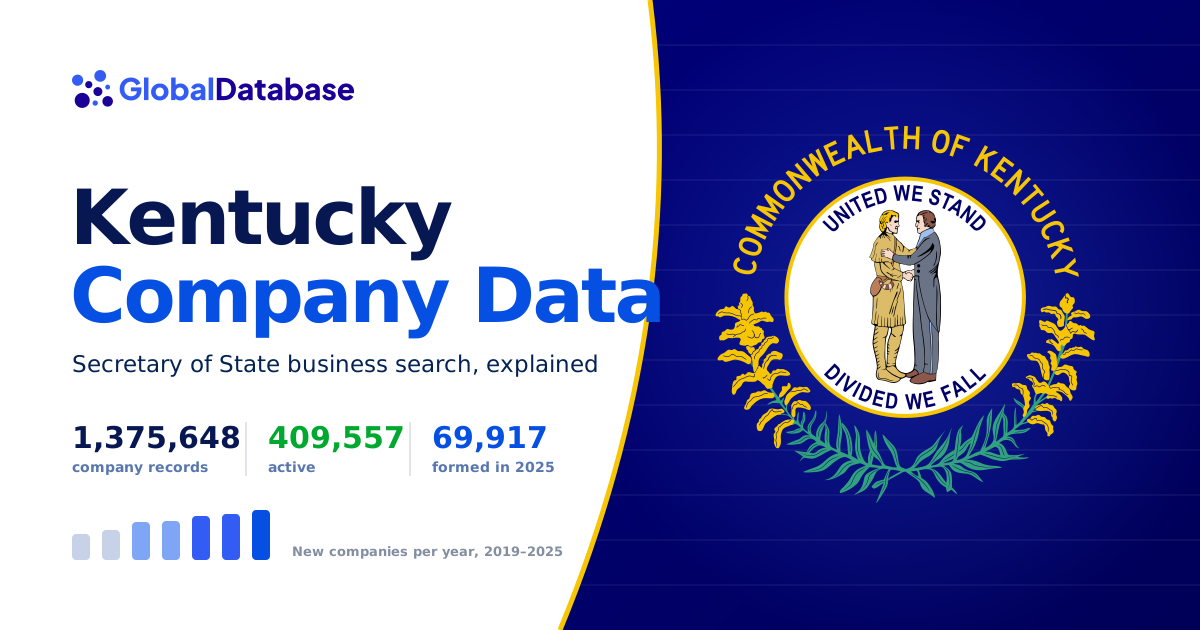
Kentucky runs one of the stricter business registers in the United States: every entity files an annual report by 30 June, and those that do not are dissolved the same year. Global Database holds 1,375,648 Kentucky company records, of which 409,557 are active, and a record 69,917 new companies were formed in 2025. This guide explains how the Kentucky Secretary of State business search (also called the Kentucky business entity search or KY SOS business search) works, what the numbers mean, what the register does and does not publish, and how to get Kentucky company data at scale.
- 1,375,648 Kentucky company records in Global Database: 409,557 active (29.8%) and 956,596 inactive (69.5%).
- 69,917 companies were incorporated in 2025, up 9.4% on 2024 and 90% on 2019. Another 61,580 were formed in 2026 up to 16 November.
- The official register is the Kentucky Secretary of State Business Entity Search: free, no login, searchable by name, organization number, officer or registered agent.
- Every entity files a $15 annual report by 30 June. Non-filers are administratively dissolved, or revoked if out of state, in the autumn of the same year.
- An LLC costs $40 to form; a certificate of existence (good standing) costs $10.
- The register holds no ownership or financial data. Officers are listed and refreshed once a year.
- Bulk data from the state costs commercial users $2,000 a month; there is no public API.
How many companies are registered in Kentucky?
The Kentucky Secretary of State (SOS) describes itself as overseeing nearly 370,000 entities that have filed to do business in the Commonwealth. That is a round figure for entities currently on the books. It leaves out the much larger archive of companies that were dissolved, revoked, merged or withdrawn, all of which stay searchable in the Kentucky business registry.
Counting every record gives the full picture. As of 16 November 2026, Global Database holds 1,375,648 company records with a Kentucky address, sourced from the Secretary of State and enriched from other sources.
The active count in Global Database (409,557) sits a little above the Secretary of State's "nearly 370,000". The two are counted in different ways and at different dates, but they point to the same conclusion: roughly seven in ten Kentucky records belong to companies that no longer exist.
New business registrations in Kentucky, year over year
Company formation in Kentucky has almost doubled in six years, from 36,770 in 2019 to 69,917 in 2025 (+90%). Growth came in two steps: +15.2% in 2020 and +27.6% in 2021, then steadier gains of 2% to 12% a year. 2025 was the busiest year on record, and 2026 is on track to match it: 61,580 companies were incorporated between 1 January and 16 November, a pace of roughly 70,000 for the full year.
Global Database: Kentucky companies by incorporation year. *2026 runs to 16 November.
Federal data shows the same curve from a different angle. The Census Bureau counted 64,042 business applications (EIN filings) from Kentucky in 2025, up 18.3% on 2024 and 94.6% above 2019. The first five months of 2026 brought another 33,481 applications, 35.3% more than a year earlier. About a quarter of them (7,997) were "high-propensity" applications, the kind most likely to become employers.
The long view comes from the Secretary of State's own annual filing statistics, which run from 1998 to 2018. New business filings rose from 18,192 in 1998 to 40,915 in 2018, with only five down years in two decades (2001, 2005, 2006, 2008 and 2009). Today's level is far above that 2018 peak. Select "SOS 1998–2018" in the chart to see the series.
Active vs inactive companies in Kentucky
Of the 1,375,648 Kentucky records, 409,557 are active (29.8%) and 956,596 are inactive (69.5%). The remaining 9,495 carry an intermediate status that is neither.
A Kentucky record carries two fields that have to be read together: status (active or inactive) and standing (good or bad). The combination tells you how a company ended.
| Status and standing | What it means |
|---|---|
| Active, good standing | Registered and up to date with its annual report. Eligible for a certificate of existence. |
| Bad standing | The entity did not file its annual report by 30 June, or its registered agent resigned and was not replaced. The state will dissolve it unless this is put right. |
| Inactive, bad standing | Administratively dissolved by the state (a Kentucky entity) or had its certificate of authority revoked (an out-of-state entity), most often for a missed annual report. |
| Inactive, good standing | Closed properly: it filed articles of dissolution, merged into another entity or changed its name. |
The annual cycle that drives the numbers
Every LLC, corporation, nonprofit and limited partnership registered in Kentucky, domestic or out of state, files a Kentucky annual report each year from the year after it was formed. The same calendar applies to all of them.
The dissolution date moves a little each year. Certificates on the public record show non-filers being dissolved on 3 November in 2009, 28 September in 2013, 8 October in 2020 and 12 October in 2024.
The Secretary of State does not publish a yearly count of dissolutions, but figures released by the office over the years give the scale. In 2017, 189,132 annual reports were filed by the deadline; in 2018 the year's total reached 219,526; and in 2019, 203,972 entities filed on time, more than 160,000 of them online. In one filing season under Secretary Grimes (2012 to 2020), roughly 92% of entities filed and about 16,900 were dissolved or revoked for not filing, which the office described as the lowest number of her term.
A dissolved entity can apply for reinstatement at any time. It pays the missed report fees and a $100 penalty, and needs good-standing letters from the Kentucky Department of Revenue and, for profit companies, the Division of Unemployment Insurance. For anyone monitoring Kentucky counterparties, the practical lesson is timing: status changes cluster in July (bad standing) and in the autumn (dissolution), so a check made in May can be out of date by October.
How old are Kentucky's companies, and how many survive?
Kentucky's active companies are young. Of the 373,242 active companies with a formation date, 49% were formed in 2021 or later and a quarter are less than two years old. At the other end, 68,208 have been on the register for more than 20 years, and 17,065 of those were formed in 1985 or earlier.
Covers the 373,242 active Kentucky companies with a formation date on record.
The second view shows what the annual report rule does to each year's intake. In Global Database's data, 93% of records created in 2026 are active, against 51% of those created in 2025. The 2025 intake faced its first annual report deadline on 30 June 2026 and its first dissolution round this autumn. After that first filter the decline slows: 41% of the 2024 intake is still active, 38% of 2023 and about a third of 2020 and 2021. Inactive here covers every way a record can end, including voluntary dissolution, merger and withdrawal, so not all of the drop is the state striking companies off. The pattern is still clear: in Kentucky, a company's first annual report is the point at which most failures show up.
Legal forms and out-of-state entities
The Kentucky register covers LLCs, profit and nonprofit corporations, limited partnerships, LLPs and out-of-state ("foreign") entities authorised to do business in the state. LLCs dominate new filings. The Secretary of State's statistics show Kentucky LLC formations rising from 3,381 in 1998 to 25,522 in 2018, when they made up 62% of all new filings. Out-of-state LLCs registering in Kentucky added another 3,404 that year, so roughly one new LLC in eight (12%) was an out-of-state entity.
The state does not publish how today's records split by legal form or by home state, and Global Database's legal-form field does not separate LLCs from private corporations. What it does show:
| Legal form in Global Database | Kentucky records | Share |
|---|---|---|
| Private companies (LLCs and private corporations) | 784,528 | 57.0% |
| Partnerships (general, limited and LLP) | 13,716 | 1.0% |
| Public companies | 801 | 0.1% |
| No legal form on record | 576,603 | 41.9% |
Out-of-state groups matter more than their numbers suggest. Among the largest active Kentucky records by revenue are Kentucky registrations of groups based elsewhere, such as Casey's General Stores, Aldi, SpartanNash and Whataburger. The reverse also holds: Humana and Yum! Brands are headquartered in Louisville, yet both appear in other states' registers as well. A Kentucky record is often one piece of a company that has to be read across several states.
When does an out-of-state company have to register in Kentucky?
Kentucky law says a foreign entity may not transact business in the Commonwealth until it obtains a certificate of authority from the Secretary of State (KRS 14A.9-010). The statute does not define "transacting business". It lists activities that do not count on their own, and says the list is not exhaustive:
- maintaining, defending or settling a legal proceeding, and holding board or owner meetings;
- maintaining bank accounts, or offices for the transfer and registration of the entity's own securities;
- selling through independent contractors, or taking orders that have to be accepted outside Kentucky;
- creating or acquiring debts, mortgages and security interests, and collecting or enforcing them;
- owning real or personal property;
- an isolated transaction completed within 30 days that is not one of a series;
- business in interstate commerce.
Two points catch companies out. The exemptions decide registration only: the statute says they do not settle whether the entity owes Kentucky tax or can be served with process. And any foreign entity seeking a state contract needs a certificate of authority, whatever else it does in Kentucky.
| If it registers | If it should have and did not (KRS 14A.9-020) |
|---|---|
| $90 certificate of authority, then the same $15 annual report by 30 June as a Kentucky entity. Miss the report and the certificate is revoked. | It cannot bring a case in a Kentucky court until it registers, and it owes a civil penalty of $2 for each day it did business without a certificate. Its contracts remain valid and it can still defend a case. |
A summary of the statute for orientation, not legal advice. Whether a particular activity amounts to transacting business depends on the facts.
Kentucky companies by industry and size
Among Kentucky companies with an industry classification in Global Database, construction leads with 26,553 companies, followed by other services (23,649) and professional services (23,339). Manufacturing ranks fourth with 20,573, which reflects the vehicle and parts plants around Georgetown, Louisville and Bowling Green, bourbon distilling and the aluminium and appliance industries.
Sector counts cover companies with an industry classification (ISIC sections); many registry-only records carry none.
By size, Kentucky is a market of small firms. Of the 566,719 Kentucky companies with a headcount figure, 87% employ fewer than 10 people. Another 53,739 have 10 to 49 staff, 16,779 have 50 to 249 and 2,640 employ 250 or more. Employment tells a different story from company counts: health care and social assistance supported 283,710 private-sector jobs across 24,349 establishments in 2024, and accommodation and food services another 179,109.
Kentucky's largest companies
A handful of large employers sit on top of the small-firm base. These are seven well-known companies headquartered in Kentucky, with the headcount held for each in Global Database.
| Company | City | Business | Headcount | Ticker |
|---|---|---|---|---|
| Humana Inc. | Louisville | Health insurance | 65,680 | HUM |
| Texas Roadhouse Inc | Louisville | Restaurants | 45,700 | — |
| Valvoline Inc. | Lexington | Vehicle maintenance | 10,600 | VVV |
| UofL Health, Inc. | Louisville | Health system | 10,000 | Not listed |
| Brown-Forman Corporation | Louisville | Spirits and wine | 5,000 | BF-B |
| Stock Yards Bancorp, Inc. | Louisville | Banking | 1,140 | SYBT |
| Republic Bancorp, Inc. | Louisville | Banking | 978 | RBCAA |
A selection, not a ranking of every Kentucky employer. Headcount is the group figure on each company's Global Database record; a dash means no ticker is held on that record.
Where Kentucky's businesses are based
Louisville accounts for 116,015 company records and Lexington for 49,024, together about 12% of the Kentucky dataset. Bowling Green (12,599), Richmond (8,685), Owensboro (8,145) and Paducah (7,519) follow, with the Northern Kentucky cities of Florence and Covington, across the river from Cincinnati, close behind. Switch the chart to see which counties are forming businesses fastest for their size.
Global Database records by city of the company address, all statuses. Records with no city are excluded.
The start-up rate view shows that size is not the whole story. Jefferson County (Louisville) filed the most business applications in 2025, 15,979, but Madison County (Richmond) had the highest rate among the larger counties at 311.7 applications per 10,000 residents, ahead of Fayette (Lexington) at 213.2 and Jefferson at 200.9.
Kentucky vs neighbouring states
Kentucky borders seven states. Per resident, it sits in the lower half of that group, with about 14.0 business applications per 1,000 people in 2025 against 16.2 in Missouri and 15.7 in Virginia. Its growth is another matter. Applications rose 18.3% in 2025, second only to Missouri (+19.2%), and by 35.3% in the first five months of 2026, the fastest rate of the eight states.
2025 applications divided by 2024 Census population estimates. Applications count requests for an EIN, not state registrations.
Registry counts vs real businesses
A register counts legal entities; the economy counts businesses. The two overlap less than most people expect. The SBA counts 393,860 small businesses in Kentucky, 99.3% of all firms, but 328,057 of them have no employees, and many of those are sole proprietors who never appear in the Secretary of State's records. Only 65,803 small businesses have staff. Federal data shows 13,733 establishments opening and 11,786 closing between March 2023 and March 2024, a net gain of 1,947, in a period when more than 60,000 new entities were being registered each year.
SBA small-business counts (2022 data) include firms without employees. Establishment openings and closings run from March 2023 to March 2024.
The gap is made up of holding LLCs, real estate vehicles, single-purpose entities, nonprofits and Kentucky registrations of out-of-state groups. Anyone building a prospect list, a risk model or a market sizing from raw Kentucky registry data needs to filter for them. The economy that the trading companies serve is export-heavy: 4,637 Kentucky firms exported $38.1 billion of goods in 2023, and 79% of those exporters were small businesses.
Kentucky's 1.38 million company records, ready to load
The state's own bulk service costs commercial users $2,000 a month for business records and arrives as raw tab-delimited files in Kentucky's format. Global Database delivers the same registry data cleaned, enriched and in one schema with every other US state, Washington DC, Puerto Rico and 200+ countries.
- Full-file and delta bulk feeds for data teams and master data management
- REST API for real-time lookups by name, organization number or website
- Monitoring alerts for the July bad-standing wave and autumn dissolutions, plus agent and officer changes
- Officers, industry, headcount and group structure linked to each record
Kentucky SOS business search: how to look up a company
The official Kentucky Secretary of State business search is free and needs no account. One tool covers every entity type, so it doubles as the Kentucky LLC search, the Kentucky corporation search and the general Kentucky business lookup. Records go online as soon as they are added to the state's database.
- Open the Business Entity Search on the Secretary of State's site (sosbes.sos.ky.gov). Kentucky Business One Stop (onestop.ky.gov) is the state's separate portal for starting and managing a business.
- Search by business name or by organization number, the ID Kentucky assigns to each entity. Partial names work; leave out "LLC" or "Inc." to widen the results.
- Untick "show active entities only" if you also want dissolved, revoked and withdrawn entities.
- Use the advanced search to filter by industry, county of the principal office or business size.
- Open a record to see status and standing, entity type, formation date, state of origin, principal office, registered agent, current officers and assumed names.
- Open the filing history to view scanned documents free of charge. Images are available for filings made since 15 September 2004.
Three further lookups set Kentucky apart from many states: you can search by current officer, by founding officer or initial director, and by registered agent, which makes it possible to find every entity linked to one person or one agent. Liens are held separately in the Kentucky UCC search, also run by the Secretary of State.
Filing fees that shape the register
| Filing | Fee | Notes |
|---|---|---|
| LLC articles of organization | $40 | Among the lowest LLC fees in the US |
| Profit corporation | $40 + tax | Organization tax on authorised shares, $10 minimum |
| Nonprofit corporation | $8 | Same annual report duty as profit entities |
| Out-of-state corporation or LLC | $90 | Certificate of authority |
| Annual report | $15 | 1 January to 30 June, every entity |
| Reinstatement penalty | $100 | Plus missed report fees and state clearance letters |
| Assumed name (DBA) | $20 | Valid five years, then must be renewed |
| Name reservation | $15 | Holds a name for 120 days |
| Certificate of existence | $10 | Kentucky's certificate of good standing |
Fees as published by the Secretary of State at the time of writing. Separately from these filing fees, the Department of Revenue charges limited-liability entities the Limited Liability Entity Tax, with a $175 annual minimum.
How to verify a Kentucky company in seven steps
A search result is not a verification. This is the sequence compliance, credit and procurement teams can follow to check a Kentucky counterparty using public records only.
- Find the right record. Search the exact legal name or, better, the organization number, with inactive entities included. Brand names often differ from the legal name.
- Read status and standing together. Active and in good standing is the only combination that qualifies for a certificate of existence. Bad standing means a dissolution is on its way unless the entity acts.
- Check where it was formed. The "state of origin" field shows whether this is a Kentucky entity or an out-of-state one authorised to do business here. For an out-of-state entity, check the home-state register too: a Kentucky record can stay active while the parent record has changed.
- Match the people and the address. Compare the current officers and principal office with the people signing your contract and the address on the invoice. Remember that officers are as of the last annual report.
- Confirm the trading name. If the company trades under another name, it should appear as an assumed name on the same record. An assumed name that belongs to a different entity is a warning sign.
- Open the latest annual report. The scanned filing shows the year it covers, who signed it and when. A report from the current year is the best evidence the company is being maintained.
- Search for liens, then get proof. Run the legal name through the UCC index (see below) and order a $10 certificate of existence if a bank or counterparty needs an official document.
Two timing rules apply. A check made before 30 June says nothing about whether the company will file this year, so repeat it in the autumn. And because the register holds no ownership data, steps 1 to 7 confirm that a company exists and is compliant, not who is behind it.
What Kentucky company data is available, and what is not
The Kentucky register is better than most on people and paperwork: officers are refreshed every year and filings are free to read. It holds nothing on ownership or finances. The right-hand column shows what Global Database adds on top.
| Data point | KY SOS register | Global Database |
|---|---|---|
| Legal name, organization number, entity type | Available | Included |
| Status and standing | Available | Normalised across states |
| Formation date, state of origin | Available | Included |
| Registered agent and principal office | Available | Included |
| Officers, directors, managers | Available | Sourced and tracked |
| Industry and size class | Self-reported | Industry codes, headcount |
| Shareholders and beneficial owners | Not available | Not on the register |
| Parent and subsidiary links | Not available | Group structure |
| Website, phone, LinkedIn | Not available | Included where known |
| Financial statements | Not available | Not filed in KY |
The Secretary of State is explicit on the two gaps: it does not record who owns an entity and it does not keep financial records. It also holds no federal tax ID (EIN), no tax status such as S corporation, no bylaws and no record of complaints or lawsuits. Federal reporting does not fill the ownership gap either. Under FinCEN's March 2025 interim final rule, companies formed in the United States no longer report beneficial ownership information.
Kentucky UCC search: checking a company for liens
Entity status tells you whether a company exists. The Uniform Commercial Code (UCC) index tells you whether a lender already has a claim on its assets. In Kentucky both are kept by the Secretary of State, whose UCC division is the state repository for financing statements filed under Revised Article 9. The Kentucky UCC search is free, available around the clock and updated as filings are made.
| Kentucky UCC | What to know |
|---|---|
| How to search | By debtor name (organization or individual) or by the file number of the initial financing statement. |
| What comes back | The initial financing statement and every later filing linked to it: amendments, assignments, continuations and terminations. |
| Cost | Online search is free. Certified search results cost $5 and copies $0.10 a page. |
| Filing fees | UCC-1 or UCC-3: $10 for up to two pages, $20 above that; $5 when filed online. |
| How long records stay | A financing statement stays in the active index until one year after it lapses. |
| What is not there | Liens on vehicles and other titled property, which are filed with county clerks. |
Three practical points. First, the online result is not certified, and only a full-name search can be certified, so use the exact legal name from the entity record. Second, the office enters names exactly as the filer wrote them and does not check a filing for correctness; a lien filed under a misspelt name may not appear, and the searcher has to judge whether a filing is still effective. Third, UCC records are free to view. In January 2025 the Secretary of State warned businesses about mailings from a "KY UCC Statement Service" asking $98 for a copy of a UCC-1 that anyone can open online.
For lenders, the useful signal is the combination: an entity that has just fallen into bad standing and has recent UCC filings against it deserves a closer look than either fact alone.
A Kentucky record, enriched
Here is what one Kentucky company looks like in Global Database: Valvoline Inc., the Lexington vehicle-maintenance group. The registry facts come from the Kentucky Secretary of State; the rest is matched from other sources, with the source labelled on every field.
- Status
- ActiveKentucky Secretary of State
- Jurisdiction
- KentuckyKentucky Secretary of State
- Registered address
- 100 Valvoline Way, Suite 100, Lexington 40509Kentucky Secretary of State
- Headcount
- 10,600 employeesCompany size data
- Website and LinkedIn
- valvoline.comContact enrichment
- Listing
- Exchange-listed, ticker VVVNYSE / Nasdaq data
The same lookup works for any Kentucky company, by name, organization number or website, through the platform, the API or an AI assistant connected to Global Database.
Where to get Kentucky business data
A Kentucky business entity search on the Secretary of State's site is the right tool for checking one company. For lists, analysis and ongoing checks, these are the options.
| Source | What you get | Cost | Best for |
|---|---|---|---|
| SOS Business Entity Search | Single records, officers, filing history, scanned documents | Free | Ad hoc checks |
| Certificate of existence | Official proof of good standing, with validation code | $10 | Bank and contract requirements |
| SOS Bulk Data Service: business records | All companies and officers monthly; new companies and changes daily and weekly; tab-delimited | $2,000 / month | Teams that can build their own pipeline |
| SOS Bulk Data Service: UCC | UCC filings, collateral, secured parties and debtors; daily images optional | $1,500 / month, images $300 | Lenders and lien monitoring |
| Census BFS and SBA profiles | Aggregate statistics only | Free | Trend and market research |
| Global Database | 1,375,648 Kentucky companies plus every US state and 200+ countries, via platform, API, bulk feed, MCP or AI connectors | Plans vary | KYB, onboarding, prospecting, risk, AI agents |
The state's bulk fees apply to commercial use and require a subscriber agreement through Kentucky.gov. Non-commercial users such as researchers pay no monthly fee.
Other Kentucky public records worth checking
The Secretary of State is one of several places where Kentucky business information sits. These are the sources that fill the gaps it leaves.
| Source | What it holds | Why it matters |
|---|---|---|
| County clerks (120 counties) | Assumed names of sole proprietors and general partnerships; deeds, mortgages and other recorded documents; liens on vehicles | The only public trace of businesses that never register with the state |
| SOS UCC index | Financing statements against companies and individuals | Shows existing secured lenders |
| SOS trademarks and service marks | Marks registered at state level | Links a brand to the entity that owns it |
| Kentucky Court of Justice (CourtNet) | State court case records; full public access is limited | Litigation, which the Secretary of State does not track |
| City and county occupational licence offices | Local occupational licences and fees | Kentucky has no single statewide business licence |
| State licensing boards | Licences for regulated trades and professions | Confirms a contractor, nurse or broker is licensed |
| Attorney General, consumer protection | Complaints about businesses | The Secretary of State keeps no complaint records |
| Department of Revenue and the IRS | State tax accounts, EIN and federal tax status | Not public; ask the company for evidence |
These sources are run by different offices, each with its own search. Matching a county assumed name, a court case and a state entity record to the same business is manual work, which is why teams that check Kentucky companies in volume prefer a single matched dataset.
Limitations of Kentucky registry data
- No official totals. The Secretary of State publishes no current count of active and inactive entities, no yearly dissolution figure and no split by legal form or home state. Its annual filing statistics stop in 2018.
- No ownership data. Officers and managers are listed; shareholders, members' stakes and beneficial owners are not.
- No financial data. Kentucky entities file no accounts, revenue or capital figures with the state.
- Officer data is a yearly snapshot. It is as current as the last annual report, so changes made in July may not appear until the following spring.
- Seasonal status swings. Standing and status changes cluster in July and the autumn, which catches out one-off checks.
- Sole proprietors are missing. They register assumed names with county clerks, and Kentucky has no statewide business licence, so a large share of real businesses never appears.
- Self-reported industry and size. The industry and business-size fields come from the filer, not from an independent classification.
- Bulk access is costly and raw. $2,000 a month buys Kentucky-format files that still need parsing, matching and joining to other states.
- Older documents are offline. Filings made before 15 September 2004 have to be requested from the office.
Who uses Kentucky company data, and how
Confirm status and standing together, check officers against the people you are dealing with, and flag entities that are one missed report from dissolution.
Monitor borrowers through the July and autumn status waves, and pair registry status with UCC filings before extending credit.
Filter the 19,419 Kentucky companies with 50+ staff by sector and city, instead of working through 409,557 active names.
Check the automotive, logistics and distilling suppliers clustered around Louisville, Georgetown and Bowling Green, and track changes in their officers.
Get company data for the entire United States by API, MCP or bulk feed
Kentucky is one register out of more than fifty, each with its own format, fees and rules. Global Database delivers official registry data for all 50 states, Washington DC and Puerto Rico in a single schema, so a company registered in Kentucky, formed in Delaware and operating in Ohio is one lookup.
Status, standing, officers, registered agents, industry, headcount and group structure, with the source registry on every record.
How Global Database adds to Kentucky registry data
The Secretary of State answers whether an entity exists and whether it filed this year. Global Database starts with that official record and adds the context Kentucky does not hold:
- Cross-state coverage. Kentucky entities sit next to their records in Delaware, Ohio, Tennessee and every other state, in one schema, so an out-of-state group can be followed back to where it was formed.
- Officers and group structure. Sourced officers and directors, and parent and subsidiary links where a group is on record.
- Firmographics. Industry codes, headcount bands, websites, phone numbers and LinkedIn pages that the register does not collect.
- Delivery that fits your stack. A REST API, full and delta bulk feeds, an MCP server, Claude and ChatGPT connectors and a Microsoft 365 Copilot app.
- Monitoring. Alerts when a Kentucky counterparty falls into bad standing, is dissolved or revoked, or changes its registered agent or officers.
- Global reach. The same schema covers 600M+ companies from 400+ official registries in 200+ countries.
Comparing registries across states? See our state-by-state Secretary of State guide and our guides to neighbouring Virginia, plus Delaware, Texas, New York and Michigan.
Frequently asked questions
How do I search for a business with the Kentucky Secretary of State?
Use the free Business Entity Search on the Kentucky Secretary of State website (sosbes.sos.ky.gov). Search by business name or organization number, untick "show active entities only" to include dissolved and revoked records, then open a record to see status, standing, formation date, principal office, registered agent, current officers and filed documents. No account is needed.
How many businesses are registered in Kentucky?
The Kentucky Secretary of State says it oversees nearly 370,000 entities that have filed to do business in the Commonwealth. Global Database holds 1,375,648 Kentucky company records across all statuses: 409,557 active and 956,596 inactive, as of November 2026.
How many new businesses were formed in Kentucky in 2025?
Global Database counts 69,917 Kentucky companies incorporated in 2025, 9.4% more than in 2024 and the highest annual total in its data. Census Bureau data shows 64,042 business applications in Kentucky in 2025, up 18.3%.
Is the Kentucky business entity search free?
Yes. Searching the Kentucky SOS business search, viewing entity records and opening scanned filings is free. A certificate of existence costs $10, certified copies cost $10 for the first five pages, and filings such as the $15 annual report carry their own fees.
What does inactive or bad standing mean in a Kentucky business search?
Kentucky shows a status (active or inactive) and a standing (good or bad). An inactive entity in bad standing was administratively dissolved, usually for missing its annual report, or had its authority revoked. An inactive entity in good standing closed properly, merged or changed its name.
When is the Kentucky annual report due, and what does it cost?
Every entity registered in Kentucky files an annual report between 1 January and 30 June each year, starting the year after formation. The fee is $15. Entities that miss the deadline fall into bad standing, receive a 60-day notice and are then administratively dissolved or, for out-of-state entities, revoked.
Can I find the owner of a Kentucky LLC?
Only partly. The Secretary of State does not record ownership. Annual reports list officers, directors, managers or members with addresses, but not shareholdings or beneficial owners, and US companies no longer report beneficial ownership to FinCEN.
Does the Kentucky Secretary of State offer bulk data or an API?
There is no public API. The Secretary of State runs a Bulk Data Service with daily, weekly and monthly tab-delimited files. Commercial subscribers pay $2,000 a month for business records, $1,500 for UCC filings and $300 for UCC images. Global Database supplies Kentucky companies by API, bulk feed and MCP in the same schema as every other US state.
How do I get a Kentucky certificate of good standing?
Kentucky calls it a certificate of existence (or certificate of authorization for out-of-state entities). It costs $10, can be ordered online from the Secretary of State and carries a validation code. It is only issued to entities in good standing.
Are sole proprietors and DBAs in the Kentucky business search?
Sole proprietors are not. They file assumed names with their county clerk, so they do not appear in the state register. Assumed names (DBAs) of LLCs, corporations and partnerships are filed with the Secretary of State, last five years and appear on the entity's record.