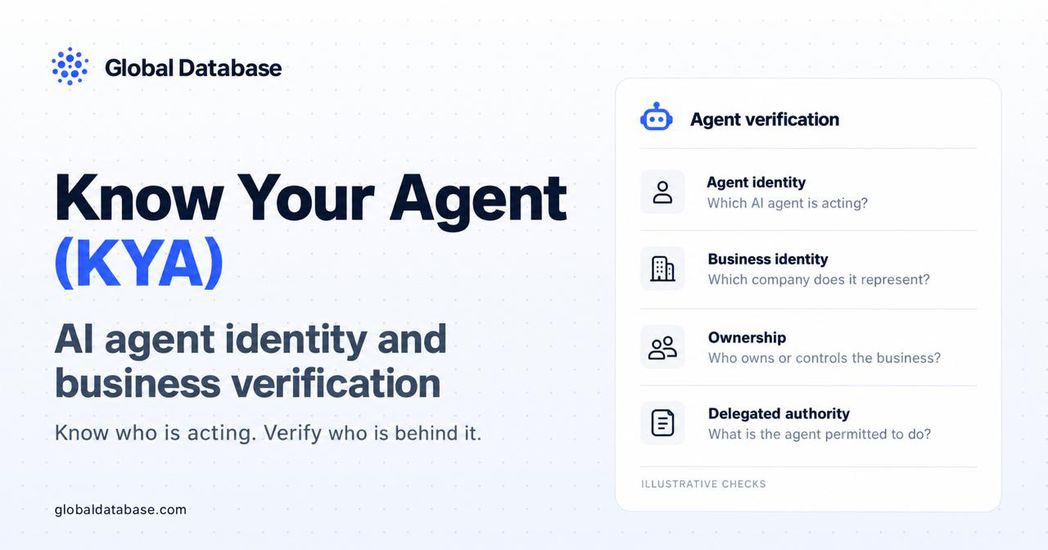
Know Your Agent (KYA) means verifying an AI agent’s identity, the person or business it represents, and its authority to perform a requested action. For enterprises, that connects technical access controls to evidence about the legal entity, its ownership and relevant risks.
An AI agent can present a valid credential even after the company it represents changes ownership. The software still authenticates. The business may now have a different controlling shareholder, financial position or risk profile.
Before accepting the agent’s next commercial commitment, the enterprise needs to establish whether the basis for approving that business still holds.
What is Know Your Agent (KYA)?
An agent might research suppliers, negotiate a purchase, access an account or initiate a payment. The required assurance should reflect the action. Reading a public catalogue creates different exposure from changing a supplier’s bank details.
KYA is already appearing in payment infrastructure. Mastercard Agent Pay describes registered agents, traceable transactions and verification of user intent. Visa describes a KYA process for assessing AI partners alongside its Trusted Agent Protocol.
Implementations differ. An enterprise evaluating a KYA service should ask which identities and relationships it verifies, what evidence supports the result, and which controls apply when an agent acts. A “verified agent” label is too broad to answer those questions by itself.
What is a Digital Agent Passport?
Trulioo describes a Digital Agent Passport as a signed credential containing verified agent signals. Its approach includes developer checks, a fingerprint for the approved build and a directory showing consent scope and current status. This is one implementation of KYA; the term should not be treated as a universal standard shared by every provider.
When assessing a passport, ask who issued it, which agent and build it identifies, and whether it identifies the represented customer or only the developer. Check the evidence behind each claim, permitted scope, expiry and revocation mechanism. Verify current status when accepting an action. A valid signature from a trusted issuer establishes the credential’s origin and integrity; it does not independently establish that every underlying claim remains current.
KYA vs KYC vs KYB vs KYP: What does each check verify?
These checks address different parts of a transaction. For this article, KYP means Know Your Payee.
| Check | Main subject | Question it helps answer |
|---|---|---|
| KYC — Know Your Customer | The individual | Who is this person? |
| KYB — Know Your Business | The legal entity and its ownership | Which business is involved, and who owns or controls it? |
| KYA — Know Your Agent | The agent and its delegated authority | Which agent is acting, for whom, and with what permission? |
| KYP — Know Your Payee | The payment recipient and destination | Does the account correspond to the intended payee, and what relevant risks need review? |
The scope of each service varies. For a corporate payment, business verification, agent authorisation and payee checks may all be necessary. A bank account name match should not be interpreted as a complete assessment of the recipient’s business.
Who is actually behind an AI agent?
“Agent owner” can mean several different things. Consider software developed by one company, hosted by another and used by a third to purchase equipment.
The developer maintains the software. The platform operator runs the service. The customer business is the principal on whose behalf the agent acts. Within that business, a person or approved organisational process grants its authority.
Those relationships should be recorded separately. Otherwise, a check on the platform provider can be mistaken for a check on the business placing the order.
Corporate ownership introduces another distinction. Shareholders and ultimate beneficial owners help establish who owns or controls a business. They may sit behind several holding companies. Their identity can matter for risk assessment, but they are not necessarily the people responsible for operating or authorising its agents.
Prove the authority of the person granting access
A verified human identity proves who a person is. It does not prove that they may bind a company or delegate a particular power. A director’s registry entry, corporate email address or platform administrator role alone may not establish the required mandate.
Link the grantor to the legal entity and validate their authority against the company’s approved delegation process. Depending on the action, evidence might include an approved role, signing-authority record or specific corporate mandate. Record the agent, permitted actions, limits, expiry and whether further delegation is allowed. If another agent receives delegated access, preserve that chain and enforce the original limits.
How to verify the company behind an AI agent
Start with a legal entity that can be identified consistently. A trading name, email domain or website can help with discovery, but registration number and jurisdiction provide a stronger basis for matching the correct business.
Establish legal identity and status
Check the registered name, registration number, jurisdiction, incorporation date, legal form and current status. Resolve discrepancies before treating two records as the same company. A familiar brand may contain subsidiaries with different ownership, financial exposure and contracting responsibilities.
Examine ownership and control
Review directors, shareholders and the ownership chain where records are available. Establish which entity is operating the agent and whether the proposed relationship involves its parent or another group company.
Where beneficial ownership cannot be fully resolved, keep that limitation visible. A missing record is not evidence that there is no beneficial owner.
Assess risk in relation to the action
The depth of assessment should follow the exposure. Extending trade credit may justify reviewing filed financials and credit information. Relevant sanctions screening may cover the company and connected people or entities. A possible name match needs resolution before it is treated as a confirmed finding.
Declining revenue, late filings or recent incorporation can justify further questions. Their significance depends on the business, jurisdiction and transaction. Financial weakness is a commercial concern; it does not establish fraud.
Keep the source attached to the finding
Record the source, the period or filing date, and when the information was retrieved. A financial statement retrieved today may describe a period that ended more than a year ago.
Official registry records provide an attributable basis for company verification, but access, available fields and filing practices differ. Registry information can also contain errors or lag events. Source transparency lets a reviewer assess those limitations rather than assume that every returned field is equally current or complete.
A public-record example: linking a UK company to a Swedish controller
The Companies House control record for Volvo Group UK Limited, number 02190944, identifies AB Volvo as an active corporate controller, incorporated in Sweden with registration number 556012-5790. It records share ownership and voting rights of 75% or more, plus the right to appoint or remove directors. The notification date is 6 April 2016; this record was accessed on 2 October 2026.
AB Volvo’s Q1 2025 announcement, published on 23 April 2025 and accessed on 2 October 2026, uses the same Swedish registration number. This corroborates the entity identifier from a separate, company-published source; it is not a direct check against Sweden’s registry.
The two records illustrate how identifiers can connect entities across jurisdictions. Preserve the filed ownership band: it does not establish an exact percentage. These records alone do not resolve the full ultimate ownership chain or authorise an agent. This is a public-record illustration, not a claim that Volvo uses this workflow.
Screening the business behind an agent: sanctions, PEPs and adverse information
An active company and a valid agent credential do not establish whether a proposed transaction is acceptable. Identify the represented business, relevant parent entities, beneficial owners, directors and counterparties, then define which checks apply to each under the relevant rules and risk policy.
Sanctions exposure can sit behind the company name
Screening the operating company alone can miss restrictions arising through ownership. Under OFAC’s 50 Percent Rule, entities owned directly or indirectly 50% or more in aggregate by blocked persons are considered blocked, even without their own listing. Two blocked shareholders holding 25% each can therefore bring an entity within that rule.
Apply the relevant sanctions regime: UK guidance also addresses control. Do not substitute a standard UBO disclosure threshold for this assessment. Resolve possible matches using identifiers and supporting evidence; a similar name alone is not a confirmed finding. Applicable restrictions may also concern geography, sectors or the transaction itself.
Political exposure requires a separate assessment
A politically exposed person (PEP) holds or has held a prominent public function. Assess relevant individuals and, where applicable, their family members and close associates. PEP status is not proof of wrongdoing or an automatic reason to reject a relationship. FATF guidance describes preventive measures. Apply enhanced due diligence and approval requirements where relevant to the relationship and applicable rules.
Keep findings and their sources distinct
Review relevant enforcement actions, director disqualifications and credible adverse reporting. Record dates, outcomes and whether a report describes allegations or established findings. A director’s connection to an insolvent company does not by itself establish misconduct.
Keep registry evidence, sanctions-list results and PEP information separately attributed. Name the lists or sources checked, their update times, the screening time and unresolved gaps. “No match found” means no match within that screening scope; it does not mean that every owner was identified or every risk assessed.
How a Know Your Agent verification process works
A practical workflow connects the technical controls to the business assessment and enforces the result when the agent acts.
- Authenticate the agent. Validate its credential, issuer, intended recipient, expiry and revocation status where supported. Check that the request is bound to the identity presenting it.
- Verify the principal. Resolve the person or legal entity represented by the agent and retrieve the evidence required for the proposed relationship.
- Validate the delegation. Establish that an authorised party granted this agent access for this business. Record the mandate and any permitted delegation to other agents.
- Evaluate the requested action. Compare the action with permitted resources, transaction limits, expiry and any requirement for human approval.
- Assess the counterparty and payment. Apply the relevant business and payee checks when the action creates commercial or payment exposure.
- Record and enforce the decision. Permit, restrict, reject or refer the action for review according to policy. Preserve the evidence and the reason.
Record the outcome and its supporting evidence.
Enforce the decision in the application or payment system. An agent’s statement that it has approval is a claim to verify.
Define what happens when a required check is unavailable. An incomplete result should lead to a documented fallback or review path, rather than quietly becoming approval.
Red flags when assessing an agent and its business
The most useful signals are inconsistencies that change the decision. Treat them according to their meaning and severity.
| Finding | Why it matters | Appropriate response |
|---|---|---|
| Company name and registration details point to different entities | The agent may represent a different business from the one approved | Resolve the entity before granting access |
| The company is dissolved or its status has materially changed | The original basis for approval may no longer apply | Pause the affected action and reassess |
| Authority cannot be linked to the represented company | A valid agent credential may lack a valid mandate | Obtain and verify the delegation |
| A credential is revoked or an action exceeds its scope | The request fails an access control | Reject the action or require new authorisation |
| Payment details point to an unexpected recipient | Funds may reach a different party | Verify the beneficiary and the reason for the difference |
| Ownership changed or sanctions screening produced a potential match | Previously accepted risk may need reassessment | Resolve the ownership change or sanctions match before deciding |
| A relevant director or owner is identified as a PEP | Political exposure requires its own assessment | Apply relevant due diligence; PEP status alone does not establish wrongdoing |
Other findings need more context. Hundreds of companies at one address may reflect a legitimate registered office provider. A recently incorporated business may be entirely genuine. Unavailable financial statements may reflect local disclosure rules rather than a failure to file.
Where enterprises need Know Your Agent checks
Banks and payment providers need to connect an agent’s request to the corporate customer, its authorisation and the payment being attempted. Procurement teams need to establish which legal entity is making or accepting a commercial commitment.
Marketplaces face the same issue when agents create listings, change seller information or request payouts. Enterprise platforms need to decide whether an external agent may access an organisation’s account and which operations it may perform.
A supplier’s agent passes authentication after a change of ownership
Consider a manufacturer receiving an order acceptance from the agent of an approved supplier. The order is worth £75,000. The agent’s credential and delegation are valid, and the represented company matches the approved vendor.
The supplier has since been acquired by a holding company. Its legal identity has not changed, but the ownership assessment in the manufacturer’s records predates the acquisition. The available evidence does not yet resolve the people behind the new parent.
Under this manufacturer’s policy, a material change of control requires renewed review before a new commitment. The workflow pauses acceptance of the order and requests evidence about the parent’s ownership. The acquisition does not, by itself, establish fraud or revoke the agent’s mandate.
What the verification report could show
The following report is illustrative. All supplier names, identifiers, events and results are fictional. It shows how separate evidence sources could be assembled; it is not a live API response. The snapshot date is 2 October 2026.
| Check | Illustrative result | Evidence and timing |
|---|---|---|
| Agent identity | DEMO-AGENT-07; credential valid | Agent identity provider; checked 2 October |
| Represented company | Example Supplier Ltd; UK; training identifier DEMO-ENTITY-01, not a real registration number | Illustrative company record; retrieved 2 October |
| Legal status | Active | Illustrative registry status; retrieved 2 October |
| Filed ownership | Example Holdings Ltd owns 100% | Mock filing DEMO-F001: effective 28 September, filed 30 September, retrieved 2 October |
| Ownership coverage | Supplier, parent and directors identified; parent’s beneficial owners unresolved | Additional ownership evidence required; missing data is not a clear result |
| Sanctions screening | No match for identified entities and directors; unresolved owners not yet screened | Mock list bundle SAN-DEMO-02, refreshed 2 October 09:55 UTC; screened 10:00 UTC |
| PEP screening | One identified director matched; unresolved owners not yet screened | Mock dataset PEP-DEMO-03 and appointment record DEMO-P001; checked 2 October 10:00 UTC |
| Adverse information | Not screened in this snapshot | Further review pending; not reported as “no adverse information” |
| Delegated authority | Valid for accepting orders of this type and value | Separately validated by the platform; checked 2 October, not inferred from the registry |
| Policy decision | Hold order acceptance pending ownership review | Manufacturer’s rule on material changes of control |
The filed shareholding is a source fact within this example. The change alert is calculated by comparing it with the previous record. The hold is the manufacturer’s policy decision. Those three outputs should remain distinguishable. A live report should name each applicable sanctions list and the evidence behind a PEP match; the dataset identifiers above are fictional placeholders.
Later that day, additional evidence identifies the parent’s two owners. Screening returns a possible sanctions match for one. The order remains on hold while the reviewer checks identifiers; the date of birth and other evidence establish that this is a different person. The PEP finding for the director remains and receives the due diligence required by the manufacturer’s policy. The reviewer records the evidence, completes the outstanding checks and decides whether to approve or restrict the relationship. Neither the initial name match nor political exposure alone determines the outcome.
How KYA supports agentic payments
If the manufacturer later uses its own agent to pay the £75,000 invoice, payment needs a separate decision. Verify the manufacturer as principal, establish the representative’s authority, validate the agent’s payment mandate, enforce its amount and beneficiary limits, check the supplier and destination account, then record the outcome. Permission to accept an order does not itself confer permission to release funds.
If the invoice introduces new bank details, route the change through independent payee verification and the approval required by policy before payment. Keep the mandate, invoice, beneficiary details, check results and transaction reference connected. That evidence helps reconstruct what was authorised if a payment is disputed.
Why agent verification needs ongoing monitoring
Approval rests on facts that can change. A company can enter liquidation, appoint new directors or undergo a change of control. The employee responsible for an agent can leave.
Track the approved agent build or version, enabled tools and permission scope. Reassess material code changes or newly connected tools; require fresh authorisation before expanding a mandate. An agent moving from reading invoices to initiating transfers creates a different exposure. A build fingerprint can help detect change, but does not prove that the software will behave safely.
Monitor business changes and agent access separately, then connect relevant events to the affected relationship. A change in registered address may warrant a record update. Revocation of a mandate should stop actions relying on that mandate. A material ownership change may trigger renewed due diligence under the enterprise’s policy.
Re-screen relevant parties when sanctions lists or PEP information change, even if their company records are unchanged. A newly designated owner may affect existing relationships. Route alerts to a named reviewer and connect the resulting decision to the agent’s permitted actions. Preserve unresolved cases rather than silently marking them clear.
Monitoring frequency should reflect risk, source availability and the action involved. Avoid treating an old onboarding result as permanent approval, or assuming that every underlying registry updates instantly.
Preserve the evidence and policy applied at decision time, even if company records later change. Restrict access and retain personal information according to applicable requirements and policy.
What to ask a KYA or business verification provider
Before evaluating a demonstration, give the provider representative companies from the countries you actually serve. Ask for the following evidence:
- A country-by-country view of available identity, ownership and financial fields, including known gaps.
- A sample result linking each material finding to its source, relevant date and retrieval time, with sanctions-list and PEP coverage stated separately.
- Separate handling of “not found”, unavailable data, unresolved ownership and adverse findings.
- Refresh intervals, source publication delays and how changes reach your workflow.
- Response-time commitments, outage behaviour and the fallback for a required check.
- Clear responsibility for credential validation, delegation, business checks and permission enforcement.
- Contractual rights to retain evidence and, where needed, pass it to customers, auditors or downstream systems.
Evaluate successful decisions as well as lookup speed. Measure unresolved cases, manual review rates and the cost of completing verification. A low-priced lookup can become expensive if it repeatedly leaves staff to finish the investigation.
Download the enterprise KYA verification checklist
Use the fillable PDF checklist to record the agent, represented business, grantor’s authority, ownership coverage, screening scope, payment controls and final decision. It includes space for evidence references, unresolved gaps and the next review trigger.
Fillable PDF · 4 pages · 12 checks · No sign-up required
How Global Database supports Know Your Agent workflows
Global Database provides company information that helps enterprises assess the business behind an agent and the counterparties it interacts with. We collect directly from official government registries, giving customers a documented basis for checking legal identity, status and corporate relationships.
Our business verification capabilities include company records, directors, shareholders and ownership information. Financial data and risk checks can support further assessment where relevant. Coverage and available fields vary by jurisdiction.
For a bank, platform or agent identity provider, this evidence can support both onboarding and later decisions. Ownership and corporate linkage distinguish the operating entity from its parent. Monitoring can surface changes that warrant renewed review. Review the named data sources alongside the fields and refresh arrangements required for your countries.
Developers can incorporate this information through APIs. Regis supports research into company records, while MCP access allows compatible agents to retrieve company information within their workflows. Payment-related checks can also use our Know Your Payee API, subject to the coverage and checks available for the country concerned.
These capabilities supply business identity and risk evidence. The enterprise or its agent identity provider still needs to bind that identity to the agent, validate delegated authority and enforce permissions.
Frequently asked questions
What does Know Your Agent mean?
Know Your Agent means establishing which AI agent is acting, which person or business it represents, and what it is permitted to do. A useful implementation also checks that those relationships remain valid.
How is KYA different from KYC and KYB?
KYC and KYB establish information about people and businesses. KYA adds the agent’s identity and its connection to delegated authority. A transaction can require all three.
How is AI agent authentication different from authorisation?
Authentication establishes that a request meets the system’s credential checks for an agent. Authorisation determines whether that agent may perform the requested action for the represented principal. Successful authentication does not confer unrestricted access.
What is a Digital Agent Passport?
In Trulioo’s framework, a Digital Agent Passport is a signed credential containing verified agent signals. Enterprises should examine its issuer, subject, evidence, scope and current validity. A passport does not automatically authorise every transaction.
Does a verified business identity prove an agent is authorised?
No. Permission requires a valid delegation with defined scope and an identifiable authorising party whose authority to act for the business has been established. The system accepting an action needs to enforce that scope.
What role do beneficial ownership checks play?
They help establish the people who ultimately own or control a business and support sanctions and PEP assessment. Screening only the company name can miss relevant owners. A PEP finding requires its own assessment and does not establish wrongdoing. Ownership records do not identify who approved an individual agent action unless separate evidence establishes that relationship.
Can a verified agent still perform a fraudulent action?
Yes. Credentials can be compromised, legitimate access can be abused, and an agent can act on misleading instructions. KYA needs to work alongside transaction controls, security monitoring and review procedures.
How does KYA support agentic payments?
It connects a payment request to the represented customer, an authorised representative and an agent mandate. The payment system must also enforce transaction limits, check the recipient and destination account, and retain the decision evidence.
What should trigger renewed verification?
Relevant triggers include changes in company status or ownership, sanctions-list or PEP updates, revoked mandates, changed payment details, material agent code changes, new tools, expanded permissions and unresolved screening findings. The response should follow the action’s risk, applicable requirements and enterprise policy.
What evidence should an enterprise retain?
Retain enough to reconstruct the decision: the agent and principal identities, delegation, requested action, relevant verification results, source timestamps, applicable policy and approvals. Set retention and access rules appropriate to the data and workflow.