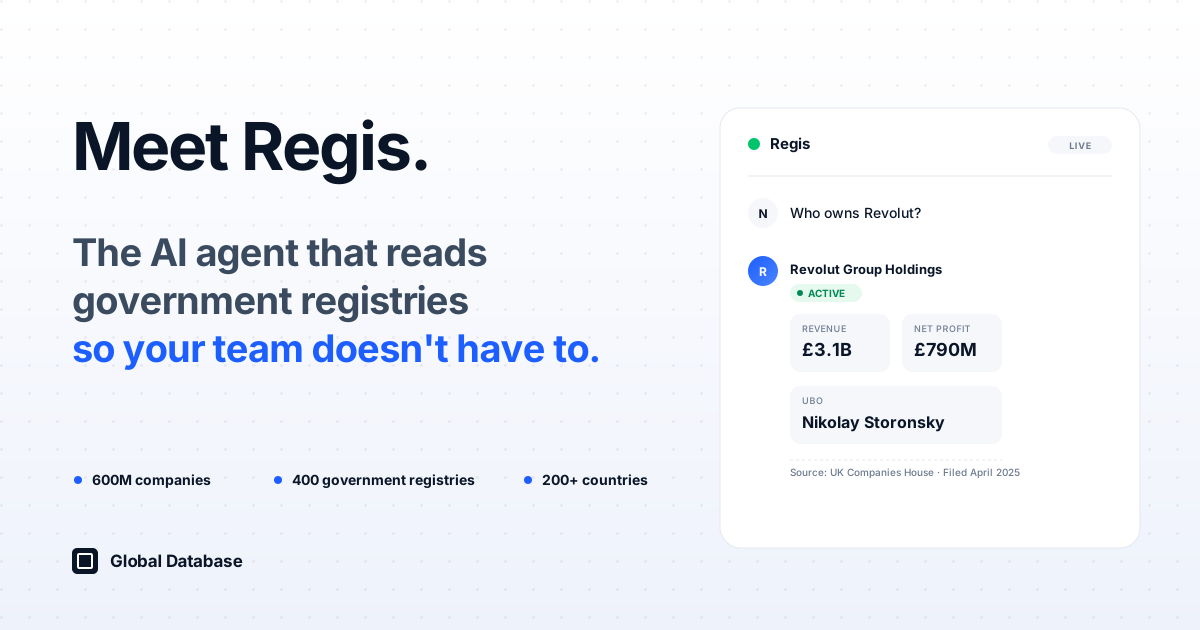
Northampton, UK — April 2026. Global Database today announced Regis, an AI agent for company intelligence, now available in early access. Regis draws on first-party data from 400 government registries across 200 countries, covering more than 600 million companies.
The pitch is simple. General-purpose AI knows everything. Regis knows every company.
What Regis Does
Ask Regis who owns Revolut. Ask it to find fintechs in Germany with €50M+ revenue growing over 20% a year. Ask it to map the full group structure of Unilever, or pull five years of Bosch GmbH financials side by side. Regis answers in plain language, and every answer links back to the government registry it came from.
It handles the questions compliance, sales, and research teams spend hours piecing together across disconnected tools:
- Verify any business by name, registration number, VAT, or EIN
- Trace ultimate beneficial owners through cross-border ownership chains
- Map parent-subsidiary structures across jurisdictions
- Pull up to 20 years of filed financial statements for private and public companies
- Build targeted prospect lists by geography, revenue, headcount, sector, and growth rate
- Spot high-growth companies based on filed accounts, not self-reported numbers
- Find contact details for key executives by name, company, or LinkedIn URL
Every answer is backed by the underlying government record, with the registry name, collection date, and a direct link to the source. No guessing. No invented directors. No filings that don't exist.
AI is great. Until you ask it about a real company.
ChatGPT, Claude, Gemini — they're incredible tools. But when it comes to company data, they hit a wall. Here's what happens when you rely on general-purpose AI for business intelligence.
Hallucinated answers
LLMs invent revenue figures, director names, and filings that don't exist. Confident tone. Zero accuracy.
No private company data
99% of companies are private. General-purpose AI can't access their financials. You get a refusal or a guess.
Outdated information
Training data is months or years old. Companies dissolve, restructure, change directors — the model doesn't know.
Sourced from the open web
LLMs pull from websites, news, and Wikipedia — not official government registries. No filings. No verified data.
Breaks at scale
Ask for 10 companies and you'll get a plausible answer. Ask for 500 and the model starts inventing — fake names, wrong revenue, made-up registration numbers. It looks like a clean list. Half of it is fiction.
No sources or audit trail
No registry citation. No filing date. No way to verify. "Based on my training data" isn't a source your compliance team can use.
Why We Built It
Company intelligence is broken at the workflow layer. Large language models are extraordinary tools — until you ask them about a real company. Then they hallucinate revenue figures, invent director names, and cite filings that don't exist. They cannot see private companies, which is 99% of the market. Their training data is months or years old. And they pull from the open web, not from official registries.
At the same time, enterprises pay seven figures a year for company data from vendors who resell the same secondary sources, then hand analysts a search box and tell them to figure it out. A single due diligence check can touch six tools and still miss the answer.
We built Regis because our enterprise customers kept asking the same thing: give us the data, but give us an interface that thinks.
Customers like LSEG, Mastercard, Experian, SAP, AWS, and PwC were clear. Large language models solved the interface problem. What they lacked was a trustworthy source of truth for the one domain where being wrong is unacceptable: who a company is, who owns it, and whether it can be trusted.
Regis closes that gap by connecting a reasoning agent directly to primary registry data.
What Makes Regis Different
Three things separate Regis from every other "AI for company data" announcement you will read this year.
It queries live data, not training data.
ChatGPT, Claude, Gemini — they all answer from what they learned during training. Regis queries 600 million company profiles from official registries in real time, with a 24-hour refresh cycle. When a filing changes in Seoul on Monday, Regis reflects it. There is no middle layer to blame.
Every answer has a source.
No hallucinations. No "based on my training data." Every data point comes with the registry name, the collection date, and a direct link to the filing. Built for compliance teams who have to defend every number they use.
It is a workflow tool, not a chatbot.
Ask a question, export the result to CSV, push it into Salesforce, or connect through the API. Regis is also available through a Model Context Protocol server that plugs directly into Claude, internal copilots, and any enterprise AI workflow. Compliance teams do not have to rip out what they have. Regis shows up where the work already happens.
The Category Shift
For twenty years, company intelligence has meant databases. You bought a seat, you searched, you exported. The incumbents — Dun and Bradstreet, Moody's, the vendors that quietly resell their files — built empires on that model.
Regis is something else. It is the first company intelligence agent. And it is built on the only foundation that makes an agent trustworthy in compliance, risk, and enterprise sales: primary government data, verified at source, refreshed every 24 hours.
The question enterprises should be asking in 2026 is not which database has the most records. It is which agent can actually answer the question in front of them.
See what an AI agent can do when it has 600 million verified company records behind it. No credit card required.
Frequently Asked Questions
What is Regis?
Regis is an AI agent for company intelligence, built by Global Database. It answers natural-language questions about any of 600 million companies using first-party data sourced directly from 400 government registries across 200 countries. Every answer links back to the underlying registry record.
How is Regis different from ChatGPT, Claude, or Gemini?
General-purpose AI models answer from training data, which is static, months or years old, and sourced from the open web. Regis queries live government registries in real time, refreshes every 24 hours, and cites the source of every answer. It is built for questions where being wrong is unacceptable — compliance, KYB, due diligence, and enterprise sales.
Where does Regis get its data?
Regis sources 100% of its company data directly from official government registries — including the UK's Companies House, Germany's Handelsregister, Singapore's ACRA, France's INPI, and 396 others. Every data point is verifiable, timestamped, and linked back to the original filing. There are no intermediaries, no resellers, and no web-scraped content.
Can Regis be used for KYB and compliance workflows?
Yes. Regis is designed for regulated environments. It verifies entity identity, traces ultimate beneficial owners through cross-border ownership chains, maps corporate hierarchies, and provides a full audit trail for every query. Compliance teams at banks, fintechs, and payment processors can use Regis to support KYB checks under FinCEN, EU AMLD, UK MLR, and FATF frameworks.
How is Regis different from Dun and Bradstreet, Moody's, or other legacy providers?
Legacy company intelligence providers rely on layered reseller networks and secondary data sources. Regis connects directly to primary government registries, updates every 24 hours, and delivers answers through a natural-language interface instead of a static database. The result is faster, more current, and fully source-attributed — without the licensing complexity of incumbent vendors.
Can Regis build prospect lists for sales teams?
Yes. Sales and revenue teams can ask Regis to build filtered target lists using criteria like geography, industry, revenue, headcount, growth rate, or ownership structure. Unlike LLMs that invent results at scale, Regis filters against 600 million real, filed company records and returns qualified targets suitable for enterprise outbound.
Does Regis hallucinate?
No. Regis does not generate company data from model memory. Every response is grounded in a live query against primary registry data, and every data point includes the source registry, collection date, and a link to the underlying filing. If a fact cannot be verified against a registry record, Regis will say so rather than invent it.
Can Regis integrate with existing enterprise tools?
Yes. Regis is available through the Global Database platform, through a REST API, and through a Model Context Protocol (MCP) server that plugs directly into Claude, internal copilots, and any enterprise AI workflow. Teams can use Regis inside the tools they already work in, without rebuilding their stack.
Which countries and registries does Regis cover?
Regis covers more than 600 million companies across 200+ countries, sourced from 400+ official government registries. Coverage includes all major jurisdictions in North America, Europe, Asia-Pacific, Middle East, Africa, and Latin America — including Companies House (UK), Handelsregister (Germany), INPI (France), ACRA (Singapore), and state Secretary of State registries across the US.
How do I get access to Regis?
Regis is available now in early access at globaldatabase.com. Enterprise teams can request a demo to see the agent in action, discuss use cases, and explore integration options. General availability is planned for Q3 2026. No credit card is required to start.