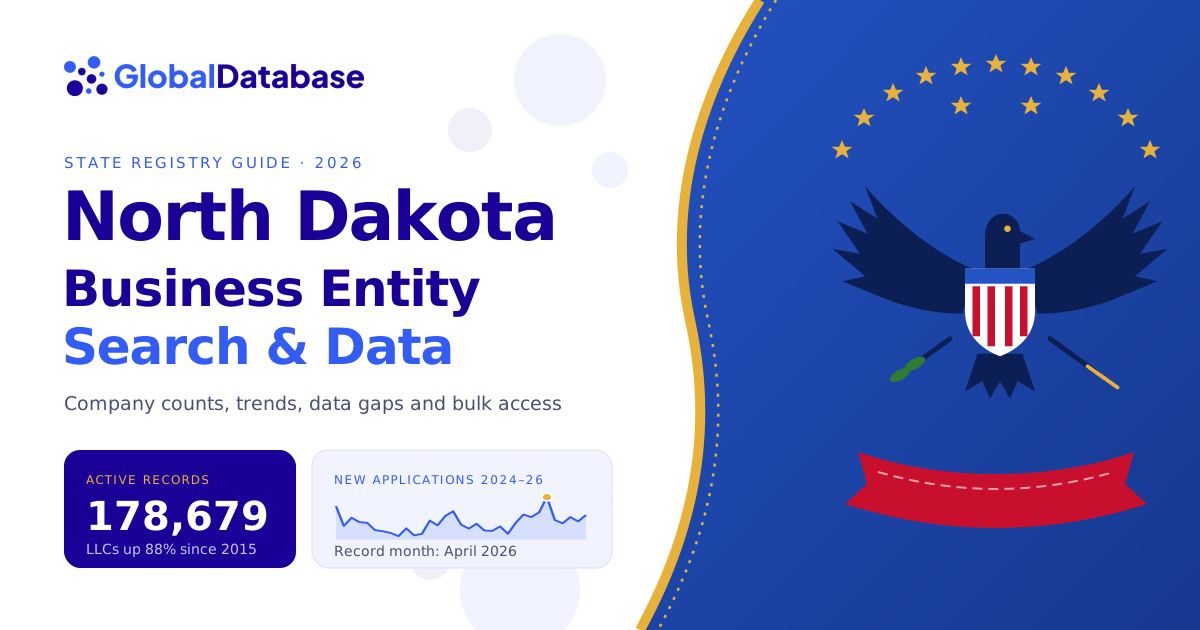
North Dakota is one of the smallest business registries in the United States by population, yet it is growing fast. At the close of fiscal 2025 the North Dakota Secretary of State reported 178,679 active business records, up 27.5% in ten years, and new business applications in the state hit an all-time monthly high in April 2026. This guide explains how the North Dakota business entity search works, what the numbers say, what the registry does and does not publish, and how to get North Dakota company data at scale.
How many companies are registered in North Dakota?
The North Dakota Secretary of State (NDSOS) publishes its business statistics in a biennial report rather than a live dashboard. The most recent edition, covering July 2023 to June 2025, reports 178,679 active records held by its Business Services Division. That figure covers four groups: corporations, limited liability companies, partnerships, and an "other" bucket that includes trade names, cooperatives, fictitious partnership names, trademarks and specialty entities such as farm and ranch corporations.
For a state of roughly 797,000 residents, that works out to about 224 active business records per 1,000 people. Not every record is an operating company, though. A single business can hold an LLC record and one or more trade name records, and out-of-state companies registered to trade in North Dakota are counted alongside domestic ones.
Active business records in North Dakota, 2015 vs 2025
Records on file with the Secretary of State at fiscal year end. Hover a bar for the exact count.
Each comparison comes from a single biennial report (2023–2025 and 2021–2023). The two reports group records slightly differently, so compare within a pair rather than across them.
Active records by entity type
The LLC is now North Dakota's dominant business structure. In 2015 corporations still outnumbered LLCs by about 7,000 records. By 2025 LLCs led by more than 31,000, and they account for 44% of all active records. Corporations slipped 3% over the decade, even though the category includes nonprofits, professional corporations and the state's distinctive farm and ranch corporations.
Share of active records by type, June 30, 2025
"Other records" includes trade names, cooperatives, trademarks, fictitious partnership names, credit unions, state banks and other record types the Business Services Division maintains.
| Record type | 2015 | 2025 | Change | % change |
|---|---|---|---|---|
| Limited liability companies | 42,251 | 79,401 | +37,150 | +88% |
| Corporations | 49,371 | 47,867 | −1,504 | −3% |
| Partnerships | 7,502 | 7,886 | +384 | +5% |
| Other | 40,995 | 43,525 | +2,530 | +6% |
| Total | 140,119 | 178,679 | +38,560 | +27.5% |
Where North Dakota's businesses are located
The Secretary of State doesn't break its records down by county, but federal employment data shows where companies with staff actually operate. In the first quarter of 2026, the U.S. Bureau of Labor Statistics counted 36,905 employer establishments in North Dakota. Cass County, home to Fargo, holds 26% of them. Cass, Burleigh (Bismarck), Grand Forks and Ward (Minot) together account for more than half. Williams and McKenzie counties, at the centre of the Bakken oil field, are small in population but have some of the state's highest average wages.
Employer establishments by county, Q1 2026
Top 10 of 53 counties. Hover a bar for the count. Share is of the statewide total of 36,905.
Establishments are workplaces with employees covered by unemployment insurance, so they include government sites and exclude sole proprietors with no staff. A further 765 establishments are reported statewide without a county.
By employment, North Dakota's private sector leans on health care and retail. Mining, including oil and gas, employs fewer people than its economic weight suggests, but it supports a large network of service and construction firms that register as LLCs.
Private-sector employees by industry, 2025
Annual average. Hover a bar for the value.
U.S. Bureau of Labor Statistics, Current Employment Statistics. Government and farm employment are not shown.
New business trend in North Dakota, 2019–2026
The Secretary of State does not publish an annual count of new formations, so the most reliable year-over-year signal comes from the U.S. Census Bureau's Business Formation Statistics. These track applications for an Employer Identification Number (EIN) with a North Dakota address. They are not identical to state registrations, since sole proprietors can apply for an EIN without filing with the state, but the two series move together.
Applications rose from 6,877 in 2019 to a record 9,005 in 2023. They dipped 6.1% in 2024 and recovered 5.4% in 2025. In 2026 the pace has accelerated: 8,012 applications were filed in the first nine months, 17.2% more than the same period of 2025, and April 2026 recorded 1,182 applications, the highest single month since the series began in 2004. At that pace, 2026 is on track to set a new annual record.
Business applications in North Dakota
Census Business Formation Statistics, not seasonally adjusted.
2026 shows January to September only (8,012). Year-over-year change: 2020 −3.3%, 2021 +21.9%, 2022 −1.0%, 2023 +12.2%, 2024 −6.1%, 2025 +5.4%.
| Year | Applications | YoY change | Reading |
|---|---|---|---|
| 2019 | 6,877 | – | Pre-pandemic baseline |
| 2020 | 6,648 | −3.3% | Pandemic slowdown |
| 2021 | 8,106 | +21.9% | National startup surge |
| 2022 | 8,023 | −1.0% | Plateau |
| 2023 | 9,005 | +12.2% | Full-year record |
| 2024 | 8,455 | −6.1% | Cooling |
| 2025 | 8,912 | +5.4% | Recovery |
| 2026 (Jan–Sep) | 8,012 | +17.2%* | Record monthly high in April |
*Compared with January–September 2025 (6,834).
North Dakota vs neighbouring states
Set against its neighbours, North Dakota's long-run growth looks modest. Business applications rose 29.6% between 2019 and 2025, against 55% in South Dakota, 60% in Minnesota and 111% in Montana. North Dakota's 2023 peak was followed by a dip in 2024, while the other three states kept climbing.
The picture changes in 2026. From January to September, North Dakota's applications grew 17.2% year on year, second only to South Dakota and ahead of both Minnesota and Montana.
Business applications indexed to 2019
2019 = 100. A value of 150 means 50% more applications than in 2019. Hover a point for the value.
| State | Applications 2025 | 2025 vs 2024 | 2025 vs 2019 | Jan–Sep 2026 vs 2025 |
|---|---|---|---|---|
| North Dakota | 8,912 | +5.4% | +29.6% | +17.2% |
| South Dakota | 12,092 | +5.2% | +55.0% | +18.6% |
| Montana | 29,887 | +10.9% | +111.2% | +14.9% |
| Minnesota | 73,825 | +9.1% | +60.4% | +12.7% |
Census Business Formation Statistics, not seasonally adjusted.
Active vs inactive companies: what the numbers leave out
NDSOS publishes active counts but no total for inactive records. Dissolved, terminated, revoked and withdrawn entities stay on file and remain searchable in FirstStop, so the full registry is considerably larger than 178,679. The decline in active corporations, from 50,882 in 2013 to 42,736 in 2023, gives a sense of the churn: thousands of older corporations were dissolved or terminated while new owners chose LLCs instead.
How to use the North Dakota Secretary of State business search
The official ND business search runs inside FirstStop, the Secretary of State's business and licensing portal, launched in January 2019. Searching is free and needs no account. For how other states compare, see our state-by-state guide to Secretary of State business searches. People reach it through many queries, including "nd sos business search", "north dakota secretary of state business search" and "north dakota corporation search", but they all lead to the same tool.
- Search by business name (using "starts with" or "contains"), system ID or registered agent name.
- Filter to active records only, or include inactive ones.
- Open a record to see filing type, status, standing, formation details, registered agent and filing history.
- Check standing separately from status. A business can be Active yet Not in Good Standing because it missed an annual report.
- Lien searches are separate. UCC and other liens sit in the Central Indexing System, which handled 115,400 filings in the 2023–2025 biennium, more than double the 2015 figure.
What North Dakota company data is available, and what is not
North Dakota's registry is built for confirming that a business exists and is in good standing. It is much thinner on who owns and runs a company and on how it performs financially.
| Data point | NDSOS registry | Notes |
|---|---|---|
| Legal name, entity type, system ID | Available | All domestic and foreign entities |
| Status and good standing | Available | Shown as separate fields |
| Formation date, home jurisdiction | Available | Includes foreign registrations |
| Registered agent | Available | Name and address |
| Filing history and documents | Available | Copies requested through FirstStop |
| Officers, directors, managers, governors | Partial | Reported in annual reports; coverage varies by entity type |
| Shareholders and members | Partial | Only professional, farm/ranch and livestock farm entities disclose them |
| Trade name owners | Partial | The owner may be another company, not the ultimate owner |
| Beneficial owners (UBO) | Not available | No state UBO register |
| Financial statements | Not available | Annual reports carry no financials |
| Group structure, parents, subsidiaries | Not available | Not recorded |
| Industry codes, employees, website | Not available | Free-text business activity only |
Federal beneficial ownership reporting does not close the gap. Under FinCEN's March 2025 interim final rule, companies created in the United States are exempt from filing beneficial ownership information, so there is no public or government source of ownership data for most North Dakota LLCs and corporations.
Skip monthly spreadsheets from FirstStop. Global Database delivers North Dakota registry records alongside all 50 states, Washington DC and Puerto Rico, normalised into one schema.
- Full-file and delta bulk feeds
- REST API for real-time lookups
- Status and standing change monitoring
- Officers and group structure linked
Where to get North Dakota business data in bulk
FirstStop is fine for checking one company at a time. For lists, analysis or ongoing monitoring there are three main routes.
| Source | What you get | Cost | Best for |
|---|---|---|---|
| FirstStop search | Single record views, filing history | Free | Ad hoc checks |
| NDSOS active records list | One-time Excel file of active records, per entity type | $40 per type | A snapshot list |
| NDSOS new records subscription | Monthly Excel file of newly added records | $40 per type/month | New business leads |
| NDSOS all records subscription | All business and trademark records, active and inactive | $1,440/month | Full registry analysis |
| Census BFS | Aggregate monthly application counts | Free | Trend research only |
| Global Database | ND plus all US states, enriched and linked, via API, bulk feed, MCP or AI connectors | Plans vary | KYB, onboarding, prospecting, AI agents |
State data lists are ordered through FirstStop under "Data List Requests" and require an ND Login account. Prices are the state's published fees at the time of writing.
Limitations of North Dakota registry data
- Statistics arrive every two years. Official counts come from the biennial report, so the latest public figure describes June 2025.
- Records are not companies. Trade names, trademarks and foreign registrations are counted as records, which overstates the number of distinct operating businesses.
- No ownership transparency. Most entities disclose no members, shareholders or beneficial owners.
- No financials. Private companies file no accounts with the state.
- Excel delivery only. Bulk lists arrive as spreadsheets. There is no public API, and full-file pricing is designed for professional buyers.
- Systems are changing. NDSOS is upgrading FirstStop and the Central Indexing System during the 2025–2027 biennium, so field names and workflows may change.
- No domestic and foreign split. Published totals mix North Dakota companies with out-of-state companies registered to do business there, and the state does not report the two separately.
- No county or industry data. Registry records carry addresses and free-text activity, but the state publishes no breakdown by location or sector.
- Counts depend on methodology. Category totals differ between biennial reports, which makes long-run comparisons approximate.
Annual reports, good standing and dissolution
Standing is one of the most useful fields in the North Dakota registry, because it shows whether a company is keeping up with its filings. Every entity type except sole proprietorships and general partnerships files an annual report, and the deadline depends on the entity type.
North Dakota annual report deadlines
The first report is due in the calendar year after registration. Filing fees range from $10 to $50 depending on entity type.
For anyone running know-your-business (KYB) checks on North Dakota counterparties, this is the field to monitor. A supplier that slips into Not in Good Standing has roughly a year before it is dissolved, and a change in standing is often the first public sign of trouble.
Regis reads official registries and answers with sources. Ask "Is this Bismarck LLC in good standing, and who are its officers?" in Claude, ChatGPT, Microsoft Copilot or your own agent through MCP.
- Claude and ChatGPT connectors
- MCP server for AI agents
- Officers and group structure
- Status and good standing checks
How Global Database adds to North Dakota registry data
The Secretary of State answers whether a company exists and whether it is in good standing. Most business decisions need more than that. Global Database starts with the official registry record and links it to the context the state does not hold:
- Coverage across borders. Many North Dakota entities are foreign registrations of companies formed in Delaware, Minnesota or elsewhere (see our Delaware registry guide). Global Database matches the North Dakota record to the home-state record and the wider group.
- Officers and control. Officers, directors and managers reported in annual reports, matched across the states where a company is registered.
- Group structure. Parent and subsidiary links that show who sits behind a local LLC.
- Firmographics. Industry classification, headcount ranges and web presence.
- Delivery that fits your stack. A REST API, full and delta bulk feeds, an MCP server, Claude and ChatGPT connectors and a Microsoft 365 Copilot app.
- Monitoring. Alerts when a North Dakota counterparty changes status, standing, agent or officers.
Comparing registries across states? Read our guides to Texas, New York, Virginia, Michigan and Arizona.
Frequently asked questions
How do I do a North Dakota business entity search?
Go to the FirstStop portal at firststop.sos.nd.gov and use the business search. You can search by business name, system ID or registered agent, filter to active records, and open any result to see status, standing, registered agent and filing history. The search is free and needs no account.
How many businesses are registered in North Dakota?
The North Dakota Secretary of State reported 178,679 active business records on June 30, 2025: 79,401 LLCs, 47,867 corporations, 7,886 partnerships and 43,525 other records such as trade names and cooperatives. Inactive records are kept on file but no official total is published.
Is the North Dakota Secretary of State business search free?
Yes. Searching FirstStop and viewing entity records is free. Certificates of good standing, document copies and bulk data lists carry fees.
How fast are new businesses forming in North Dakota?
Census data shows 8,912 business applications in North Dakota in 2025, up 5.4% on 2024. From January to September 2026 applications reached 8,012, 17.2% ahead of the same period in 2025, and April 2026 was the highest month on record.
Can I see who owns a North Dakota LLC?
Usually not. Standard business LLCs do not disclose members in public records. Ownership details appear only for professional, farm/ranch and livestock farm entities, and trade name records list an owner that may itself be a company. Since March 2025, US-formed companies are also exempt from federal beneficial ownership reporting.
How do I download a list of North Dakota companies?
Order a data list through FirstStop under "Data List Requests" with an ND Login account. An active records list costs $40 per entity type, new records cost $40 per type each month, and the full active and inactive file costs $1,440 per month. All lists arrive as Excel files.
What does "Not in Good Standing" mean in North Dakota?
It means the entity missed its annual report or another compliance requirement. The business still exists, but it has about one year to file the past-due report and reinstate. After that, a domestic entity is involuntarily dissolved and a foreign entity loses its authority to do business in the state.
When are North Dakota annual reports due?
LLCs file by November 15, domestic corporations by August 1, foreign corporations by May 15, farm and ranch entities by April 15, and partnerships and cooperatives by March 31. The first report is due in the year after the business registers.
Where do I search North Dakota UCC filings and liens?
UCC financing statements, tax liens and agricultural liens are filed in the Secretary of State's Central Indexing System, which is separate from the FirstStop business search. Filings must be made electronically.
Is there an API for North Dakota company data?
The state offers Excel data lists but no public API. Global Database provides North Dakota company data through a REST API, bulk feeds, an MCP server and Claude and ChatGPT connectors, linked to officers, group structure and data for every other US state.