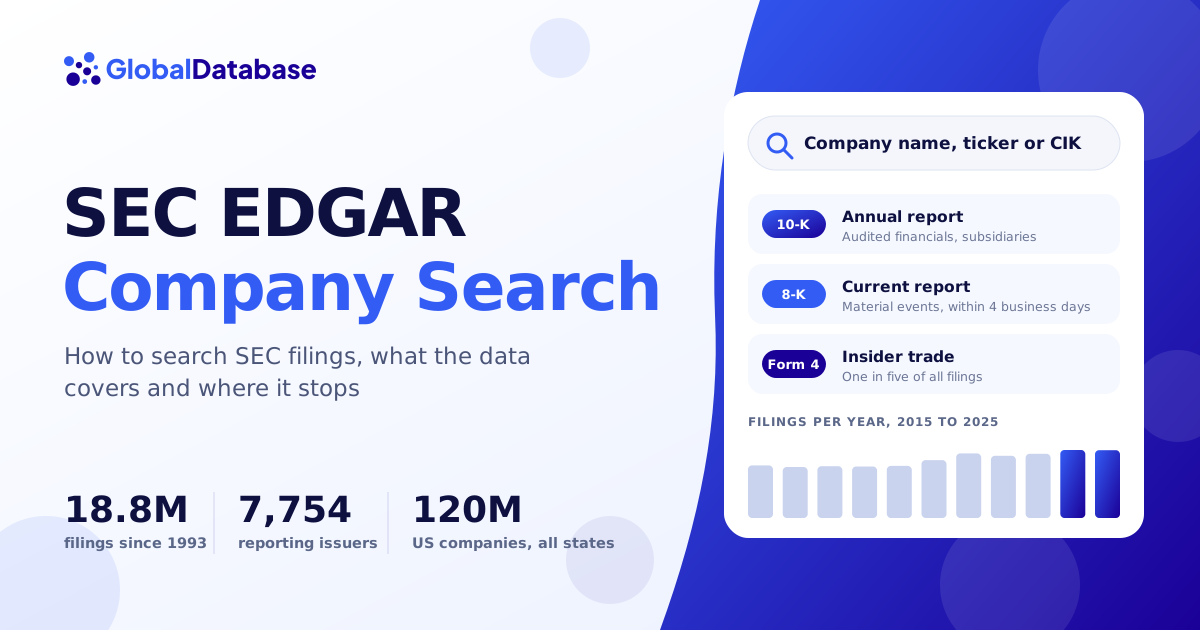
The SEC EDGAR company search is the free public window into every filing made with the US Securities and Exchange Commission: almost 18.8 million public filings since 1993, from about 7,750 reporting companies and well over 100,000 other filers each year. This guide explains how to run an SEC filings search, what the data covers, how the numbers have moved year over year, and where EDGAR stops.
Figures checked in November 2026. Search tools described are those on sec.gov/search-filings.
What is SEC EDGAR?
EDGAR stands for Electronic Data Gathering, Analysis, and Retrieval. It is the system the SEC uses to receive, check and publish the disclosure documents that federal securities law requires. Electronic filing was phased in from 1993, became mandatory for US public companies in May 1996, and was extended to foreign companies in November 2002.
So what are SEC filings? They are the reports that companies, their insiders and large investors must submit: annual and quarterly accounts, notices of material events, prospectuses, proxy statements and ownership disclosures. Everything accepted for public release appears in the SEC EDGAR database within moments, free to read and download, with no account.
The distinction that matters most for anyone doing company research: EDGAR is a register of filers, not a register of companies. A business appears only if securities law gives it something to file.
SEC EDGAR in numbers: registrants, active filers and yearly trend
The question "how many public companies are there in the US" has an official answer. SEC staff count reporting issuers, meaning entities that filed an annual report on Form 10-K, 20-F or 40-F. There were 7,750 in calendar 2025 and 7,754 in the four quarters to Q1 2026.
The long-run direction is down. Reporting issuers peaked at 10,598 in 2009 and have fallen 27% since. After a low of 7,475 in 2020, the IPO and SPAC wave lifted the count to 8,737 in 2022. It has dropped every year since: 4.4% in 2023, 5.4% in 2024 and 1.9% in 2025, before holding flat into 2026.
Inside that total, two lines are moving in opposite directions. US-domiciled listed companies fell from 4,461 in 2004 to 3,600. Foreign-domiciled listed companies almost tripled, from 392 to 1,139, with most of that growth since 2020.
*Now is the rolling four quarters from Q2 2025 to Q1 2026. Hover or tap any bar for the figure and its year-on-year change.
Who the 7,750 reporting issuers are
Fewer than half are what most people picture as a US public company. The rest are foreign listings, issuers traded over the counter, securitisation vehicles and funds.
Active versus inactive filers
EDGAR has no "active" or "inactive" flag of the kind a state business registry shows. A filer is active when it files and silent when it stops. The clearest measure is how many distinct filers submitted at least one document in a year: 148,185 in 2023, down from a record 160,186 in 2021. Set against 8,351 reporting issuers that year, fewer than 6 in every 100 active filers were companies publishing annual reports. The rest were insiders reporting trades, investment managers, funds and private issuers lodging one-off notices.
Every filer keeps its CIK and its filing history for good, so the cumulative list also holds entities that stopped filing years ago. A company leaves the reporting system by filing Form 15 to deregister or Form 25 to delist, and the SEC can revoke the registration of issuers that fall behind on their reports. In 2025, EDGAR received 581 Form 15 deregistration notices and 884 delisting notifications from exchanges. Of the 2023 reporting issuers, 7,243 filed a 10-K, 953 a 20-F and 155 a 40-F, and 570 were shell companies.
Public filings disseminated through EDGAR, calendar years 2015 to 2025. The first nine months of 2026 added a further 714,010.
Filing volume sat near 650,000 a year through the 2010s, then rose by more than 11% in both 2020 and 2021 during the IPO and SPAC boom. It has kept climbing: 861,214 filings in 2024 was the highest on record, 2025 came within 0.2% of it at 859,108, and the first nine months of 2026 already total 714,010, which puts this year on course for a new high.
Those filings were spread across 391 form types in 2025, and the mix is not what most people expect. Form 4 insider reports are one filing in five. Annual reports on Form 10-K are fewer than one in a hundred.
How to use SEC EDGAR company search
The SEC EDGAR search page at sec.gov/search-filings is the starting point for a single SEC company lookup. The EDGAR company search box sits at the top.

- Enter a name, ticker or CIK. Suggestions appear as you type. Pick the exact entity, because parents, subsidiaries and funds often share a name.
- Read the company landing page. It shows the CIK, state of incorporation, SIC industry code, fiscal year end, business address and former names, with the latest filings grouped by type.
- Open the full filing list. Filter by form type (10-K, 8-K, 4 and so on) and by date range, search within the list by keyword, or export it to CSV or Excel.
- Open a filing. Each has an index page listing the main document and every exhibit. Financial reports open in an inline viewer where tagged figures can be clicked.
- Narrow a broad search. The classic search form also filters by state, country, SIC code and file number, which helps when a name returns dozens of matches.


The same page links to the other tools: a latest filings feed that updates in real time, a mutual fund and ETF search, an insurance product search, and the full text search covered below.
CIK lookup: what a CIK number is and how to find one
A CIK (Central Index Key) is the unique number, up to 10 digits, that the SEC assigns to every filer. Companies, funds and individuals all receive one, and it never changes when a name does. That makes it the reliable key for an SEC CIK lookup: names are ambiguous, tickers get reused, the CIK is permanent.
To find one, use the CIK lookup tool linked from the search page, or search the company name and read the number beside it. The SEC also publishes a full list of CIKs matched to entity names. That list is cumulative: it includes individuals, funds and entities that no longer file, so it is a poor guide to how many companies exist.

EDGAR full text search
EDGAR full text search looks inside documents, exhibits included, for every filing submitted since 2001. It is the tool for questions such as "which companies name this supplier" or "who mentions this subsidiary".

- Exact phrases go in double quotation marks.
- All words are required by default. Use capitalised
ORfor alternatives andNOTor a leading hyphen to exclude a term. - Wildcards work at the end of a word only:
acqui*. - Proximity uses
NEAR(), 10 words by default. - Filters cover form type, date range, company, CIK and location.

It does not accept natural language questions, results are ranked by relevance and not by date, and filings from before 2001 are out of reach. Those older documents can still be opened through company search.
The main SEC filing types explained
Several hundred form types exist, yet a short list answers most research questions. Use the buttons to filter the table.
| Form | Filed by | What it tells you | Deadline |
|---|---|---|---|
| 10-K | US reporting companies | Annual report: audited financials, business description, risk factors, subsidiaries list (Exhibit 21) | 60, 75 or 90 days after year end, by filer size |
| 10-Q | US reporting companies | Quarterly unaudited financial statements and management discussion | 40 or 45 days after quarter end |
| 8-K | US reporting companies | Material events: acquisitions, executive changes, results, bankruptcies | 4 business days after the event |
| DEF 14A | Companies holding a shareholder vote | Proxy statement: board, executive pay, holders above 5% | Ahead of the shareholder meeting |
| S-1 | Companies registering securities, including IPOs | Prospectus: business, financials, use of proceeds, selling shareholders | Before the offering |
| Form D | Companies raising private capital under Regulation D | Offering size, executives and directors; often the only SEC trace of a private company | 15 days after the first sale |
| Forms 3, 4, 5 | Directors, officers, holders above 10% | Insider holdings and every purchase or sale | Form 4: 2 business days |
| Schedule 13D | Holders above 5% who may seek influence | Identity, source of funds, purpose of the stake | 5 business days |
| Schedule 13G | Passive and institutional holders above 5% | Short-form stake disclosure | 5 business days, or 45 days after quarter end for institutions |
| 13F | Managers with $100 million+ in US-listed securities | Quarterly portfolio holdings | 45 days after quarter end |
| 20-F | Foreign private issuers | Annual report, the foreign equivalent of the 10-K | 4 months after year end |
| 6-K | Foreign private issuers | Material information published in the home market | Promptly after home release |
| 40-F | Eligible Canadian issuers | Annual report built on Canadian disclosure documents | With the Canadian annual filing |
Two recent changes are worth knowing. A foreign private issuer files Form 20-F and 6-K in place of the 10-K, 10-Q and 8-K, and its insiders were long exempt from trade reporting. Since 18 March 2026, directors and officers of foreign private issuers must file Forms 3, 4 and 5 like their US counterparts. And in May 2026 the SEC proposed letting companies replace three quarterly 10-Q reports with a single semiannual report on a new Form 10-S. That is a proposal, not a final rule, so quarterly reporting remains the standard.
S-1 filings deserve a special mention for anyone researching a company before it lists: the prospectus is usually the most complete description of a business it will ever publish.
Ownership data on EDGAR: Schedule 13D, Schedule 13G and insider filings
EDGAR is strong on ownership of listed companies, within clear thresholds. Anyone who acquires more than 5% of a listed company's voting shares must report it. Schedule 13D is the long form for investors who may seek influence, due within five business days, with amendments within two business days of a material change. Schedule 13G is the short form for passive and institutional holders. Both have been filed as structured data since December 2024.
Add 13F filings (quarterly portfolios of managers with $100 million or more in US-listed securities), Forms 3, 4 and 5 for insiders, and the ownership table in each proxy statement, and you can see who holds the large blocks of any reporting company.
What you cannot see: holders below 5%, the people behind a nominee or fund, and anything at all for a company with no SEC obligation. EDGAR shows major shareholders of public companies. It is not a beneficial ownership register.
What information is available on EDGAR, and what is not
| Data point | On EDGAR | Notes |
|---|---|---|
| Name, former names, CIK, SIC code, state of incorporation, address | Yes | For every filer |
| Audited annual and quarterly financials | Yes | Reporting issuers only; machine-readable XBRL phased in from 2009 |
| Directors and executive officers | Yes | In proxy statements and annual reports |
| Shareholders above 5% and insider trades | Yes | Schedules 13D and 13G, Forms 3, 4, 5 |
| Subsidiaries and group structure | Partial | Exhibit 21 lists significant subsidiaries as plain text, with no ownership percentages or hierarchy |
| Private companies raising capital | Partial | A Form D, Regulation A or crowdfunding filing, with little financial detail |
| Private US companies and LLCs in general | No | No SEC filing obligation; held by state registries |
| State registration status, good standing, registered agent | No | Secretary of State data |
| Owners below 5% and ultimate beneficial owners | No | Not required in SEC filings |
| Non-US companies with no US listing or registration | No | Held by each country's own registry |
| Employee contacts, websites, headcount as data fields | No | Appear only as text inside documents, if at all |
SEC vs Secretary of State: what is the difference?
The two are often confused, and they do different jobs. The Secretary of State (SOS) in each state creates a company and keeps the record of its legal existence. The SEC is a federal regulator that makes companies disclose information to investors once they sell securities to the public. Every US company has a state record. Only a small fraction ever file with the SEC.
| SEC (EDGAR) | Secretary of State registries | |
|---|---|---|
| Level | Federal, one national system | State: 50 states plus Washington DC, each with its own register |
| Purpose | Investor disclosure under securities law | Formation and legal existence of the entity |
| Who is in it | Companies with registered securities, plus insiders, funds and large investors | Every corporation, LLC, partnership and nonprofit formed or registered in the state |
| Scale | About 7,750 reporting companies | About 120 million company records across all states |
| Identifier | CIK, one number nationwide | State entity or file number, different in every state |
| Status | No status field | Active, good standing, dissolved, revoked and similar |
| Typical filings | 10-K, 10-Q, 8-K, proxy statements, ownership forms | Formation documents, annual reports, amendments, registered agent changes |
| Financial statements | Yes, audited and tagged | Generally none |
| Ownership | Holders above 5% and insiders | Usually none; officers or managers in many states |
| Access | One free search, free APIs and bulk files | A separate website per state; bulk data and APIs are rare |
A listed company appears in both. Apple Inc. files its annual report with the SEC, while its legal record sits with the state where it is incorporated, shown on its EDGAR page as California. A private LLC appears only in its state register. That is why a full picture of a US company needs both layers, and why checking EDGAR alone tells you nothing about whether a company legally exists or is in good standing.
Each state register works differently. Our guides cover them one by one, including Delaware, where many listed companies are incorporated, New York, Florida and Tennessee, with the rest in the company registry guides.
SEC EDGAR API and bulk downloads
There is an official SEC EDGAR API, and it is free. The SEC API endpoints live on data.sec.gov, return JSON and need no key or sign-up.
- Submissions: a filer's profile and filing history, by 10-digit CIK. Each call returns at least a year of filings or the 1,000 most recent.
- Company facts and company concept: every XBRL-tagged figure a company has reported, or one line item across time.
- Frames: one figure, such as revenue, for every reporting company in a given period.
For those asking how to download files from SEC EDGAR in volume: the SEC rebuilds two bulk ZIP files each night at about 3 a.m. Eastern, one with all submission histories and one with all XBRL facts. Daily and quarterly index files list every filing with its path, and a paid Public Dissemination Service delivers the live feed.
The constraints are practical. Automated access is capped at 10 requests per second, scripts must identify themselves, and the EDGAR API returns filings and tagged numbers only. Anything outside XBRL, including subsidiaries, officers and ownership stakes, still has to be extracted from the filings themselves.
Query SEC registrants and private companies in one call
One structured profile for listed and private companies, through a REST API, an MCP server, or Regis inside Claude and ChatGPT.
EDGAR Next: what changed for filers
EDGAR Next is the SEC's overhaul of how filers log in and manage their accounts. The rules were adopted in September 2024, enrolment opened on 24 March 2025, compliance became mandatory on 15 September 2025, and the enrolment window closed on 19 December 2025.
Shared company passwords are gone. Each person now signs in with individual Login.gov credentials and multi-factor authentication, every filer appoints account administrators who control who may file on its behalf, and that set-up must be confirmed once a year. Filers also gained optional APIs for submitting and checking filings.
For researchers, nothing changed: EDGAR Next governs filing, and public search remains open with no login. The practical effect is on anyone who files, including every director and officer who submits a Form 4.
Limitations of SEC EDGAR
- It covers a sliver of US business. About 7,750 reporting issuers against roughly 120 million company records held across the state registries.
- Documents first, data second. Outside XBRL financials and recent ownership forms, the facts sit in prose and exhibits.
- No status field. Nothing tells you at a glance whether a filer is current, delinquent or defunct.
- No corporate tree. Exhibit 21 is a flat list that may leave out smaller subsidiaries.
- Federal layer only. A company's legal existence, standing and registered agent are recorded by its state, not by the SEC.
- US securities law only. A foreign group appears only as far as it has registered securities in the US.
- Names are inconsistent. The same entity can appear under several spellings across filings, and matching it to a state record takes work.
For every SEC reporting issuer there are roughly 15,500 US company records at state level.
How Global Database adds value
EDGAR answers the question "what has this public company disclosed". Most due diligence, credit and sales work begins a step earlier, with "does this company exist, and who is it".
Global Database sources US company data from all the Secretary of State registries, covering 120 million companies, active and inactive, in one schema. That is the layer EDGAR does not hold: the private corporations and LLCs that make up nearly all of US business, and the state-level records behind the listed ones.
- State registry facts for each entity: status, legal form, formation date, jurisdiction and registered agent.
- Listed and private companies together, so an SEC registrant can be tied to its state record and to its operating subsidiaries.
- Group structure as data, with parents and subsidiaries linked across states and across borders.
- Global registry data from 400+ official registries in 200+ countries, for the foreign parents and subsidiaries EDGAR only names in passing.
- Delivery to fit the job: platform search, REST API, MCP server, Claude and ChatGPT connectors, and bulk data feeds.
120 million US companies, from every Secretary of State
The whole US company universe, public and private, as full-file and delta feeds in the same schema as 200+ other countries.
Frequently asked questions
What is SEC EDGAR?
EDGAR stands for Electronic Data Gathering, Analysis, and Retrieval. It is the US Securities and Exchange Commission's free online system where companies, funds and individuals submit the filings required by federal securities law, and where anyone can search and read them.
How do I use the SEC EDGAR company search?
Go to sec.gov/search-filings, type a company name, ticker symbol or CIK number in the company search box and pick the entity from the suggestions. The results page lists every filing by date, and you can filter by form type such as 10-K, 8-K or Form 4. No account is needed.
Is SEC EDGAR free to use?
Yes. Searching, reading and downloading filings on EDGAR is free, with no registration. The SEC's APIs and nightly bulk files are also free and need no API key, although automated access is limited to 10 requests per second.
What is a CIK number and how do I find one?
A CIK (Central Index Key) is the unique number, up to 10 digits, that the SEC assigns to every filer, whether a company, a fund or an individual. Use the CIK lookup on sec.gov, or search the company name in EDGAR company search; the CIK appears next to the name.
How many public companies are there in the US?
SEC statistics count 7,754 reporting issuers for the four quarters to Q1 2026. Of these, 3,600 are US-domiciled companies listed on an exchange and 1,139 are foreign-domiciled listed companies. The rest are OTC-traded issuers, asset-backed issuers, ADRs, REITs and funds.
What are SEC filings?
SEC filings are the documents that companies, insiders and investors must submit to the Securities and Exchange Commission. The main ones are the annual report (10-K), quarterly report (10-Q), current report (8-K), proxy statement (DEF 14A), registration statement (S-1) and ownership reports such as Form 4, Schedule 13D, Schedule 13G and 13F.
How far back does EDGAR full text search go?
EDGAR full text search covers filings submitted electronically since 2001, including exhibits and attachments. Older electronic filings, back to the mid-1990s, can still be found through company search and the EDGAR index files, but their text is not searchable through that tool.
Does SEC EDGAR have an API?
Yes. The SEC runs free JSON APIs on data.sec.gov for each filer's submission history and for XBRL financial data, plus nightly bulk ZIP files. There is no API key. Scripts must stay under 10 requests per second and identify themselves.
Can I find private companies on SEC EDGAR?
Mostly no. EDGAR covers entities with an SEC filing obligation, so the great majority of private US companies and LLCs never appear. A private company may show up only through a Form D notice, a Regulation A or crowdfunding offering, or as a named subsidiary or shareholder in someone else's filing. Private company records sit with the Secretary of State registries.
What is the difference between the SEC and the Secretary of State?
The Secretary of State in each US state forms companies and keeps the record of their legal existence, status and registered agent. The SEC is a federal regulator that requires companies with publicly offered securities to disclose financial and ownership information on EDGAR. Every US company has a state record; only about 7,750 file annual reports with the SEC.