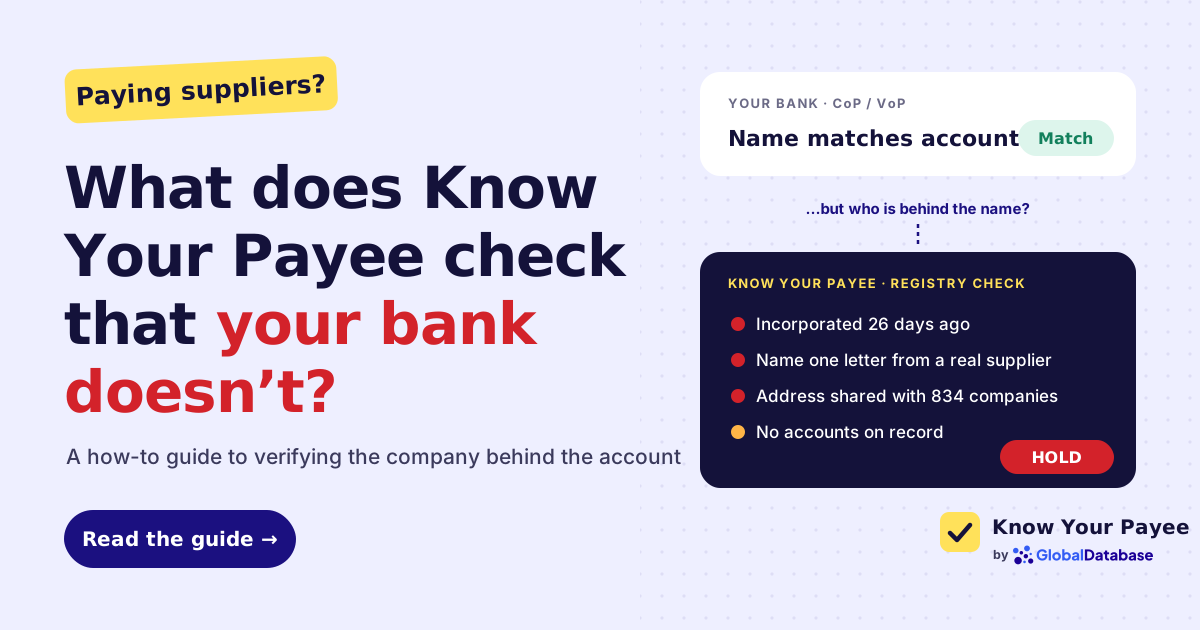
Your bank now checks that the name on a payment matches the name on the account. That check — Confirmation of Payee in the UK, Verification of Payee in the eurozone — is genuinely good at catching typos and crude redirections. But it answers only one question: does this name belong to this account? It cannot tell you who is actually behind the name. This guide shows, step by step, how to verify a supplier's bank details and the company behind them before you release a payment.
Key takeaways
- Confirmation of Payee (CoP) and Verification of Payee (VoP) match a name to an account. They return match, close match or no match — nothing about the company itself.
- A fraudster who registers a lookalike company and opens an account in its name passes the name check, because the name genuinely matches.
- In the UK, losses from payments redirected to the wrong payee fell to 24% of all APP fraud in 2025, down from 52% in 2020 — while frauds where the payee is exactly who they say they are kept rising.
- The fix is a second layer: resolve the account name to a legal entity in the official register, read its age, status, address, filings, directors and owners, then decide Proceed, Review or Hold.
- Know Your Payee by Global Database runs both layers in one request: the bank's own name-match result, plus 22 registry-derived risk signals on the company and its people.
What your bank's payee check actually does
Since 2020, UK payers have seen a Confirmation of Payee prompt before most bank transfers. The Payment Systems Regulator first directed the six largest banking groups to offer it in August 2019; its Specific Direction 17 then pulled in around 400 more payment service providers in two waves, with the last group due by 31 October 2024. CoP now covers over 99% of Faster Payments.
The eurozone followed. Under the EU Instant Payments Regulation, every payment service provider in a euro-area country has had to run Verification of Payee on euro credit transfers — standard and instant, single and bulk — since 9 October 2025. Providers in non-euro EU countries must follow by 9 July 2027.
Both schemes work the same way. Your bank sends the name and account identifier you entered to the payee's bank, which compares them to its own records and replies within seconds:
That is the whole of the check. A green "match" proves the account is held in that name. It says nothing about whether the company is two weeks old, shares an address with hundreds of shell firms, has never filed accounts, imitates your real supplier by one letter, or is run by someone who has dissolved a string of companies before. Those facts sit in the company register — and your bank does not read it before the money leaves.
The numbers: name checks work, so fraud moved
UK Finance splits authorised push payment (APP) fraud into two families. In malicious redirection — invoice and mandate fraud, CEO fraud and impersonation — you mean to pay a genuine payee but are tricked into paying someone else. In malicious payee fraud, the payee is exactly who it says it is; the deal itself is the fraud. Name checks are built for the first family. Watch what happened to each.
UK APP fraud losses by family, 2020–2025
£ millions, gross. Toggle to see the share of total losses.
Redirection = invoice & mandate, CEO, impersonation (police/bank), impersonation (other). Malicious payee = purchase, investment, romance, advance fee. Totals computed from UK Finance Annual Fraud Report 2026 tables.
Redirection losses fell from £220.3m in 2020 to £139.3m in 2025, while malicious-payee losses more than doubled to £437.2m. UK Finance itself points to Confirmation of Payee and in-journey warnings as tools that help catch redirection earlier. The lesson for a finance team is not that the name check is enough. It is the opposite: criminals have learned that the cheapest way past a name check is to control a payee whose name genuinely matches. For business payments, that means a registered company.
Invoice and mandate fraud: smaller in count, heavy per case
Invoice and mandate fraud hit a record low in 2025 — £41.3m across 2,305 cases — but it remains a business problem. Business (non-personal) accounts carried £28.0m, or 68% of those losses, because firms pay large genuine invoices every week, which makes one fraudulent payment hard to spot.
Average loss per case by APP fraud type, UK 2025
£ per confirmed case. Business-targeted redirection scams sit at the top.
Calculated as total losses ÷ confirmed cases per scam type (UK Finance, 2025 data). Purchase scam average as published.
The UK's mandatory reimbursement rules, in force since October 2024, cover consumers, micro-enterprises and charities for payments up to £85,000. A mid-sized or large company that pays a fraudulent supplier invoice is outside that safety net. The control has to happen before the money moves.
The eurozone: scams now drive credit-transfer fraud
Verification of Payee arrived because European losses were moving the same way. The joint EBA–ECB payment fraud report puts total payment fraud in the European Economic Area at €4.2bn in 2024, up 17% on 2023. Fraudulent credit transfers alone reached €2.5bn, up 24% — and 74% of that value came from payers being manipulated into authorising the payment themselves, up from 65% a year earlier. Unlike card fraud, the payer usually carries the loss: users bore around 85% of credit-transfer fraud losses in 2024.
Those figures pre-date mandatory VoP, which only started in October 2025. VoP will stop payments to accounts whose name doesn't match. It won't stop a manipulated payer from paying a correctly named account — which is exactly where the register check comes in.
The United States: no national name check at all
US businesses do not have a CoP or VoP equivalent across ACH and wire payments, and the losses show it. Business email compromise (BEC) — the umbrella under which supplier impersonation and changed-bank-detail scams are reported — cost victims who reported to the FBI $3.05bn in 2025 across 24,768 complaints. In the Association for Financial Professionals' 2026 survey, 76% of US organisations faced attempted or actual payments fraud in 2025, and 74% were affected by BEC.
Reported business email compromise losses, United States
US$ billions reported to the FBI Internet Crime Complaint Center (IC3).
IC3 figures reflect only incidents reported to the FBI; the true total is higher.
Bank check vs Know Your Payee: what each one sees
Here is where the two layers differ, field by field.
| Question before you pay | CoP / VoP (your bank) | Know Your Payee |
|---|---|---|
| Is the account held under this name? | Yes — match / close / no match | Yes — the bank's own result, reported as received |
| Does a legal entity with this name exist in the official register? | No | Yes — resolved in the country's register |
| Is the company active, dormant, in liquidation or dissolved? | No | Yes — registry status |
| How old is it? (hard flag inside the first 90 days) | No | Yes — incorporation date |
| Is it a lookalike of a real company? | No | Yes — screened against the live register |
| Does it share its registered address with many others? | No | Yes — shared-address count |
| Has it filed accounts? Are they overdue? Negative net assets? | No | Yes — filed accounts and filing gaps |
| Who are the directors, shareholders and beneficial owners (25%+)? | No | Yes — each resolved in its own register |
| What else do the directors control — serial formations, dead companies, secrecy jurisdictions? | No | Yes — cross-registry officer network |
| What changes after I've paid? | No — each payment is a one-off check | Yes — Payee Monitoring pushes changes to your webhook |
| Payee outside UK / eurozone schemes? | Often no name check available | Bank verification in 49 countries; company and owner layers run across 200+ |
Try it: six real-world scenarios
Pick a scenario to see what the bank's name check returns, and what reading the register adds.
Illustrative scenarios built from the signal types Know Your Payee reports. Real results show the registry fact and source behind each signal.
Scenarios three, four and five are the ones that cost businesses most: the bank says match, and the payment looks routine — often because it is the first one to a new payee, or the first since the bank details "changed".
Send us labelled historical business payees — names and account identifiers only. We return the 22 Entity Risk Signals and the five assessments for every row, so you can measure extra detection and false-positive reduction against the controls you already run. No integration work, no commitment.
Start a back-test →How to verify a supplier's bank details: 8 steps
Use this sequence at supplier onboarding and on every change of bank details. Steps 1–3 are what most teams already do. Steps 4–8 are what closes the gap the name check leaves open.
- Treat every change of bank details as a brand-new payee AP
Fraud concentrates on the moment details change. Freeze the payment run for that supplier until the new details pass every step below — don't just edit the vendor master record.
- Call back on a number you already hold AP
Use the phone number from your contract or vendor file, never the one in the email, letterhead or invoice that announced the change. Email accounts get compromised; replies to them prove nothing.
- Run the bank's name check — and read the result properly Bank
Use CoP, VoP or a bank account verification service. "Close match" means stop and compare the returned name. "No match" or "not possible" means hold. A "match" means only that the name and account belong together — continue to step 4.
- Resolve the account name to a legal entity in the official register KYB
Find the exact company — registration number, not just the trading name — in the register of its home country — or run a KYB verification across 400+ registries at once. Confirm status (active, dormant, in liquidation, dissolved), incorporation date and registered address. If no entity matches, that's your answer.
- Check the red flags in the record KYB
Incorporated in the last 90 days? Name one character away from your real supplier? Registered office shared with hundreds of companies? No accounts filed, or accounts overdue? Missing or invalid VAT number, or no web footprint? Each of these is a fact you can see in the register.
- Look at the people and owners behind it KYB
List the directors, shareholders and beneficial owners at 25% or more, and map the group structure above the payee. Then follow each director to their other companies: three or more incorporations in 24 months, companies formed and closed within a year, or appointments in secrecy jurisdictions all point to a vehicle, not a trading business. Screen names against sanctions and PEP lists.
- Decide Proceed, Review or Hold — and record why Controls
Treat a failed payment link, an unverifiable company or a broken continuity record as a stop condition. Keep financial strength and data gaps as reviewer inputs, not automatic blocks. Write down the evidence and its source, so an auditor can follow the decision.
- Keep watching after you've paid Monitoring
Bank account details themselves can't be monitored, but the company can — through registry monitoring. A change of status, registered office, directors or ownership is the trigger to re-verify the bank details before the next payment.
Quick self-check: would this payee pass?
Tick what you can see in the payee's bank result and company record. This is a simplified triage based on the logic above, not the Know Your Payee rule engine.
Get Know Your Payee: the complete guide as a PDF — to keep, share with your AP, treasury and procurement teams, and use whenever a supplier's bank details change.
Download the free guide →Where this data comes from — and its limits
Everything in steps 4–6 is public in most countries. The problem is that it's spread across hundreds of registers, each with its own format and rules.
FromThe payee's bank (CoP, VoP or a verification provider)
Watch outNo national scheme in the US. Non-euro EU joins in 2027.
FromNational company registers — e.g. Companies House, US Secretaries of State, European registers
Watch outEvery country uses a different format. Some charge per record.
FromMost national registers
Watch outPartial birth dates make it hard to match people across countries.
FromUBO registers or shareholder filings
Watch outPublic access varies in the EU. US domestic firms are mostly exempt.
FromRegisters and gazettes (company financials)
Watch outSmall firms can hide revenue. Filings can lag by months.
FromNew filings and gazette notices
Watch outNobody tells you. You have to keep checking.
How Know Your Payee by Global Database closes the gap
Know Your Payee is built by Global Database on its own first-party registry data: 600M+ companies collected directly from 400+ official government registries in 200+ countries and territories — the same data behind Global Database's KYB, UBO and monitoring products.
One request — payee name, account number, country — runs four checks.
Every fact in a Global Database result shows which register it came from and when. If a register doesn't publish something, the result says so plainly — a gap is never shown as a red flag.
Call the API on every new payee and every change of bank details, send a CSV of beneficiaries for your whole supplier master file, and receive monitoring alerts by webhook. Need the company and ownership layer for analysts and AI agents too? It's the same registry data, available through Regis, our MCP server and Claude and ChatGPT connectors, and bulk data feeds with financials and group structure.
Who should add a Know Your Payee layer
Accounts payable and procurement teams — at supplier onboarding and on every bank-detail change, especially for first payments and high-value runs. Banks and payment service providers — to extend the VoP or CoP result they already return with the company behind it. Payment networks and schemes — to embed the check at network level for every corporate on the rail. Marketplaces and platforms — to verify the legal entity and owners behind a seller before releasing payouts.
Frequently asked questions
What does Confirmation of Payee check?
Confirmation of Payee (CoP) checks whether the name you enter for a UK payment matches the name held on the destination account. The payee's bank returns a match, close match or no match before you send the money. It does not check whether the business behind the account is legitimate, how old it is, or who owns it.
What is Verification of Payee and when did it become mandatory?
Verification of Payee (VoP) is the EU's name-checking service under the Instant Payments Regulation. It has been mandatory for payment service providers in euro-area countries since 9 October 2025, for every euro credit transfer, standard or instant. Providers in non-euro EU countries must comply by 9 July 2027.
Can a fraudster pass a Confirmation of Payee or Verification of Payee check?
Yes. If a fraudster registers a company — often with a name close to a real supplier — and opens a bank account in that company's name, the name check returns a match because the name genuinely belongs to the account. Only the company register reveals the warning signs, such as a very recent incorporation date or a shared registered address.
How do I verify a supplier's bank details before paying?
Treat any change of bank details as a new payee, call the supplier back on a number you already hold, run the bank's name check, then resolve the account name to a company in the official register and review its status, age, address, filings, directors and owners. Decide Proceed, Review or Hold, record the evidence, and monitor the company for changes afterwards.
What is Know Your Payee?
Know Your Payee by Global Database is a payment-fraud control that runs before a business payment is released. It takes the bank's account-name result, verifies the company behind the account against official government registries, checks directors, shareholders and beneficial owners, and returns five assessments and one decision: Proceed, Review or Hold.
Does Know Your Payee replace Confirmation of Payee or Verification of Payee?
No. It works alongside them. Know Your Payee reports the bank's own name-match result exactly as received and adds the company and ownership checks that a name match cannot see. Global Database does not issue the regulated CoP or VoP result itself.
What company register red flags suggest invoice or mandate fraud?
The strongest signals are a company incorporated in the last 90 days, a name nearly identical to an existing company, a registered address shared with many other firms, no filed or overdue accounts, recent director changes, and directors linked to several short-lived or dissolved companies. Any of these on a newly added or changed payee justifies holding the payment for review.
How much is lost to invoice and mandate fraud in the UK?
UK Finance reported £41.3 million lost to invoice and mandate scams across 2,305 cases in 2025, an average of about £17,900 per case. Business accounts carried £28.0 million, or 68%, of those losses, and only 48% of invoice and mandate losses were returned to victims.
How do I verify a vendor's bank account in the United States?
The US has no nationwide equivalent of CoP or VoP for ACH and wire payments, so businesses rely on call-back procedures and bank account validation services. Verifying the vendor's legal entity in its state Secretary of State register, and reviewing its officers and history, adds the layer that account validation alone does not cover.
How can payee verification be integrated into AP or ERP systems?
Know Your Payee runs through the Global Database API, so it can be called automatically whenever a new payee is created or bank details change, or as a file-based service with a CSV of beneficiaries in and results out. Payee Monitoring then sends changes to your webhook so details are re-verified before the next payment.