On January 21, 2026, the European Parliament voted 492-144 to recommend the creation of the Unified European Company (S.EU). The headline feature: incorporate a business anywhere in the EU in 48 hours, fully digital, with just €1 in capital.
Politicians called it a breakthrough for European competitiveness. Startup founders celebrated. But for those of us who have spent the last five years building cross-border company verification infrastructure, the announcement raised a different question.
Not whether this could be done. But what happens after.
The Problem the S.EU Solves
The frustration behind this legislation is real. A German founder who wants to expand to Spain faces a maze of local requirements. Different incorporation rules. Different notarization standards. Different timelines. The friction is measurable, and it costs Europe startups every year.
The S.EU aims to fix this by creating a single legal form that works across all 27 member states. One set of rules. One digital process. One European identity.
That’s the right goal. But legal harmonization is only half the challenge.
The Problem It Doesn’t Solve
The S.EU creates a unified legal framework. It does not create unified data infrastructure.
Each of the 27 EU member states maintains its own company registry. Different data formats. Different update frequencies. Different levels of public access. A company registered in Estonia looks nothing like one registered in Italy when you pull the raw filings.
This matters because verification doesn’t stop at incorporation. When a bank onboards a new client, when an enterprise signs a vendor contract, when an investor conducts due diligence—they need to verify that company against official records. Not once. Continuously.
The S.EU makes it easier to create companies. It doesn’t make it easier to verify them.
What We Learned Building Across 27 Registries
Five years ago, we started connecting to European company registries directly. Not through aggregators. Not through scraped databases. Direct access to official government sources.
Here’s what we learned.
Standardization is harder than access.
Getting data from 27 registries is a solvable technical problem. Making that data comparable is a design problem. A “director” in Germany carries different legal weight than a “director” in Malta. A “registered address” in France may or may not match the operational address in the UK filing system. Building a unified view requires not just connectivity, but interpretation.Financial data is a different beast entirely.
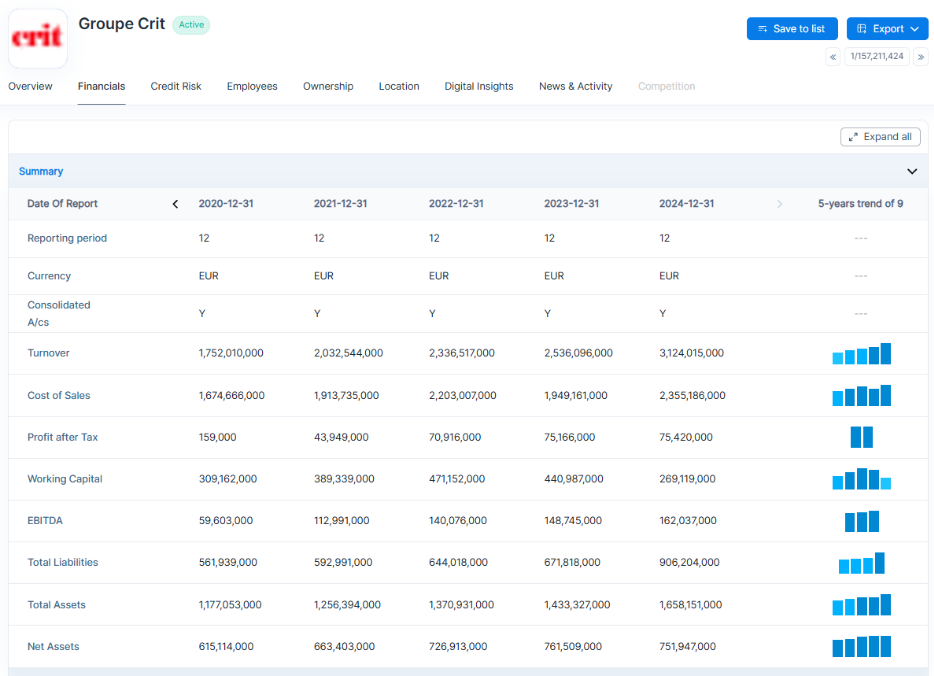
Every jurisdiction reports company financials differently. Balance sheet line items don’t map one-to-one across borders. Accounting standards vary. Fiscal year definitions vary. Currency conversions add another layer. We had to build normalization logic that translates financial statements into a consistent format—so a user comparing a German GmbH to a French SAS sees apples to apples, not raw filing data that requires an accountant to interpret.
Language is an invisible barrier.
Registry documents arrive in 24 official EU languages. A Polish sp. z o.o.’s filings are in Polish. A Greek Α.Ε.’s articles of incorporation are in Greek. For cross-border verification to work, documents need translation—not just of text, but of legal concepts that don’t have direct equivalents. We invested heavily in multilingual processing so users can search, filter, and analyze companies regardless of the source language.Update frequencies vary wildly.
Some registries update daily. Others update quarterly. Some jurisdictions publish beneficial ownership data in real-time; others lag by months. A verification system needs to account for these gaps, not pretend they don’t exist.Cross-border relationships are invisible in siloed systems.
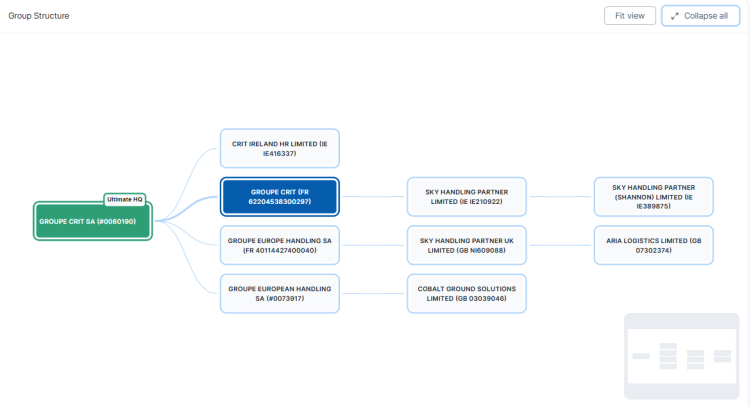
A parent company in the Netherlands with subsidiaries in Poland and Portugal won’t show up as a connected structure if you query each registry separately. You need a layer that links entities across jurisdictions—and keeps those links current as ownership changes.
Infrastructure has to be built for scale.
Connecting to registries is step one. Building infrastructure that handles thousands of API requests per second is step two. Enterprise compliance teams don’t run one query at a time. They run batch verifications across entire vendor portfolios. They integrate verification into onboarding workflows that can’t tolerate latency. We had to build backend systems that deliver sub-second responses at scale—not just demo-ready performance, but production-grade reliability.Speed creates new risks.
When incorporation takes weeks, there’s built-in friction that slows bad actors. When it takes 48 hours with €1 capital, verification infrastructure becomes the last line of defense. The faster companies can form, the faster compliance teams need to verify them.
What the S.EU Gets Right
Credit where it’s due. The S.EU framework includes some forward-thinking elements.
The digital-first approach is essential. Paper-based processes don’t scale, and they create data quality problems downstream. If the S.EU mandate forces registries to modernize their systems, that benefits everyone who relies on that data.
The cross-border seat transfer provision is genuinely novel. Allowing a company to move its registered office from one member state to another without dissolution eliminates a significant barrier to pan-European operations.
But these features also create new challenges for verification. A company that moves from Romania to Ireland mid-year needs to be trackable across that transition. Its historical filings need to remain accessible. Its ownership structure needs to be re-verified against the new jurisdiction’s standards.
What Still Needs to Be Built
The Commission proposal is expected in Q1 2026. Implementation likely won’t begin until 2027 or 2028. That gives Europe time to get the data infrastructure right.
Four areas need attention.
A common data schema.
If every registry continues to store and publish company data in its own format, the S.EU’s legal harmonization won’t translate to operational harmonization. A standardized schema—covering entity types, officer roles, ownership structures, and filing events—would make cross-border verification tractable.Cross-jurisdiction entity linkage.
A unified registry framework needs to connect companies across borders. When a German holding company owns a Spanish subsidiary that owns a Portuguese operating company, that chain should be visible in a single query. Today, you have to search each registry separately and manually piece together the structure. The S.EU should mandate interoperable identifiers that allow ownership graphs to span jurisdictions automatically.Real-time beneficial ownership access.
The EU’s Anti-Money Laundering Directives already mandate UBO registers. But access remains fragmented, with some jurisdictions requiring justification for each query and others providing open APIs. A unified registry framework needs unified ownership transparency.Discovery, not just verification.
Current registry infrastructure assumes you already know which company you’re looking for. You search by name or registration number. But businesses don’t only need verification—they need discovery. A procurement team looking for suppliers shouldn’t have to search 27 registries one by one. They should be able to query: show me all ice cream manufacturing companies in Italy with revenue above €5 million. Show me all logistics providers in the Baltics founded in the last three years. Show me all certified organic food producers in the DACH region. This requires more than a unified registry. It requires a platform with industry classification, financial filtering, geographic segmentation, and company attributes that go beyond basic registration data. The S.EU creates an opportunity to build this. Whether Europe takes it is another question.Change event infrastructure.
Static snapshots of company data are insufficient for compliance. Verification systems need to know when a director changes, when ownership transfers, when a company moves jurisdictions. Event-based data feeds—not just periodic bulk extracts—should be part of the S.EU specification.
The Opportunity
The S.EU is a competitiveness play dressed as a simplification measure. It aims to make Europe a better place to start and scale companies. That’s a worthy goal.
But competitiveness requires trust. And trust requires verification. The same infrastructure that helps a Polish startup expand to France helps a French bank verify that the Polish startup is legitimate.
We’ve spent five years building the plumbing that connects Europe’s registries. Not because we anticipated this legislation, but because the fragmentation was already a problem for anyone doing serious cross-border business.
The S.EU doesn’t make that work obsolete. It makes it more necessary.
Now the question is whether Europe builds the data infrastructure to match the legal framework—or leaves that gap for the private sector to fill.
We already know the answer. We’ve been filling it for years.
—
Global Database provides direct access to company data from 100+ official government registries worldwide, covering 600+ million companies. Our platform serves enterprise compliance, KYB verification, and business intelligence teams at organizations including Uber, AWS, Kroll, SAP, and LSEG.