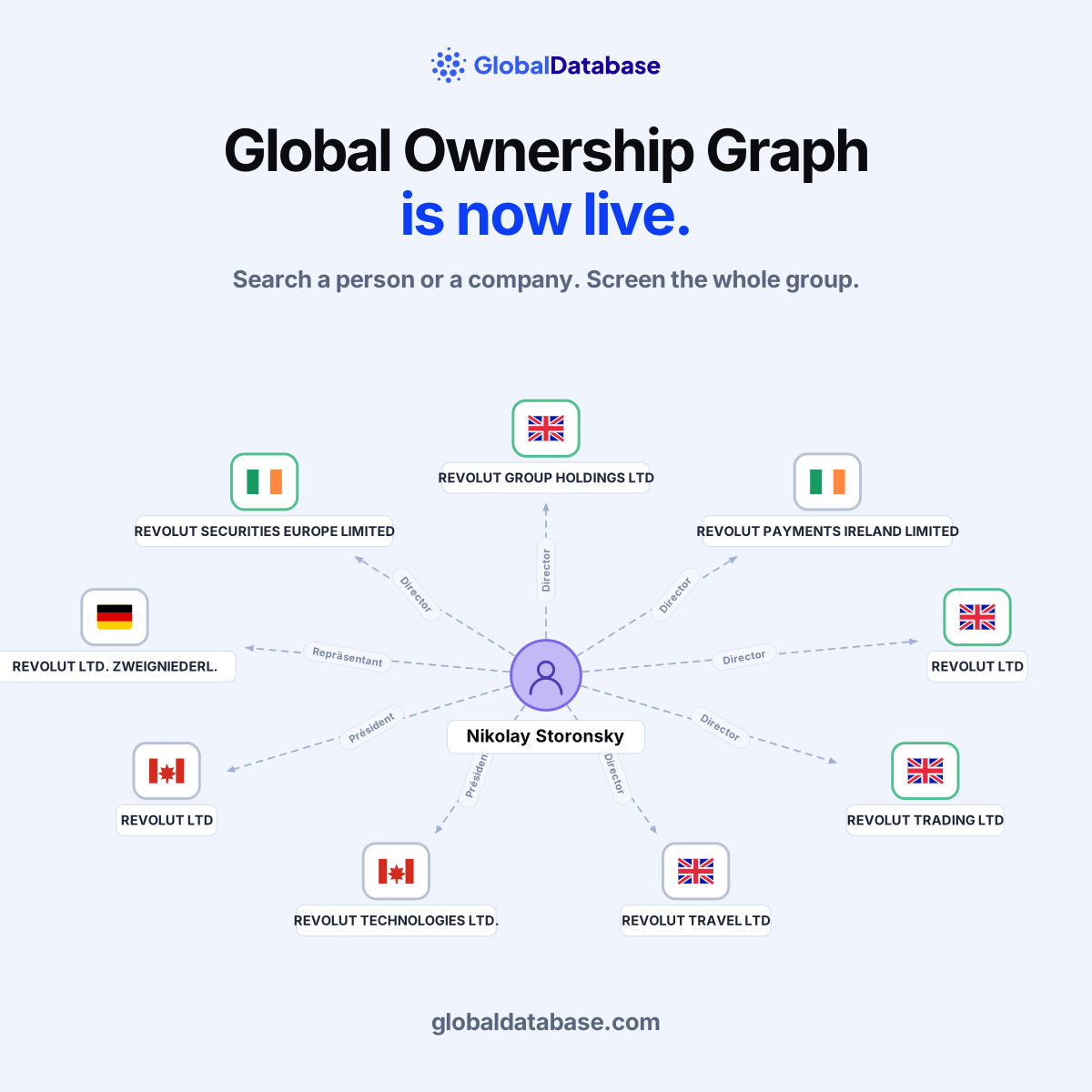
Corporate ownership is recorded in public registries. It just isn't recorded in one place. A group with entities in eleven countries files eleven times, in eleven formats, under eleven sets of rules — and anyone who needs the whole picture has been left to assemble it by hand.
Today we are launching the Global Ownership Graph. It is live now for all Global Database users. Search a company and you get its group structure. Search a person and you get every company they hold a position in. Both directions, across borders, with every relationship traceable back to the filing it came from.
Search a person, see every appointment
Start with a name. The graph returns every company that person is connected to, the role they hold in each, and the jurisdiction that recorded it. Roles appear as they were filed — a director in the UK, a président in Quebec, a Repräsentant of a German branch. We don't normalise those into a single generic label, because the distinction is often the point.

The same view scales to people with far larger portfolios. Directors of property groups, serial founders, and professional non-executives routinely hold twenty or more appointments spread across separate filings that were never designed to be read together — and a single search returns all of them, active and historic alike.
Search a company, see the whole group
Run the same search against a company and the graph resolves downward instead: subsidiaries, the jurisdictions they file in, and how each is held. For a large banking group this is dozens of entities across every continent — holding companies, nominee vehicles, branches, and operating subsidiaries that share little more than a name fragment.

Filters narrow the view to subsidiaries, management, or shareholders. An active-only toggle drops dissolved entities and historic appointments, and a list view gives you the same data in a form you can export and attach to a file.
Screen the group, not just the entity
Finding the structure is only half the job. The reason most teams build a group chart in the first place is to screen everything in it — and that is where the manual work usually multiplies. Ten subsidiaries and five directors is fifteen separate checks, fifteen separate evidence records, and a refresh cycle every time something changes.
From any graph you can run a compliance check across the entire group in one action. Choose whether to screen the single entity or the entity plus everything connected to it — subsidiaries, directors, and shareholders — and the check runs against PEP, sanctions, and watchlist data for every name at once.

Choosing the group scope assembles the full list before anything runs, so you can see exactly what is about to be checked. Ongoing monitoring is enabled at the same point, which means the group stays under watch after the initial run rather than only at the moment of onboarding.

Results come back per entity with a clear status, so a reviewer sees immediately which names need attention and which don't. Ongoing monitoring can be switched on at the same time, which means a change in status arrives as a notification rather than as a discovery during the next periodic review.
Where the data comes from
Every node and every edge in the graph originates in a government register. Global Database collects primary filings from more than 400 official registries across 200+ countries, covering over 600 million companies, and each relationship in the graph carries the source it was collected from.
That matters more than it sounds. Ownership data is frequently resold through several intermediaries before it reaches the buyer, and by then the question "where did this record come from?" often has no answer beyond a methodology document. When a regulator, an auditor, or an internal reviewer asks you to evidence a decision made two years ago, a methodology document is not what they are asking for.
Registry data has real limits, and we would rather state them than paper over them. Some jurisdictions do not publish shareholder information at all. Others publish it only on payment, or only in scanned documents, or only in the local language. Beneficial ownership registers vary widely in coverage and in how rigorously they are verified. A graph built from filings is exactly as complete as the filings underneath it — which is why we show you the source rather than presenting an estimate as a fact.
Who this is built for
The common thread is anyone who has to answer a question about control and then prove how they answered it.
KYB and onboarding teams
A corporate customer submits an application naming one legal entity. Before approval you need its parent, its subsidiaries, its directors and its shareholders — and in a cross-border group that has historically meant opening four or five national registry portals, exporting from each, and reconciling names that don't match. The graph returns the structure in a single search, which shortens onboarding without weakening the file. Every entity resolved carries the filing it came from, so the evidence pack builds itself as you work.
Financial crime, sanctions and AML analysts
Sanctions exposure frequently doesn't sit with the counterparty in front of you. It sits two levels up in a holding company, or sideways in a sister entity, or with a director who also sits on the board of something designated. Screening the named entity alone will not find it. Screening the graph will — and with ongoing monitoring across the group, a designation that lands next quarter reaches you as an alert rather than as a finding in an audit.
Procurement and third-party risk
Supplier due diligence tends to stop at the contracting entity, which is exactly where concentration risk hides. Two suppliers you treat as independent may share an ultimate parent; a vendor in a low-risk jurisdiction may be controlled from a higher-risk one. Mapping supplier ownership makes both visible, and matters increasingly for supply chain and responsible sourcing obligations that ask you to know who ultimately owns your vendors.
Corporate development, M&A and diligence
Before a term sheet, you need to know what a target actually owns — dormant subsidiaries, dissolved entities still on the register, minority holdings nobody mentioned in the data room. The active-only toggle separates the live structure from the historic one, and the list view exports into the diligence file. It is also the fastest way to sanity-check a management-provided group chart against what was actually filed.
Credit, underwriting and counterparty risk
Exposure is rarely to a single entity. If you are lending to, insuring, or extending terms to several companies that share a parent, your real concentration is the group, not the names on the individual agreements. Ownership traversal turns a list of separate exposures into a single view of who you are actually exposed to.
Investigative journalists and researchers
Following control across borders is the core of most corporate investigations, and the hard part has always been that each jurisdiction is a separate silo. Because every relationship in the graph carries its source filing, findings can be cited back to a primary public record rather than to a database — which is the standard any serious publication or academic paper has to meet.
Data and product teams building on top of it
If the graph needs to live inside your own onboarding flow, monitoring system, or customer-facing product rather than in a separate tool, the same ownership, officer and shareholder data is available through the API, with bulk delivery for teams that need it in their own environment.
The Global Ownership Graph is live today in the Global Database platform. Existing customers have access already — it appears in your account with no setup required.
Frequently asked questions
What is the Global Ownership Graph?
It is an interactive view of corporate ownership and control built from primary government registry filings. Searching a company returns its group structure — subsidiaries, shareholders, and officers. Searching a person returns every company they hold a position in. Relationships are traversable, so you can move from one entity to the next rather than reading isolated records.
Where does the underlying data come from?
From official government registries. Global Database collects primary filings from more than 400 registries across 200+ countries, covering over 600 million companies. Each relationship shown in the graph carries the source it was collected from, so any node can be traced back to the filing that supports it.
How does this differ from a UBO lookup?
A lookup answers a single question and returns a record. A graph lets you traverse the structure — expand a subsidiary, follow a director into their other appointments, or move up through a holding chain — without starting a new search each time. It also works in both directions, from company to people and from person to companies.
Can I trace ownership across multiple countries?
Yes. Cross-border tracing is the main reason the product exists. Entities are resolved across jurisdictions, so a group filing in the UK, Ireland, Germany and Canada appears as one connected structure rather than four unconnected searches. Each node displays the jurisdiction it is registered in.
How current is the data?
Refresh frequency follows the publication cycle of each source registry, which varies considerably — some publish changes daily, others in batches, and some only on an annual filing cycle. Because the graph exposes the source of each record, you can see what a given relationship is based on rather than relying on a single global freshness claim.
What does the compliance check screen against?
PEP, sanctions, and watchlist data. You choose the scope before running it: the single entity, or the entity plus every company and person connected to it in the graph. Each name returns its own result so a reviewer can see exactly which entities need follow-up.
Does ongoing monitoring cover the whole group?
Yes. Monitoring can be enabled for the full set of screened entities, not only the primary company, so a change affecting a subsidiary or an individual officer surfaces as an alert rather than waiting for the next periodic review.
Is shareholder data available for every country?
No, and no provider can honestly claim otherwise. Availability depends on what each jurisdiction publishes. Some registries disclose full shareholder registers, some disclose only beneficial owners above a threshold, and some disclose nothing. Coverage details for a specific market are available on request.
Can I access the ownership data through an API?
Yes. The same ownership, officer, and shareholder data available in the graph is accessible via API for teams integrating it into onboarding, monitoring, or internal risk systems. Bulk delivery is available for customers who need the data in their own environment.
How do I get access?
The Global Ownership Graph is available in the Global Database platform. You can request a trial at globaldatabase.com/free-trial, or contact the team to discuss API access, bulk delivery, or coverage for specific jurisdictions.