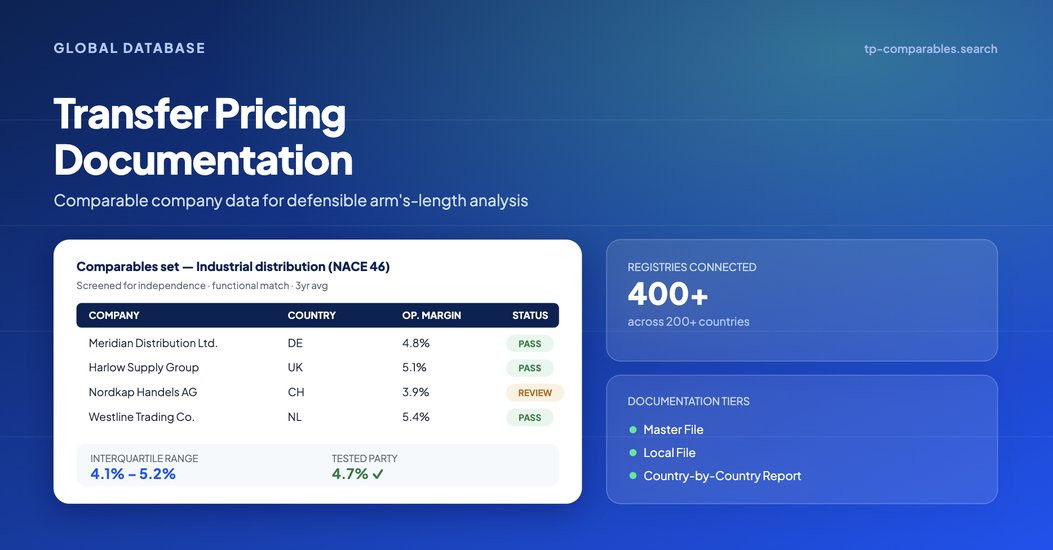
Transfer pricing rules all converge on one test: would an unrelated party have agreed to this price? Proving that answer for a related-party transaction isn't a legal argument you can write your way around — it requires comparable, independent company data, pulled from somewhere a tax authority will actually accept. Most transfer pricing disputes aren't lost on the economics. They're lost on the comparables.
The Arm's-Length Principle, in Practice
Every major transfer pricing regime — OECD member states, the US, and most of the rest of the world — applies some version of the same standard: the price charged between related entities (a parent and its subsidiary, or two subsidiaries under common control) should match what two independent, unrelated parties would have agreed to for the same transaction, under the same conditions.
The principle is simple to state and genuinely hard to apply, because "what would unrelated parties have agreed to" isn't a fact that exists anywhere by default. It has to be constructed, transaction by transaction, from real comparable data — which is the entire discipline of transfer pricing benchmarking.
Transfer pricing is not about whether a company can legally structure intercompany transactions a certain way — it almost always can. It's about whether the price assigned to that structure matches an independent-party benchmark. The structure is rarely the dispute; the number is.
OECD BEPS Action 13: The Three-Tier Documentation Standard
The OECD's 2015 BEPS Action 13 final report set the documentation framework that most jurisdictions have since adopted into domestic law. It has three distinct components, each answering a different question for a different audience.
| Tier | Scope | Who sees it |
|---|---|---|
| Master File | High-level overview of the entire MNE group's global operations, structure, and transfer pricing policies | Made available to all relevant tax administrations where the group operates |
| Local File | Detail on the material related-party transactions specific to that country — amounts involved, and the entity's own transfer pricing analysis | Filed with, or made available to, the local tax authority |
| Country-by-Country (CbC) Report | Revenue, profit, tax paid, and activity measures, reported jurisdiction-by-jurisdiction rather than entity-by-entity | Filed separately — not bundled into the master file |
The Five Transfer Pricing Methods
The OECD Transfer Pricing Guidelines recognise five methods, split into two families: three traditional transaction methods that compare prices or margins directly, and two transactional profit methods that compare net results. Which method applies determines exactly what comparable data the analysis needs.
| Method | Family | Tests | Best suited to |
|---|---|---|---|
| Comparable Uncontrolled Price (CUP) | Transactional | The controlled price directly against prices in comparable independent transactions | Commoditised goods with a visible, liquid market price |
| Resale Price Method (RPM) | Transactional | Gross margin, working backward from the reseller's third-party resale price | Routine distributors that don't add significant value before resale |
| Cost Plus Method (CPM) | Transactional | Gross margin, working forward from the supplier's cost base | Routine manufacturers or contract service providers |
| Transactional Net Margin Method (TNMM) | Profit-based | A net profit indicator (e.g. operating margin) against comparable independent companies | Routine entities on one side of the transaction — the most commonly used method in practice, largely on data availability |
| Profit Split Method (PSM) | Profit-based | Combined profit, divided between parties based on their relative contributions | Highly integrated transactions where both sides make unique, valuable contributions |
In practice, TNMM dominates real-world filings — not because it's theoretically preferred (CUP is generally ranked highest when a reliable comparable price exists), but because net-margin data on comparable independent companies is simply more available than the transaction-level pricing data CUP requires.
Where the Comparables Actually Come From
The local file's core requirement — proving the related-party price was arm's length — depends entirely on finding genuinely comparable independent transactions or companies to benchmark against. That's where documentation stops being a legal exercise and becomes a data problem.
Intangibles and the DEMPE Framework
Legal ownership of an intangible asset — a patent, a brand, proprietary know-how — isn't what determines who's entitled to the profit it generates, under OECD rules. The DEMPE framework, introduced in the BEPS Actions 8–10 final report (5 October 2015) and since folded into the OECD Transfer Pricing Guidelines, allocates intangible-related returns to whichever group entity actually performs the real functions:
US Treasury Regulation §1.482-4(f)(3) starts from a different default: the legal owner is treated as the intangible's sole owner, unless that legal ownership conflicts with the underlying economic substance. The OECD's DEMPE approach isn't binding US authority, though the IRS has referenced it in bilateral APA and competent-authority cases. A group with US and OECD-aligned entities in the same intangible chain needs to reconcile both standards, not assume one covers the other.
Why "Just Use Public Filings" Doesn't Scale
In principle, comparable company data is public — filed financial statements exist in company registries around the world. In practice, assembling a defensible comparables set from registry filings directly runs into the same problem every cross-border data task does: every registry publishes financials in a different format, on a different schedule, under different disclosure thresholds, and several jurisdictions don't require public filing of financials at all for smaller entities.
Advance Pricing Agreements
An Advance Pricing Agreement (APA) flips the usual sequence: instead of defending a pricing methodology after the fact, a taxpayer agrees the methodology with the tax authority in advance, for a fixed period of future transactions. Most APAs are bilateral or multilateral — negotiated between the taxpayer and two or more tax administrations under a mutual agreement procedure (MAP), specifically to avoid the double taxation that arises if two countries disagree on the same transaction's correct price.
APAs are voluntary, and the process itself has real cost — typically a multi-year negotiation. The trade-off: a valid APA can shield the covered transactions from later Section 482 adjustments and associated penalties, converting years of audit uncertainty into a single upfront agreement.
The 2025 Safe Harbor Shift: Amount B
In IRS Notice 2025-4, the IRS and Treasury announced their intent to adopt the OECD's "Amount B" approach — which they term the Simplified and Streamlined Approach (SSA) — under Section 482. It applies narrowly: only to "baseline" marketing and distribution arrangements, where the service provider doesn't contribute unique or valuable intangibles and doesn't assume economically significant risk.
Where a transaction qualifies and a taxpayer makes a valid election — filed transaction-by-transaction, for the taxable year in question — the Commissioner will treat the SSA as the "best method" automatically. The election applies to taxable years beginning on or after 1 January 2025. It's an elective safe harbor, not a mandatory regime: taxpayers with in-scope transactions can choose it to reduce dispute risk, but detailed records under the Notice's own documentation requirements still have to be maintained even when electing in.
What Amount B does not touch: anything outside baseline distribution. Transactions involving unique intangibles, meaningful risk, or any function more complex than routine distribution still need a full comparables analysis under one of the five methods above — the safe harbor narrows the problem, it doesn't replace it.
The Cost of Getting It Wrong
Weak comparables don't just risk losing an audit — they carry direct financial penalties in most major jurisdictions, independent of the underlying tax owed.
For US taxpayers, the IRS can adjust related-party prices under Section 482, and penalties for substantial or gross valuation misstatements attributable to transfer pricing can reach 20% or 40% of the resulting underpayment — on top of the tax itself. Contemporaneous documentation, built at the time of the transaction rather than reconstructed afterward, is the standard route to penalty protection.
Singapore's approach is a useful contrast point: IRAS requires businesses to prepare and retain contemporaneous transfer pricing documentation — built when the transaction happens, not assembled defensively once an audit starts. That timing requirement, not just the content requirement, is itself a global trend worth tracking jurisdiction by jurisdiction.
Frequently Asked Questions
Documentation is the written analysis and filings (master file, local file, CbC report) a company produces to justify its related-party pricing. A transfer pricing database is the underlying source of comparable company and transaction data used to build that analysis — the database feeds the documentation, it isn't the documentation itself.
The Transactional Net Margin Method (TNMM) is the most commonly applied in real-world filings, largely because net-margin data on comparable independent companies is more widely available than the transaction-level price data the Comparable Uncontrolled Price method requires — even though CUP is generally ranked higher in the OECD's conceptual hierarchy when a reliable comparable exists.
Nothing about legal ownership itself — DEMPE changes who's entitled to the return the intangible generates. Under the OECD framework, that return follows the entity performing the Development, Enhancement, Maintenance, Protection, and Exploitation functions, not necessarily the entity holding legal title. The US takes a different default position under Treas. Reg. §1.482-4(f)(3).
Most major economies have adopted some version of the master file / local file / CbC structure following BEPS Action 13, but implementation details — filing thresholds, deadlines, and local additions — vary by country. Always confirm the specific requirement in each jurisdiction where the group operates rather than assuming uniform rules.
It's an elective simplified method, formalised for US purposes in IRS Notice 2025-4, that applies only to baseline marketing and distribution arrangements — where the distributor doesn't contribute unique intangibles or take on significant risk. If a transaction qualifies and the election is made, the IRS will treat it as the "best method" automatically for taxable years from 1 January 2025 onward. It does not cover manufacturing, R&D, or any non-baseline function.
It means the transfer pricing analysis is prepared at or near the time of the transaction, not reconstructed after a tax authority opens an inquiry. Several regimes, including Singapore's, explicitly require this timing and treat after-the-fact documentation as materially weaker evidence.
Registries are the ultimate source of the underlying financial filings, but assembling them into a usable comparables set requires normalising formats across jurisdictions, applying independence and functional screens, and cross-referencing ownership data to confirm a candidate isn't itself related-party — work that raw registry access doesn't do for you.
Comparable company data, sealed against the day you pulled it
Global Database's transfer pricing solution connects directly to 400+ official registries across 200+ jurisdictions, with filed financials, industry classification mapped to NACE Rev. 2.1, and ownership structure in one normalised record — every field carrying the filing it was digitised from. Comparables sets are sealed against the data as it stood on the day you built them, with a change feed that flags a restatement before an examiner does. Licensing runs per jurisdiction and per study, not per named user.