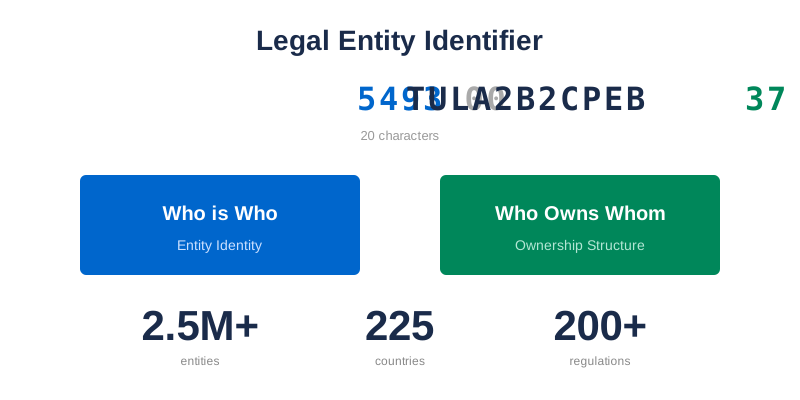
What is a Legal Entity Identifier (LEI)?
A Legal Entity Identifier (LEI) is a 20-character alphanumeric code that uniquely identifies any legal entity participating in financial transactions anywhere in the world.
Think of it as a global barcode for businesses. Just as a product barcode identifies a specific item on a shelf, an LEI identifies a specific company in the global financial system.
The LEI is based on the ISO 17442 standard. Every LEI connects to a set of reference data that answers two fundamental questions:
Who is who? (The entity's legal name, registered address, and formation details)
Who owns whom? (The entity's direct and ultimate parent companies)
Unlike national identifiers that only work within one country, the LEI works across all 195+ jurisdictions. A compliance officer in Singapore can verify a counterparty in Germany using the same system.
How the LEI Code is Structured
Every LEI follows the same 20-character format:
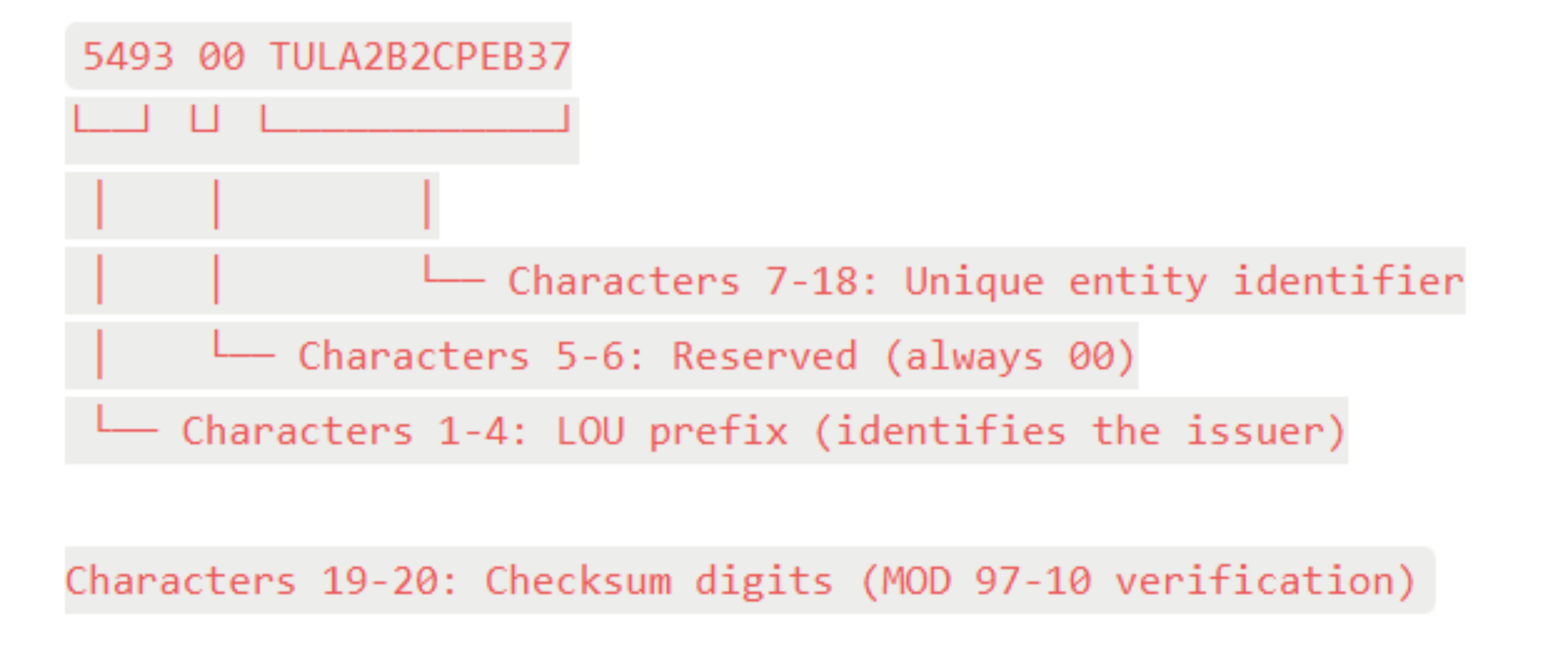 Example breakdown:
LEI | 549300TULA2B2CPEB37 |
|---|---|
LOU Prefix | 5493 (Bloomberg Finance L.P.) |
Reserved | 00 |
Entity ID | TULA2B2CPEB |
Checksum | 37 |
The structure ensures every LEI is globally unique. No two entities can share the same code, and the checksum catches typos during data entry.
Level 1 vs Level 2 Data: "Who is Who" vs "Who Owns Whom"
The LEI system provides two tiers of reference data:
Level 1 Data (Who is Who)
This is the "business card" information for every entity:
Legal name and any trading names
Registered address and headquarters address
Country of formation and legal jurisdiction
Entity status (active, inactive, merged)
Registration date and next renewal date
Legal form (corporation, LLC, trust, fund, etc.)
Level 2 Data (Who Owns Whom)
This reveals corporate ownership structures:
Direct parent entity (immediate owner)
Ultimate parent entity (top of the ownership chain)
Subsidiary relationships (entities owned by the LEI holder)
Percentage of ownership where disclosed
Level 2 data is what makes the LEI system powerful for compliance. It allows you to trace ownership across borders and through complex corporate structures—something impossible with national registries alone.
Why Was the LEI Created?
The 2008 financial crisis exposed a critical gap: there was no way to identify counterparties consistently across the global financial system.
When Lehman Brothers collapsed, regulators couldn't quickly determine which institutions had exposure. Different countries used different identification systems. The same entity might appear under multiple names across jurisdictions. Risk calculations were impossible at the speed the crisis demanded.
The timeline of LEI development:
Year | Milestone |
|---|---|
2011 | G20 Cannes Summit directs the Financial Stability Board (FSB) to develop a global LEI system |
2012 | LEI Regulatory Oversight Committee (ROC) established; first LEIs issued in December |
2014 | Global Legal Entity Identifier Foundation (GLEIF) created to operate the system |
2017 | EMIR mandates LEI for EU derivative reporting (Nov 1) |
2018 | MiFID II requires LEI for all securities trading in the EU (Jan 3) |
2020+ | Over 200 regulations globally now reference LEI requirements |
Today, more than 2.5 million LEIs have been issued to entities in over 225 countries and territories. The system processes millions of verification requests daily.
Who Needs an LEI?
The short answer: any legal entity that trades financial instruments, reports to regulators, or operates in regulated financial services.
The longer answer depends on your jurisdiction and business activities.
LEI Requirements in the EU (MiFID II, EMIR, SFTR)
The European Union has the most comprehensive LEI mandates:
MiFID II / MiFIR (since January 2018)
Any entity trading securities or derivatives on EU-regulated markets needs an LEI. This includes:
Investment firms executing or reporting trades
Corporate clients of EU brokers and banks
Non-EU entities trading with EU counterparties
Funds, trusts, and pension schemes making investment decisions
The rule is absolute: No LEI, no trade. EU investment firms cannot execute transactions for clients who lack a valid LEI.
EMIR (European Market Infrastructure Regulation)
All counterparties to derivative contracts reported to EU trade repositories must have an LEI. This covers:
OTC derivatives (swaps, forwards, options)
Exchange-traded derivatives
FX forwards (with limited exceptions)
SFTR (Securities Financing Transactions Regulation)
Since July 2021, entities involved in securities financing transactions (repos, securities lending, margin lending) must be identified by LEI in transaction reports.
LEI Requirements in the US (Dodd-Frank, SEC, CFTC)
US requirements are sector-specific but expanding:
CFTC (Commodity Futures Trading Commission)
Swap dealers and major swap participants must obtain LEIs
Counterparties to reportable swaps must be identified by LEI
Commodity pool operators and commodity trading advisors need LEIs
SEC (Securities and Exchange Commission)
Registered investment companies must report LEIs (Form N-PORT)
Security-based swap dealers require LEIs
Certain large traders may need LEI identification
Federal Reserve and FDIC
Foreign banking organizations may need LEIs for registry reporting
Certain insurance investment reporting requires LEI identification
LEI Requirements in UK, APAC & Other Jurisdictions
Post-Brexit, the UK onshored MiFID II and EMIR requirements. UK entities trading on UK markets need LEIs under UK MiFIR.
Asia-Pacific mandates include:
Australia (ASIC): Derivative transaction reporting requires LEI
Hong Kong (HKMA): OTC derivative reporting mandates LEI
Singapore (MAS): Derivative reporting rules reference LEI
Japan (FSA): Certain transaction reporting requires LEI
India (RBI, SEBI): LEI required for large corporate borrowers and market participants
The trend is clear: LEI requirements are expanding globally. Even if your jurisdiction doesn't mandate LEI today, your counterparties' jurisdictions might—which effectively makes it your requirement too.
Entities That Typically Need an LEI
Entity Type | LEI Required? |
|---|---|
Banks and financial institutions | Yes |
Investment funds and sub-funds | Yes (each fund separately) |
Pension funds | Yes |
Insurance companies trading instruments | Yes |
Corporates trading derivatives or securities | Yes |
Holding companies with financial subsidiaries | Yes |
Trusts participating in financial transactions | Yes |
Government entities in financial markets | Yes |
Sole proprietors (non-trading) | Generally no |
Individuals | No (LEI is for entities only) |
LEI vs Other Business Identifiers
The LEI isn't the only business identifier, but it serves a distinct purpose. Here's how it compares:
LEI vs DUNS Number
The D-U-N-S Number (Data Universal Numbering System) is a 9-digit identifier assigned by Dun & Bradstreet.
Factor | LEI | DUNS Number |
|---|---|---|
Issuer | GLEIF-accredited LOUs (30+ globally) | Dun & Bradstreet (single provider) |
Format | 20 alphanumeric characters | 9 digits |
Cost | $50-200/year (varies by LOU) | Free to obtain, data access is paid |
Data Access | Free and open (GLEIF database) | Proprietary (requires D&B subscription) |
Ownership Data | Included (Level 2 parent relationships) | Separate product (corporate linkage) |
Regulatory Status | ISO standard, mandated globally | Industry standard, not mandated |
Renewal | Annual verification required | No expiration |
Coverage | 2.5M+ entities | 500M+ entities |
Key difference: The LEI is an open standard with free data access. Anyone can search the GLEIF database and verify an entity's identity. DUNS data requires a commercial relationship with D&B.
When you need both: Many enterprises maintain both identifiers. DUNS provides broader coverage and credit data. LEI satisfies regulatory requirements and provides verified ownership data.
LEI vs Company Registration Number
Every country has its own company registration system. In the UK, it's Companies House. In Germany, it's the Handelsregister. In the US, it's 50+ Secretary of State offices.
Factor | LEI | Company Registration Number |
|---|---|---|
Scope | Global (single system) | National/regional only |
Standardization | Uniform 20-character format | Varies by jurisdiction |
Cross-border Use | Works everywhere | Requires jurisdiction knowledge |
Data Included | Standardized reference data + ownership | Varies by registry |
Verification | Annual renewal ensures accuracy | Static until company updates |
Key difference: Company registration numbers prove legal existence in one jurisdiction. LEIs provide a consistent identifier that works across all jurisdictions.
Practical example: A German company's Handelsregister number is meaningless to a compliance officer in Japan. But both can verify the same LEI in the GLEIF database.
LEI vs EIN / VAT ID / Tax ID
Tax identifiers serve fiscal authorities, not financial markets.
Identifier | Purpose | Scope |
|---|---|---|
LEI | Financial transaction identification | Global |
EIN (US) | IRS tax identification | US only |
VAT ID (EU) | Value-added tax compliance | EU member states |
TIN (various) | National tax administration | Country-specific |
Key difference: Tax IDs are issued by revenue authorities for tax collection. LEIs are issued for financial market transparency. A company might have an EIN, a VAT ID, and an LEI—each serving different regulatory purposes.
How to Get an LEI
Obtaining an LEI is straightforward. The process typically takes 1-3 business days.
Step-by-Step Application Process
Step 1: Choose an LEI Issuer (LOU)
GLEIF accredits Local Operating Units (LOUs) to issue LEIs. You can apply through any LOU regardless of your location. Factors to consider:
Pricing (registration and annual renewal)
Processing speed
Customer support quality
Multi-year discount options
Step 2: Gather Required Information
You'll need:
Legal name (exactly as registered)
Registered address
Headquarters address (if different)
Legal form (corporation, LLC, partnership, etc.)
Company registration number and registry name
Direct parent entity information (if applicable)
Ultimate parent entity information (if applicable)
Step 3: Submit Application
Complete the LOU's online application form. You may need to upload supporting documents:
Certificate of incorporation
Registry extract showing current status
Evidence of registered address
Step 4: Verification
The LOU verifies your information against official sources (company registries, regulatory databases). This typically takes 24-72 hours.
Step 5: Receive Your LEI
Once verified, your LEI is published in the Global LEI Index. You'll receive confirmation with your 20-character code.
LEI Costs and Renewal Requirements
LEI pricing varies by issuer and term length:
Term | Typical Cost Range |
|---|---|
1 year | $50 - $150 |
3 years | $120 - $300 |
5 years | $180 - $450 |
Annual renewal is mandatory. LEI reference data must be verified at least once per year. If you don't renew:
Your LEI status changes to "LAPSED"
Reference data may become stale
Some counterparties and systems reject lapsed LEIs
You may be unable to execute trades in regulated markets
Pro tip: Set up auto-renewal to avoid lapses. Most LOUs offer this option.
GLEIF-Accredited LEI Issuers (LOUs)
Major LEI issuers include:
LOU | Region Focus |
|---|---|
Bloomberg Finance L.P. | Global |
London Stock Exchange | UK, Europe |
DTCC (GMEI Utility) | US, Global |
Ubisecure (RapidLEI) | Global |
WM Datenservice | Germany, Europe |
Takasbank | Turkey, Middle East |
Nasdaq CSD | Nordics, Baltics |
The full list of GLEIF-accredited LOUs is available at gleif.org. All LOUs connect to the same Global LEI Index, so your LEI works the same regardless of which issuer you use.
How to Look Up and Verify an LEI
The Global LEI Index is freely searchable. No registration or subscription required.
Using the GLEIF LEI Search
Direct search at gleif.org:
Go to search.gleif.org
Enter company name or LEI code
Review the reference data returned
What you'll see:
LEI code and registration status (ISSUED, LAPSED, RETIRED)
Legal name and any other registered names
Registered address and headquarters
Legal jurisdiction and entity legal form
Registration date and next renewal date
Direct and ultimate parent entities (if reported)
LEI issuer (LOU) that manages the record
Status definitions:
Status | Meaning |
|---|---|
ISSUED | Active, verified within the last year |
LAPSED | Overdue for renewal, data may be stale |
RETIRED | Entity no longer exists or merged |
PENDING | Application in progress |
LEI Verification for KYB and Compliance
For compliance teams processing high volumes, manual GLEIF searches don't scale. This is where LEI verification integrates with broader KYB (Know Your Business) workflows.
What enterprise verification looks like:
Ingest: Receive counterparty data (name, jurisdiction, LEI if provided)
Match: Cross-reference against LEI database and company registries
Verify: Confirm LEI status is ISSUED and matches entity details
Enrich: Pull ownership data (Level 2) to identify ultimate beneficial owners
Monitor: Track for status changes, lapses, or corporate events
Integration points:
API access to LEI data (GLEIF provides a free API)
Batch verification for onboarding pipelines
Real-time checks during transaction processing
Alerts for LEI status changes
Search LEI Alongside Other Business Identifiers
Global Database allows you to search and verify LEIs alongside other key business identifiers in a single platform:
LEI — Legal Entity Identifier
Company Registration Numbers — From 200+ official government registries
VAT Numbers — European and international VAT validation
EIN — US Employer Identification Numbers
Tax IDs — Country-specific tax identifiers
This unified approach eliminates the need to check multiple databases. Instead of searching GLEIF for LEI, then Companies House for UK registration, then VIES for VAT validation—you verify everything in one lookup.
Global Database pulls LEI data and cross-references it with registry-sourced company information. This means you can confirm not just that an LEI exists, but that it matches the official company registration, current status, and address on file with government authorities.
LEI Data in Practice: Use Cases
KYB Onboarding and AML Compliance
Financial institutions use LEI as a foundational data point in customer due diligence:
During onboarding:
Verify the entity exists and is active
Confirm legal name matches documentation
Identify parent companies for group-level risk assessment
Cross-reference against sanctions and PEP databases
For ongoing monitoring:
Track LEI status changes (lapses, retirements)
Monitor for corporate restructuring
Detect ownership changes via Level 2 updates
The LEI doesn't replace KYB—it accelerates it. Having a verified LEI means you're starting with confirmed reference data rather than manually validating company documents.
M&A Due Diligence and Risk Assessment
Investment banks and corporate development teams use LEI data during transactions:
Target analysis:
Map the corporate structure using Level 2 relationships
Identify all subsidiaries that will transfer in the deal
Verify legal entities match the disclosed corporate family
Counterparty risk:
Confirm all entities in a transaction chain have active LEIs
Identify gaps where entities lack LEI coverage
Flag unusual ownership structures for deeper review
Regulatory Reporting and Transaction Transparency
The original purpose of LEI—and still its primary use:
Transaction reporting:
Derivatives trades (EMIR, Dodd-Frank)
Securities transactions (MiFIR)
Securities financing (SFTR)
Position reporting:
Aggregate position limits (MiFID II commodity derivatives)
Large trader reporting (SEC)
Systemic risk monitoring:
Regulators can aggregate exposures by entity and corporate group
Cross-border risk concentrations become visible
Interconnectedness between financial institutions can be mapped
LEI Limitations and Disadvantages
The LEI system has clear benefits, but it's not without drawbacks. Compliance teams should understand these limitations.
Data Freshness Depends on Renewal
LEI reference data is only as current as the last renewal. If a company doesn't pay its annual renewal fee:
The LEI status changes to LAPSED
Reference data (name, address, ownership) is not re-verified
The information may be months or years out of date
A lapsed LEI doesn't mean the data is wrong—it means nobody has confirmed it's still accurate. The company may have moved headquarters, changed legal name, or restructured ownership without the LEI record reflecting those changes.
The problem: Roughly 30% of LEIs are in LAPSED status at any given time. If you're relying on LEI data for due diligence, you may be working with stale information.
Annual Fee Creates Update Gaps
Unlike company registration numbers (which are maintained by government registries), LEI is a paid service. Companies must actively renew and pay fees to keep data current.
This creates a gap:
Company registry: Updated when the company files changes (legally required)
LEI record: Updated only if the company pays to renew
A company might file a change of directors with Companies House today, but that change won't appear in the LEI record until renewal—which could be 11 months away.
Coverage Gaps
Not every company has an LEI. The system covers primarily:
Financial institutions
Companies trading regulated instruments
Entities required by specific regulations
Many small and mid-sized businesses—especially those outside financial services—have no LEI at all. If your counterparty isn't in a regulated industry, they may not exist in the GLEIF database.
Ownership Data is Self-Reported
Level 2 data (parent relationships) relies on companies self-declaring their ownership structure. While LOUs verify against available sources, complex multinational structures may not be fully captured—especially where:
Ownership is held through nominee arrangements
Parent entities are in jurisdictions with limited transparency
The company chooses not to disclose relationships
What This Means for Due Diligence
LEI is a useful verification layer, but it shouldn't be your only source:
LEI Strength | LEI Weakness |
|---|---|
Global standard | Data freshness depends on renewal |
Ownership structure included | ~30% of LEIs are lapsed |
Free public access | Coverage limited to regulated entities |
ISO-standardized format | Self-reported ownership data |
Best practice: Cross-reference LEI data with official company registry records. Registry data is updated in real-time when companies file changes—it doesn't depend on annual renewal fees. Platforms like Global Database combine LEI verification with live registry data to give you both the global identifier and the authoritative source record.
The Future of LEI: vLEI and Digital Identity
The LEI system is evolving beyond static identifiers toward verifiable digital credentials.
Verifiable LEI (vLEI)
GLEIF launched the verifiable LEI (vLEI) program to enable automated, cryptographically secure verification of organizational identity.
What vLEI adds:
Digital credentials: LEI data packaged as verifiable credentials (W3C standard)
Instant verification: Cryptographic proof without database lookups
Role attestation: Verify that a person is authorized to act for an organization
Automated workflows: Machine-readable credentials for straight-through processing
Use cases emerging:
Digital signing of contracts with verified organizational identity
Automated KYB where credentials verify themselves
Supply chain verification with trusted entity identification
Cross-border payments with embedded counterparty verification
Expanding Adoption Beyond Finance
While LEI started in financial markets, adoption is expanding:
Government procurement: Some jurisdictions require LEI for government contract bidders
Supply chain compliance: Companies verifying suppliers across global networks
Digital trade documentation: LEI as the entity identifier in electronic bills of lading and trade finance
ESG reporting: Consistent entity identification for sustainability disclosures
The vision is an LEI for every legal entity in the global economy—not just those in financial services.
Frequently Asked Questions About LEI
What does LEI stand for?
LEI stands for Legal Entity Identifier. It's a 20-character code that uniquely identifies legal entities participating in financial transactions worldwide.How much does an LEI cost?
LEI costs typically range from $50 to $150 per year, depending on the issuer and term length. Multi-year packages offer discounts. Annual renewal is required.How long does it take to get an LEI?
Most LEI applications are processed within 1-3 business days. Some issuers offer expedited processing for an additional fee.Do individuals need an LEI?
No. LEIs are issued only to legal entities (companies, funds, trusts, government bodies). Individuals cannot obtain an LEI.What happens if my LEI lapses?
A lapsed LEI may prevent you from executing trades in regulated markets. Some counterparties and systems reject lapsed LEIs. Reference data becomes unverified and may be treated as unreliable.Can a company have more than one LEI?
No. Each legal entity can have only one LEI. If a company discovers duplicate LEIs, the records should be merged or retired.Do subsidiaries need their own LEIs?
Yes. Each legally distinct entity requires its own LEI. A parent company's LEI does not cover its subsidiaries.Is my LEI valid in all countries?
Yes. The LEI is a global standard. An LEI issued in any jurisdiction is valid and recognized worldwide.What's the difference between LEI and DUNS?
LEI is a global, open standard with free data access, mandated by financial regulators. DUNS is a proprietary identifier from Dun & Bradstreet with broader coverage but restricted data access. Many companies maintain both.How do I check if a company has an LEI?
Search the GLEIF database at search.gleif.org. Enter the company name or LEI code to view the reference data.
Verify Business Identity at Scale
The LEI is one piece of the entity verification puzzle. For compliance teams processing thousands of counterparties, you need more than LEI lookup—you need complete KYB verification that combines LEI status with registry data, ownership structures, and financial information.
Global Database provides LEI verification alongside company data from 200+ official government registries. Verify any entity's LEI, registration status, directors, shareholders, and financials in a single API call.