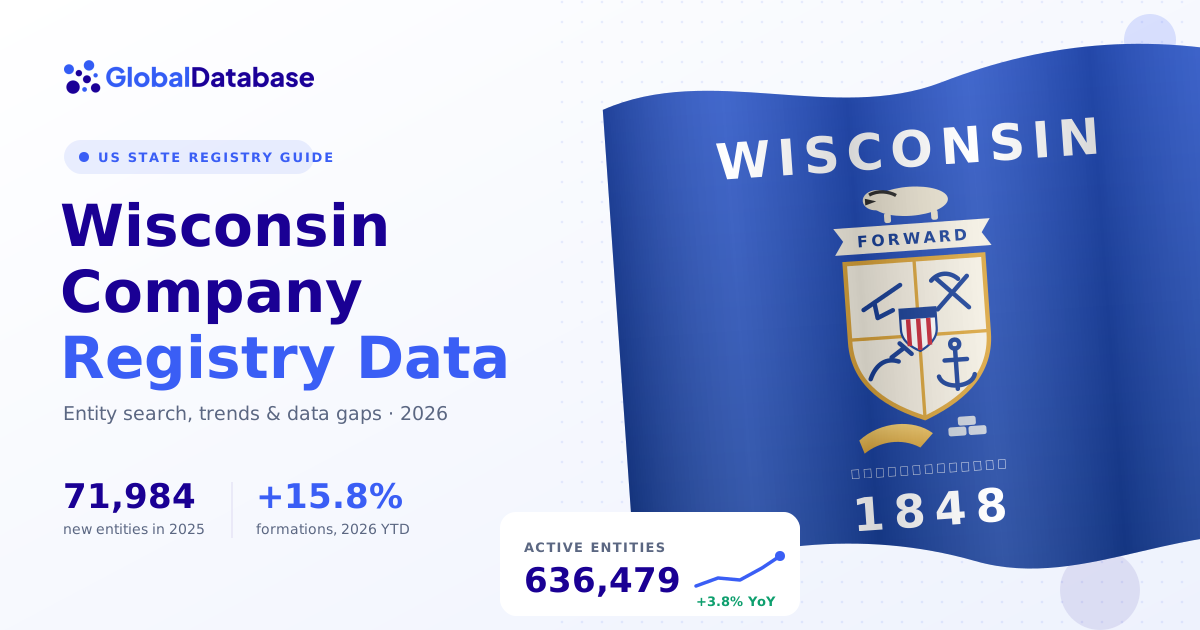
A Wisconsin business entity search is free, fast and surprisingly detailed — but it only answers one question at a time. Behind the search box sits a register of more than 636,000 active entities that grew faster in 2026 than in any of the previous three years. This guide breaks down how many companies are registered in Wisconsin, how many are active and inactive, how the numbers have moved year over year, what the Wisconsin Department of Financial Institutions (DFI) publishes, what it doesn't, and how to work with Wisconsin company data at scale.
Who keeps Wisconsin's company register?
Many people search for a "Wisconsin Secretary of State business search" — and end up confused. In Wisconsin, business entity records are not held by the Secretary of State. Formation filings, annual reports, registered agents and certificates of status are handled by the Department of Financial Institutions (DFI), through its Division of Corporate & Consumer Services. The public lookup tool is the DFI's Corporate Records Search, sometimes still called CRIS or "WDFI business search".
The register covers domestic and foreign (out-of-state) business corporations, LLCs, nonstock corporations, cooperatives, limited partnerships, limited liability partnerships and common law trusts. Sole proprietorships and most general partnerships do not appear, because Wisconsin does not require them to file a formation document — the DFI itself states that it is not a registry of every business operating in the state.
How many companies are registered in Wisconsin?
At the end of September 2026, the DFI counted 636,479 active entities. Of these, 585,998 are domestic entities formed under Wisconsin law and 50,481 (7.9%) are foreign entities registered to transact business in the state. The limited liability company dominates: three out of every four active Wisconsin entities is a domestic LLC.
Active Wisconsin entities by type
Domestic corporations combine business, service, close and service close corporations. "Other" includes limited partnerships, LLPs, cooperatives, foreign nonstock corporations, general partnerships, common law trusts and cemetery associations.
Registered vs. active vs. inactive
The DFI publishes a monthly count of active entities, but it does not publish a running total of inactive ones. Every dissolved, administratively dissolved, revoked, merged or withdrawn entity stays searchable in the Corporate Records Search with its history, so the full register — active plus historical — is considerably larger than the active count. To give a sense of scale, Global Database currently indexes 1.6 million company records linked to a Wisconsin location: about 688,000 active and 910,000 inactive or historical. That figure is broader than the DFI count because it also captures businesses that operate in Wisconsin but were formed in another state.
Wisconsin company trends: year-over-year growth
The active register has grown every year since 2022, adding roughly 72,500 entities in under four years (+12.9%). Growth slowed to 1.7% in 2024 as new formations dipped, then re-accelerated: 2025 added 16,606 entities, and in the first nine months of 2026 the register has already added 21,724 — more than in the whole of 2025.
Active entities on the Wisconsin register
"Domestic corporations" = DFI org type 01 (domestic business corporation). "Foreign entities" = foreign LLCs plus foreign business corporations.
| Period end | Active entities | Net change | YoY | Domestic LLCs | Domestic business corps |
|---|---|---|---|---|---|
| Dec 2022 | 563,926 | — | — | 409,352 | 55,434 |
| Dec 2023 | 588,388 | +24,462 | +4.3% | 434,279 | 54,076 |
| Dec 2024 | 598,149 | +9,761 | +1.7% | 443,629 | 52,215 |
| Dec 2025 | 614,755 | +16,606 | +2.8% | 461,746 | 50,701 |
| Sep 2026 | 636,479 | +21,724 YTD | +3.8%* | 480,678 | 49,627 |
*Compared with 613,038 active entities at the end of September 2025.
Three structural shifts stand out in the Wisconsin company data:
LLCs keep taking share. Domestic LLCs grew 17.4% between December 2022 and September 2026, while domestic business corporations fell 10.5% — a net loss of about 5,800 corporations as owners dissolve, convert or simply stop forming new ones.
Out-of-state companies are arriving faster. Foreign LLCs registered in Wisconsin are up 38.1% over the same period, and new foreign registrations jumped 27.1% in 2025. For anyone checking counterparties, that means a growing share of Wisconsin-active businesses has its primary record in another state's registry.
Limited partnerships collapsed. Active domestic limited partnerships fell from 5,419 to 1,589 (−70.7%). The drop follows the introduction of annual reports for Chapter 179 limited partnerships from January 2023; in 2025 alone, 2,935 LPs were administratively dissolved for failing to file them.
New business formations in Wisconsin
After three soft years, new business filings in Wisconsin rebounded strongly. The DFI recorded 71,984 new entities in 2025 (+12.6%) — the highest annual total of the last five years — and 2026 is running even hotter, with 63,531 formations to the end of September, up 15.8% on the same period of 2025. Domestic LLCs account for about 85% of everything formed.
New entities formed or registered in Wisconsin
2026 annual bar covers January–September only. Every month of 2026 so far has beaten the same month of 2025.
| Year | Total new entities | YoY | Domestic LLCs | Domestic business corps | Foreign (out-of-state) |
|---|---|---|---|---|---|
| 2021 | 71,151 | — | 60,490 | 2,571 | 5,614 |
| 2022 | 70,148 | −1.4% | 59,400 | 2,435 | 5,865 |
| 2023 | 66,325 | −5.4% | 57,692 | 2,450 | 3,990 |
| 2024 | 63,949 | −3.6% | 54,463 | 2,355 | 4,799 |
| 2025 | 71,984 | +12.6% | 60,870 | 2,329 | 6,098 |
| 2026 (Jan–Sep) | 63,531 | +15.8% | 54,476 | 2,002 | 4,903 |
Where Wisconsin companies are based
The DFI does not publish company counts by city or county, so we used Global Database's Wisconsin records to map where active companies have their business address. Milwaukee and Madison together account for more than 52,000 active company records — roughly the next ten cities combined — while the Fox Valley corridor (Green Bay, Appleton, Oshkosh) forms a clear third cluster.
Top Wisconsin cities by active companies
Counts are based on the city in each company's business address and include companies formed in other states that operate from Wisconsin.
Wisconsin companies by industry
The state register holds no industry codes at all — a Wisconsin business entity search will never tell you what a company does. Where Global Database has classified Wisconsin companies by NAICS sector, personal and repair services, construction, retail and professional services lead by count, with manufacturing — the backbone of the state's economy — in fifth place by number of companies.
Active Wisconsin companies by NAICS sector
Sectors follow NAICS: "Other services" covers repair, maintenance and personal services; "Admin & support" includes staffing, facilities and waste services. A company can carry more than one sector code; only companies with an assigned classification are counted.
How Wisconsin companies become inactive
Growth in the active count is the difference between two large flows. In 2025, roughly 76,500 entities entered or re-entered the active register (71,984 new plus 4,514 reinstatements), while 56,219 left it. Most exits are not deliberate: administrative dissolution for unfiled annual reports removed 43,787 entities in 2025, five times more than the 8,493 owners who filed voluntary articles of dissolution.
Where the Wisconsin register gains and loses entities
Administrative dissolutions run in quarterly sweeps (March, June, September, December). Foreign revocations cluster in October, after the four-month grace period that follows foreign annual reports due on 31 March.
The quarterly rhythm matters for risk teams. A company that looked "active" in a search in February can be administratively dissolved in March — and 61,687 entities had to file to cure a delinquent status during 2025, a reminder of how many businesses drift out of good standing before they are formally dissolved. A one-off lookup captures the status on the day you check it; it does not tell you when it changes.
Wisconsin vs. neighbouring states
State registers count companies in different ways, so the cleanest like-for-like comparison is the federal measure of new business applications (requests for an employer identification number). In the first nine months of 2026, Wisconsin recorded 60,944 business applications — about 10.2 per 1,000 residents. That puts it behind Michigan, Illinois and Minnesota on start-up intensity, but ahead of Iowa.
New business applications per 1,000 residents
| State | Business applications Jan–Sep 2026 | Per 1,000 residents | Company register |
|---|---|---|---|
| Michigan | 131,698 | 13.0 | LARA — 1,152,821 corporations and LLCs in good standing (Oct 2025) |
| Illinois | 150,514 | 11.8 | Secretary of State |
| Minnesota | 63,322 | 10.9 | Secretary of State |
| Wisconsin | 60,944 | 10.2 | DFI — 636,479 active entities (Sep 2026) |
| Iowa | 30,457 | 9.4 | Secretary of State |
Two practical points follow. First, Wisconsin is one of the few states where business registration sits outside the Secretary of State, which trips up many searches. Second, a supplier or customer "in Wisconsin" may well hold its primary registration in Illinois, Minnesota or Michigan — so any serious check has to look across state lines. Our state-by-state guide to official business registries lists where to search in all 50 states and DC.
What information is available in a Wisconsin business entity search?
The DFI's Corporate Records Search is one of the more open US state registers: no login, no fee for viewing a record, and both current and historical names are searchable. Here is what you can and cannot get from it.
| Data point | Wisconsin DFI | Notes |
|---|---|---|
| Legal name, old names, entity ID | Available | Search by name, keyword or registered agent |
| Entity type and status, with status date | Available | Incorporated/Registered, Delinquent, Administratively Dissolved, Revoked, Merged, etc. |
| Registered effective date, period of existence | Available | Foreign records also show home state and foreign formation date |
| Registered agent and registered office | Available | Updated via annual report or statement of change |
| Principal office address | Available | As reported by the entity |
| Annual report history and filing chronology | Available | Amendments, mergers, conversions, dissolutions |
| Filed document images and certificates of status | Paid | Certificate of status $10; certified copies $10, simple copies $5 |
| Officers and directors | Limited | Corporations list them on annual reports, but they are excluded from DFI bulk data |
| LLC members, owners and shareholders | Not held | DFI states it does not hold owner or member information |
| Beneficial ownership | Not held | Not collected by the state; US companies were exempted from federal BOI reporting in 2025 |
| Financial statements, revenue, employees | Not held | Wisconsin private companies file no accounts with the DFI |
| Industry codes, website, phone, email | Not held | Must come from other sources |
| Sole proprietorships, most general partnerships | Not held | No formation filing required |
Checking and reserving a business name
A Wisconsin business name search uses the same DFI tool: search the exact phrase and keyword variants, include old names, and check both active and inactive records — names of dissolved entities can still conflict for a period. To hold a name before filing, submit a name reservation application (Form 1). A standard reservation costs $15 ($10 for nonstock corporations and limited partnerships) and lasts 120 days (60 days for limited partnerships). Entities changing their name, merging or dissolving can reserve their old name for up to 10 years.
Check a Wisconsin annual report deadline
Wisconsin's annual report calendar is unusual: domestic entities file by the end of the calendar quarter in which their formation anniversary falls, starting the year after formation, while foreign entities all file by 31 March. Missing reports leads to delinquency and, eventually, administrative dissolution. Use the tool below to see when a given entity's report is due.
| Common DFI fees | Online | Paper |
|---|---|---|
| Domestic LLC — articles of organization | $130 | $170 |
| Business corporation — articles of incorporation | $100 | $100 |
| Nonstock corporation — articles of incorporation | $35 | $35 |
| Annual report — domestic LLC, corporation or nonstock | $25 | $40 |
| Annual report — foreign LLC, corporation or nonstock | $65 | $80 |
| Certificate of status | $10 | — |
| Certified copy / simple copy of a filed document | $10 / $5 | $10 / $5 |
| Name reservation (120 days) | $15 | $15 |
Where to get Wisconsin company data
| Source | Best for | Format and cost |
|---|---|---|
| DFI Corporate Records Search | Checking one entity's status, agent and history | Web lookup, free |
| DFI certificates and copies | Certificate of status, certified filings for banks and lenders | $10 per certificate or certified copy |
| DFI Corporation Master File | A full snapshot of the register | .txt via ShareFile, by request (Form 51); no officers |
| DFI monthly new-entity file | Lead lists of newly formed entities | .txt and .xlsx by email, $5/month |
| DFI statistics reports | Active counts, new formations, filing volumes | Monthly PDFs |
| DFI UCC lien search | Secured lending checks | Separate search system |
| Global Database | Wisconsin and all other US states in one schema, with monitoring, API, MCP and bulk delivery | Platform, API, MCP connectors, bulk feeds |
Wisconsin plus all other 49 states, DC and Puerto Rico — collected directly from the registries and delivered as one standardised bulk file, ready to load into your warehouse.
Limitations of Wisconsin registry data
No ownership. The DFI holds no LLC member or shareholder information, and the federal beneficial ownership register no longer applies to US companies. A Wisconsin search alone cannot tell you who owns or controls a business.
No financials. Private Wisconsin companies do not file accounts with the state, so there is no revenue, profit or balance sheet data in the register.
Status is a filing status, not a health check. The DFI explicitly says that an entity's status reflects compliance with filing requirements, not its financial condition or whether it operates legally. A delinquent company may be trading normally; an "incorporated" one may be dormant.
Point-in-time only. The free search has no alerts. With administrative dissolutions arriving in quarterly waves of 8,000–10,000 entities, a status checked once can be stale within weeks.
Single-state view. 50,481 active entities in Wisconsin are foreign registrations whose ownership changes, mergers and dissolutions are filed first in their home state. And a business formed in another state can be based in Wisconsin without its full corporate history ever appearing in the DFI record.
Bulk data is thin. The DFI master file covers name, agent, type, dates, status and an annual report indicator — no officers, no principal office history, no industry codes — and it arrives as a flat text file that you must parse, match and refresh yourself.
How Global Database adds value to Wisconsin company data
Global Database collects company data directly from official registries and standardises it into a single schema. For Wisconsin that means the DFI record sits next to the records of all 50 states, Washington DC and Puerto Rico, so a Wisconsin foreign registration can be linked back to its home-state entity in one query.
One schema across US states. Statuses, entity types and addresses are normalised, so "Administratively Dissolved" in Wisconsin and "Forfeited" elsewhere can be filtered the same way.
Monitoring instead of re-checking. Watch a portfolio of Wisconsin counterparties and get notified when an entity's status changes — delinquency, administrative or voluntary dissolution, revocation or merger, the events behind tens of thousands of Wisconsin status changes every year.
Enrichment beyond the register. Where available, registry records are enriched with industry classification, websites, phone numbers, corporate linkage and digital signals, giving sales and risk teams the context the DFI does not collect.
Delivery that fits your stack. Query through the web platform, REST API, MCP server for Claude and ChatGPT, the Global Database app for Microsoft Copilot, or receive full Wisconsin and US bulk files with daily change feeds for your data warehouse.
Clear provenance. Every record carries its registry source and update timestamp, which matters when a KYB decision has to be explained to an auditor.
Daily change feeds for new, updated and dissolved companies across all 50 states, DC and Puerto Rico — or monitoring on your own customer and supplier lists.
Frequently asked questions
How do I do a Wisconsin business entity search?
Use the Wisconsin Department of Financial Institutions (DFI) Corporate Records Search. You can search by entity name, keyword or registered agent, filter by entity type and status, and open a record to see its entity ID, status, registered agent, principal office, annual report history and filing chronology. Viewing records is free.
Does the Wisconsin Secretary of State handle business searches?
No. In Wisconsin, business entity registration and records are maintained by the Department of Financial Institutions, not the Secretary of State. A "Wisconsin Secretary of State business search" should be done on the DFI Corporate Records Search.
How many businesses are registered in Wisconsin?
The DFI counted 636,479 active entities at the end of September 2026, up 3.8% year over year. That includes 480,678 domestic LLCs, 49,627 domestic business corporations, 42,456 nonstock corporations and 50,481 foreign entities registered to do business in Wisconsin. Inactive and historical entities are not counted in that figure.
How many new businesses are formed in Wisconsin each year?
Wisconsin recorded 71,984 new business entities in 2025, a 12.6% increase on 2024. In the first nine months of 2026, 63,531 entities were formed, 15.8% more than in the same period of 2025. About 85% of new filings are domestic LLCs.
How can I do a Wisconsin LLC lookup by owner name?
You can't through the DFI. The department does not hold LLC member or owner information, so a Wisconsin LLC search only returns the entity, its registered agent and its addresses. You can search by registered agent name, but ownership has to be established through other documents or data providers.
When is a Wisconsin LLC annual report due?
A domestic Wisconsin LLC files its annual report by the last day of the calendar quarter in which its formation anniversary falls, starting the year after it was formed — for example, an LLC formed in August files by 30 September each year. Foreign entities file by 31 March. The online fee is $25 for a domestic LLC and $65 for a foreign LLC.
What does administratively dissolved mean in Wisconsin?
It means the DFI dissolved the entity because it failed to file annual reports for several years. The DFI sends notices, publishes a Notice of Administrative Dissolution, and issues a certificate of dissolution 60 days later if no report is filed. In 2025, 43,787 Wisconsin entities were administratively dissolved. Dissolved entities can apply for reinstatement.
Can I download a list of all Wisconsin companies?
Yes. The DFI sells a Corporation Master File and a monthly file of newly formed entities ($5 per month), containing name, registered agent and office, entity type, formation date, status and an annual report indicator. Officers are not included. Providers such as Global Database deliver Wisconsin data in a standardised format alongside all other US states, with daily change feeds.
Does the Wisconsin company register include financial information?
No. Private Wisconsin companies do not file financial statements with the DFI, so the register contains no revenue, profit or employee data. An entity's status reflects only whether it is current with its filing obligations, not its financial health.
How can I monitor Wisconsin companies for status changes?
The DFI search has no alert function, so changes such as delinquency, administrative dissolution or revocation are only visible if you re-check each record. Global Database lets you monitor Wisconsin entities, receive status-change notifications, and access the data through an API, MCP connectors for Claude and ChatGPT, or bulk feeds.