How to Verify Any Company for Free: 5 Best Tools in 2026

by Nicolae Buldumac
· 01/09/2026 09:17 · 15 min read
How to Verify Any Company for Free: 5 Best Tools in 2026

Why Does Business Verification Matter in 2026?

If you need to verify a company for free, you're not alone. Millions of businesses run company due diligence checks every day — and for good reason.

Fraud is expensive. In 2025 alone, businesses lost over $4.7 trillion globally to financial crime, according to Nasdaq's Global Financial Crime Report. Shell companies, fake suppliers, and fraudulent partners account for a significant portion of that number.

The problem is getting worse.

AI-generated documents, synthetic identities, and sophisticated corporate structures make it harder than ever to know who you're really doing business with. A professional website and a LinkedIn page mean nothing. Scammers can spin up a convincing "company" in hours.

This is why business verification — also called Know Your Business (KYB) — has moved from a compliance checkbox to a survival skill.

Three reasons KYB verification is non-negotiable in 2026:

  1. Regulatory pressure is intensifying. AML directives in the EU, the Corporate Transparency Act in the US, and similar legislation worldwide now mandate that companies verify business partners and identify ultimate beneficial owners (UBOs). Non-compliance carries heavy fines. In some cases, personal liability for executives.

  2. Supply chain risk is real. One bad vendor can expose your entire operation. Whether it's a supplier who doesn't actually exist or a partner hiding beneficial owners on sanctions lists, the downstream damage — financial, legal, reputational — can be catastrophic.

  3. Trust drives deals. Enterprise buyers and investors conduct corporate due diligence before signing anything. If you can't verify a potential partner using a company registry or verification tool quickly, you lose the deal. Speed matters.

The good news? You don't need expensive subscriptions to run basic company verification checks. Free business verification tools exist — and they're more powerful than most people realize.

Let's look at what separates a good verification tool from a useless one.

5 Best Free Business Verification Tools in 2026

These are the most reliable free tools for verifying company information in 2026. Each serves a different purpose. Some excel at global coverage. Others go deep on a single market. The smartest approach is using them together.

Global Database Browser Extension

tg_image_3072629751 1.svg

Best for: Instant verification while browsing — on any website or LinkedIn profile.

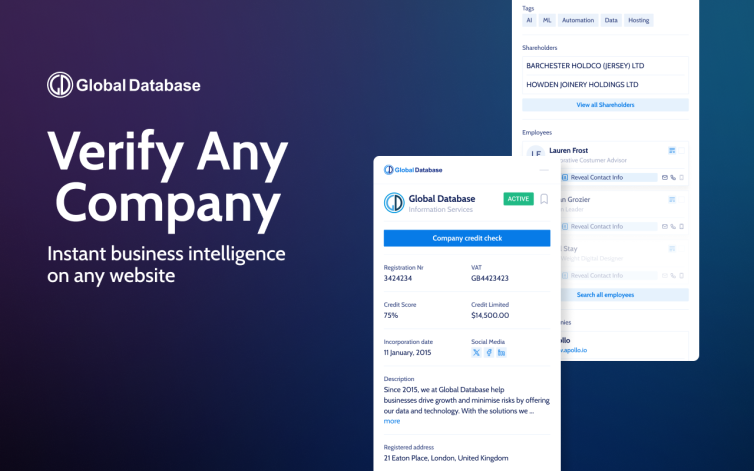
The Global Database Browser Extension transforms your browser into a real-time company verification tool. Instead of switching between tabs and searching registries manually, you get verified company data overlaid directly on the pages you're already viewing.

This is particularly useful for sales teams prospecting on LinkedIn or compliance officers reviewing supplier websites. One click reveals whether a company is active, its registration number, VAT ID, financial health, and ownership structure.

What you get for free:

  • Company registration status and legal identifiers

  • 20 years of financial history (select markets)

  • Shareholder and group structure visibility

  • Credit scores and credit limits

  • Contact details for key executives

  • Works on LinkedIn and any website

Data source: Official government registries — over 200 worldwide. Global Database pulls first-party data directly from Companies House, commercial registers, and tax authorities — not scraped or aggregated datasets.

Coverage: 600+ million companies across 195 countries.

Pros & Cons

Pros

Cons

✅ Free browser extension with no signup required

⚠️ Bulk verification and API require paid subscription

✅ First-party data from 200+ official government registries

⚠️ Real-time monitoring not available in free tier

✅ Works directly on LinkedIn and any website

⚠️ Deepest financial data limited to select markets

✅ Includes financials, credit scores, and ownership — rare for free tools

✅ Covers 600M+ companies globally

Who Should Use Global Database?

Use Case

Fit

Sales teams verifying prospects on LinkedIn

✅ Excellent

Compliance officers doing pre-onboarding checks

✅ Excellent

Investors researching potential targets

✅ Excellent

Procurement teams vetting suppliers

✅ Excellent

Developers needing API access

⚠️ Paid plans only

High-volume KYB screening (1000+ checks/month)

⚠️ Paid plans only

How to Get Started with Global Database

Step 1: Go to globaldatabase.com/outreach and download the free browser extension.

Step 2: Pin the extension to your browser toolbar for easy access.

Step 3: Navigate to any company website or LinkedIn company page.

Step 4: Click the Global Database icon — verified company data appears instantly.

Step 5: Review registration status, financials, ownership, and contacts before engaging.

No account creation required. Install and start verifying companies in under 60 seconds.

Limitations: Advanced features like bulk verification, API access, and real-time monitoring require a paid subscription. The free extension provides significant depth for individual lookups but isn't designed for high-volume KYB workflows.

Ideal use case: You're on a prospect's LinkedIn page or company website and need to verify they're a legitimate, active business before engaging. One click. Instant answer.

🔗 Download the Global Database Browser Extension

Frequently Asked Questions About Global Database Browser Extension

  1. Is the Global Database Browser Extension really free?
    Yes. The browser extension is completely free to download and use. You can verify company registration status, view financial history, check ownership structures, and access credit scores without paying. Advanced features like bulk lookups, API integration, and real-time monitoring are available through paid plans, but individual company checks through the extension cost nothing.

  2. What company data can I see with the Global Database extension?
    The free extension provides registration status, company registration numbers, VAT and tax IDs, 20 years of financial history, shareholder and group structures, credit scores, credit limits, and contact details for key executives. Data is sourced directly from over 200 official government registries worldwide — covering 600+ million companies across 195 countries.

  3. Does Global Database work on LinkedIn?
    Yes. The extension integrates directly with LinkedIn. When you view a company page or individual profile, it automatically surfaces verified company data — registration status, financials, ownership, and contacts — without leaving the page. This makes it particularly useful for sales prospecting and pre-call research.

  4. Where does Global Database get its company information?
    Global Database pulls first-party data directly from official government registries — over 200 sources including Companies House, commercial registers, Chambers of Commerce, and tax authorities. Unlike aggregators that scrape or resell third-party data, Global Database connects to primary sources, ensuring accuracy and freshness.

  5. How is Global Database different from OpenCorporates or Companies House?
    Companies House covers only UK-registered entities. OpenCorporates aggregates basic registration data across 140+ countries but lacks financial depth. Global Database combines broad global coverage (600+ million companies, 195 countries) with deep data — including 20 years of financials, credit scores, UBO structures, and executive contacts — all accessible instantly through a free browser extension.

Companies House (UK)
Untitled.svg

Best for: Verifying UK-registered companies with official government data.

Companies House is the UK's official registrar of companies. Every limited company, LLP, and PLC registered in England, Wales, Scotland, or Northern Ireland appears in this free database. It's the authoritative source — not a third-party aggregator.

If you're doing business with a UK company, this is where you start. The data comes directly from company filings, making it the most reliable source for verifying UK business entities.

What you get for free:

  • Company registration number and status (active, dissolved, liquidation)

  • Registered office address

  • Incorporation date and company type

  • Current and past directors and secretaries

  • Persons with Significant Control (PSC) — UK's UBO register

  • Full filing history including annual accounts

  • Document images (accounts, confirmation statements, resolutions)

  • Email alerts when a company files new documents

Data source: UK Government official registry. Data is uploaded directly by companies as part of their legal filing obligations under the Companies Act 2006.

Coverage: 5+ million UK companies. Includes active companies, dissolved entities, and overseas companies registered in the UK.

Pros & Cons

Pros

Cons

✅ 100% free with no account required for searches

⚠️ Only covers UK-registered entities

✅ Official government source — most authoritative UK data

⚠️ Financial depth depends on company filing type

✅ Includes PSC (beneficial ownership) information

⚠️ Small companies can file abbreviated accounts

✅ Full filing history and document downloads

⚠️ No credit scores or risk ratings

✅ Email alerts for company changes available

⚠️ Does not verify accuracy of submitted information

Who Should Use Companies House?

Use Case

Fit

Verifying UK suppliers or partners

✅ Excellent

Checking director history and appointments

✅ Excellent

Reviewing UK company financials and filings

✅ Excellent

Identifying UK beneficial owners (PSCs)

✅ Excellent

Verifying companies outside the UK

❌ Not supported

Credit risk assessment

⚠️ Limited — no credit scores

How to Verify a Company on Companies House

Step 1: Go to find-and-update.company-information.service.gov.uk

Step 2: Enter the company name, registration number, or officer name in the search bar.

Step 3: Select the correct company from the results list.

Step 4: Review the overview page — status, registered address, incorporation date, and SIC codes.

Step 5: Click "People" to view current and former directors and PSCs.

Step 6: Click "Filing history" to download accounts, confirmation statements, and other documents.

Optional: Create a free account to set up email alerts and follow companies for filing updates.

Limitations: Companies House only covers UK-registered entities. It cannot verify companies in other jurisdictions. Financial data quality varies — small companies can submit abbreviated or micro-entity accounts with minimal detail. Importantly, Companies House does not verify the accuracy of information submitted; it only confirms that filings are complete and on time.

Ideal use case: You're onboarding a UK supplier, vetting a potential business partner, or conducting due diligence on a UK acquisition target. You need official registration status, director names, ownership details, and filed accounts — all from the authoritative source.

Frequently Asked Questions About Companies House

  1. Is Companies House free to use?
    Yes. Searching the Companies House register is completely free. You can view company details, director information, PSC data, and filing history without paying. Downloading most documents is also free. Some premium services — like ordering certified copies or expedited filings — have fees, but standard verification searches cost nothing.

  2. What information does Companies House provide?
    Companies House provides company registration number, status (active/dissolved), registered address, incorporation date, company type, SIC codes, current and former directors, secretaries, Persons with Significant Control (beneficial owners), and full filing history. You can download annual accounts, confirmation statements, and other official documents directly from the site.

  3. Does Companies House show who owns a company?
    Yes. Since 2016, UK companies must report Persons with Significant Control (PSCs) — individuals who own more than 25% of shares or voting rights, or who otherwise control the company. PSC information is publicly available on Companies House for free. However, complex ownership structures involving foreign entities may not be fully visible.

  4. How accurate is Companies House data?
    Companies House data comes directly from company filings. However, Companies House does not verify the accuracy of information submitted — it only checks that filings are complete. Directors and companies are legally responsible for the accuracy of their submissions. For high-stakes due diligence, cross-reference Companies House data with other sources like credit agencies or official financial audits.

  5. Can I use Companies House to verify non-UK companies?
    No. Companies House only covers entities registered in England, Wales, Scotland, or Northern Ireland. For non-UK companies, use tools like OpenCorporates for multi-jurisdiction searches, or Global Database for global coverage across 195 countries. Some overseas companies with UK establishments do appear on Companies House, but their full corporate details remain in their home jurisdiction.

OpenCorporates
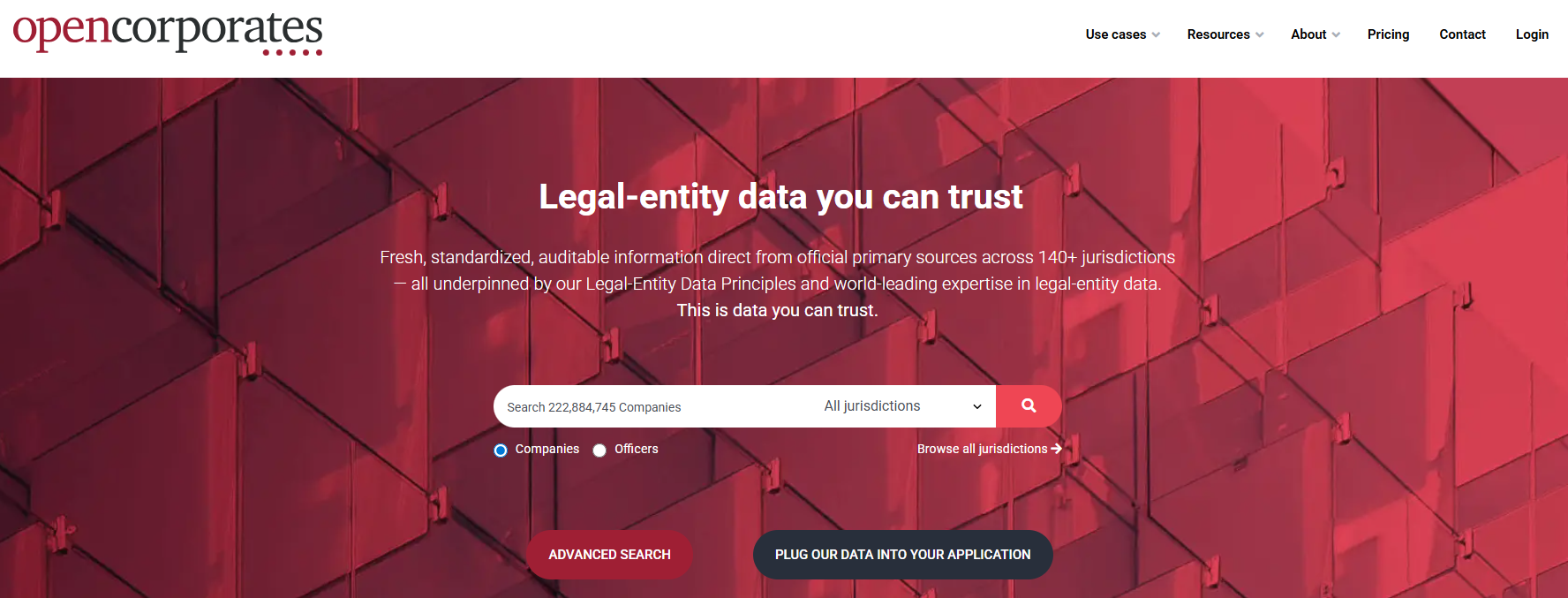
open.pngBest for: Searching company records across 140+ jurisdictions in one place.

OpenCorporates is the world's largest open database of companies. It aggregates official registry data from over 140 countries into a single searchable interface. For investigators, compliance teams, and researchers who need to verify entities across borders, it's an essential free resource.

The platform was built on open data principles. Basic company information is freely accessible to everyone. The goal is corporate transparency — making it harder for shell companies and fraudulent entities to hide behind complex international structures.

What you get for free:

  • Company name, registration number, and jurisdiction

  • Incorporation and dissolution dates

  • Company status (active, inactive, dissolved)

  • Registered address

  • Director and officer names

  • Links to original source registries

  • Basic search across all jurisdictions

  • Officer search to find individuals across companies

Data source: Aggregated from official government registries worldwide. OpenCorporates standardizes data formats across jurisdictions, making cross-border company searches possible through a single interface.

Coverage: 230+ million companies across 140+ jurisdictions including the US (all 50 states), UK, EU member states, and many offshore financial centres like the British Virgin Islands, Cayman Islands, and Panama.

Pros & Cons

Pros

Cons

✅ Largest open company database — 230M+ companies

⚠️ Data depth varies significantly by jurisdiction

✅ Covers 140+ jurisdictions in one search

⚠️ No financial data in free tier

✅ Free to search without account

⚠️ UBO/ownership data generally not available

✅ Links to original source registries

⚠️ Advanced search and bulk export require paid plans

✅ Officer search across multiple companies

⚠️ Some jurisdictions have limited or outdated data

✅ Open data principles — transparency-focused

Who Should Use OpenCorporates?

Use Case

Fit

Cross-border company verification

✅ Excellent

Investigating corporate networks across jurisdictions

✅ Excellent

Finding all companies linked to a specific officer

✅ Excellent

Journalists and researchers tracking shell companies

✅ Excellent

Checking company financials

❌ Not supported

Credit risk assessment

❌ Not supported

Deep UBO analysis

⚠️ Limited — basic officer data only

How to Verify a Company on OpenCorporates

Step 1: Go to opencorporates.com

Step 2: Enter the company name in the search bar. Select "Companies" to search entities or "Officers" to search individuals.

Step 3: Use the jurisdiction dropdown to narrow results to a specific country or search globally.

Step 4: Select the correct company from the results list.

Step 5: Review company details — registration number, status, incorporation date, registered address, and jurisdiction.

Step 6: Click on officer names to see their other company appointments across the database.

Step 7: Use the "Source" link to visit the original government registry for additional details.

No account required for basic searches. Create a free account to save searches and access additional features.

Limitations: Depth of data varies significantly by country. Some registries provide full director and ownership details; others only offer company name and status. Financial data, credit scores, and UBO information are not available in the free tier. Advanced search filters, bulk downloads, and API access require a paid subscription. Data freshness depends on how frequently OpenCorporates syncs with each source registry.

Ideal use case: You need to verify whether a company exists in an unfamiliar jurisdiction, trace an officer's involvement across multiple entities, or cross-check a company's registration in several countries. OpenCorporates excels at breadth — answering "does this company exist and where?" across borders.

Frequently Asked Questions About OpenCorporates

  1. Is OpenCorporates free to use?
    Yes. Basic company searches on OpenCorporates are free and require no account. You can search for companies and officers across 140+ jurisdictions, view registration details, and access links to original source registries. Advanced features — including bulk data exports, API access, and enhanced search filters — require a paid subscription.

  2. How many companies does OpenCorporates cover?
    OpenCorporates contains data on over 230 million companies from 140+ jurisdictions worldwide. Coverage includes all 50 US states, the UK, EU member states, and many offshore financial centres. It is the largest open database of company information in the world, aggregated from official government registries.

  3. Does OpenCorporates show company ownership?
    OpenCorporates provides basic officer information — directors, secretaries, and registered agents — but does not typically show full ownership structures or ultimate beneficial owners (UBOs). For detailed ownership and shareholder data, you'll need to visit the original source registry or use tools like Global Database that specialize in UBO discovery.

  4. Where does OpenCorporates get its data?
    OpenCorporates aggregates data from official government registries worldwide. The platform standardizes information from different jurisdictions into a consistent format, making cross-border searches possible. Each company record includes a link to the original source registry, allowing users to verify data directly with the authoritative source.

  5. How is OpenCorporates different from Global Database?
    OpenCorporates focuses on breadth — aggregating basic registration data across 140+ jurisdictions into one searchable database. Global Database focuses on both breadth and depth — covering 600M+ companies across 195 countries while also providing financials, credit scores, UBO structures, and executive contacts. OpenCorporates is best for cross-border existence checks; Global Database is better for comprehensive due diligence.

Zephira.ai
zeph.png

Best for: AI-powered company verification with real-time global registry access.

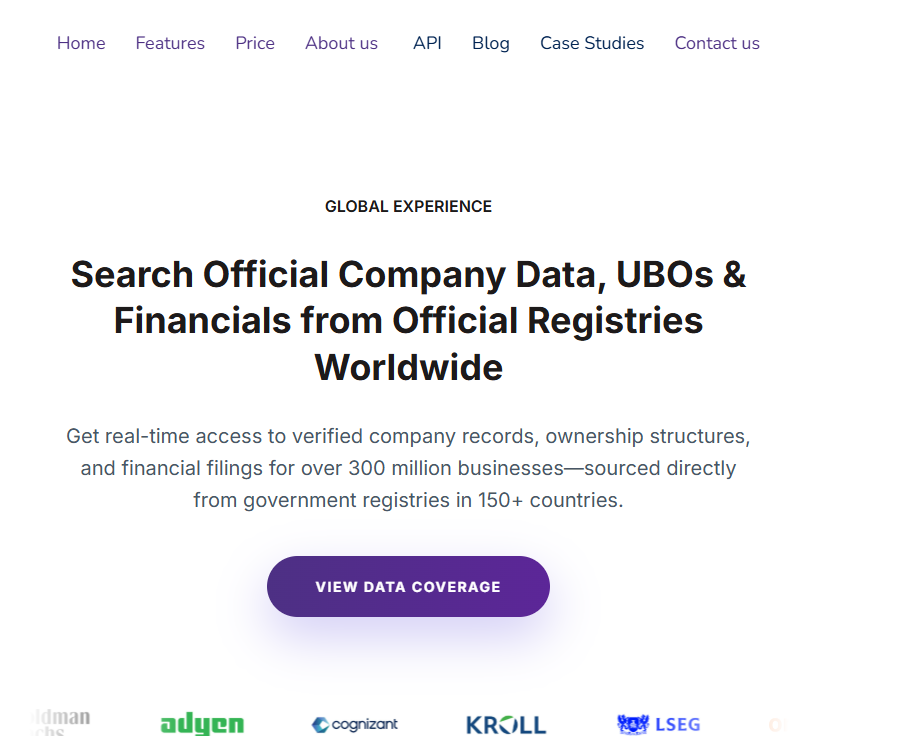
Zephira.ai is a modern, API-first business intelligence platform built for fintechs, compliance teams, and developers who need fast, structured company data. The platform connects directly to government registries in 100+ countries and uses AI to process, standardize, and enrich the results.

What sets Zephira apart is speed and automation. While traditional tools require manual searches, Zephira delivers instant company profiles with registration details, ownership structures, and financial indicators — formatted consistently regardless of source jurisdiction.

What you get for free:

  • Company registration status and legal name

  • Registration number and tax identifiers

  • Country of incorporation and legal form

  • Registered address and contact details

  • Basic ownership and shareholder visibility

  • Industry classification codes

  • Limited free searches to test the platform

Data source: Official government registries across 150+ countries. Zephira connects directly to primary sources — commercial registers, tax authorities, and business registries — then uses AI to normalize data into a consistent, structured format.

Coverage: 300+ million companies across 150+ countries. Strong coverage in Europe, North America, Latin America, and Asia-Pacific.

Pros & Cons

Pros

Cons

✅ AI-powered data processing and enrichment

⚠️ Free tier limited to basic searches

✅ Real-time registry connections — not cached data

⚠️ Full API access requires paid subscription

✅ Standardized output across 100+ jurisdictions

⚠️ Newer platform — less brand recognition

✅ Built for developers — clean API documentation

⚠️ Advanced UBO mapping in paid tiers only

✅ Fast onboarding — no lengthy contracts

⚠️ Credit scores and financials limited in free tier

✅ Pay-as-you-go pricing available

Who Should Use Zephira.ai?

Use Case

Fit

Fintechs building KYB into onboarding flows

✅ Excellent

Developers needing clean API integration

✅ Excellent

Compliance teams verifying global entities

✅ Excellent

Startups needing flexible, scalable verification

✅ Excellent

Non-technical users wanting browser-based searches

⚠️ Limited — platform is API-focused

Deep financial analysis and credit scoring

⚠️ Paid plans only

How to Verify a Company on Zephira.ai

Step 1: Go to zephira.ai and create a free account.

Step 2: Access the search dashboard or API sandbox environment.

Step 3: Enter the company name, registration number, or domain to search.

Step 4: Select the correct jurisdiction or search globally.

Step 5: Review the company profile — registration status, legal identifiers, address, and ownership data.

Step 6: For developers: explore the API documentation to integrate verification into your own platform.

Free tier includes limited searches. Pay-as-you-go and subscription plans available for higher volumes.

Limitations: The free tier is designed for testing and evaluation — not production-scale verification. Full API access, advanced UBO resolution, financial data, and real-time monitoring require paid plans. The platform is optimized for developers and technical teams; non-technical users may find the interface less intuitive than browser-based tools like the Global Database extension.

Ideal use case: You're a fintech or SaaS company building KYB verification into your product. You need structured, real-time company data via API — not manual searches. Zephira delivers clean, normalized data that integrates directly into onboarding workflows without custom parsing.

Frequently Asked Questions About Zephira.ai

  1. Is Zephira.ai free to use?
    Zephira.ai offers a free tier for testing and evaluation. You can run limited company searches to explore the platform and data quality. For production use, API integration, and higher search volumes, paid plans are required. Zephira offers flexible pay-as-you-go pricing, making it accessible for startups and scale-ups.

  2. What company data does Zephira.ai provide?
    Zephira provides company registration status, legal name, registration number, tax identifiers, country of incorporation, legal form, registered address, industry classification, and basic ownership data. Paid tiers unlock deeper insights including full UBO hierarchies, financial indicators, and real-time change monitoring.

  3. How does Zephira.ai use AI?
    Zephira uses AI to process and standardize company data from 100+ government registries worldwide. Each registry uses different formats, languages, and data structures. Zephira's AI normalizes this data into a consistent, structured output — saving developers from building custom parsers for each jurisdiction.

  4. Is Zephira.ai good for KYB compliance?
    Yes. Zephira is built specifically for KYB and compliance workflows. The platform connects to official government registries, provides structured company profiles, and offers API integration for automated onboarding. For full compliance — including sanctions screening, PEP checks, and ongoing monitoring — you'll need a paid plan or supplementary tools.

  5. How is Zephira.ai different from Global Database?
    Both platforms source data from official government registries. Zephira.ai is API-first — designed for developers embedding KYB into their products. Global Database offers both API access and a free browser extension for instant verification on any website or LinkedIn. Zephira covers 300M+ companies in 150+ countries; Global Database covers 600M+ companies in 195 countries with deeper financial and credit data in the free tier.
European Business Registry Association (EBRA)

download 1.svg

Best for: Accessing official European business registry data through a unified network.

The European Business Registry Association (EBRA) is not a single search tool — it's the organization that connects official business registries across Europe. Through its European Business Register (EBR) network, EBRA provides access to company data from 22 European countries, pulled directly from each nation's official registry.

This matters because European company data is fragmented. Each country maintains its own registry with different formats, languages, and access methods. EBRA standardizes access through authorized information distributors, giving users a single entry point to verified company records across the continent.

What you get for free:

  • Access to official registry data from 22 European countries

  • Company registration status and legal identifiers

  • Registered office address

  • Incorporation and dissolution dates

  • Director and officer information (varies by country)

  • Links to national source registries

  • Basic search functionality through partner distributors

Data source: Official national business registries across Europe. EBRA members include registries from Austria, Belgium, Estonia, Finland, France, Germany, Greece, Ireland, Italy, Latvia, Luxembourg, Netherlands, Norway, Portugal, Serbia, Slovenia, Spain, Sweden, UK, and others. Data comes directly from the source — not aggregated or scraped.

Coverage: 22 European countries through the EBR network. Coverage depth varies by member registry. Strong in Western and Northern Europe; growing in Eastern Europe.

Pros & Cons

Pros

Cons

✅ Official government registry data — authoritative source

⚠️ Limited to European jurisdictions only

✅ Unified access to 22 national registries

⚠️ Access through third-party distributors — not direct search

✅ Standardized data format across countries

⚠️ Some distributors charge fees for detailed reports

✅ Backed by official registry associations

⚠️ No financial data or credit scores

✅ Supports cross-border European verification

⚠️ Coverage gaps in some Eastern European countries

✅ Free inclusion for companies registered in member states

⚠️ No API for direct integration

Who Should Use EBRA?

Use Case

Fit

Verifying European companies across multiple countries

✅ Excellent

Compliance teams with EU-focused operations

✅ Excellent

Legal professionals researching European entities

✅ Excellent

Cross-border M&A due diligence within Europe

✅ Excellent

Verifying companies outside Europe

❌ Not supported

Developers needing API access

❌ Not supported

Credit risk assessment

❌ Not supported

How to Access Company Data Through EBRA

Step 1: Go to ebra.be to learn about the EBR network and member registries.

Step 2: Identify which European countries you need to verify companies in.

Step 3: Access data through an authorized EBR Information Distributor — partners who provide search interfaces to the network.

Step 4: Alternatively, go directly to the national registry for each country (e.g., Companies House for UK, KVK for Netherlands, Handelsregister for Germany).

Step 5: Search by company name or registration number to retrieve official records.

Step 6: Review company status, registration details, directors, and filed documents.

EBRA itself does not provide a public search portal. Access is through member registries or licensed distributors.

Limitations: EBRA is a network, not a search engine. You cannot search all 22 countries from a single interface on the EBRA website. Access requires using authorized distributors or visiting individual national registries. Coverage is Europe-only — no data on companies in the Americas, Asia, Africa, or Oceania. Financial data, credit scores, and UBO information are generally not available through the network. Some distributors charge fees for detailed company reports.

Ideal use case: You're conducting due diligence on European business partners and need verified data from official national registries — not third-party aggregators. EBRA ensures you're accessing authoritative sources, even if the search process requires navigating multiple entry points.

Frequently Asked Questions About EBRA

  1. What is EBRA?
    EBRA — the European Business Registry Association — is an international non-profit organization that connects official business registries across Europe. Formed in 2019, EBRA operates the European Business Register (EBR) network, which provides standardized access to company data from 22 member countries. EBRA itself does not verify companies; it coordinates the registries that do.

  2. Is the European Business Register free?
    Access to basic company information through national registries is often free. However, some EBR distributors charge fees for detailed reports, document downloads, or cross-border searches. Costs vary by country and distributor. Direct searches on individual national registries — like Companies House (UK) or KVK (Netherlands) — are typically free for basic data.

  3. Which countries are covered by EBRA?
    The EBR network includes official registries from 22 European countries: Austria, Belgium, Estonia, Finland, France, Germany, Greece, Ireland, Italy, Jersey, Latvia, Lithuania, Luxembourg, Netherlands, North Macedonia, Norway, Portugal, Serbia, Slovenia, Spain, Sweden, and the United Kingdom. Coverage depth varies by member.

  4. How is EBRA different from OpenCorporates?
    OpenCorporates aggregates company data from 140+ jurisdictions worldwide into a single searchable database. EBRA connects official European registries but does not provide a unified search interface — access is through individual registries or authorized distributors. OpenCorporates offers broader global coverage; EBRA offers deeper, more authoritative European data directly from the source.

  5. Can I use EBRA to verify companies outside Europe?

  6. No. EBRA and the EBR network cover European jurisdictions only. For global company verification — including the Americas, Asia, Africa, and Oceania — use tools like Global Database (600M+ companies, 195 countries), OpenCorporates (230M+ companies, 140+ jurisdictions), or Zephira.ai (300M+ companies, 150+ countries).

Comparison Table: Features at a Glance

Choosing the right free business verification tool depends on what you need — global coverage, financial depth, API access, or official government data. This comparison breaks down how each tool performs across the criteria that matter most.

Free Business Verification Tools Compared (2026)

Feature

Global Database

Companies House

OpenCorporates

Zephira.ai

EBRA

Coverage

600M+ companies, 195 countries

5M+ UK companies only

230M+ companies, 140+ jurisdictions

300M+ companies, 150+ countries

22 European countries

Data Source

200+ official government registries

UK Government registry

Aggregated from official registries

100+ official government registries

Official national registries

Registration Status

✅ Yes

✅ Yes

✅ Yes

✅ Yes

✅ Yes

Director/Officer Names

✅ Yes

✅ Yes

✅ Yes

✅ Yes

✅ Varies by country

Registered Address

✅ Yes

✅ Yes

✅ Yes

✅ Yes

✅ Yes

UBO/Ownership Data

✅ Yes

✅ PSC data

⚠️ Limited

⚠️ Paid tiers

⚠️ Varies by country

Financial Statements

✅ 20 years

✅ Filed accounts

❌ No

⚠️ Paid tiers

❌ No

Credit Scores

✅ Yes

❌ No

❌ No

⚠️ Paid tiers

❌ No

Free Browser Extension

✅ Yes

❌ No

❌ No

❌ No

❌ No

Works on LinkedIn

✅ Yes

❌ No

❌ No

❌ No

❌ No

API Access

⚠️ Paid plans

✅ Free API

⚠️ Paid plans

⚠️ Paid plans

❌ No

Account Required

❌ No

❌ No

❌ No

✅ Yes

Varies

Best For

Instant global verification

UK company checks

Cross-border searches

Developer integrations

European compliance

Quick Recommendations by Use Case

Your Need

Best Tool

Verify companies while browsing LinkedIn or websites

Global Database

Check UK company registration, directors, and filings

Companies House

Search for companies across 140+ countries

OpenCorporates

Build KYB verification into your product via API

Zephira.ai

Verify companies across European jurisdictions

EBRA

Access financials and credit scores for free

Global Database

Research officer connections across multiple companies

OpenCorporates

Get official UK PSC (beneficial ownership) data

Companies House

Key Takeaways

  1. For breadth + depth: Global Database offers the widest coverage (600M+ companies) with the deepest free data (financials, credit scores, ownership) — plus a browser extension that works everywhere.

  2. For UK-specific checks: Companies House is the authoritative source. Free, official, and comprehensive for UK-registered entities.

  3. For multi-jurisdiction searches: OpenCorporates covers 140+ countries in one search. Ideal for cross-border existence checks, but lacks financial depth.

  4. For developers: Zephira.ai is built API-first. Clean documentation, real-time registry data, and flexible pricing for fintechs building KYB into their products.

  5. For European compliance: EBRA connects you to official national registries across 22 European countries — authoritative data, but no unified search interface.

No single tool does everything. The smartest approach is layering multiple sources — using Global Database for instant verification and financial depth, Companies House for UK-specific details, and OpenCorporates for jurisdictions outside your primary markets.

Conclusion

You don't need a five-figure compliance budget to verify a company. You need the right tools.

The five platforms in this guide give you free access to official government registry data — the same authoritative sources that enterprise solutions charge thousands to access. Registration status. Directors. Ownership. Financials. All available without paying a penny.

The tools worth bookmarking:

  • Global Database Extension — Install this first. Instant verification on any website or LinkedIn. Financials, credit scores, and ownership on 600M+ companies. Free.

  • Companies House — The definitive source for UK company data. Official. Comprehensive. Free.

  • OpenCorporates — 230M+ companies across 140+ countries. Best for cross-border existence checks.

  • Zephira.ai — API-first platform for developers embedding KYB into products.

  • EBRA — Gateway to official European registries across 22 countries.

One tool won't cover everything. Use them in combination. Global Database for speed and depth. Companies House for UK-specific filings. OpenCorporates for unfamiliar jurisdictions.

Verification takes minutes. Recovery from fraud takes months — sometimes years.

Make it a habit. Check every company before you sign, send money, or shake hands. The tools are free. The excuses aren't.

Frequently Asked Questions About Business Verification

  1. What is business verification?
    Business verification — also called Know Your Business (KYB) — is the process of confirming a company is legally registered, actively trading, and controlled by legitimate owners. It involves checking official government registries for registration status, director names, ownership structures, and financial health. Businesses use verification to prevent fraud, comply with AML regulations, and reduce risk before entering partnerships, contracts, or transactions.

  2. How can I verify a company for free?
    You can verify a company for free using official government registries and free verification tools. Start with the Global Database Browser Extension for instant checks on any website or LinkedIn — covering 600M+ companies across 195 countries. Use Companies House for UK companies, OpenCorporates for cross-border searches across 140+ jurisdictions, and EBRA for European registry access. These tools provide registration status, director names, and company details at no cost.

  3. What is the best free business verification tool in 2026?
    The Global Database Browser Extension is the most comprehensive free business verification tool in 2026. It provides instant access to registration status, 20 years of financial history, ownership structures, credit scores, and executive contacts — covering 600M+ companies from 200+ official government registries. Unlike other free tools, it works directly on any website or LinkedIn profile without requiring manual searches or account creation.

  4. What is the difference between KYC and KYB?
    KYC (Know Your Customer) verifies individual identities — confirming a person is who they claim to be using ID documents, biometrics, or database checks. KYB (Know Your Business) verifies company identities — confirming a business is legally registered, actively trading, and controlled by legitimate beneficial owners. KYB is typically more complex because it involves corporate structures, ownership hierarchies, and multiple jurisdictions. Both are required under anti-money laundering regulations.

  5. What information can I find with free company verification tools?
    Free company verification tools typically provide company name, registration number, incorporation date, registered address, company status (active or dissolved), and director names. The best free tools — like Global Database — also include 20 years of financial history, shareholder structures, ultimate beneficial owners (UBOs), credit scores, and executive contact details. Data depth varies by tool and jurisdiction.

  6. Are free business verification tools reliable for compliance?
    Free tools are reliable for initial screening and basic due diligence. They pull data from official government registries — the same authoritative sources used by paid platforms. However, free tools typically lack real-time monitoring, sanctions screening, PEP checks, and audit-ready documentation required for full KYB compliance. For regulated industries, use free tools as a first step, then escalate to paid solutions for deeper due diligence when needed.

  7. How do I check if a company is legitimate?
    To check if a company is legitimate, verify five key elements: (1) Registration status — confirm the company is registered and active using official registries or tools like Global Database. (2) Directors — identify who runs the company and check their history. (3) Ownership — understand who controls the entity, including ultimate beneficial owners. (4) Financials — review filed accounts and credit scores for signs of stability. (5) Contact details — confirm the registered address, phone, and website match official records.

  8. What is a UBO and why does it matter for verification?
    UBO stands for Ultimate Beneficial Owner — the real person who ultimately owns or controls a company, typically holding 25% or more of shares or voting rights. UBO verification matters because criminals use complex corporate structures to hide ownership and launder money. Regulations like the EU Anti-Money Laundering Directives and the US Corporate Transparency Act require businesses to identify and verify UBOs before entering relationships. Tools like Global Database provide UBO data from official registries.

  9. Can I verify international companies for free?
    Yes. Several free tools support international company verification. Global Database covers 600M+ companies across 195 countries with data from 200+ official registries. OpenCorporates provides basic registration data on 230M+ companies across 140+ jurisdictions. Zephira.ai covers 300M+ companies in 150+ countries. For European companies specifically, EBRA connects to official registries in 22 countries. Coverage depth varies by tool and jurisdiction.

  10. How often should I verify business partners?
    Verify business partners at onboarding and periodically throughout the relationship — at minimum annually, or more frequently for high-risk partners. Company details change: directors resign, ownership transfers, financial health declines, companies dissolve. Ongoing verification catches red flags early. For continuous monitoring, paid tools offer real-time alerts. For manual checks, use free tools like Global Database or Companies House to re-verify key partners quarterly or when renewing contracts.

Related posts

View more