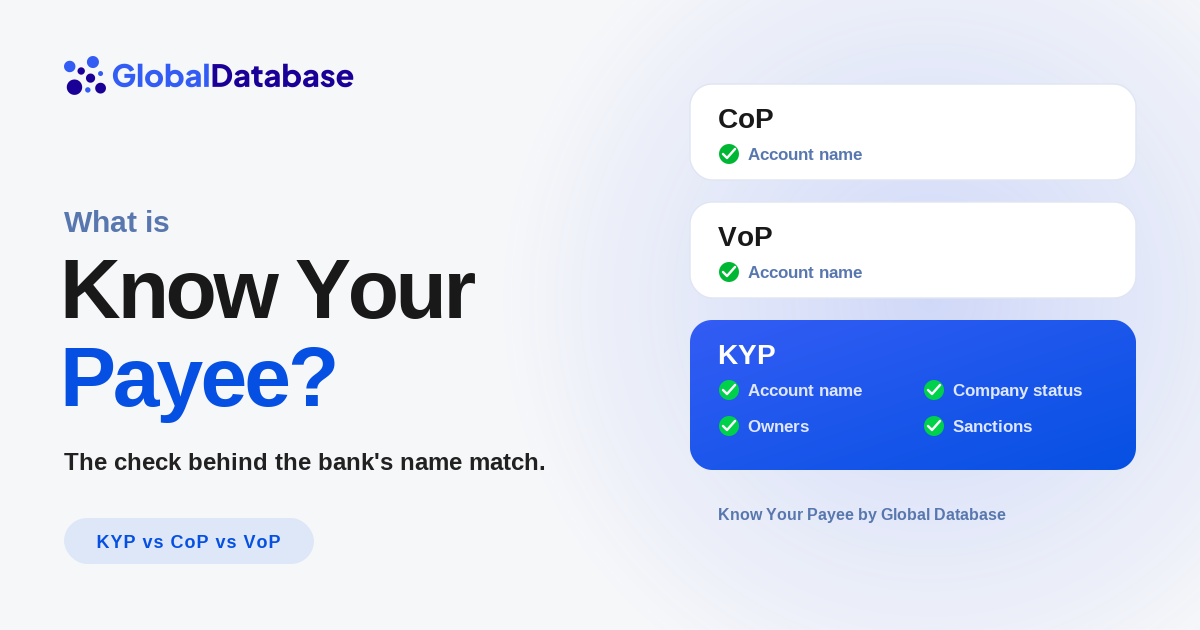
Your bank can now tell you whether the name on a payment matches the name on the account. It cannot tell you whether the company behind that account was incorporated three weeks ago, is in liquidation, or is owned by someone on a sanctions list. Know Your Payee (KYP) is the check that answers the second set of questions.
Know Your Payee (KYP) is the practice of verifying, before money moves, both that a bank account belongs to the named payee and that the business behind the account is real, active, legitimately owned and free of sanctions.
This guide explains what KYP is, how it differs from the two bank-run name checks, Confirmation of Payee (CoP) in the UK and Verification of Payee (VoP) in the European Union, and where the United States and Canada stand. It is written for finance, accounts payable, treasury, procurement and compliance teams who approve supplier payments.
Key takeaways
- CoP and VoP are name-matching checks. They compare the name you typed with the name the payee's bank holds, and return match, close match, no match or unable to check.
- KYP is a wider control. It keeps the bank's name match and adds the company register: legal status, age, address, directors, shareholders, beneficial owners, sanctions and ongoing monitoring.
- Name checks have worked, and fraud has moved. In the UK, payment redirection fell from 52% of authorised push payment losses in 2020 to 24% in 2025. Most losses now go to accounts the fraudster legitimately controls, where the name matches.
- North America has no universal name check for business payments. US ACH and wire payments have none, and Canada's new Real-Time Rail applies it to payments from personal accounts.
In this guide: What is KYPCoPVoPKYP vs CoP vs VoPWhy a match is not enoughUK, EU, US, CanadaKYP vs KYBLimitsFAQ
What is Know Your Payee (KYP)?
Know Your Payee is a payment-control discipline. Before a business pays a supplier, contractor, partner or any other company, it confirms four things: the account details are valid, the account belongs to the payee, the payee is a genuine and active legal entity, and the people who own and run it do not create a legal or fraud risk.
The name follows the pattern of Know Your Customer (KYC) and Know Your Business (KYB), with one difference. KYC and KYB are legal obligations for regulated firms and look at the party you take money from. KYP is a control any business can choose to run, and it looks at the party you send money to. No regulator defines the term, and vendors use it in different ways. Some use it for bank-detail validation alone, others for identity checks on individual recipients. This guide uses the broader meaning: the account and the entity behind it, checked together.
A note on the acronym: KYP is also used for "Know Your Product" in investment advice and "Know Your Patient" in healthcare. In payments and accounts payable, it means Know Your Payee.
The four questions a KYP check answers
- Account: do the account number and the payee name belong together, according to the payee's own bank?
- Company: is the payee registered, active and trading where it says it is?
- People: who are the directors, shareholders and ultimate beneficial owners (UBOs), and is any of them sanctioned or politically exposed?
- Change: has anything about the company changed since you last approved it?
What is Confirmation of Payee (CoP)?
Confirmation of Payee is the UK's account name-checking service, run by Pay.UK. When you set up a new payee, your bank sends the name, sort code and account number to the payee's bank, which compares them with its own records and answers within seconds. CoP applies to payments made over Faster Payments and CHAPS.
The Payment Systems Regulator (PSR) first directed the six largest banking groups to use CoP in 2020. Specific Direction 17 then extended it to around 400 more firms, with deadlines of 31 October 2023 and 31 October 2024. The PSR's November 2025 compliance report puts coverage at around 99% of the market, with more than two million CoP checks completed every day.
CoP returns one of four outcomes: match, close match, no match, or unable to check. It can also flag when you selected a personal account and the payee holds a business account, or the reverse. CoP is a domestic service. It does not cover payments sent abroad.
What is Verification of Payee (VoP)?
Verification of Payee is the EU equivalent. It was created by the Instant Payments Regulation (EU) 2024/886 and runs on a scheme rulebook published by the European Payments Council. Payment service providers in the euro area have had to offer it since 9 October 2025. Providers in EU member states outside the euro area must follow by 9 July 2027.
VoP checks the payee's name against the IBAN before the payer authorises a euro credit transfer, standard or instant. The payee's bank answers with match, close match, no match or verification not possible, and the scheme expects that answer within five seconds. The service is free for the payer.
Two details matter to business payers:
- Identifier matching. For companies, the check can run on an identifier such as a VAT number or Legal Entity Identifier (LEI) in place of the name, where both banks support it.
- Bulk opt-out. Payers that are not consumers may opt out of VoP when they submit multiple payment orders as a package. Many do, and some payment platforms apply the opt-out by default, because a payment file of several thousand lines would otherwise stop on every close match. Those payment runs then go out with no name check at all.
What each name-check result means, and what to do next
CoP and VoP return the same four answers. None of them blocks the payment. The decision stays with the payer, and so does the consequence: under the EU rules, a payer who authorises a transfer after being warned of a mismatch is liable if the money reaches the wrong recipient.
| Result | What it means | What to do | What it leaves unanswered |
|---|---|---|---|
| Match | The name you entered is the name on the account | Proceed if the supplier itself is verified | Whether the company is real, active and safe to pay |
| Close match | The name is similar: a trading name, abbreviation or typo | Compare the suggested name with the registered legal name | Whether the difference is a trading name or a look-alike company |
| No match | The account is held in a different name | Stop. Confirm the details by phone on a number you already hold | Who the account belongs to. The bank will not say |
| Unable to check | The payee's bank or account type is not reachable | Treat as unverified and check the supplier another way | Everything. This is where a registry check carries the decision |
KYP vs CoP vs VoP: the comparison
CoP and VoP are close relatives: one checks a name against a UK sort code and account number, the other against an IBAN. KYP differs in kind. It uses the bank's answer as one input and then looks at the company.
| Confirmation of Payee (CoP) | Verification of Payee (VoP) | Know Your Payee (KYP) | |
|---|---|---|---|
| What it is | Bank-to-bank name check | Bank-to-bank name check | Name check plus company, ownership and sanctions verification |
| Where it applies | UK: Faster Payments and CHAPS | EU/EEA euro credit transfers | Any country where account and registry data are available |
| Who runs it | Pay.UK scheme, directed by the PSR | European Payments Council scheme, under EU regulation | The paying business, usually through a data provider |
| Legal status | Mandatory for directed UK firms | Mandatory for PSPs to offer | Voluntary control |
| Input | Name, sort code, account number | Name (or VAT/LEI) and IBAN | Name, account details, country |
| Result | Match, close match, no match, unable to check | Match, close match, no match, not possible | Name-match result, risk signals and a pay decision |
| Is the company active? | No | No | Yes |
| Who owns and runs it? | No | No | Yes |
| Sanctions and PEPs? | No | No | Yes |
| Monitoring after approval? | No | No | Yes |
The four layers of a payee check
A bank name check stops at layer 1. Select a layer to see what sits inside it.
The account
Does the name on the account match the name you were given?
This is the layer CoP and VoP were built for, and they do it well. The payee's bank never reveals the real account-holder name. It only returns a match status.
Catches
- Typos in the name or account number
- An account swapped for one in someone else's name
Does not catch
- An account opened in a look-alike company name
The company
Is the payee a registered, active business?
Legal status, incorporation date, registered address and filing history come from the official register. The payment scheme holds none of it, so a name check cannot return it.
Catches
- A company registered a few weeks ago
- A company in liquidation or dissolved
- Same name, different country
- More than 100 companies at one address
The people
Who owns and runs the company?
Directors, shareholders and beneficial owners are screened against sanctions and politically exposed persons (PEP) lists, and checked for patterns that point to a shell company.
Catches
- A sanctioned owner or director
- A director who opened ten companies in a short period
- A director aged under 18 or over 70
- A recent change of ownership
Monitoring
Has anything changed since you approved the supplier?
Bank account details themselves cannot be monitored. The company can. A change in its record is the trigger to verify the bank details again before the next payment.
Catches
- Status change, such as active to liquidation
- A new director or shareholder
- A change of registered address
Why a name match is no longer enough
Name checks were designed for one fraud pattern: a criminal intercepts an invoice and swaps in their own account number while keeping the genuine supplier's name. The name on the criminal's account does not match, the bank warns the payer, and the payment stops.
UK data shows the checks did their job. UK Finance's Annual Fraud Report 2026 records £576.4 million of authorised push payment (APP) fraud in 2025. Losses from payments redirected away from a genuine payee fell from £220.3 million in 2020 to £139.3 million in 2025. Invoice and mandate fraud, the classic supplier-impersonation scam, dropped from 4,721 cases to 2,305, with £41.3 million lost.
UK APP fraud: where the losses went
Share of authorised push payment losses by type of payee
Total APP losses still rose 19% in 2025. The money moved to scams where the victim pays an account the fraudster legitimately controls. In those cases the name matches, because the fraudster opened the account in that name. Redirection is now under a quarter of UK APP losses, down from more than half.
For a business, the equivalent is a supplier that exists on paper: a company incorporated last month with a plausible name, a registered-office address shared with hundreds of others, and a bank account opened in the company's own name. CoP and VoP will both return a clean match. Only a look at the register shows the problem.
One payee, two answers
The same new supplier, checked by the bank and by a KYP check. Illustrative example, not a real company.
The account is held in the name "Supplier A Ltd". The name you entered is the same. No warning is shown.
- Account name: match
- Company incorporated 19 days ago
- Registered address shared with more than 200 other companies
- Sole director appointed to 11 companies in two months
- No accounts filed, no trading history
Impersonation is also getting cheaper to produce. The FBI's 2025 Internet Crime Report carried a section on artificial intelligence for the first time, with more than 22,000 complaints and $893 million in reported losses that referenced AI. A convincing email, invoice or voice call is now easy to fake. A company's filing history at the official register is much harder to fake, which is why KYP anchors the decision there.
There are three more gaps to plan for:
- Cross-border payments. CoP is domestic and VoP covers euro credit transfers inside the EU/EEA. A payment from London to Toronto or from Frankfurt to Dallas passes through neither.
- Bulk payment files. Corporates that opt out of VoP for payment packages send those runs unchecked.
- Refund rights. The UK's mandatory APP reimbursement rules, in force since 7 October 2024 with a cap of £85,000 per claim, protect consumers, micro-enterprises and small charities. Larger businesses are outside them. In the EEA, payment service users bore about 85% of credit-transfer fraud losses in 2024, according to the EBA and ECB.
Run your vendor master file through Know Your Payee
Upload a CSV of up to 2,000 supplier accounts per run. Each row returns the bank's name-match result, the company's registry status and a Proceed, Review or Hold recommendation, so you can see how many approved suppliers a name check alone would have passed.
Payee verification by region: UK, EU, US and Canada
The rules differ sharply by market. Europe has mandated name checks. North America has stronger monitoring duties and new infrastructure, and still no name check that covers ordinary business payments.
Where does a name check apply?
Select a market.
United Kingdom
Mandatory- Scheme
- Confirmation of Payee
- In force
- 2020
- Applies to
- Faster Payments and CHAPS
Coverage is around 99% of the market. Mandatory reimbursement of APP scams has applied since 7 October 2024, up to £85,000 per claim, for consumers, micro-enterprises and small charities.
Euro area
Mandatory- Scheme
- Verification of Payee
- In force
- 9 October 2025
- Applies to
- Standard and instant euro credit transfers
Free to the payer, with a response expected within five seconds. Payment fraud in the EEA reached €4.2 billion in 2024, of which €2.5 billion was fraudulent credit transfers.
Non-euro EU
Due by July 2027- Scheme
- Verification of Payee
- In force
- By 9 July 2027
- Applies to
- Euro credit transfers
Payment service providers in EU countries that do not use the euro, such as Poland, Sweden, Czechia, Hungary, Romania and Denmark, have until the deadline to offer VoP. Until then, coverage depends on the provider.
United States
None mandated- Scheme
- No scheme-wide name check
- In force
- Fraud monitoring from 20 March 2026
- Applies to
- ACH and wire: no name-to-account match
Businesses rely on commercial account-validation services and call-backs. Nacha's 2026 rules require risk-based monitoring for payments authorised under "false pretenses", which covers business email compromise and vendor impersonation. BEC cost US victims $3.05 billion across 24,768 complaints in 2025.
Canada
Consumer accounts- Scheme
- Confirmation of payee on the Real-Time Rail
- In force
- 9 November 2026
- Applies to
- Payments sent from personal accounts
The Real-Time Rail launched with mandatory centralised fraud services. The Canadian Anti-Fraud Centre recorded more than C$704 million of reported fraud losses in 2025, with about C$68 million from spear phishing, the category that includes payment redirection against businesses. A further C$57.7 million was reported in the first half of 2026.
Timeline: how payee checks became law
- The Netherlands introduces the IBAN-Name Check, years ahead of any EU-wide requirement.
- Confirmation of Payee goes live across the UK's six largest banking groups.
- Specific Direction 17, Group 1: 32 more UK payment firms must use CoP.
- Group 2 deadline brings UK coverage to around 99%. Mandatory APP scam reimbursement starts on 7 October.
- New Zealand's banks begin rolling out Confirmation of Payee for domestic payments.
- Australia launches Confirmation of Payee, matching name, BSB and account number.
- Verification of Payee becomes mandatory for euro-area payment service providers on 9 October.
- Nacha's fraud-monitoring rules take effect in the US, introducing the "false pretenses" definition.
- Canada's Real-Time Rail launches with confirmation of payee for consumer accounts.
- VoP deadline for payment service providers in non-euro EU member states, 9 July.
The pattern is the same in every market. Each scheme is domestic or regional, each matches a name to an account, and none looks at the company. Australia and New Zealand adopted the UK model in 2024 and 2025, and Australia's service has since been used more than 150 million times. A business that pays suppliers in several countries still has no single bank check that covers them all, which is the practical case for running KYP as one control across every market.
KYP vs KYB vs KYC
The three terms overlap, and the same registry data feeds two of them. The difference is who is being checked and why.
| KYC | KYB | KYP | |
|---|---|---|---|
| Stands for | Know Your Customer | Know Your Business | Know Your Payee |
| Who is checked | An individual customer | A business customer and its owners | A business you are about to pay |
| Direction of money | Inbound relationship | Inbound relationship | Outbound payment |
| Driven by | Anti-money-laundering law | Anti-money-laundering law | Fraud prevention and payment control |
| Bank account check | Sometimes | Sometimes | Always |
| When it runs | Onboarding and periodic review | Onboarding and periodic review | Supplier onboarding, bank-detail changes and before payment |
In short, KYP is KYB pointed at your payables, joined to the bank account. A team that already runs KYB verification on customers has most of the company-side logic in place. What KYP adds is the link between the entity and the account you are about to pay.
When to run a KYP check
- New supplier onboarding. Before the first payment, while the purchase order is still open.
- Any change of bank details. This is the highest-risk moment in accounts payable. Our guide to handling a supplier bank-detail change covers the process step by step.
- Before large or unusual payments. First payment above a threshold, a new country, or a payee that has been dormant in your system.
- Before bulk payment runs. Especially where the file goes out with VoP switched off.
- Continuously, on the company. Monitoring the supplier's registry record tells you when to verify again.
What KYP cannot do
KYP has limits, and a control that overstates itself is a risk in its own right.
- It does not replace the bank's check. KYP uses the CoP or VoP response where one exists. If your bank shows a warning at the point of payment, that warning still stands.
- It never returns the real account-holder name. Banks disclose a match status only. No provider can show you who holds an account.
- It is built for businesses. Sole traders and private individuals are often absent from company registers. For a person, only the bank account verification applies.
- Coverage follows the infrastructure. Account verification is complete where a scheme mandates participation, as in the UK and the euro area, and partial where it depends on which banks take part, as in the US and Canada. The company layer does not depend on the payment scheme.
- Registers differ. Shareholder and beneficial-ownership disclosure varies by country, and filings arrive with a delay. A good KYP result reports what the register holds and where it is silent.
- It informs a decision. A Hold recommendation is a reason to pick up the phone and call the supplier on a number you already trust.
How Know Your Payee by Global Database works
Most payee-verification tools match a name to an account. Know Your Payee by Global Database verifies the business behind the account. It takes one request, containing the payee name, account details and country, and returns the account and the company together.
- Bank account verification in 53 countries, including the UK and EU through the CoP and VoP schemes, and the US and Canada through direct bank connections.
- Company data from the source: 600M+ companies from 400+ official registries in 200+ countries and territories, with the registry name and retrieval time attached to each record.
- 22 risk signals on the company and its people, grouped into five assessments: incorporation date, ownership history, registered address, financial filings, and PEPs and sanctions.
- One recommendation: Proceed, Review or Hold, with the reasons shown.
- Monitoring after approval: status, address, director and ownership changes delivered by webhook, each one a prompt to verify the account again.
It runs wherever your team works: a web platform and CSV batch upload for accounts payable, a REST API and webhooks for ERP and payment systems, iOS and Android apps for checks away from the desk, and an MCP server for AI assistants.
Put KYP inside the payment run
Call one REST API endpoint from your ERP or payment system before each new payee or bank-detail change, and get the name-match result, the company checks and a Proceed, Review or Hold recommendation in a single response. No integration budget yet? Run the same checks in the web platform, one supplier at a time or by CSV upload.
Frequently asked questions about Know Your Payee
What is Know Your Payee (KYP)?
Know Your Payee (KYP) is the practice of verifying, before a payment is released, that a bank account belongs to the named payee and that the business behind the account is real, active, legitimately owned and free of sanctions. It combines bank account verification with company registry, ownership and sanctions checks.
What does KYP stand for in payments?
In payments, accounts payable and treasury, KYP stands for Know Your Payee. The same acronym is used for Know Your Product in investment advice and Know Your Patient in healthcare, so the full phrase is worth spelling out in policies and supplier communications.
What is the difference between Know Your Payee and Confirmation of Payee?
Confirmation of Payee (CoP) is a UK bank service that checks whether the name you entered matches the name on the account. Know Your Payee includes that name-match result and adds checks on the company itself: registration status, incorporation date, address, directors, shareholders, beneficial owners, sanctions and ongoing monitoring.
What is the difference between CoP and VoP?
Confirmation of Payee (CoP) is the UK scheme, run by Pay.UK, and checks a name against a sort code and account number for Faster Payments and CHAPS. Verification of Payee (VoP) is the EU scheme under the Instant Payments Regulation and checks a name against an IBAN for euro credit transfers. Both return match, close match, no match or unable to check.
Is Verification of Payee mandatory?
Yes. Payment service providers in the euro area have had to offer Verification of Payee since 9 October 2025, free of charge to the payer. Providers in EU member states outside the euro area must comply by 9 July 2027. Business payers can opt out when submitting multiple payment orders as a package.
Does Confirmation of Payee work for international payments?
No. Confirmation of Payee covers UK domestic payments over Faster Payments and CHAPS. Verification of Payee covers euro credit transfers within the EU and EEA. A cross-border payment outside those schemes is not name-checked by the bank, which is one reason businesses add a Know Your Payee check.
Can a fraudulent payee pass a CoP or VoP check?
Yes. A name check passes whenever the name matches the account. If a fraudster registers a company and opens a bank account in that company's name, CoP and VoP both return a match. Detecting it requires company data such as incorporation date, registered address, directors and ownership.
Is there Confirmation of Payee in the United States or Canada?
The United States has no scheme-wide name check for ACH or wire payments; Nacha's 2026 rules require risk-based fraud monitoring and leave the method to each organisation. Canada's Real-Time Rail launched on 9 November 2026 with confirmation of payee for payments sent from personal accounts. Business payments in both countries largely rely on the payer's own verification.
What is the difference between KYP and KYB?
Know Your Business (KYB) is a regulatory due-diligence process that regulated firms run on business customers. Know Your Payee (KYP) applies similar company and ownership checks to the businesses you pay, and always ties them to the bank account receiving the money. KYB is driven by anti-money-laundering law, KYP by fraud prevention and payment control.
How do I verify a supplier's bank details before paying?
Check the account with a bank name-matching service, confirm the supplier is an active registered company, review its directors and owners against sanctions lists, and confirm any change of bank details by calling a number you already hold. Know Your Payee by Global Database runs the account and company checks in one request across 53 countries for account verification and 200+ countries for company data, through a web platform, CSV batch, REST API or MCP.