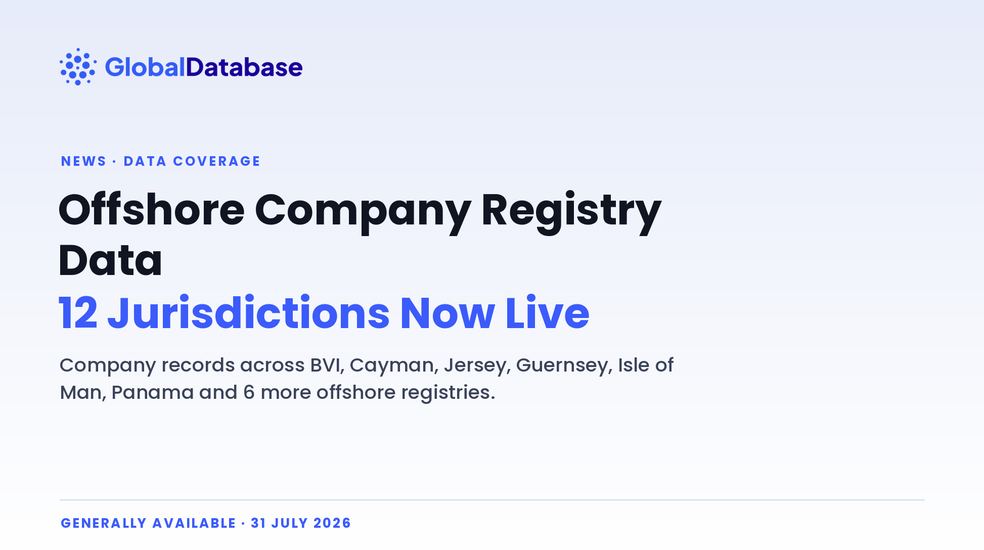
We have added 2.41 million company records across 12 offshore registers — Jersey, Guernsey, the Isle of Man, the BVI, Cayman, Panama and six more. Offshore is the point where most corporate structure work stops, and this is the layer that was missing.
Every KYB team has the same failure point. The onboarding file moves cleanly through UK, US and EU entities, and then hits a holding company in the British Virgin Islands or a Panamanian intermediary. At that point the work usually goes one of two ways: a manual retrieval through a local agent, which takes days and costs money, or a judgement call made without a verified record.
Neither survives a regulator asking how you verified the entity. Both are still normal practice, because the underlying data has been hard to obtain in structured form.
What changed: 12 offshore registers, 2.41 million entities, seven fields per record, available through the platform, API, bulk feeds, CRM integrations, MCP, assistant connectors and Regis AI.
Offshore company registry coverage in full
| Jurisdiction | ISO | Registry authority | Companies |
|---|---|---|---|
| Panama | PA | Registro Público de Panamá | 971,000 |
| British Virgin Islands | VG | BVI Financial Services Commission — Registry of Corporate Affairs | 350,000 |
| Jersey | JE | Jersey Financial Services Commission — Companies Registry | 205,000 |
| Bahamas | BS | Registrar General’s Department | 203,000 |
| Isle of Man | IM | Isle of Man Companies Registry | 202,000 |
| Cayman Islands | KY | Cayman Islands General Registry — Registrar of Companies | 123,000 |
| Gibraltar | GI | Companies House Gibraltar | 104,000 |
| Guernsey | GG | Guernsey Registry | 93,800 |
| Belize | BZ | Belize Companies and Corporate Affairs Registry | 58,000 |
| Monaco | MC | Répertoire du Commerce et de l’Industrie | 46,400 |
| Bermuda | BM | Registrar of Companies | 38,000 |
| Macau | MO | Conservatória dos Registos Comercial e de Bens Móveis | 13,300 |
| Total | 12 registers | 2,407,500 |
Counts reflect records available through Global Database as at July 2026. Where a register restricts public access, the figure reflects the obtainable set rather than the total number of entities ever incorporated. Jurisdiction names link to the detail below.
What each record contains
Seven fields per entity, in a single schema across all 12 jurisdictions:
- Registration number
- Legal name
- Status
- Incorporation date
- Legal form
- Registered address
- Industry
The registration number is the field that decides whether the rest is useful. It is the join key between an offshore entity and the record you already hold in your entity master data. Without it you are matching on legal name, and legal names are re-used across jurisdictions, change on restructuring, and appear in registers with inconsistent suffixes. Name-only matching produces duplicates, and duplicates are what compliance teams spend their remediation budget unwinding.
One schema across 12 registers also removes the normalisation work. Each of these registers publishes in its own format, language and legal-form vocabulary — Panama in Spanish, Macau in Portuguese and Chinese, Monaco in French. Reconciling those into a single structure is the part that usually consumes an integration project.
Jurisdiction by jurisdiction
Each register below is legally and operationally distinct. The differences are not cosmetic: they determine what is obtainable about an entity, and treating any two of them as interchangeable is how duplicate and mismatched records enter a system in the first place.
Jersey company registry
Maintained by the Jersey Financial Services Commission, which acts as Registrar of Companies under the Companies (Jersey) Law 1991, the Registry holds fifteen separate registers — private and public companies, limited partnerships, limited liability partnerships, separate and incorporated limited partnerships, foundations, and protected and incorporated cell companies. Our coverage runs to 205,000 entities.
For compliance work the important detail is what Jersey does not publish. Basic entity data is freely searchable by name or registration number, but director particulars filed with the JFSC are not part of the public record, and shareholder information is not disclosed. That makes registration number and status the fields carrying the weight — they confirm the entity exists and is in good standing, and they are what an ownership chain has to hang on.
Jersey companies file an annual confirmation statement between January and the end of February. The Registrar can strike off an entity that fails to file, under the Financial Services (Disclosure and Provision of Information) (Jersey) Law 2020.
Guernsey company registry
Guernsey is not Jersey, and treating the Channel Islands as one jurisdiction is a common and expensive mistake. Separate registrar, separate company law, separate register. The Guernsey Registry supports the Registrar — a public office holder of the States of Guernsey — under the Companies (Guernsey) Law, 2008, covering the whole Bailiwick including Alderney and Sark, and accounts for 93,800 of the entities here.
An entity incorporated in one island does not appear in the other, and structures routinely span both — which is why we hold them as distinct registers rather than a combined Channel Islands set.
Basic company information is published free of charge: registered office, registration date, status and economic activity code. Director details require a Statement of the Register. Shareholder information is not held by the Registry at all, and beneficial ownership is filed with the Registrar but not publicly accessible.
Isle of Man companies registry
Two parallel company law regimes run on the Island simultaneously: the Companies Acts 1931–2004, modelled on the English Companies Act 1929, and the standalone Companies Act 2006, which follows the international business company model. Both sit in the same registry in Douglas, which supplies 202,000 entities.
This matters more than it sounds, because the two regimes disclose different things. A 1931 Act company lists both directors and shareholders in its annual return. A 2006 Act company discloses neither shareholders nor — since 2025 — directors in the annual return. Establishing which regime governs an entity is the first step in knowing what is obtainable about it, and the company number itself tells you: a C suffix denotes a 1931 Act company, V denotes a 2006 Act company.
The Registry also holds limited liability companies, limited partnerships, foreign companies, business names, industrial societies and foundations. Beneficial ownership sits under the Beneficial Ownership Act 2017 and is not publicly accessible.
British Virgin Islands company search
VIRRGIN — the Virtual Integrated Registry and Regulatory General Information Network — is operated by the Registry of Corporate Affairs, an arm of the BVI Financial Services Commission. It is the largest offshore register in this set after Panama, contributing 350,000 entities.
The BVI is the most common stopping point in offshore ownership work, and the reason is structural rather than legal. VIRRGIN is not a freely browsable public database. Searches are submitted as requests and charged per search, and in practice most access runs through a licensed registered agent. That friction is precisely why analysts so often accept an unverified BVI record and move on.
More than a million companies have been formed since the International Business Companies Act 1984, which the BVI Business Companies Act 2004 replaced; roughly 350,000 remain active. Registration numbers are numeric, sequential and permanent, which makes them a dependable join key — though legacy IBCs incorporated before 2004 use a different format and need handling accordingly.
Beneficial ownership sits in the BOSS system. Since April 2026 a Legitimate Interest Access route has allowed compliance professionals to apply through VIRRGIN for beneficial ownership information on specific entities.
Cayman Islands company registry
Cayman’s entity mix is unlike anything else on this list. The exempted company dominates — used for investment funds, holding structures and special purpose vehicles — sitting alongside LLCs, exempted limited partnerships and registered foreign companies. The General Registry, under the Registrar of Companies, supplies 123,000 entities, governed principally by the Companies Act (As Revised).
Cayman entities consequently appear in institutional counterparty files far more often than the raw count suggests, because a single fund structure can contribute several.
Public access runs through CORIS, the Companies Online Registry Information System, returning name, registration number, incorporation date, company type, registered office and status. The register of members is not public for most entity types, and beneficial ownership is restricted to competent authorities.
Gibraltar company registry
Gibraltar is a British Overseas Territory with a common law system and its own companies legislation, outside the EU since Brexit while retaining close commercial linkage to both the UK and Spain. Companies House Gibraltar accounts for 104,000 entities.
Gibraltar appears disproportionately in online gaming, insurance and holding structures, which means it turns up in counterparty files well outside its size. For entity resolution the practical issue is name collision with UK companies: similar naming conventions, similar suffixes, entirely separate register. The registration number is what separates them, and matching on name alone across a UK–Gibraltar structure is a reliable way to generate duplicates.
Bermuda company registry
Bermuda has the smallest count-to-economic-weight ratio in this set: 38,000 entities from the Registrar of Companies, concentrated in insurance, reinsurance and listed holding companies rather than volume incorporations.
The practical consequence is that a Bermuda entity in an ownership chain is more likely to be a substantive operating or holding company than a shell, and more likely to have a listed parent somewhere above it. Bermuda entities appear frequently as the top company in structures listed on US exchanges, which makes them a useful anchor point when a chain is otherwise opaque.
Bahamas company registry
Two populations sit in the same register at the Registrar General’s Department: a large body of International Business Companies alongside domestic Bahamian companies. Both are represented in the 203,000 entities covered here.
That mix is worth understanding before matching. Domestic Bahamian companies and IBCs serve entirely different purposes and surface in different kinds of file, but they sit in the same register, so filtering on legal form is usually the first step in any Bahamas workflow rather than an afterthought.
Panama company registry
By a wide margin the largest register in this set, the Registro Público de Panamá contributes 971,000 entities — more than a third of the total coverage on its own.
Panama is where most offshore integration projects run into difficulty, for three compounding reasons. The register is Spanish-language throughout. Panamanian legal forms — the sociedad anónima, the fundación de interés privado — have no clean common-law equivalent, and mapping them approximately misclassifies entity type across an entire dataset. And Panama’s corporate population carries a very large historical layer, so status is doing more work than in most jurisdictions.
Records are normalised into the same schema as every other jurisdiction here, with legal form preserved as filed rather than forced into an approximate English translation.
Belize company search
Established under the Belize Companies Act No. 11 of 2022, the Belize Companies and Corporate Affairs Registry operates under a framework that appointed the Director General of the Belize Financial Services Commission as Registrar. It accounts for 58,000 entities.
That restructuring matters for compliance work because it changed both the governing legislation and the identity of the registrar within recent memory. Older Belize records and current ones do not always sit under the same framework, and a Belize entity’s incorporation date tells you which regime it originated under. The Registry now operates an online business registry system for registration services.
Monaco company registry
Monaco’s register is small at 46,400 entities, but appears disproportionately in private wealth, real estate and marine structures — which is to say, in exactly the files where source-of-wealth questions are hardest to answer. Maintained as the Répertoire du Commerce et de l’Industrie.
Monaco is a French-language civil law jurisdiction and legally separate from France despite the customs union. Entities registered in Monaco do not appear in French registers, and the reverse holds too. Analysts who assume otherwise tend to conclude an entity does not exist when it simply sits in the other register.
Macau company registry
Administered by the Direcção dos Serviços de Assuntos de Justiça, the Conservatória dos Registos Comercial e de Bens Móveis — the Commercial and Movable Property Registry — holds the 13,300 entities covered here.
Macau operates a legal system entirely separate from mainland China under the Special Administrative Region framework, with commercial registration governed by its own Commercial Registry Code derived from Portuguese law. A Macau entity will not appear in any mainland Chinese register, and the two should never be reconciled as one jurisdiction.
Records are issued in Chinese and Portuguese. The Macau government has made commercial registry information available through a dedicated platform covering registration number, company name, registered office, corporate object, share capital and directors.
Why offshore coverage is a compliance problem, not a data problem
The regulatory direction is clear. The EU AML package and the AMLA supervisory regime raise the standard of evidence required to establish an entity exists and to identify who controls it. “We could not obtain a record” is not a finding a supervisor accepts when the record exists in a government register.
Registry data is not beneficial ownership data, and it should not be sold as such. Across almost every jurisdiction above, the beneficial ownership register exists but sits behind competent-authority access. What registry data does is establish the floor: that an entity exists, that it is in the status claimed, where it is registered, and under what number. A UBO investigation that skips this layer is building an ownership chain on unverified nodes.
This is also the layer where entity resolution succeeds or fails. Corporate linkage across an international group cannot be constructed reliably if a third of the nodes are offshore vehicles matched on name alone.
Access
Seven routes into the same primary, government-sourced dataset — pick the one that fits your stack.
Platform
Search, screen and export company records from the web application.
API
Query any company by registry ID — documented endpoints, JSON responses, provenance on every value.
Bulk data feeds
Full datasets and scheduled deltas, delivered to your warehouse on your cadence.
CRM
HubSpot, Salesforce and Microsoft Dynamics. Registry fields on the record your team already works in, matched on registration number.
MCP
Connect the dataset to any MCP-compatible agent or tool, on the same key.
Assistant connectors
Pull registry data straight into your AI assistant, with the source attached to the answer.
Frequently asked questions
Which offshore company registries does Global Database cover?
Twelve jurisdictions: Panama, the British Virgin Islands, Jersey, the Bahamas, the Isle of Man, the Cayman Islands, Gibraltar, Guernsey, Belize, Monaco, Bermuda and Macau — approximately 2.41 million company records in total.
What fields are returned for an offshore company record?
Registration number, legal name, status, incorporation date, legal form, registered address and industry classification, in a single schema across all 12 registers.
Why does the registration number matter more than the company name?
It is the join key. It allows an offshore entity to be matched against a record already held in your entity master data instead of creating a duplicate. Legal names are re-used across jurisdictions and change over time, so name-only matching produces both false positives and duplicate records.
Is offshore company registry data the same as beneficial ownership data?
No. Registry data establishes that an entity exists, its legal status, and where and under what number it is registered. Beneficial ownership identifies the natural persons who ultimately own or control it. Across most of these jurisdictions beneficial ownership registers exist but are restricted to competent authorities. Registry data is the layer beneath a UBO investigation, not a substitute for one.
How do I run a BVI company search?
The British Virgin Islands register is maintained by the Registry of Corporate Affairs at the BVI Financial Services Commission through the VIRRGIN platform, which is not a freely browsable public database — searches are submitted as chargeable requests, usually through a licensed registered agent. Global Database returns structured BVI records through the API, bulk feed, platform and Regis AI without that step.
Are the Jersey and Guernsey registries the same?
No. Jersey and Guernsey are separate Crown Dependencies with separate registrars and separate companies legislation — the Companies (Jersey) Law 1991 and the Companies (Guernsey) Law, 2008. An entity registered in one will not appear in the other. Because structures frequently span both islands, we hold them as distinct registers rather than a combined Channel Islands set.
Why do Isle of Man companies disclose different information?
Because the Island runs two company law regimes in parallel. A company formed under the Companies Acts 1931–2004 lists directors and shareholders in its annual return; a company formed under the Companies Act 2006 discloses neither. The company number identifies which applies, through a C or V suffix. Establishing the regime is the first step in knowing what is obtainable about the entity.
Does the data include dissolved and struck-off companies?
Where the source register publishes them, yes — carried in the status field rather than removed from the record. Historical entities matter in compliance work: a dissolved company in an ownership chain is a finding, not an absence.
Why does the Cayman Islands count differ from other sources?
Counts vary depending on whether a source reports registered entities, active entities, or entities ever incorporated, and on how much of a register is exposed for public access. Our figures reflect the records currently obtainable for each jurisdiction. We publish the basis for any jurisdiction on request.
How can offshore registry data be accessed?
Seven routes into the same dataset: the web platform, the REST API, bulk data feeds, CRM integrations for HubSpot, Salesforce and Microsoft Dynamics, an MCP server, assistant connectors for Claude and ChatGPT, and Regis AI. All seven run against the same underlying records.
If you are resolving offshore entities by hand, or carrying duplicates you cannot reconcile, we can run your entity list against the covered registers and show you the match rate before you commit to anything.
Request a demo