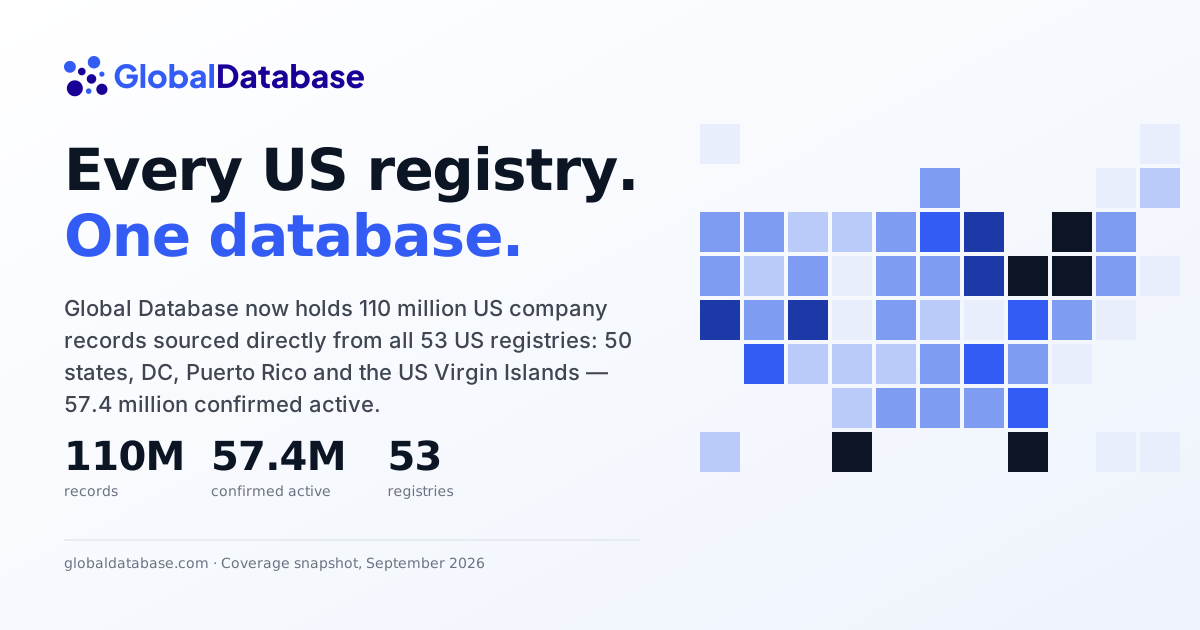
Global Database today publishes full state-by-state coverage figures for the United States. The platform now holds 109.6 million company records sourced directly from every US company registry, with 57.4 million confirmed active by the registry that formed them, a registered address on 42.1 million and officers on 29.6 million. The US file is available through the API, the Master Data Bulk Feed, the web platform and the MCP server, alongside the 600M+ companies already covered in 200+ countries. This article sets out the numbers in full: every jurisdiction, every field, and what the record can and cannot do.
In this report: why coverage is counted by state · headline numbers · interactive map · reading a state's count · field coverage · how many businesses are in the US · full state table · where registry data falls short · how Global Database fills the gap · FAQ
Every US registry, one file. 109,567,346 company records across 50 states, the District of Columbia, Puerto Rico and the US Virgin Islands, each sourced first-party from the official state registry that holds the filing and carrying that registry's name and collection date on every field.
57,390,977 confirmed active. Status is taken from the registry itself, not inferred. A further 7.2 million records sit in registries that do not publish status in the free record, and 45 million dissolved and historic entities are retained for matching and audit.
Depth, not just breadth. Legal form on 93% of active records, a full registered address on 65% (100% in Florida, Texas and New York), officers on 46%, plus firmographics, industry tags, SEC data, group structure and perpetual updates layered on the registry record.
Available now through the API, the Master Data Bulk Feed, the web platform and the MCP server.
"The United States has no national company register, so the only way to cover it properly is to connect to every state. That is what we have done. Every one of the 109.6 million records can be traced to the registry it came from, and on top of the filing we add the firmographics, group structure, industry tags and perpetual updates that the registries themselves never will."
Why there is no single US business registry, and why this took 53 connections
Company formation in the United States is a state function. An LLC formed in Texas exists because the Texas Secretary of State accepted a Certificate of Formation; a Delaware corporation exists because the Delaware Division of Corporations filed its certificate. No federal body holds a master list, and the one attempt at a national layer, the Corporate Transparency Act's beneficial ownership register, was narrowed by FinCEN's interim final rule of 26 March 2025 so that entities formed in the United States are now exempt from reporting. That leaves the state filing as the only authoritative record of a domestic company's existence.
The practical consequence for anyone buying US company data is that "coverage" means fifty-three separate answers, and reaching all of them is the milestone this announcement marks. Each registry decides what it collects, what it publishes for free, how it labels status, and how often it updates. A vendor that quotes one national figure for all US companies is either summing those fifty-three answers, or has stopped counting what is behind it. This report shows the sum and what is behind it. For how each registry works individually, see the state-by-state guide to US business registries.
The US company database by the numbers
Three numbers do most of the work.
- 109.6 million records is the full file: every entity we hold from every US registry, including the ones that dissolved in 1994. The file is large because the registries are large. Florida alone contributes 13.7 million records; California 9.8 million.
- 64.6 million active or status-unknown is what a KYB or prospecting team would normally treat as the addressable universe. It combines entities the registry marks active with entities in registries that do not publish a status field without a paid lookup.
- 57.4 million confirmed active is the conservative figure. Here the registry itself says the entity is active or in good standing. This is the number we would put in front of a compliance buyer, because it is the one that can be traced to a status field on a filing.
The 45 million inactive, dissolved and historic records are not padding. They matter for entity resolution (a supplier that re-forms under the same name), for fraud checks (a payee quoting a dissolved company's registration number), and for audit trails that need to show what an entity's status was on a given date. We keep them, and we label them.
US business registry coverage, state by state
Every tile below is one jurisdiction. The default view is confirmed-active companies; switch to address or officer coverage to see how differently the registries behave once you look past the headcount.
For how the individual registries work, the state guides cover Florida, Texas, Pennsylvania, New York, Illinois, Ohio, Georgia, Maryland and Delaware, with the full list in the state-by-state hub.
The map makes one point quickly: the concentration is real, but it is not where population would put it. Florida, Texas, Pennsylvania, New York and New Jersey each hold more than four million confirmed-active records. California, the most populous state, sits sixth at 3.8 million, because 61% of its 9.8 million records are inactive. Wyoming, with under 600,000 residents, carries 935,797 active-or-unknown entities.
Reading a state's count: active share, identity depth and status
The gap between Figure 4's two columns is the first thing an experienced data buyer looks at. Georgia's file is 35% active; New Jersey's is 100%. Neither number says anything about data quality. It says that Georgia keeps dissolved entities on the public register and New Jersey's public record is effectively a live register. Both are correct reflections of the source. But if you were scoring a vendor on "total US companies", Georgia would look twice as large as it is.
The second thing to look at is how deep the identity record goes once an entity is confirmed. On that measure the large registries are strong: 28 jurisdictions publish a complete registered address for 97% or more of their active entities, and four of the five biggest confirmed-active files (Texas, Pennsylvania, New York, New Jersey) carry a legal form on more than 98% of records, with Florida at 86%. Formation date is above 97% in Pennsylvania and New Jersey and close to 89% in Texas and Florida. Where a large registry sits below the others it reflects what that state publishes, not how it was collected.
Status is the one field where a few registries hold back. Delaware is the case that matters, because it is the jurisdiction most likely to appear in an enterprise supplier file. The Division of Corporations publishes entity name, file number, formation date, entity type and registered agent for free. Status, franchise tax standing and filing history are paid lookups. The state also does not collect officer or director names at all, which is why Delaware shows 0.2% officer coverage in our data and would show the same in anyone's. We hold the full 5.8 million-record Delaware file, more than the 2.1 million the state itself reports as active, and where the public filing does not carry a status we return the field as unknown so a KYB workflow can route the entity to a certificate check instead of silently passing it. West Virginia, Wyoming, Louisiana and Mississippi behave the same way to a lesser degree. Every one of those records still carries its name, file number, legal form and registered agent from the filing.
One schema across 53 registries, with the source on every field
Global Database connects directly to each US state registry, normalises the records into a single company schema, and keeps the registry name and collection date attached to every field. When a state does not publish a status, an address or an officer, the field comes back empty rather than estimated. That is the same standard we apply across 400+ registries in 200+ countries.
Coverage figures on this page are from the September 2026 snapshot and will move as registries publish new filings.What each record carries
A company record is only as useful as its fields, and for US private company data the fields are the whole story: there are no filed accounts to fall back on, so the firmographic attributes on the registry record (legal form, formation date, address, officers, NAICS) carry the weight. The chart below shows how many of the 64.6 million active-or-status-unknown records carry each attribute. Read it as a description of what US state registries publish, because that is what it is.
Identity: legal form, formation date, address
Legal form is present on 60.0 million records (93%). Formation date on 52.9 million. Registered address on 42.1 million (65%) and city on 43.4 million (67%). The address gap is concentrated in a handful of registries whose public search shows the registered agent rather than the entity's own address, or shows a city without a street: Delaware, Pennsylvania, New Jersey, New Mexico, Oklahoma, Wyoming and Ohio all return principal-address data on under 6% of active records. Texas, Florida, New York, Maryland, Missouri and Oregon return it on effectively 100%.
People: officers and directors
29.6 million active records carry at least one officer or director, 46% nationally. The spread between states is the widest of any field, and it maps almost perfectly onto what each state requires on the annual report.
For a KYB team this chart is a planning tool. If your supplier base is heavy in California, Georgia or Washington, registry officer data will cover most of your file. If it is heavy in Delaware or New Jersey, you will need a second source for control persons, and no registry-based vendor can honestly tell you otherwise.
Classification: NAICS and industry
10.7 million active records carry a NAICS code. Only a few registries collect it at formation, and it shows: Mississippi (86%), Connecticut (68%), Alaska (45%) and Washington (43%) lead, while most states sit between 10% and 20%. Texas contributes the largest absolute count at 1.24 million. If you need to filter US companies by industry at scale, NAICS from the registry is a starting point rather than a complete answer, and we flag the field's origin so you know which it is.
Digital footprint: website, LinkedIn, email
5.6 million records have a matched website, 2.0 million a LinkedIn company page, and 151,150 an email address. These are small shares of a 64.6 million file and we are not going to dress them up. No US registry collects a web address or an email at formation, so these fields are matched to the registry record from elsewhere and only kept where the match is unambiguous. Washington is the outlier for email, at 81,691, because of what its registry publishes. Contact-level data for outreach is a different product line, covered in our data enrichment offering, and should not be confused with the registry file described here.
Size: estimates, labelled as estimates
8.5 million records carry an employee estimate and 5.4 million a turnover estimate. US private companies do not file accounts with any state registry, so there are no filed financials to report for the overwhelming majority of the file. Where we deliver a size figure it sits in a separately named estimate field, never in a field that implies a filed value. That is the opposite of how filed European accounts are delivered on the same platform, and the distinction is kept deliberately visible.
How many businesses are in the US? Registry entities vs small businesses
The most searched question in this area is how many businesses the United States has, and the honest answer is that it depends which register you are reading.
The SBA's 2025 Small Business Profile counts 36.2 million small businesses nationally: 29.8 million with no employees, 5.7 million with 1–19 employees and 654,501 with 20–499. That figure is built from Census nonemployer statistics and business surveys, and most of the 29.8 million are sole proprietors who have never filed a formation document with any state. They will never appear in a state registry, and they are not legal entities that can be verified against one.
Our 57.4 million confirmed-active figure counts registered legal entities: LLCs, corporations, partnerships and similar forms on file with a state. It includes shells, holding vehicles and dormant companies that remain in good standing, which the SBA does not count as businesses. Florida shows the divergence clearly: 4.94 million confirmed-active entities against 3.49 million SBA small businesses. Neither is wrong. If you are verifying counterparties, the registry number is the one that describes your addressable universe. If you are sizing a market for consumer-facing small-business software, the SBA number is closer, and a small business database built on registry entities alone will undercount sole proprietors by design.
The file also does not stand still. The Census Bureau's Business Formation Statistics recorded 531,728 new business applications in August 2026 alone, seasonally adjusted. Roughly half a million EIN applications a month is why a registry snapshot dated September 2026 will not describe September 2027, and why refresh cadence matters at least as much as the headline count.
Every US state: the full company data coverage table
All 53 jurisdictions. Click a column header to sort, type to filter, and toggle between counts and coverage percentages. Address and officer percentages use each state's active-or-status-unknown count as the denominator.
| State | Total records | Active + status unknown | Confirmed active | Address | Officers | NAICS code | Legal form | Formation date | Website | Employee est. | Turnover est. | |
|---|---|---|---|---|---|---|---|---|---|---|---|---|
| Florida FL | 13,746,671 | 4,943,748 | 4,943,748 | 100% | 55% | 832,754 | 4,226,913 | 4,363,461 | 542,024 | 199,097 | 737,620 | 479,309 |
| Texas TX | 4,599,687 | 4,449,854 | 4,445,673 | 100% | 52% | 1,244,862 | 4,372,733 | 3,950,972 | 490,782 | 193,713 | 795,825 | 497,207 |
| Pennsylvania PA | 4,583,387 | 4,345,077 | 4,276,475 | 2% | 33% | 510,639 | 4,338,292 | 4,210,806 | 296,026 | 95,952 | 407,805 | 284,700 |
| New York NY | 4,161,403 | 4,035,679 | 4,035,679 | 100% | 23% | 734,863 | 4,017,990 | 4,962,334 | 341,689 | 118,967 | 730,601 | 438,651 |
| New Jersey NJ | 4,031,610 | 4,030,379 | 4,030,379 | 1% | 1% | 238,825 | 4,024,358 | 3,996,546 | 125,056 | 45,016 | 185,841 | 106,981 |
| California CA | 9,832,322 | 3,829,695 | 3,829,571 | 99% | 98% | 597,940 | 2,852,946 | 3,811,165 | 466,967 | 221,896 | 658,401 | 379,346 |
| Michigan MI | 2,930,073 | 2,748,823 | 2,748,823 | 99% | 0% | 401,078 | 2,713,392 | 2,383,499 | 222,447 | 65,409 | 322,695 | 234,495 |
| Colorado CO | 3,312,751 | 2,376,026 | 2,376,026 | 99% | 62% | 317,836 | 2,241,401 | 2,260,819 | 199,424 | 67,811 | 258,708 | 186,263 |
| Ohio OH | 3,205,413 | 2,221,151 | 2,221,151 | 5% | 34% | 299,932 | 2,139,380 | 2,169,048 | 171,995 | 65,279 | 242,580 | 150,876 |
| Arizona AZ | 2,571,001 | 1,620,363 | 1,620,363 | 50% | 52% | 239,696 | 1,613,134 | 345,506 | 129,150 | 42,790 | 224,669 | 141,042 |
| North Carolina NC | 2,799,053 | 1,512,636 | 1,512,636 | 77% | 61% | 235,354 | 1,018,889 | 1,509,498 | 140,294 | 48,105 | 201,091 | 133,021 |
| Georgia GA | 4,240,866 | 1,488,807 | 1,488,807 | 100% | 98% | 221,478 | 1,483,243 | 1,209,572 | 136,369 | 51,625 | 192,709 | 127,315 |
| Illinois IL | 3,510,144 | 1,233,529 | 1,233,467 | 100% | 65% | 216,751 | 1,203,123 | 1,187,896 | 154,333 | 59,526 | 208,616 | 121,768 |
| Virginia VA | 2,867,798 | 1,019,862 | 1,019,862 | 14% | 86% | 177,811 | 1,010,513 | 942,998 | 121,904 | 43,617 | 167,152 | 109,715 |
| Oregon OR | 1,052,156 | 937,484 | 937,484 | 100% | 88% | 239,762 | 835,112 | 810,336 | 140,030 | 54,564 | 220,292 | 158,646 |
| Missouri MO | 1,118,283 | 928,219 | 928,219 | 100% | 65% | 290,853 | 786,231 | 767,110 | 152,376 | 41,194 | 217,261 | 155,802 |
| Alabama AL | 1,235,269 | 885,900 | 885,900 | 54% | 99% | 110,855 | 882,872 | 878,629 | 63,810 | 18,600 | 82,592 | 54,029 |
| Washington WA | 1,724,377 | 833,209 | 833,209 | 99% | 98% | 358,484 | 822,332 | 696,174 | 140,422 | 68,202 | 199,305 | 124,190 |
| Maryland MD | 1,057,354 | 806,427 | 806,427 | 100% | 18% | 265,954 | 669,732 | 512,794 | 157,539 | 45,495 | 223,232 | 163,948 |
| Idaho ID | 1,278,401 | 799,682 | 799,682 | 62% | 57% | 65,497 | 753,525 | 652,737 | 39,165 | 14,346 | 72,865 | 37,702 |
| Connecticut CT | 1,256,553 | 794,202 | 793,908 | 85% | 98% | 536,714 | 792,101 | 797,166 | 86,044 | 26,010 | 124,603 | 90,091 |
| Utah UT | 2,263,071 | 779,493 | 779,493 | 100% | 54% | 109,717 | 719,541 | 730,595 | 64,524 | 21,258 | 104,536 | 64,698 |
| South Carolina SC | 827,034 | 731,160 | 731,160 | 69% | 1% | 148,817 | 703,185 | 469,627 | 79,185 | 21,735 | 104,903 | 67,113 |
| Indiana IN | 1,535,581 | 691,545 | 691,545 | 98% | 78% | 159,687 | 679,789 | 579,552 | 94,762 | 30,667 | 141,269 | 100,930 |
| Louisiana LA | 1,184,091 | 1,036,795 | 678,243 | 100% | 54% | 226,094 | 636,993 | 546,333 | 104,163 | 27,944 | 170,931 | 131,377 |
| Minnesota MN | 2,424,773 | 662,938 | 662,938 | 95% | 79% | 100,539 | 658,249 | 662,582 | 67,401 | 25,730 | 96,332 | 62,848 |
| Wisconsin WI | 1,525,596 | 648,821 | 648,821 | 98% | 1% | 101,451 | 646,175 | 649,681 | 67,227 | 26,130 | 92,631 | 60,412 |
| Massachusetts MA | 1,721,836 | 617,050 | 617,050 | 20% | 93% | 107,415 | 234,120 | 612,785 | 83,888 | 32,870 | 113,878 | 66,264 |
| Mississippi MS | 667,630 | 629,926 | 554,520 | 97% | 44% | 544,431 | 627,962 | 585,594 | 46,798 | 12,747 | 80,853 | 48,898 |
| Wyoming WY | 1,400,074 | 935,797 | 505,506 | 2% | 8% | 27,471 | 500,411 | 488,452 | 20,198 | 6,526 | 30,415 | 16,330 |
| Iowa IA | 511,582 | 501,323 | 501,323 | 98% | 82% | 125,281 | 485,139 | 439,183 | 74,466 | 28,665 | 112,579 | 80,213 |
| Tennessee TN | 1,436,397 | 500,459 | 500,459 | 100% | 2% | 78,350 | 496,178 | 499,029 | 62,339 | 28,698 | 82,287 | 46,594 |
| Oklahoma OK | 1,597,707 | 489,182 | 489,182 | 2% | 83% | 60,667 | 486,479 | 489,022 | 38,986 | 12,852 | 51,513 | 31,121 |
| New Mexico NM | 718,825 | 469,906 | 469,906 | 1% | 98% | 52,421 | 467,910 | 469,299 | 33,497 | 9,526 | 43,150 | 30,219 |
| Montana MT | 879,320 | 452,796 | 452,796 | 100% | 43% | 54,722 | 407,968 | 409,421 | 27,813 | 5,463 | 43,471 | 30,541 |
| Nevada NV | 1,918,016 | 417,188 | 417,188 | 9% | 84% | 41,608 | 409,839 | 411,088 | 35,768 | 12,412 | 42,147 | 21,288 |
| Kentucky KY | 1,280,735 | 409,450 | 409,450 | 95% | 72% | 66,326 | 407,539 | 381,402 | 43,620 | 13,822 | 307,650 | 40,222 |
| Kansas KS | 845,945 | 333,109 | 333,109 | 100% | 11% | 63,392 | 321,930 | 310,995 | 45,148 | 20,044 | 66,091 | 40,694 |
| Arkansas AR | 809,113 | 294,786 | 294,786 | 99% | 96% | 44,128 | 292,101 | 293,497 | 27,706 | 8,877 | 38,451 | 23,137 |
| North Dakota ND | 477,553 | 229,727 | 229,727 | 100% | 33% | 39,073 | 203,416 | 184,168 | 20,788 | 4,937 | 32,789 | 24,866 |
| New Hampshire NH | 797,855 | 218,238 | 218,238 | 99% | 28% | 33,190 | 165,971 | 48,071 | 22,509 | 7,283 | 31,846 | 21,442 |
| Hawaii HI | 673,850 | 214,613 | 214,613 | 63% | 87% | 27,299 | 192,028 | 208,702 | 19,295 | 6,870 | 26,573 | 17,196 |
| Maine ME | 400,195 | 178,227 | 178,227 | 93% | 1% | 23,038 | 171,053 | 163,751 | 15,545 | 5,296 | 20,789 | 12,326 |
| Nebraska NE | 264,512 | 175,132 | 175,132 | 100% | 35% | 57,358 | 158,751 | 135,688 | 35,970 | 10,860 | 56,344 | 40,763 |
| Rhode Island RI | 355,379 | 138,234 | 138,234 | 83% | 36% | 21,262 | 137,384 | 135,805 | 15,726 | 5,092 | 19,600 | 12,430 |
| Alaska AK | 144,045 | 122,277 | 122,277 | 100% | 89% | 54,552 | 116,794 | 110,539 | 18,880 | 8,875 | 25,570 | 16,196 |
| West Virginia WV | 702,978 | 701,369 | 120,428 | 81% | 92% | 45,427 | 700,305 | 116,186 | 24,746 | 6,360 | 35,293 | 25,722 |
| Delaware DE | 5,822,819 | 5,818,575 | 112,877 | 0% | 0% | 30,753 | 5,817,343 | 115,486 | 25,723 | 14,137 | 25,707 | 13,677 |
| District of Columbia DC | 497,553 | 107,301 | 107,301 | 100% | 94% | 14,595 | 105,230 | 104,824 | 14,664 | 5,342 | 16,293 | 8,451 |
| Vermont VT | 264,215 | 104,178 | 104,178 | 99% | 25% | 22,733 | 91,120 | 50,899 | 14,585 | 4,666 | 20,583 | 13,759 |
| South Dakota SD | 133,492 | 98,908 | 98,908 | 100% | 23% | 32,675 | 92,249 | 75,645 | 19,548 | 4,621 | 27,546 | 20,340 |
| Puerto Rico PR | 310,147 | 42,752 | 42,752 | 0% | 0% | 3 | 42,750 | 918 | 58 | 39 | 932 | 8 |
| U.S. Virgin Islands VI | 60,855 | 23,121 | 23,121 | 88% | 52% | 0 | 23,121 | 23,121 | 1 | 1 | 0 | 0 |
| United States (53 jurisdictions) | 109,567,346 | 64,615,128 | 57,390,977 | 65% | 46% | 10,652,413 | 59,997,235 | 52,921,006 | 5,583,373 | 2,017,559 | 8,537,415 | 5,365,172 |
Puerto Rico and the US Virgin Islands are included for completeness; their public registries publish little beyond the entity name and legal form, and their coverage figures reflect that. Employee and turnover columns are estimate fields.
How to read the table
- Total records: every entity record held for the jurisdiction, including dissolved, merged, revoked and historic entities.
- Active + status unknown: records the registry marks active or in good standing, plus records from registries that do not publish a status in the free public record. This is the denominator for the address and officer percentages.
- Confirmed active: records where the registry itself reports the entity as active or in good standing. Where a state publishes status for every entity, this equals the previous column.
- Address, officers, NAICS, legal form, formation date, website, LinkedIn: the business entity data on each record, counted as the number of records carrying at least one value in that field. Fields are populated only from the registry filing or from an unambiguous match to it; an absent value is returned empty.
- Employee and turnover estimates: the number of records carrying a size estimate. These are delivered in separately named estimate fields and are never presented as filed figures.
- Snapshot: all counts were taken in September 2026 and will change as registries publish new filings and dissolutions.
What this means in practice
Whether you consume it as KYB data, as a US company database for master-data matching, or as a list of US companies to prospect, the same four properties matter: which registry the record came from, whether the status is confirmed, which fields the state publishes, and when the record was last collected.
- KYB and onboardingVerify a US counterparty against the registry that formed it, with a status you can cite. Where the state does not publish status (Delaware being the main case), the field is returned as unknown so your workflow can route it to a paid certificate check rather than silently pass it. See Business Verification.
- Master data managementMatch a supplier or customer file against 109.6 million records including dissolved entities, so that re-formed companies, renamed entities and reused names resolve correctly. Legal form and formation date are present on more than 80% of active records, which makes them reliable match keys. See Master Data Management.
- Prospecting and market sizingUse the file as a B2B company database: build state-level target lists from confirmed-active entities, then narrow by NAICS where the registry collects it. Know in advance that Texas gives you 1.24 million coded entities and Delaware gives you 30,753, and plan accordingly.
- AI agents and RAG pipelinesGround company lookups in a record that carries its registry source and collection date, so an agent answering "is this company active?" can cite the filing rather than a training-set memory. See Company Data for AI Agents.
Where US registry data falls short
A state filing is the authoritative record that a company exists. It is a poor record of almost everything else about that company, and anyone who has tried to run KYB, credit or prospecting on raw state data has hit the same six walls.
- Shareholders and beneficial owners: largely non-existent. No state registry collects shareholder or ownership information for LLCs and corporations, and since 26 March 2025 no domestic US entity is required to report beneficial ownership to FinCEN. For a purely domestic company there is no public ownership record anywhere.
- Financials for private companies: limited to a sliver. Private US companies do not file accounts with any state. Within the state corporations registries, the one place filed financial figures appear is the Washington Secretary of State's Charities Program, which publishes total revenue, funds applied to charitable purpose and fundraising costs, and only for registered charities. Everything else is either an SEC filing (public companies) or an estimate.
- Industry codes: mostly absent. A NAICS code appears on 16% of active records nationally. Most state departments do not ask for one at formation, and the states that do (Mississippi, Connecticut, Alaska, Washington) are the exceptions rather than the rule. Registry data alone cannot tell you what most US companies do.
- No entity resolution and no group structure. Each registry sees one legal entity per filing. A company incorporated in Delaware and registered as a foreign entity in Texas, California and New York is four unrelated records in four systems with four identifiers and no link between them: that is the entity-resolution gap. Separately, no state records that one company owns another, so a US subsidiary, its US sister companies and its parent abroad are never connected: that is the group-structure gap.
- No firmographics. The registry record stops at name, address, registered agent, officers where collected, and dates. There is no website, no description of the business, no size indicator of any kind.
- No updates. A state publishes a filing once. Nothing tells you when the entity later dissolves, changes its registered agent, replaces an officer or falls out of good standing. A registry lookup is a snapshot of the moment you ran it, and it starts ageing immediately.
A vendor claiming complete US beneficial ownership, filed US private-company financials, or registry-sourced contact data is describing something the source data cannot support. See our guide to which countries publish beneficial ownership for where the ownership record does exist.
How Global Database fills the gap
The registry record is the foundation, and it stays visible as the registry record. What we add on top is kept in separately attributed fields so a compliance reviewer can always tell a filed fact from an added one.
- Company firmographicsWebsite, social media profiles, a description of the business, and estimates for revenue and employee numbers are matched to the registry record. The estimates sit in named estimate fields and are never presented as filed figures.
- Entity resolution, then group structureTwo layers. First, the Delaware incorporation and its Texas, California and New York foreign registrations are resolved into one company with one identifier. Second, that company is placed in its corporate group: parent, subsidiaries and sister entities, mapped across the 200+ countries on the platform, so a US operating company resolves up to a Frankfurt or London parent and down to its own affiliates. See Corporate Linkage and the UBO and ownership graph.
- SEC data for public companiesFor listed companies the record is not limited to the state filing: SEC/EDGAR filings supply the financial statements, officers and ownership disclosures the state never collects. See Company Financials.
- International dataThe US file is one region of a 600M+ company platform sourced from 400+ government registries. A US subsidiary of a German, British or Singaporean parent inherits the shareholders, directors and filed accounts that the parent's home registry publishes.
- Industry tagsEvery resolved company is tagged with an industry classification, so that a US company can be found by sector even when its state never collected a NAICS code. Where the registry does hold a code, it is kept alongside the tag.
- Perpetual updatesRecords are refreshed as each registry publishes, not on a fixed annual cycle, and every field carries its collection date. Portfolio Monitoring turns that into alerts on status, officer, ownership and filing changes for the companies you care about, so a supplier that loses good standing in March is flagged in March.
Get the US file the way your team works
The same 109.6 million records, with the same field-level attribution, are available four ways: as a bulk feed with full-file and delta delivery for data and MDM teams; through the REST API, a company database API for real-time verification and enrichment; in the web platform for analysts who want to search, filter and export without writing code; or through the MCP server, which gives Claude and other AI agents live, sourced access to the same registry records.
Bulk deliveries are refreshed quarterly; the API and platform return the latest filing available from each registry. Coverage by state, field-level fill rates and refresh cadence for each registry are available on request. Book a demo to walk through the US file with your own supplier or customer list.Frequently asked questions
How many companies are registered in the United States?
There is no single official count because company formation is a state function. Global Database's September 2026 snapshot holds 109.6 million entity records across 50 states, DC, Puerto Rico and the US Virgin Islands, of which 57.4 million are confirmed active by the registry that formed them and a further 7.2 million sit in registries that do not publish status in the free record. The SBA's separate 2025 estimate of 36.2 million small businesses counts mostly sole proprietors who never register an entity, so the two figures measure different populations.
Which US state has the most registered companies?
By confirmed-active entities, Florida leads with 4,943,748, followed by Texas (4,445,673), Pennsylvania (4,276,475), New York (4,035,679) and New Jersey (4,030,379). By total records including dissolved entities, Florida (13.7 million) and California (9.8 million) are largest. Delaware holds 5.8 million records but its free public search does not return entity status, so only 112,877 can be confirmed active from the filing; the state's own 2024 Annual Report counts more than 2.1 million active entities.
Is there a central US company registry or business database?
No. Each state's Secretary of State or equivalent agency maintains its own register, and there is no federal company registry. FinCEN's beneficial ownership register was narrowed by an interim final rule in March 2025 so that entities formed in the United States no longer report. A national US company database therefore has to be assembled from 50-plus separate state sources, which is what Global Database does, keeping the originating registry attached to every record.
What data does a US company record include?
It depends on the state. Across Global Database's active US file, 93% of records carry a legal form, 82% a formation date, 65% a registered address, 46% at least one officer or director and 16% a NAICS code. Website (9%), LinkedIn (3%) and email (under 1%) are matched from outside the registry and are scarce. Employee and turnover figures are estimate fields on 13% and 8% of records respectively, because private US companies do not file accounts with any state.
What does "status unknown" mean in US company data?
It means the registry that formed the entity does not publish an active or inactive status in its free public record, so the status cannot be confirmed from the filing. Delaware is the largest example: status is a paid lookup, not part of the free search. West Virginia, Wyoming, Louisiana and Mississippi show the same pattern to a lesser degree. Global Database returns the field as unknown rather than assuming active.
Does US company data include beneficial owners or UBOs?
Not from any US source. No state registry collects beneficial ownership, and since 26 March 2025 domestic entities are exempt from reporting it to FinCEN. Ownership of a US entity can sometimes be resolved through a foreign parent whose home registry publishes shareholders (the UK or most EU states, for example), but a purely domestic LLC has no public ownership record. Any vendor claiming complete US UBO coverage is describing data the source cannot supply.
Do US private companies file financial statements?
No. Unlike the UK, most of the EU and many other jurisdictions, US states do not require private companies to file accounts. Within the state corporations registries the only published financial figures come from the Washington Secretary of State Charities Program, and only for registered charities. Listed companies publish audited statements through the SEC, which Global Database adds to the record. Any revenue or employee figure for a US private company is an estimate, delivered in a separately labelled estimate field rather than as a filed value.
Which states publish officer and director names?
Coverage follows what each state requires on formation documents and annual reports. In Global Database's file, Alabama (99.5%), New Mexico, California, Georgia, Connecticut and Washington all deliver officers on more than 97% of active records. Delaware, Michigan, New Jersey, Wisconsin and South Carolina publish almost none, at under 1%. Ten registries exceed 90% coverage; eight fall below 2%.
How often is US company data refreshed?
Global Database follows each registry's own publishing cadence, collecting new filings, status changes and dissolutions as the state releases them and stamping every record with its collection date. The US file changes quickly: the Census Bureau recorded 531,728 new business applications in August 2026 alone. The figures in this report are a September 2026 snapshot and will move as registries publish.
How can I access US company data in bulk, by API or online?
Four ways, all drawing on the same 109.6 million records with the same field-level registry attribution. The Master Data Bulk Feed delivers full-file and delta extracts for data and MDM teams. The REST API supports real-time verification, lookup and enrichment by name, registration number or EIN. The web platform lets analysts search, filter by state, status, legal form and NAICS, and export results. The MCP server connects the same records to Claude and other AI agents, with the registry source attached to every answer. A free tier is available through Regis, the AI research agent, for individual lookups.
- Global Database, US registry coverage snapshot, September 2026 (all record and field counts on this page).
- FinCEN, Beneficial Ownership Information Reporting, interim final rule published 26 March 2025 exempting entities formed in the United States.
- Delaware Division of Corporations, 2024 Annual Report: over 2.1 million active entities; 289,810 formations in 2024.
- SBA Office of Advocacy, 2025 Small Business Profile, United States (June 2025): 36.2 million small businesses; state profiles for California, Texas and Florida.
- U.S. Census Bureau, Business Formation Statistics, August 2026 (released 11 September 2026): 531,728 business applications, seasonally adjusted.