What is Ultimate Beneficial Ownership?
A company can have dozens of shareholders. Those shareholders can be other companies. Those companies can be registered in different countries, owned by trusts, managed by nominees. Somewhere at the end of this chain sits a real person — the one who actually controls the money, makes the decisions, and benefits from the profits.
That person is the ultimate beneficial owner.
The Legal Definition
An ultimate beneficial owner (UBO) is the natural person who ultimately owns or controls a legal entity, or on whose behalf a transaction is conducted. Unlike legal ownership — which can be held by corporations, trusts, or nominees — beneficial ownership always traces back to a human being.
The Financial Action Task Force (FATF), the global standard-setter for anti-money laundering, defines a beneficial owner as:
The natural person(s) who ultimately owns or controls a customer and/or the natural person on whose behalf a transaction is being conducted. It also includes those persons who exercise ultimate effective control over a legal person or arrangement.
Three elements trigger beneficial ownership status:
Ownership — holding shares or equity above a defined threshold (typically 25%, but varies by jurisdiction)
Control — exercising influence over decisions through voting rights, board appointments, or contractual arrangements
Benefit — receiving economic benefits from the entity's activities
A person can qualify as a UBO through any of these paths, even without direct shareholding.
UBO vs. Legal Owner: Why the Distinction Matters
Legal ownership appears on official documents. It tells you who holds shares on paper. Beneficial ownership tells you who actually controls the money.
Consider a simple example:
Legal Structure:
Company A is owned by Company B (100%)
Company B is owned by Trust C (100%)
Trust C is managed by Nominee Director D
Trust C's beneficiary is Person E
Legal owner of Company A: Company B
Ultimate beneficial owner of Company A: Person E
The legal owner is a shell company. The UBO is the person who receives dividends, directs strategy, and benefits from Company A's success. For compliance purposes, knowing Company B owns Company A is nearly useless. Knowing Person E controls the structure is everything.
This distinction matters because:
Money launderers use layered structures to distance themselves from criminal proceeds
Sanctions evaders hide behind nominee shareholders to access financial systems
Tax evaders use offshore vehicles to conceal taxable income
Corrupt officials disguise ill-gotten wealth through complex corporate chains
Identifying the legal owner catches none of this. Identifying the beneficial owner catches all of it.
Ownership Thresholds by Region
Not every shareholder qualifies as a beneficial owner. Jurisdictions set thresholds — own less than the threshold, and you don't need to be declared.
Region/Framework | Standard Threshold | Notes |
|---|---|---|
FATF Standard | 25% | Recommended minimum |
European Union (AMLD) | 25% | All member states |
United Kingdom | 25% | PSC Register |
United States (CTA) | 25% | FinCEN reporting |
Nigeria | 5% | One of the world's lowest |
Colombia | 5% | Aggressive anti-corruption stance |
Kenya | 10% | Lower than regional peers |
Ghana (extractives) | 0% | Domestic companies in mining/oil |
India | 10% (listed) / 25% (other) | Tiered approach |
Lower thresholds catch more beneficial owners but increase compliance burden. Higher thresholds reduce paperwork but create loopholes.
A 25% threshold means four equal partners can each hold 24.9% — and none would be declared as beneficial owners. This is not a theoretical concern. It's a common structuring technique.
Control Without Ownership
Ownership isn't the only path to beneficial ownership. Control matters equally.
A person exercises control through:
Voting rights — controlling how shares vote, even without owning them
Board influence — appointing or removing directors
Contractual arrangements — shareholder agreements, side letters, or management contracts
Financing arrangements — debt holders with effective veto power
Family or personal relationships — acting in concert with other shareholders
Example: A private equity fund owns 60% of a company through a holding structure. The fund itself has thousands of limited partners. But the fund's general partner — controlled by two individuals — makes all investment decisions. Those two individuals are the beneficial owners, despite owning zero shares directly.
Regulators increasingly focus on "control by other means" because sophisticated actors structure around ownership thresholds while retaining actual control.
The Problem: Layered Structures Designed to Hide Ownership
Beneficial ownership transparency exists because opacity serves those with something to hide.
Common concealment techniques include:
Layered Corporate Structures
Chain companies across multiple jurisdictions. Each layer adds complexity. A structure running through Delaware → BVI → Cyprus → Luxembourg can take months to unwind — if the information is available at all.Nominee Shareholders and Directors
Pay someone to appear as the owner. The nominee has no economic interest but shows up on all official documents. Common in offshore jurisdictions where nominee services are a cottage industry.Bearer Shares
Shares owned by whoever physically holds the certificate. No registration required. Ownership transfers by handing over paper. Largely eliminated after FATF pressure, but legacy instruments still exist.Trusts and Foundations
Separate legal ownership from beneficial enjoyment. A trust can own assets while the settlor, beneficiary, or protector retains effective control. Foundations serve similar purposes in civil law jurisdictions.Circular Ownership
Company A owns Company B. Company B owns Company C. Company C owns Company A. Each entity has a legitimate "parent company" — and the circular structure obscures who actually controls the group.Jurisdictional Arbitrage
Incorporate in countries with no beneficial ownership registers. Route transactions through jurisdictions with bank secrecy. Exploit gaps between national systems.
The response to these techniques is beneficial ownership transparency: requiring disclosure of the real humans behind corporate structures, storing that information in central registers, and making it available to authorities — and increasingly, the public.
The Compliance Challenge
Verifying beneficial ownership is straightforward in principle: identify the natural persons who own or control an entity above the relevant threshold.
In practice, it's one of the hardest problems in compliance.Data Availability Varies by Jurisdiction
Some countries publish beneficial ownership data online for free. Others restrict access to authorities. Many have no registers at all. A single corporate structure spanning multiple countries may require navigating dozens of different data regimes.Self-Reported Data
Most beneficial ownership registers rely on self-declaration. Companies report their own beneficial owners. Verification is limited. False declarations carry penalties, but enforcement varies wildly.Structures Change
A beneficial ownership declaration is a snapshot. Shares trade. Directors change. Trusts distribute. Yesterday's accurate declaration becomes today's false statement. Ongoing monitoring is essential but resource-intensive.Definition Inconsistency
"Beneficial owner" means different things in different jurisdictions. Thresholds vary. Control definitions diverge. A person who qualifies as a UBO under EU law may not qualify under US law — and vice versa.Verification Difficulty
How do you confirm someone actually owns what they claim? Cross-reference with share registers, tax filings, bank records? Most of this information isn't publicly available. Verification often means trusting the declaration.Nominee Concealment
A declared beneficial owner may themselves be a nominee. Without investigating the relationship between the declared owner and potential hidden principals, the register captures form over substance.
These challenges don't make UBO verification impossible. They make it hard, expensive, and imperfect. This guide exists to help you navigate the complexity — jurisdiction by jurisdiction, with practical strategies for real-world verification.
The Global Push for UBO Transparency
Twenty years ago, beneficial ownership was a niche compliance concern. Today, it's a global regulatory priority. International bodies set standards. Regional blocs pass directives. National governments build registers. The direction is clear: corporate secrecy is ending.
This section maps the regulatory landscape — who sets the rules, what they require, and where the gaps remain.
FATF: The Global Standard-Setter
The Financial Action Task Force writes the rulebook. Established in 1989 to combat money laundering, FATF now covers terrorist financing, proliferation, and beneficial ownership transparency.
FATF doesn't pass laws. It issues Recommendations. Countries that ignore them face consequences: grey-listing, black-listing, restricted access to global finance. The incentive to comply is powerful.
Two Recommendations drive beneficial ownership policy:
Recommendation 24: Transparency of Legal Persons
Countries must ensure that competent authorities can obtain adequate, accurate, and current beneficial ownership information for companies and other legal persons. This means:
Requiring companies to obtain and hold BO information
Establishing mechanisms to access that information (registers, company records, or other sources)
Ensuring information is available to law enforcement, tax authorities, and financial intelligence units
Applying sanctions for non-compliance
In March 2022, FATF strengthened Recommendation 24. The revised standard requires countries to use a "multi-pronged approach" — combining company-held information with central registers or alternative mechanisms. A single data source is no longer sufficient.
Recommendation 25: Transparency of Legal Arrangements
Trusts and similar arrangements must also disclose beneficial ownership. Trustees must hold information on settlors, beneficiaries, protectors, and any person exercising effective control. Countries must ensure this information reaches competent authorities.
The February 2023 revisions extended requirements to trusts administered or operating within a jurisdiction, even if established elsewhere.
FATF Mutual Evaluations
Every country undergoes periodic review. Assessors examine laws on paper (technical compliance) and effectiveness in practice. Poor ratings trigger follow-up, action plans, and potential listing.
Recent evaluations show mixed results:
Rating | Meaning | Example Countries |
|---|---|---|
Compliant | Meets standard | Few achieve this on R.24 |
Largely Compliant | Minor deficiencies | UK, Germany, France |
Partially Compliant | Moderate deficiencies | Most countries |
Non-Compliant | Major deficiencies | Several developing nations |
Effectiveness ratings are worse. Even countries with good laws often score "Low" or "Moderate" on actually using beneficial ownership information.
The Grey List
Countries with strategic deficiencies land on FATF's "grey list" (officially: jurisdictions under increased monitoring). As of late 2024, this includes:
Algeria (added 2024)
Libya (added 2024)
South Africa
Nigeria (removed June 2024)
Turkey (removed June 2024)
Grey-listing carries real costs: higher compliance burdens for banks, reduced foreign investment, reputational damage. It's FATF's primary enforcement mechanism — and it works.
European Union: Leading on Public Access
The EU has pushed beneficial ownership transparency further than any other major bloc. Four Anti-Money Laundering Directives have progressively tightened requirements.
4th Anti-Money Laundering Directive (4AMLD) — 2015
Established the foundation:
Member states must create central beneficial ownership registers
Companies must identify and report their beneficial owners
Competent authorities and obliged entities (banks, lawyers, etc.) get access
5th Anti-Money Laundering Directive (5AMLD) — 2018
The breakthrough on public access:
Beneficial ownership registers must be publicly accessible
Trusts must be included when they generate tax consequences
Member states must interconnect their registers
By January 2020, EU citizens could search beneficial ownership information in most member states. Transparency advocates celebrated. Privacy advocates raised concerns.
November 2022: The CJEU Ruling That Changed Everything
On November 22, 2022, the Court of Justice of the European Union struck down public access. In joined cases C-37/20 and C-601/20, the Court ruled that unrestricted public access to beneficial ownership registers violates fundamental rights under the EU Charter — specifically, the right to privacy and data protection.
The ruling didn't eliminate registers. It required "legitimate interest" for access. Only persons demonstrating a valid reason could query the data.
The impact was immediate:
Country | Response to CJEU Ruling |
|---|---|
Luxembourg | Closed public access within days |
Netherlands | Suspended public access |
Austria | Restricted to legitimate interest applications |
Germany | Implemented legitimate interest test |
Belgium | Case-by-case access approval |
Ireland | Very strict LIA criteria — most requests refused |
Cyprus, Greece, Malta | Closed to public entirely |
Estonia, Latvia, Denmark | Maintained public access (pushing boundaries) |
The EU is now fragmented. Some countries interpret "legitimate interest" broadly; others use it to effectively close registers. Cross-border verification became significantly harder overnight.
6th Anti-Money Laundering Directive (6AMLD) — Implementation Ongoing
6AMLD and the proposed AML Regulation attempt to re-harmonize:
Clearer legitimate interest criteria
Mandatory interconnection of registers (BORIS system)
Enhanced verification requirements
Lower thresholds under consideration
Implementation deadlines extend through 2025-2027. Until then, the patchwork remains.
United Kingdom: The Pioneer
The UK launched the world's first public beneficial ownership register in April 2016. The People with Significant Control (PSC) Register, maintained by Companies House, set the template others followed.
What the PSC Register Requires
Companies must identify individuals who:
Hold more than 25% of shares
Hold more than 25% of voting rights
Hold the right to appoint or remove a majority of directors
Otherwise exercise significant influence or control
Information disclosed includes name, date of birth (month/year only), nationality, country of residence, and nature of control.
The Verification Problem
For years, Companies House accepted declarations without verification. Anyone could file. False information faced minimal scrutiny. Investigations revealed thousands of suspicious entries — beneficial owners listed as living at Buckingham Palace, infants controlling companies, deceased individuals appearing on active filings.
Economic Crime and Corporate Transparency Act 2023
The UK responded with major reforms:
ID verification for all directors and PSCs (phased implementation from November 2024)
Companies House gains powers to query and reject filings
Enhanced penalties for false statements
Expanded data sharing with law enforcement
The Register of Overseas Entities, launched in August 2022, extends requirements to foreign companies owning UK property. Designed to combat "dirty money" in London real estate, it faced enforcement challenges — nearly half of required entities missed the initial deadline.
United States: Late Arrival with Restricted Access
The US lagged on beneficial ownership for years. State-level incorporation — particularly in Delaware, Nevada, and Wyoming — allowed company formation with minimal disclosure. Shell companies flourished.
Corporate Transparency Act (CTA) — Effective January 2024
The CTA created a national beneficial ownership database, maintained by FinCEN (Financial Crimes Enforcement Network).
Requirements:
Most US companies must report beneficial owners
Beneficial owner = 25% ownership OR substantial control
Information includes name, date of birth, address, ID number
New companies: file within 90 days of formation (2024) or 30 days (2025+)
Existing companies: file by January 1, 2025
Critical Limitation: No Public Access
Unlike the UK or EU registers, the FinCEN database is not public. Access is limited to:
Federal law enforcement
State/local law enforcement (with court order)
Financial institutions (with customer consent, for CDD purposes)
Treasury and federal agencies
Businesses conducting due diligence cannot access FinCEN data directly. They must rely on customer declarations, state filings, and commercial databases — same as before.
Legal Challenges
The CTA faces constitutional challenges. In March 2024, a federal court in Alabama (National Small Business United v. Yellen) ruled the CTA unconstitutional. The government appealed. Implementation continues for most companies, but uncertainty remains.
As of early 2025, beneficial ownership reporting requirements are in effect, with adjusted deadlines following the litigation.
[[form]]
Regional Frameworks: ECOWAS, FATF-Style Regional Bodies
Beyond major economies, regional bodies drive adoption.
ECOWAS (West Africa)
Directive C/DIR.2/07/23 requires all 15 member states to implement central beneficial ownership registers by January 2027. Nigeria, Ghana, and Senegal lead implementation. Others are building systems.GAFILAT (Latin America)
The Latin American FATF-style body conducts mutual evaluations and promotes beneficial ownership reforms. Recent years saw new registers or legislation in Costa Rica, Nicaragua, Colombia, and Argentina.APG (Asia-Pacific)
The Asia/Pacific Group evaluates countries from Mongolia to New Zealand. Recommendations push adoption, but implementation varies wildly. Indonesia leads Southeast Asia; others lag significantly.ESAAMLG (Eastern and Southern Africa)
Evaluates African countries outside FATF membership. Kenya, Tanzania, and Zambia show progress. Conflict-affected states remain challenging.
What "Public Access" Actually Means
Not all registers are created equal. "Public access" spans a spectrum:
Access Level | Description | Examples |
|---|---|---|
Fully Public | Anyone can search, no justification needed | UK, Estonia, Denmark, Ukraine |
Registration Required | Must create account, but no vetting | Latvia, Bulgaria, Slovenia |
Legitimate Interest (Broad) | Must state reason, but approval routine | France, Germany (in theory) |
Legitimate Interest (Strict) | Must demonstrate specific need, often refused | Ireland, Netherlands, Austria |
Authorities Only | Law enforcement, regulators, obliged entities | US (FinCEN), Singapore, UAE |
Authorities + On Request | Courts can order disclosure in litigation | Many offshore jurisdictions |
No Central Register | Information held by companies, not centralized | Many developing countries |
For compliance teams, "public" may mean waiting six months for a German Transparenzregister response. Or being rejected entirely in Ireland. Or searching freely in Estonia. The label matters less than the practical reality.
The Transparency Gap
Despite progress, significant gaps remain.
Jurisdictions Without Registers
Dozens of countries have no central beneficial ownership register:
Most of the Middle East (Saudi Arabia, Qatar, Kuwait)
Large parts of Asia (China, Thailand, Vietnam)
Conflict zones (Syria, Yemen, South Sudan)
Some offshore centers (though UK pressure is changing this)
Self-Reported, Unverified Data
Even the best registers rely on self-declaration. Companies report their own beneficial owners. Verification ranges from none (historic UK approach) to cross-referencing with other databases (emerging best practice). Sophisticated actors can still file false information.
Nominee Concealment
A register entry might show a "beneficial owner" who is actually a nominee — holding on behalf of someone else. Without investigating the relationship, registers capture the form of transparency without the substance.
Trust Opacity
Trusts remain harder to track than companies. Many jurisdictions exempt trusts from BO registers entirely. Where trusts are covered, information often stays confidential or requires court orders to access.
Bearer Instruments
FATF pressure has largely eliminated bearer shares, but legacy instruments persist. Some jurisdictions immobilized rather than eliminated them — meaning bearer shares exist but are held by custodians who must identify owners.
Rate of Change
Corporate structures change constantly. Shares trade. Owners die. Trusts distribute. A beneficial ownership register reflects filing date, not current reality. Ongoing monitoring is essential but rarely systematic.
What This Means for Verification
The regulatory landscape shapes what's possible. UBO verification in 2025 means:
Check the register — if one exists and you can access it
Don't trust the register alone — data may be outdated, incomplete, or false
Layer your sources — combine registry data with commercial databases, document review, and direct inquiry
Know the jurisdiction — a UK company and a BVI company require completely different approaches
Document your process — regulators want to see reasonable efforts, not perfect outcomes
Monitor ongoing — point-in-time verification isn't enough for high-risk relationships
The sections that follow provide jurisdiction-by-jurisdiction guidance. What data is available. How to access it. What limitations to expect. Practical strategies for real-world verification.
[[form]]
UBO Data Accessibility Matrix
This section provides a global overview of beneficial ownership data availability. The matrix covers 231 countries and territories — every jurisdiction where a company might be incorporated or a UBO might be hiding.
For each jurisdiction, we track: whether a register exists, who can access it, what threshold triggers disclosure, and what practical limitations apply.
Global Summary: The State of UBO Transparency
Of 231 jurisdictions analyzed:
Access Level | Count | Percentage |
|---|---|---|
Fully Public | 39 | 17% |
Partial/Limited Public | 43 | 19% |
Restricted (Legitimate Interest) | 30 | 13% |
Authorities Only | 103 | 44% |
No Central Register | 16 | 7% |
Key finding: Less than one-fifth of global jurisdictions offer truly public beneficial ownership data. For the majority, verification requires either regulatory status, legitimate interest applications, or reliance on company-held records.
Complete Jurisdiction Matrix
The table below covers all 231 jurisdictions. For detailed country guides with verification strategies, see the Country-by-Country section.
How to read this table:
Public Register: Yes = searchable by anyone; Partial = limited data public; LIA = legitimate interest required; No = authorities only or no register
Threshold: Ownership percentage triggering disclosure (25% = FATF standard)
Director/Shareholder: Whether basic corporate data is publicly available
Europe (58 jurisdictions) - UBO Register Access in Europe: Country-by-Country Comparison
Country | Public Register | Threshold | Director Data | Shareholder Data | Key Notes |
|---|---|---|---|---|---|
Albania | No | 25% | Yes | Limited | Register in development |
Andorra | No | 25% | Limited | No | Small jurisdiction |
Armenia | No | 25% | Yes | Limited | Authorities only |
Austria | LIA | 25% | Yes | No | Strict legitimate interest test |
Azerbaijan | No | 25% | Yes | Limited | Authorities only |
Belarus | No | 25% | Limited | No | Limited transparency |
Belgium | LIA | 25% | Yes | Partial | Case-by-case approval |
Bosnia & Herzegovina | No | 25% | Yes | Limited | Fragmented system |
Bulgaria | Yes | 25% | Yes | Yes | Public access maintained |
Croatia | Yes | 25% | Yes | Yes | Publicly accessible |
Cyprus | No | 25% | Yes | Yes | Closed after CJEU ruling |
Czech Republic | Closing | 25% | Yes | Yes | Public until Dec 2025 |
Denmark | Yes | 25% | Yes | Yes | Public access maintained |
Estonia | Yes | 25% | Yes | Yes | Most transparent EU, API access |
Faroe Islands | Yes | 25% | Yes | Yes | Follows Danish model |
Finland | Yes | 25% | Yes | Yes | Public via PRH |
France | LIA | 25% | Yes | Limited | INPI register, LIA required |
Georgia | Partial | 25% | Yes | Yes | Basic data public |
Germany | LIA | 25% | Yes | No | Transparenzregister, slow processing |
Gibraltar | LIA | 25% | Yes | Limited | UK-aligned post-Brexit |
Greece | No | 25% | Yes | Limited | Closed to public |
Greenland | Yes | 25% | Yes | Yes | Follows Danish model |
Guernsey | No | 25% | Yes | Limited | Authorities + regulated entities |
Hungary | Yes | 25% | Yes | Yes | Public access |
Iceland | Yes | 25% | Yes | Yes | Public register |
Ireland | LIA | 25% | Yes | No | Very strict LIA, most refused |
Isle of Man | No | 25% | Yes | Limited | Authorities only |
Italy | LIA | 25% | Yes | Limited | Implementation ongoing |
Jersey | No | 25% | Yes | Limited | Authorities + regulated entities |
Kosovo | No | 25% | Yes | Limited | Register developing |
Latvia | Yes | 25% | Yes | Yes | Public access, registration required |
Liechtenstein | LIA | 25% | Limited | No | Strict access |
Lithuania | Yes | 25% | Yes | Yes | Public via JAR |
Luxembourg | LIA | 25% | Yes | No | Closed immediately after CJEU |
Malta | No | 25% | Yes | Limited | Closed to public |
Moldova | No | 25% | Yes | Limited | Register in development |
Monaco | No | 25% | Limited | No | Limited transparency |
Montenegro | Partial | 25% | Yes | Limited | Basic data available |
Netherlands | LIA | 25% | Yes | No | Suspended public access |
North Macedonia | Partial | 25% | Yes | Limited | Partial public access |
Norway | Yes | 25% | Yes | Yes | Public via Brønnøysund |
Poland | Yes | 25% | Yes | Yes | CRBR publicly accessible |
Portugal | LIA | 25% | Yes | Limited | RCBE, LIA required |
Romania | Yes | 25% | Yes | Yes | Public access |
Russia | No | 25% | Yes | Limited | Authorities only, limited cooperation |
San Marino | No | 25% | Limited | No | Small jurisdiction |
Serbia | Partial | 25% | Yes | Limited | APR provides some data |
Slovakia | Yes | 25% | Yes | Yes | Public RPVS |
Slovenia | Yes | 25% | Yes | Yes | Public access, registration required |
Spain | LIA | 25% | Yes | Limited | RETIR, LIA processing |
Sweden | Yes | 25% | Yes | Yes | Public via Bolagsverket |
Switzerland | No → Coming | 25% | Yes | Limited | Register mid-2026 (LETA) |
Turkey | No | 25% | Yes | Limited | Removed from grey list Jun 2024 |
Ukraine | Yes | 25% | Yes | Yes | First public register globally (2015) |
United Kingdom | Yes | 25% | Yes | Yes | PSC Register, ID verification from Nov 2024 |
Vatican City | No | N/A | No | No | Minimal corporate activity |
Americas (50 jurisdictions) - Beneficial Ownership Transparency in the Americas: North, Central, South America & Caribbean
Country | Public Register | Threshold | Director Data | Shareholder Data | Key Notes |
|---|---|---|---|---|---|
Anguilla | No | 25% | Limited | No | UK OT, authorities only |
Antigua & Barbuda | No | 25% | Yes | Limited | Authorities only |
Argentina | Partial | 25% | Yes | Limited | EITI extractives, otherwise authorities |
Aruba | No | 25% | Yes | Limited | Dutch territory |
Bahamas | No | 25% | Yes | Limited | Authorities only |
Barbados | No | 25% | Yes | Limited | Register exists, restricted |
Belize | No | 25% | Yes | Limited | Authorities only |
Bermuda | No | 25% | Yes | Limited | Authorities + regulated |
Bolivia | Partial | 25% | Yes | Limited | EITI extractives |
Brazil | No | 25% | Yes | Limited | RFB authorities only |
British Virgin Islands | No | 25% | No | No | BOSS — authorities + regulated only |
Canada (Federal) | Yes | 25% | Yes | Yes | CBCA register public |
Canada (Provincial) | Varies | 25% | Yes | Varies | Ontario, BC, Quebec differ |
Cayman Islands | LIA | 25% | No | No | BOTA Jul 2024, LIA approved |
Chile | No | 10% | Yes | Limited | Authorities only |
Colombia | Partial | 5% | Yes | Limited | RUB, lowest threshold in region |
Costa Rica | Yes | 15% | Yes | Yes | Publicly accessible |
Cuba | No | N/A | Limited | No | Minimal framework |
Curaçao | No | 25% | Yes | Limited | Dutch territory |
Dominica | No | 25% | Yes | Limited | Authorities only |
Dominican Republic | No | 25% | Yes | Limited | Register developing |
Ecuador | Yes | 25% | Yes | Yes | Public access |
El Salvador | No | 25% | Yes | Limited | Authorities only |
Grenada | No | 25% | Yes | Limited | Authorities only |
Guatemala | No → Coming | 25% | Yes | Limited | New law April 2025 |
Guyana | Partial | 25% | Yes | Limited | EITI extractives |
Haiti | No | N/A | Limited | No | Minimal framework |
Honduras | No | 25% | Yes | Limited | Authorities only |
Jamaica | No | 25% | Yes | Limited | Removed grey list Jun 2024 |
Mexico | No | 25% | Yes | Limited | SAT authorities only |
Montserrat | No | 25% | Limited | No | UK OT |
Nicaragua | Yes | 25% | Yes | Yes | Public access |
Panama | No | 25% | Limited | No | Authorities only, reputation issues |
Paraguay | No | 25% | Yes | Limited | Authorities only |
Peru | Partial | 10% | Yes | Limited | EITI + SUNAT |
Puerto Rico | No | 25% | Yes | Limited | US territory, FinCEN applies |
Saint Kitts & Nevis | No | 25% | Limited | No | Citizenship by investment |
Saint Lucia | No | 25% | Yes | Limited | Authorities only |
St Vincent & Grenadines | No | 25% | Yes | Limited | Authorities only |
Sint Maarten | No | 25% | Yes | Limited | Dutch territory |
Suriname | No | 25% | Yes | Limited | Limited framework |
Trinidad & Tobago | Partial | 25% | Yes | Limited | EITI extractives |
Turks & Caicos | No | 25% | Limited | No | UK OT |
United States | No | 25% | Varies by state | Varies | FinCEN authorities only |
Uruguay | No | 15% | Yes | Limited | BCU authorities |
US Virgin Islands | No | 25% | Yes | Limited | US territory |
Venezuela | No | 25% | Limited | Limited | Limited framework |
Asia & Middle East (47 jurisdictions) -UBO Data Availability in Asia and the Middle East: Complete Registry Guide
Country | Public Register | Threshold | Director Data | Shareholder Data | Key Notes |
|---|---|---|---|---|---|
Afghanistan | No | N/A | No | No | No functional register |
Bahrain | No | 25% | Yes | Limited | MOICT authorities only |
Bangladesh | No | 20% | Yes | Limited | RJSC authorities only |
Bhutan | No | 25% | Limited | Limited | Minimal framework |
Brunei | No | 25% | Yes | Limited | Authorities only |
Cambodia | No | 25% | Yes | Limited | MOC register, restricted |
China | No | 25% | Limited | No | SAMR authorities only |
Hong Kong | No | 25% | Yes | Limited | SCR company-held, not central |
India | Partial | 10-25% | Yes | Yes | MCA21 — directors/shareholders, not BO |
Indonesia | Yes | 25% | Yes | Yes | Only ASEAN public central register |
Iran | No | N/A | Limited | No | FATF blacklist |
Iraq | No | 25% | Limited | No | Limited framework |
Israel | No | 25% | Yes | Limited | Authorities only |
Japan | No | 25% | Yes | Limited | Authorities only |
Jordan | No | 25% | Yes | Limited | Authorities only |
Kazakhstan | No | 25% | Yes | Limited | Authorities only |
Kuwait | No | 25% | Yes | Limited | Authorities only |
Kyrgyzstan | No | 25% | Yes | Limited | Authorities only |
Laos | No | 25% | Limited | Limited | Limited framework |
Lebanon | No | 25% | Yes | Limited | Authorities only, crisis |
Macau | No | 25% | Yes | Limited | Follows China model |
Malaysia | No | 20% | Yes | Limited | SSM authorities only, new guidelines Apr 2024 |
Maldives | No | 25% | Limited | Limited | Minimal framework |
Mongolia | Yes | 20% | Yes | Yes | Public via eBurtgel |
Myanmar | No | 25% | Limited | Limited | Political instability |
Nepal | No | 25% | Yes | Limited | Authorities only |
North Korea | No | N/A | No | No | No corporate framework |
Oman | No | 25% | Yes | Limited | Authorities only |
Pakistan | Partial | 25% | Yes | Limited | SECP partial data |
Philippines | Yes | 25% | Yes | Yes | SEC BO register |
Qatar | No | 25% | Yes | Limited | Authorities only |
Saudi Arabia | No | 25% | Yes | Limited | MOCI authorities only |
Singapore | No | 25% | Yes | Limited | ACRA authorities only |
South Korea | No | 25% | Yes | Limited | Authorities only |
Sri Lanka | No | 25% | Yes | Limited | Authorities only |
Syria | No | N/A | No | No | Conflict, sanctions |
Taiwan | No | 25% | Yes | Limited | Authorities only |
Tajikistan | No | 25% | Limited | Limited | Authorities only |
Thailand | No | 25% | Yes | Limited | DBD authorities only |
Timor-Leste | No | 25% | Limited | Limited | EITI extractives |
Turkey | No | 25% | Yes | Limited | Off grey list Jun 2024 |
Turkmenistan | No | 25% | Limited | No | Minimal transparency |
UAE (Mainland) | No | 25% | Yes | Limited | Authorities only |
UAE (DIFC) | No | 25% | Yes | Limited | Separate regime |
UAE (ADGM) | No | 25% | Yes | Limited | Separate regime |
Uzbekistan | No | 25% | Yes | Limited | Authorities only |
Vietnam | No | 25% | Yes | Limited | Authorities only |
Yemen | No | N/A | No | No | Conflict zone |
Africa (54 jurisdictions) - Beneficial Ownership Registers in Africa: Access Status by Country
Country | Public Register | Threshold | Director Data | Shareholder Data | Key Notes |
|---|---|---|---|---|---|
Algeria | Yes | 25% | Yes | Yes | Public Nov 2023, grey list Nov 2024 |
Angola | Partial | 25% | Yes | Limited | EITI extractives |
Benin | No | 25% | Yes | Limited | Authorities only |
Botswana | Yes | 25% | Yes | Yes | Public register |
Burkina Faso | Partial | 25% | Yes | Limited | EITI extractives |
Burundi | No | 25% | Limited | Limited | Minimal framework |
Cabo Verde | No | 25% | Yes | Limited | Authorities only |
Cameroon | Partial | 25% | Yes | Limited | EITI extractives |
Central African Republic | No | N/A | Limited | No | Conflict zone |
Chad | Partial | 25% | Limited | Limited | EITI extractives |
Comoros | No | 25% | Limited | Limited | Minimal framework |
Congo (DRC) | Partial | 25% | Yes | Limited | EITI extractives |
Congo (Republic) | Partial | 25% | Yes | Limited | EITI extractives |
Côte d'Ivoire | Partial | 25% | Yes | Limited | EITI extractives |
Djibouti | No | 25% | Limited | Limited | Minimal framework |
Egypt | No | 25% | Yes | Limited | GAFI authorities only |
Equatorial Guinea | No | 25% | Limited | Limited | Limited framework |
Eritrea | No | N/A | No | No | Minimal framework |
Eswatini | No | 25% | Yes | Limited | Authorities only |
Ethiopia | No | 25% | Yes | Limited | Authorities only |
Gabon | Partial | 25% | Yes | Limited | EITI extractives |
Gambia | No | 25% | Yes | Limited | Authorities only |
Ghana | Yes | 0-20% | Yes | Yes | 0% for domestic extractives |
Guinea | Partial | 25% | Yes | Limited | EITI extractives |
Guinea-Bissau | No | 25% | Limited | Limited | Minimal framework |
Kenya | Yes | 10% | Yes | Yes | BRS public, 10% threshold |
Lesotho | No | 25% | Yes | Limited | Authorities only |
Liberia | Partial | 25% | Yes | Limited | EITI extractives |
Libya | No | N/A | Limited | No | FATF grey list 2024, conflict |
Madagascar | Partial | 25% | Yes | Limited | EITI extractives |
Malawi | No | 25% | Yes | Limited | Authorities only |
Mali | Partial | 25% | Yes | Limited | EITI extractives |
Mauritania | Partial | 25% | Yes | Limited | EITI extractives |
Mauritius | Partial | 25% | Yes | Limited | FSC regulated access |
Morocco | No | 25% | Yes | Limited | Authorities only |
Mozambique | Partial | 25% | Yes | Limited | EITI extractives |
Namibia | No | 25% | Yes | Limited | Authorities only |
Niger | Partial | 25% | Yes | Limited | EITI extractives |
Nigeria | Yes | 5% | Yes | Yes | CAC public, BODS adopter |
Rwanda | No | 25% | Yes | Limited | Authorities only |
São Tomé & Príncipe | No | 25% | Limited | Limited | Minimal framework |
Senegal | Partial | 25% | Yes | Limited | EITI, register developing |
Seychelles | No | 25% | Yes | Limited | Authorities only |
Sierra Leone | Partial | 25% | Yes | Limited | EITI extractives |
Somalia | No | N/A | No | No | No functional register |
South Africa | No | 5% | Yes | Limited | CIPC authorities only |
South Sudan | No | N/A | No | No | Conflict zone |
Sudan | No | N/A | Limited | No | Conflict, limited framework |
Tanzania | Partial | 25% | Yes | Limited | EITI extractives |
Togo | Partial | 25% | Yes | Limited | EITI extractives |
Tunisia | No | 25% | Yes | Limited | Authorities only |
Uganda | Partial | 25% | Yes | Limited | EITI extractives |
Zambia | Yes | 25% | Yes | Yes | PACRA public |
Zimbabwe | No | 25% | Yes | Limited | Authorities only |
Oceania & Pacifc**(16 jurisdictions) -** UBO Transparency in Australia, New Zealand & Pacific Islands
Country | Public Register | Threshold | Director Data | Shareholder Data | Key Notes |
|---|---|---|---|---|---|
Australia | No → Coming | 25% | Yes | Limited | Register expected 2025-2026 |
Cook Islands | No | 25% | Limited | Limited | Offshore center |
Fiji | No | 25% | Yes | Limited | Authorities only |
Kiribati | No | N/A | Limited | Limited | Minimal framework |
Marshall Islands | No | 25% | Limited | No | Ship registry, authorities only |
Micronesia | No | N/A | Limited | Limited | Minimal framework |
Nauru | No | 25% | Limited | Limited | Historical offshore issues |
New Zealand | Yes | 25% | Yes | Yes | Companies Register public |
Niue | No | 25% | Limited | Limited | Small jurisdiction |
Palau | No | N/A | Limited | Limited | Minimal framework |
Papua New Guinea | Partial | 25% | Yes | Limited | IPA partial data, EITI extractives |
Samoa | No | 25% | Yes | Limited | Authorities only |
Solomon Islands | No | 25% | Limited | Limited | Limited framework |
Tonga | No | 25% | Limited | Limited | Minimal framework |
Tuvalu | No | N/A | Limited | Limited | Minimal framework |
Vanuatu | No | 25% | Yes | Limited | Authorities only |
Key Takeaways from the Matrix
Transparency Leaders:
Estonia — API access, most transparent in EU
Ukraine — First public register globally (2015)
United Kingdom — PSC register, now adding verification
Nigeria — 5% threshold, BODS standard, first in Africa
Denmark/Latvia — Maintained public access post-CJEU
Critical Gaps:
United States — Database exists but no business access
China — World's second-largest economy, authorities only
Singapore — Strong AML framework, no public BO register
Switzerland — No register until mid-2026
UAE — Authorities only across all three regimes
Threshold Extremes:
Lowest: Ghana 0% (domestic extractives), Nigeria/Colombia/South Africa 5%
Highest: FATF standard 25% (majority of jurisdictions)
Recent Momentum:
ECOWAS 2027 deadline driving West African adoption
Cayman, BVI shifting to legitimate interest models
UK, EU strengthening verification requirements
FATF grey list pressure accelerating reforms
Download the complete matrix: UBO Data Accessibility Matrix (Excel) — 231 jurisdictions, 12 data points each, updated quarterly.
[[form]]
Challenges in Cross-Border UBO Verification
Single-jurisdiction verification is hard. Cross-border verification is exponentially harder.
A company incorporated in Delaware, owned by a holding company in the Netherlands, which is owned by a trust in Jersey, with a protector in Singapore and beneficiaries in three countries — this isn't an edge case. It's Tuesday.
This section maps the obstacles. Understanding why verification fails is the first step toward building processes that succeed.
The Layering Problem
Corporate structures exist in layers. Each layer adds complexity. Each jurisdiction adds friction.
A typical structure:
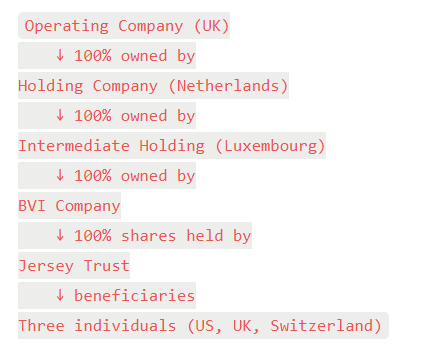
To identify the beneficial owners, you need to:
Search UK Companies House — find Dutch parent
Search Dutch KVK — find Luxembourg parent (LIA application needed)
Search Luxembourg RCS — find BVI parent (minimal data available)
Search BVI — find nothing public, Jersey trustee listed
Contact Jersey trustee — refused without authority
Dead end
Six jurisdictions. Five different access regimes. One answer you cannot reach through public sources.
Why this matters:
Layered structures aren't always suspicious. Tax efficiency, liability separation, regulatory compliance — legitimate reasons exist. But the same structures that serve legitimate purposes also serve illegitimate ones. Verification processes must handle both.
Jurisdictional Arbitrage
Sophisticated actors structure deliberately. They know which jurisdictions disclose what. They route ownership through opacity.
Common arbitrage patterns:
Pattern | How It Works | Why It's Hard |
|---|---|---|
Opacity Sandwich | Transparent jurisdiction → Opaque jurisdiction → Transparent jurisdiction | Middle layer breaks the chain |
Trust Interposition | Corporate chain → Trust → Beneficiaries | Trusts often exempt from BO registers |
Nominee Stacking | Nominee shareholder → Nominee director → Actual controller | Each layer adds deniability |
Free Zone Fragmentation | UAE mainland → DIFC → ADGM | Three regimes, no consolidated view |
Federal/State Split | Delaware LLC → Wyoming LLC → Operating company | State-level opacity defeats federal rules |
The Delaware-BVI-Cyprus triangle:
A structure optimized for opacity:
Delaware LLC: No public ownership disclosure
BVI company: No public register
Cyprus holding: Closed after CJEU ruling
Each jurisdiction is individually compliant with its own rules. Together, they create impenetrable opacity.
Data Quality Issues
Even when registers exist and access is granted, the data may be worthless.
Self-declaration without verification
Most registers rely on companies declaring their own beneficial owners. No independent verification. No cross-checking against other sources. The company says "John Smith owns 30%" — the register records "John Smith owns 30%."
This creates obvious problems:
False declarations go undetected
Outdated information persists
Nominee arrangements aren't flagged
Deliberate concealment is trivially easy
The UK example:
Before 2024 reforms, Companies House accepted any filing without verification. Investigations found:
Beneficial owners listed as residing at Buckingham Palace
Infants registered as company controllers
Deceased individuals appearing on active filings
Thousands of likely false entries
The UK is now fixing this. Most countries haven't started.
Format inconsistencies
No global standard exists for beneficial ownership data. Each jurisdiction uses different:
Name formats (Western order vs. Eastern order)
Date formats (DD/MM/YYYY vs. MM/DD/YYYY)
Address structures
Identification numbers
Threshold calculations
Matching "John Smith" in the UK register to "SMITH, John" in an Australian filing to "约翰·史密斯" in a Chinese document requires human judgment, not automated matching.
Staleness
Beneficial ownership changes. Shares transfer. Trusts distribute. Owners die. Registers reflect the filing date, not current reality.
Filing deadlines vary:
UK: 14 days to update PSC register
EU: Generally 30 days
Many jurisdictions: Annual confirmation only
Some jurisdictions: No ongoing obligation
A register entry from January may be wrong by March. By December, it's guesswork.
The Trust Problem
Trusts break corporate ownership chains.
A company can have shareholders. Shareholders can be traced. But when a trust owns shares, the trail goes cold. Trusts separate legal ownership (trustee) from beneficial enjoyment (beneficiaries). The trustee appears on corporate records. The beneficiaries do not.
Trust opacity by design:
Jurisdiction | Trust Register | Access |
|---|---|---|
Jersey | Yes | Authorities only |
Guernsey | Yes | Authorities only |
BVI | No central register | — |
Cayman | Limited | Authorities only |
Delaware | No register | — |
Nevada | No register | — |
Switzerland | No register | — |
Singapore | No central register | — |
Even where trust registers exist, access is restricted to authorities. For compliance teams, a trust in the ownership chain means relying entirely on counterparty declarations.
Discretionary trusts:
The hardest case. A discretionary trust has no fixed beneficiaries — the trustee decides who receives distributions. The beneficial owners are whoever the trustee chooses, whenever the trustee chooses.
How do you declare the beneficial owner of a structure where the beneficial owner changes at someone's discretion?
Most frameworks require disclosure of:
Settlor (who created the trust)
Trustee (who manages it)
Protector (who oversees the trustee)
Named beneficiaries (if any)
Class of beneficiaries (if discretionary)
But "class of beneficiaries: descendants of the settlor" doesn't tell you who actually receives money today.
Nominee Concealment
Registers capture declared beneficial owners. They don't capture whether those declarations are true.
How nominee arrangements work:
A nominee holds shares "on behalf of" someone else. The nominee appears on official records. The actual owner stays hidden.
Nominee shareholder: Registered owner with no economic interest
Nominee director: Appointed director taking instructions from elsewhere
Nominee beneficiary: Named in trust documents but passing benefits onward
Nominee services are legal in most jurisdictions. Professional nominees — lawyers, accountants, licensed service providers — offer these arrangements commercially.
The disclosure gap:
Some jurisdictions require disclosure of nominee status:
UK: PSC register should flag nominee arrangements
EU: AMLD requires identifying the person "on whose behalf" shares are held
But enforcement is weak. A nominee who fails to disclose their status faces penalties — in theory. In practice, detection requires investigation that rarely happens.
Layered nominees:
Nominee A (disclosed) → Nominee B (undisclosed) → Actual owner
Even if the first nominee is flagged, the chain can continue. Without investigating the relationship between each party, registers capture form over substance.
Legal and Practical Access Barriers
Knowing data exists isn't the same as getting it.
Legitimate interest fragmentation
Post-CJEU, "legitimate interest" means different things in different countries:
Country | Interpretation | Practical Access |
|---|---|---|
Estonia | Broad — public interest sufficient | Easy |
France | Reasonable — journalists, researchers approved | Moderate |
Germany | Narrow — processing delays, some refusals | Difficult |
Ireland | Very narrow — most applications refused | Nearly impossible |
Luxembourg | Minimal — effectively authorities only | Impossible |
A compliance team with identical legitimate interest faces five different outcomes across five EU countries.
Language barriers
Registers operate in local languages:
German Transparenzregister: German interface, German documents
French RBE: French interface, French documents
Japanese registry: Japanese only
Chinese SAMR: Mandarin only
Translation adds cost, time, and error risk. Automated translation misses nuance. Professional translation is expensive at scale.
Authentication requirements
Some registries require:
Local entity registration
Notarized requests
Apostilled documents
In-person applications
Local representative
These barriers prevent casual access — which is the point. They also prevent legitimate verification.
Cost accumulation
Individual registry searches may be cheap. But verification across 10 jurisdictions at €5-50 per search, plus translation, plus professional time, plus commercial database subscriptions — costs compound quickly.
For high-volume verification (onboarding hundreds of corporate customers), the economics become prohibitive without automation.
Timing and Coordination Failures
Verification is a race against change.
Snapshot vs. reality
Every data source reflects a point in time:
Registry filing: Date of submission
Commercial database: Date of last update
Customer declaration: Date signed
A corporate restructuring can make all three obsolete overnight. The beneficial owner you verified last month sold their shares last week.
Monitoring gaps
Ongoing monitoring requires:
Alerts from registries (where available)
Regular re-pulls from commercial databases
Periodic customer re-verification
News and adverse media screening
Most registries don't offer alerts. Commercial databases update on varying schedules. Customer re-verification is manual and slow. News monitoring catches problems after they become public — too late for prevention.
Cross-border coordination
When ownership changes in one jurisdiction, connected filings in other jurisdictions should update. They often don't.
Example: A Dutch holding company changes its shareholder from a UK company to a Luxembourg company. The Dutch register updates. The UK register still shows the old downstream ownership. The Luxembourg register has no record of upstream entities.
No automated synchronization exists between national registers. BORIS (EU interconnection system) helps within Europe but doesn't solve the global problem.
Sanctions and PEP Screening Complications
Identifying beneficial owners is step one. Screening them is step two. Both are hard.
Name matching challenges
Sanctions lists and PEP databases contain names. Beneficial ownership records contain names. Matching them is harder than it sounds.
Challenge | Example |
|---|---|
Transliteration | محمد → Mohammed, Mohammad, Mohamed, Muhammed |
Name order | "Kim Jong Un" vs. "Jong Un Kim" vs. "Kim Jong-un" |
Aliases | Known aliases may not appear in BO declarations |
Common names | Screening "John Smith" generates thousands of false positives |
Partial data | Some records have name only, no DOB or address |
Automated screening produces false positives (wasted investigation time) and false negatives (missed matches). Human review is essential but doesn't scale.
Indirect ownership
Sanctions apply to entities "owned or controlled" by designated persons. But ownership thresholds vary:
US (OFAC): 50% ownership rule
EU: 50% ownership or control
UK: "Owned or controlled directly or indirectly"
A sanctioned person owning 30% may not trigger US sanctions but might trigger UK sanctions depending on control analysis. A sanctioned person owning 10% through multiple layers might aggregate to 50% — or might not, depending on calculation methodology.
PEP identification
Politically Exposed Persons change status:
Elected officials lose elections
Appointed officials leave office
Family members become PEPs when relatives are appointed
PEP databases lag reality. A newly appointed minister might not appear for weeks. A former official might remain flagged for years after leaving office.
Jurisdiction-specific lists
Beyond global sanctions (UN, OFAC, EU), hundreds of national lists exist:
Country-specific sanctions
Sectoral restrictions
Export controls
Local PEP definitions
Comprehensive screening requires checking all relevant lists — which lists are "relevant" depends on your business, your customers, and your risk appetite.
Resource and Expertise Constraints
Effective UBO verification requires:
Resource | Requirement |
|---|---|
Technology | Registry access, database subscriptions, screening tools |
Data | Commercial databases, watchlists, adverse media sources |
People | Analysts who understand corporate structures, local languages, legal frameworks |
Process | Documented procedures, escalation paths, audit trails |
Time | Hours to days per complex structure |
Most organizations lack all five. They compromise — accepting lower verification standards, relying on customer declarations, or avoiding high-risk jurisdictions entirely.
The expertise gap:
Understanding a Jersey trust requires different knowledge than understanding a Delaware LLC or a German GmbH & Co. KG. Analysts with multi-jurisdictional expertise are rare and expensive.
Most compliance teams know their home jurisdiction well, a few common jurisdictions adequately, and obscure jurisdictions not at all. When an ownership chain runs through Liechtenstein, Labuan, and Liberia, expertise gaps become verification gaps.
The technology gap:
Legacy systems weren't built for UBO verification. Customer databases store names and addresses, not corporate structures. Risk systems flag individuals, not ownership chains. Integration between registry access, commercial databases, and screening tools is often manual.
Modern platforms exist but require investment, implementation time, and process change.
What This Means for Compliance
These challenges don't make UBO verification impossible. They make it imperfect.
Compliance is about reasonable efforts, not perfect outcomes. Regulators assess:
Did you follow a documented process?
Did you use appropriate sources?
Did you escalate when verification failed?
Did you make risk-based decisions?
Did you document your reasoning?
A well-documented verification attempt that hits a dead end is compliant. An undocumented assumption that happens to be correct is not.
The next section covers best practices — how to build verification processes that satisfy regulators while acknowledging real-world limitations.
[[form]]
Solving UBO Verification at Scale
The previous section laid out the problem. Fragmented registries. Layered structures. Jurisdictional arbitrage. Data that exists but can't be accessed, or can be accessed but can't be trusted.
These aren't abstract challenges. They're the daily reality for every compliance team trying to answer a simple question: who actually owns this company?
Global Database exists because that question shouldn't require six registry searches, four language translations, three rejected access requests, and two weeks of analyst time.
From 231 Jurisdictions to One Platform
This guide documents beneficial ownership access across 231 countries and territories. The matrix in Section 3 shows the patchwork: public here, restricted there, authorities-only somewhere else.
Global Database connects directly to 200+ official government registries — the same sources that matrix is built from. When we say a jurisdiction has public director data or shareholder filings, we're pulling that data live.
600+ million company profiles. Not scraped. Not aggregated from third parties. First-party data from the registries themselves.
That matters because provenance matters. When a regulator asks where your beneficial ownership data came from, "the official government registry" is the right answer.
How We Map Beneficial Ownership
Section 5 described the layering problem:
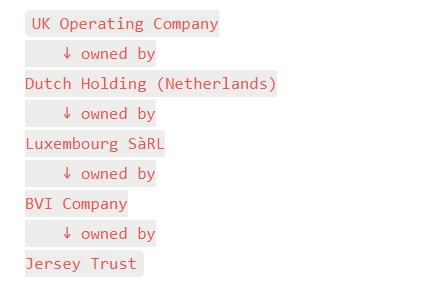
Tracing this manually means searching five registries, navigating five interfaces, dealing with five data formats. Most compliance teams give up at layer three.
Global Database builds the chain automatically.
Step 1: Pull the target company
Start with the UK entity. Our profile shows:
Directors (natural persons with control)
PSC data (beneficial owners as declared to Companies House)
Shareholders (including corporate shareholders)
Step 2: Identify corporate shareholders
The UK company is 100% owned by a Dutch BV. That's not an endpoint — it's a link.
Global Database recognizes the Dutch entity and connects to its profile in the Dutch registry. Same for Luxembourg, same for BVI where corporate filings exist.
Step 3: Map the group structure
Our Global Ownership Graph links parent companies, subsidiaries, and affiliates across jurisdictions. Instead of five separate searches, you see one structure:
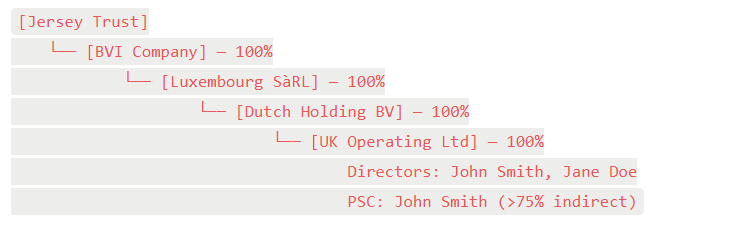
The visual shows what the registries don't: the complete chain from operating company to ultimate owner.
Step 4: Identify the natural persons
Somewhere in every structure, there's a human. Our platform surfaces:
Declared beneficial owners (from BO registers where public)
Directors at each level (natural persons with control)
Shareholders who are individuals (direct ownership)
When the chain hits a trust or foundation, we flag it. You know where verification requires additional steps — counterparty declarations, trust documentation, or regulatory requests.
[[form]]
The Registries Behind the Matrix
Remember the UBO Data Accessibility Matrix from Section 3? Here's how Global Database coverage maps to it:
Where we have direct beneficial ownership data:
Jurisdiction | Register | What We Pull |
|---|---|---|
United Kingdom | Companies House PSC | Full PSC declarations, nature of control |
Estonia | e-Business Register | BO data via API, most transparent in EU |
Latvia | Enterprise Register | Beneficial owners, public access |
Denmark | CVR | BO declarations, publicly searchable |
Bulgaria | Commercial Register | BO filings |
Ukraine | EDR | Beneficial owners, first public register globally |
Nigeria | CAC | 5% threshold BO data |
Norway | Brønnøysund | BO register data |
Where registries publish corporate data but not BO:
Some jurisdictions publish director and shareholder information even when beneficial ownership registers are restricted. Where that data is public, we have it:
Data Type | Use for UBO Verification |
|---|---|
Directors | Natural persons exercising control |
Shareholders | Ownership stakes, corporate vs. individual |
Corporate hierarchies | Parent-subsidiary relationships |
Filing history | Changes in ownership over time |
Germany's Transparenzregister requires legitimate interest — but Handelsregister publishes directors and shareholders publicly. We have that. Singapore's ACRA publishes company profiles with directors and shareholders. We have that too.
Where registries publish nothing, we have nothing.
BVI doesn't publish directors or shareholders. Neither does Cayman. The matrix in Section 3 shows these gaps — "No" in the Director Data and Shareholder Data columns means no public data exists. We can't pull what registries don't publish.
This is the honest reality of UBO verification. Some jurisdictions are transparent. Some are opaque by design. We give you everything that's publicly available. For the rest, you need counterparty declarations, regulatory requests, or acceptance that verification has limits.
Real-Time Registry Connections
Section 5 flagged staleness as a critical problem. A filing from January is outdated by March.
Aggregated databases update on their schedule — weekly, monthly, whenever they get around to it. By the time data reaches you, it's already old.
Global Database connects to registries directly. When you pull a company profile, you're getting current filings. When a company files a PSC change at Companies House, it's reflected in our data — not weeks later, but when the registry updates.
For monitoring, this matters even more. Our Signals product watches for changes:
New director appointments
Director resignations
Shareholder changes
Status changes (dissolved, struck off, restored)
New filings
When the ownership structure changes, you know. Not from a quarterly database refresh. From the registry filing itself.
Connecting the Country Guides
Section 4 provided verification strategies for 16 key jurisdictions. Each guide ended with practical steps. Global Database is how you execute them.
United Kingdom — "Search Companies House for PSC data" → We pull PSC data directly. Full beneficial owner declarations with nature of control.
Germany — "Check Handelsregister for director and shareholder data" → We have Handelsregister coverage. Directors, shareholders, corporate structure — without navigating German-language interfaces.
Singapore — "Purchase ACRA profile for director and shareholder data" → We pull ACRA data. Company profile, directors, shareholders in our standard format.
United States — "Identify state of incorporation, search state registry" → We cover all 50 states. Delaware, Wyoming, Nevada — even the opaque ones. Whatever's filed, we have it.
Hong Kong — "Search Companies Registry for directors and shareholders" → We pull CR data. Directors, shareholders, annual returns — structured and searchable.
The country guides tell you what's possible. Global Database makes it practical.
From Verification to Monitoring
Section 5 described the timing problem: beneficial ownership is a snapshot, but compliance is ongoing.
The verification you did at onboarding becomes stale. Shares transfer. Directors resign. Structures reorganize. A compliant customer becomes a problem customer — and you don't know until it's too late.
Global Database addresses this with ongoing monitoring:
Registry change alerts When filings change at the source registry, we flag it. New PSC declaration in the UK? Director resignation in Singapore? You get notified.
Ownership structure monitoring Track changes across the entire group structure, not just the immediate entity. When the Dutch parent gets a new shareholder, the downstream UK subsidiary's risk profile changes too.
Scheduled re-verification Set review cycles — quarterly, annually, or custom. Automated re-pulls ensure you're working with current data.
Historical comparison See what changed between verification dates. Director turnover, ownership shifts, status changes — documented and auditable.
Where We Fit in Your Workflow
UBO verification doesn't happen in isolation. It's step three in a five-step KYB process:
Step | Task | Global Database Role |
|---|---|---|
1 | Entity verification | Confirm company exists, is active, details match |
2 | Director identification | Pull current directors, verify against declarations |
3 | UBO determination | Map ownership chain, identify natural persons |
4 | Screening | Cross-reference against sanctions, PEP lists |
5 | Ongoing monitoring | Track changes, re-verify periodically |
We handle steps 1-3 and 5 directly. For step 4, our data integrates with screening tools — structured output that feeds directly into your sanctions and PEP checks.
Integration options:
API — Programmatic access for automated workflows. REST API, JSON responses, sandbox for testing.
Platform — Web interface for analyst-driven investigations. Search, explore, export.
Bulk data — Full datasets for organizations building their own systems.
The output is standardized regardless of source jurisdiction. A UK company profile and a Singapore company profile have the same structure. Your systems don't need to handle 200 different formats.
The Gap We Fill
Go back to the matrix. 231 jurisdictions. 39 with public BO registers. 30 with legitimate interest access. The rest: restricted, authorities-only, or nothing at all.
For jurisdictions with public BO data, we pull it directly.
For jurisdictions with public corporate data (directors, shareholders), we provide what's available — the building blocks for tracing ownership chains.
For jurisdictions that publish nothing — BVI, Cayman, and others designed for opacity — we have what they have: company name, registration number, registered agent. Nothing more, because nothing more exists publicly.
We don't manufacture data that doesn't exist.
The matrix shows reality. Green cells mean public data — we have it. Red cells mean no public data — nobody has it, including us. Our value is aggregating the green cells across 200+ registries into one platform, not pretending the red cells don't exist.
600 million companies. 200+ registries. One platform.
Where the data exists, we surface it. Where it doesn't, we're honest about the gap.
Frequently Asked Questions About Ultimate Beneficial Ownership
What is an ultimate beneficial owner (UBO)?
An ultimate beneficial owner is the natural person who ultimately owns or controls a company, or on whose behalf a transaction is conducted. Unlike legal ownership — which can be held by other companies, trusts, or nominees — beneficial ownership always traces back to a human being. A person qualifies as a UBO through ownership (typically 25%+ shares), control (voting rights, board influence), or benefit (receiving economic gains from the entity).What is the difference between a shareholder and a beneficial owner?
A shareholder is the legal owner of shares as recorded in company documents. A beneficial owner is the natural person who ultimately benefits from or controls those shares. They can be the same person — but often aren't. A shareholder might be a holding company, a trust, or a nominee acting on someone else's behalf. The beneficial owner is the human at the end of that chain. Compliance requirements focus on beneficial owners because legal ownership can be used to hide the true controllers.What is the beneficial ownership threshold?
The beneficial ownership threshold is the minimum ownership percentage that triggers disclosure requirements. The FATF recommends 25% as the standard threshold, and most jurisdictions follow this. However, thresholds vary: Nigeria and Colombia use 5%, Kenya uses 10%, Costa Rica uses 15%, and Ghana requires disclosure of all shareholders (0%) for domestic extractives companies. Ownership below the threshold doesn't require UBO declaration — which is why some structures deliberately keep individual stakes at 24.9%.Which countries have public beneficial ownership registers?
As of 2025, approximately 39 countries have fully public beneficial ownership registers. These include the United Kingdom (PSC Register), Estonia, Denmark, Latvia, Ukraine, Nigeria, and New Zealand. The European Union previously required public access, but the November 2022 CJEU ruling allowed member states to restrict access. Countries like Germany, France, and Netherlands now require "legitimate interest" for access, while Cyprus, Malta, and Luxembourg effectively closed their registers to the public.How do I verify the beneficial owner of a company?
UBO verification typically follows these steps: (1) Identify the jurisdiction of incorporation, (2) Search the official company registry for director and shareholder data, (3) Access the beneficial ownership register if one exists and is accessible, (4) Trace through corporate shareholders to identify ultimate natural person owners, (5) Request UBO declarations directly from the company for gaps in public data, (6) Cross-reference with commercial databases and screening tools. The process varies by jurisdiction — some countries publish BO data freely, others restrict access, and many have no central register at all.What is the EU CJEU ruling on beneficial ownership registers?
On November 22, 2022, the Court of Justice of the European Union ruled that unrestricted public access to beneficial ownership registers violates fundamental privacy rights under the EU Charter. The joined cases (C-37/20 and C-601/20) didn't eliminate registers — it required "legitimate interest" for access. The ruling fragmented the EU: some countries (Estonia, Denmark, Latvia) maintained public access, while others (Luxembourg, Cyprus, Malta) closed registers almost entirely. Germany, France, and Netherlands implemented legitimate interest tests with varying strictness.What is the US Corporate Transparency Act?
The Corporate Transparency Act (CTA), effective January 2024, created the first US federal beneficial ownership database. Most US companies must report their beneficial owners (25%+ ownership or substantial control) to FinCEN (Financial Crimes Enforcement Network). However, unlike UK or EU registers, the FinCEN database is not publicly accessible. Only federal law enforcement, state/local law enforcement (with court order), and financial institutions (with customer consent) can access it. Businesses conducting due diligence cannot query the database directly.Why is beneficial ownership verification important for AML compliance?
Beneficial ownership verification is central to anti-money laundering because money launderers use corporate structures to hide their identity. Shell companies, layered holdings, and nominee arrangements distance criminals from their illicit funds. Without identifying the beneficial owner, financial institutions can unknowingly process transactions for sanctioned individuals, corrupt officials, or terrorist financiers. Regulations like the EU Anti-Money Laundering Directives, UK PSC requirements, and US CTA exist specifically to close these loopholes by requiring disclosure of the humans behind corporate vehicles.What are the challenges in cross-border UBO verification?
Cross-border verification faces multiple obstacles: (1) Jurisdictional fragmentation — each country has different registers, access rules, and thresholds, (2) Layered structures — ownership chains spanning multiple countries require searching multiple registries, (3) Data quality — most registers rely on self-declaration without verification, (4) Trust opacity — trusts break corporate ownership chains and are often exempt from registers, (5) Nominee concealment — declared owners may be nominees acting for hidden principals, (6) Access barriers — language, authentication requirements, and legitimate interest applications, (7) Staleness — registers reflect filing dates, not current reality.How often should beneficial ownership information be updated?
Regulatory requirements vary by jurisdiction. The UK requires PSC register updates within 14 days of any change. EU member states generally require updates within 30 days. The US CTA requires updates within 30 days of changes. However, compliance best practice goes beyond minimum requirements. For high-risk relationships, ongoing monitoring should include: alerts for registry filing changes, periodic re-verification (quarterly or annually), and adverse media screening. Point-in-time verification at onboarding is insufficient — beneficial ownership changes constantly through share transfers, director changes, trust distributions, and corporate restructurings.