Master data management, anchored to the registry of record.

Match, dedupe, and enrich every customer, supplier, and prospect record — resolved to its official registration number, with the filing behind each field and the date it was read. Stewards decide on evidence, not on a score.

0M+records resolvable
0+registries read live
Entity resolutionSampleSynced daily
ACME MANUFACTURING LTDSalesforce
Matching✓ 0.98
Acme Mfg. LimitedSAP
Matching✓ 0.96
acme manufacturing coBilling
Matching✓ 0.93
3 records1 entity
Registry of record
ACME MANUFACTURING LIMITED
Active
Reg. number
04123987
Registry
Companies House · GB
companies_house/filing2026-07-21

0M+

Company profiles, resolvable to a registry entry

0+

Government registries read directly at source

0+

Countries and territories, including thin-file markets

Daily

Refresh cadence, with change events pushed to your systems

Company master data rarely fails loudly.

It degrades quietly — a near-duplicate here, a stale status there, a field nobody can trace. You feel it when finance can't roll up spend to a parent, or an auditor asks where a number came from and the file has no answer.

The through-lineEvery one of these traces back to one thing — a company identified by a name, not a number.
01

A company name is not an identifier

"Acme Ltd", "ACME LIMITED", and "Acme Mfg." are one company to a human and three to a database. Keying identity on a string guarantees drift.

02

Every system onboarded the company separately

Sales, procurement, billing, and compliance each created their own record with its own spelling and ID. Without a shared key, one customer is counted four times and governed zero times.

03

Records decay after onboarding

Companies change name, address, directors, and status. A record that was right at onboarding quietly becomes wrong — and re-cleansing projects only reset the clock.

04

Enrichment arrives with no source attached

A vendor appends revenue and headcount, but not the filing it came from or when it was read. The field can inform an opinion but cannot support an audit.

05

Hierarchy is missing, so roll-ups don't add up

Spend, exposure, and risk sit at the legal entity but are managed at the group. When parent-child linkage is missing or stale, the ultimate parent's true exposure never rolls up.

06

Match decisions can't be interrogated

A black-box score says 87 and nothing more. Stewards can't see which attributes agreed, so they review everything by hand — which is where most match automation quietly dies.

Four steps, each one inspectable

Matching is a pipeline rather than a single score. Every stage exposes what it did, so a low-confidence result tells a steward what was missing instead of leaving them to guess.

01

Normalise per jurisdiction

Legal-form suffixes, punctuation, diacritics, transliteration, and address formats are normalised using rules specific to the country — because "Ltd", "GmbH", and "S.A." carry different meanings and different collision risks.

02

Generate candidates

The normalised record is blocked against 600M+ registry profiles on name, address, domain, officer names, and any identifier you supplied. Supplying a registration number or postcode is what moves a record from the review band into auto-merge.

03

Score on evidence

Each candidate is scored attribute by attribute, and the agreeing attributes are returned alongside the number. A score of 0.93 arrives with the reason it is 0.93 — and with the runner-up it was chosen over.

04

You set the merge rules

Above your auto-merge line, records merge and write back. Below it, they queue for a steward with the evidence already attached. Decisions are retained, so the same ambiguity isn't reviewed twice at the next refresh.

Every field on the resolved record, sourced

Up to 40 fields per company, grouped into six categories — each read from the registry it was filed with and carrying its source. Modelled values are labelled as modelled.

01

Company registry data

  • Legal name & previous names
  • Registration number, VAT & tax IDs
  • Legal form & incorporation date
  • Company status
  • Registered & trading addresses
  • Registry source & filing link
02

Financials

  • Filed revenue & turnover
  • Assets, liabilities & net worth
  • Profit & loss figures
  • Filing history & latest accounts
  • Currency & reporting period
  • Multi-year financial trend
03

Firmographics

  • Industry codes — SIC, NACE, NAICS
  • Employee counts & size bands
  • Company age & trading status
  • Websites & digital footprint
  • Phone numbers
  • Geographic & jurisdiction data
04

Shareholders & ownership

  • Shareholders & shareholdings
  • Share classes & percentages
  • Beneficial owners (PSCs / UBOs)
  • Ownership percentages
  • Ultimate beneficial owner chain
05

Group structure

  • Immediate parent
  • Global ultimate owner
  • Subsidiaries & branches
  • Corporate linkage across registries
  • Cross-registry entity resolution
06

Directors & officers

  • Directors & active officers
  • Officer role & position
  • Appointment & resignation dates
  • Nationality & country of residence
  • Date of birth (where filed)
  • Occupation

Up to 40 fields per record. See the full data dictionary

Dedupe solves the row. Linkage solves the roll-up.

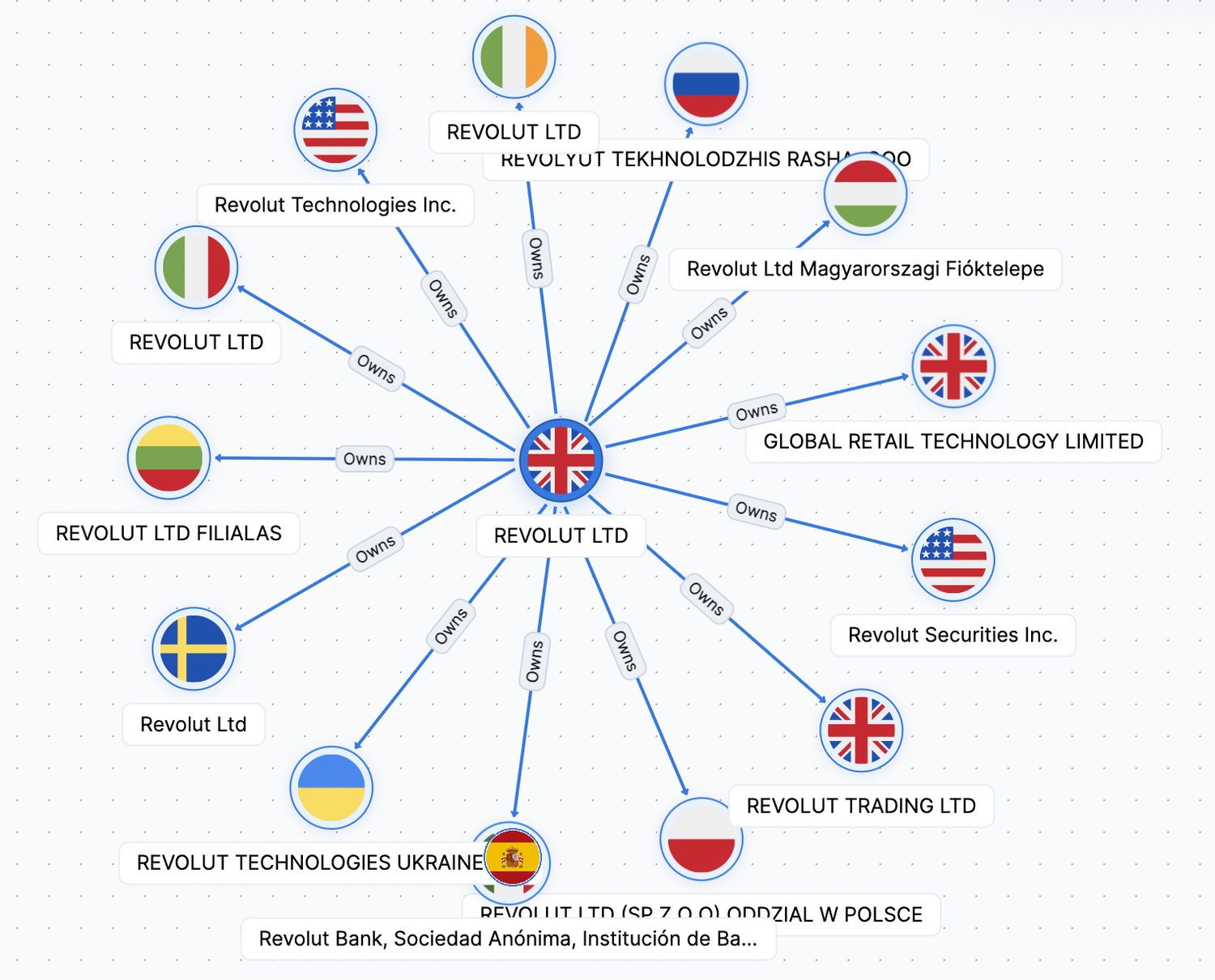
Collapsing four records into one customer is only half the job. If the golden record has no parent, finance still can't see that six separate vendors belong to one group — so negotiated terms leak, concentration looks lower than it is, and credit limits are set against the subsidiary instead of the group.

Group structure is built from ownership filings and officer registers across jurisdictions, so parents, subsidiaries, and shared beneficial owners resolve to the same identifiers as the rest of your master data.

Ownership graph: Revolut Ltd with its group of subsidiaries across jurisdictions, each linked by an Owns relationship

Master data that maintains itself

Registries are read daily. When something material changes on a company you hold, the delta is pushed into your systems as an event — so the golden record is corrected before the next quarter's reporting, not during it.

See it on your data
change_eventsSynced daily
ACME LOGISTICS SP. Z O.O.Status changed to In liquidation · KRS
06:11Z
ACME MANUFACTURING LIMITEDRegistered office changed · AD01 filed
06:12Z
ACME NORDIC ABLegal name changed from Acme Sverige AB
06:14Z
ACME HOLDINGS LIMITEDNew subsidiary registered · ACME IBERIA S.L.
06:15Z
ACME MANUFACTURING GMBHFY2025 accounts filed · turnover updated
06:17Z

The difference is the source

Most enrichment suppliers resell a chain of upstream vendors, then wrap the result in an identifier you license. We read the registry, keep the trail, and hand you keys you already own.

Primary, government-sourced

Company attributes are read directly from the registry of record and 400+ official sources. You see the filing behind the field, rather than a value that has passed through three resellers on its way to you.

Identity you own outright

Resolution keys on registration numbers and LEIs — public identifiers. There is no proprietary ID embedded in your estate to license annually or unpick if you move.

Auditable by construction

Provenance is attached at field level as data is written, not reconstructed on request. When governance asks how a value was derived, the lineage is already in the record.

Redistribution rights available

If you embed company data in a product your own customers use, licensing can include reseller and redistribution rights — a conversation that ends most enterprise procurement cycles early elsewhere.

Coverage where matching usually fails

Match rates hold up outside the easy jurisdictions. 200+ countries including the thin-file and emerging markets where supplier and customer records are hardest to resolve.

Case study · Statista

How Statista Enriches Its Company Data Product

Statista scales its own B2B company intelligence product on data sourced directly from official government registries — a master dataset it can trust as the single source of truth downstream.

Read the case study

Into the systems that hold the record

Match and enrichment run where your master data already lives — through the API, as scheduled batches, in the warehouse, or directly inside the CRM.

Integrate
Company Data API

Resolve a record on write. Send a name and country, receive the entity, identifier, confidence, and matched attributes.

Batch & warehouse

Match an existing file at volume, or land resolved records and change events straight into your warehouse on a schedule.

Connect
CRM

Dedupe accounts, fix parent-child structures, and enrich on create — inside Salesforce, HubSpot, or Dynamics 365, with the source written alongside every field.

MCP

Connect Global Database to any MCP-compatible client or agent through the Model Context Protocol — company data queried in natural language, with sources attached.

Work with it
Claude & ChatGPT

Ask master-data questions in plain language — duplicates by group, unresolved records, what changed this week — with sources attached.

Regis AI

Global Database's built-in analyst. Ask for duplicate groups, unresolved records, or what changed this week — answered in-platform, traceable to the filing.

Put one company identity behind every system

Send us a sample of your account or vendor file. We'll return it resolved, deduplicated, and enriched — with the source and timestamp on every field, so you can judge the match rate on evidence.

Questions data teams ask first

How is this different from a DUNS-based approach?

The identifier. A DUNS number is issued and licensed by a vendor, so it becomes a dependency the moment it spreads through your systems. We resolve to the registration number issued by the government registry — a public identifier you can use, publish, and reconcile against without a licence, and that stays valid whoever supplies your data.

What happens when a match is ambiguous?

It stays ambiguous rather than being forced. Records below your auto-merge threshold return the candidate set with the evidence for each — which attributes agreed and which were missing — and route to a steward queue. Adjudications are retained, so the same record isn't re-reviewed at the next refresh.

Can we keep our own internal IDs?

Yes, and most customers do. Your internal key stays primary; the registry identifier is added as the cross-system anchor that lets CRM, ERP, and billing records recognise each other. Nothing requires you to re-key your estate.

How current is the data?

Registries are read on a daily cycle, and each field carries the timestamp of the read that produced it — so currency is a property of the record rather than a claim on a website. Publication cadence does vary by registry: some file continuously, others in batches, and the retrieval timestamp makes that visible per field.

Can we redistribute enriched records in our own product?

Reseller and redistribution rights are available and negotiated as part of the licence. If company data will surface to your own customers, raise it early and the terms can be scoped around that use.

What about companies with very thin filings?

Identity, status, and address still resolve from the registry, because those are filed everywhere. Financial depth genuinely varies by jurisdiction — where figures aren't filed, estimated revenue and headcount are provided as modelled values and labelled as modelled, so a filed figure and an estimate are never mixed in the same field.

What match rate can we expect on our data?

It depends on what you send, and we'd rather show you than quote a headline number. Records that arrive with a registration number, postcode, or domain resolve at very high rates automatically; a bare, misspelt name in a common-name market lands in the review band by design — forcing those to auto-merge is exactly how false merges happen. The number that matters is the split between auto-merge, review, and no-match, and we'll return that split on a sample of your own file before you commit.

Two companies share a name in different countries — how do you tell them apart?

Jurisdiction is part of the key. Because identity resolves to the registry a company is incorporated in, "Acme Ltd" at Companies House and "Acme LLC" in Delaware are never the same record — different registers, different registration numbers. When an input doesn't say which country it belongs to, the candidates are returned side by side for a steward rather than collapsed into a guess.

We already run an MDM platform — Informatica, Reltio. How does this fit?

It feeds the hub rather than replacing it. We are the company-entity layer — resolution, registry identifiers, and enriched attributes with provenance — delivered through the API, batch, or your warehouse. Your platform keeps governing survivorship and stewardship; we supply the matched, sourced company data underneath it, so the golden record your teams already trust gets a public identifier and a traceable source on every field.

Do you overwrite our records, or do we stay in control?

You stay in control. Nothing is overwritten by default. You set the survivorship rules — which system wins for which field, and where the registry should override an internal value — and changes arrive as events you can accept, route to a steward, or ignore. The golden record is governed by your rules, not ours.