2. Dun & Bradstreet (D&B) Review (2026) — A Leading Factiva Competitor for Global Credit, Risk & Corporate Intelligence
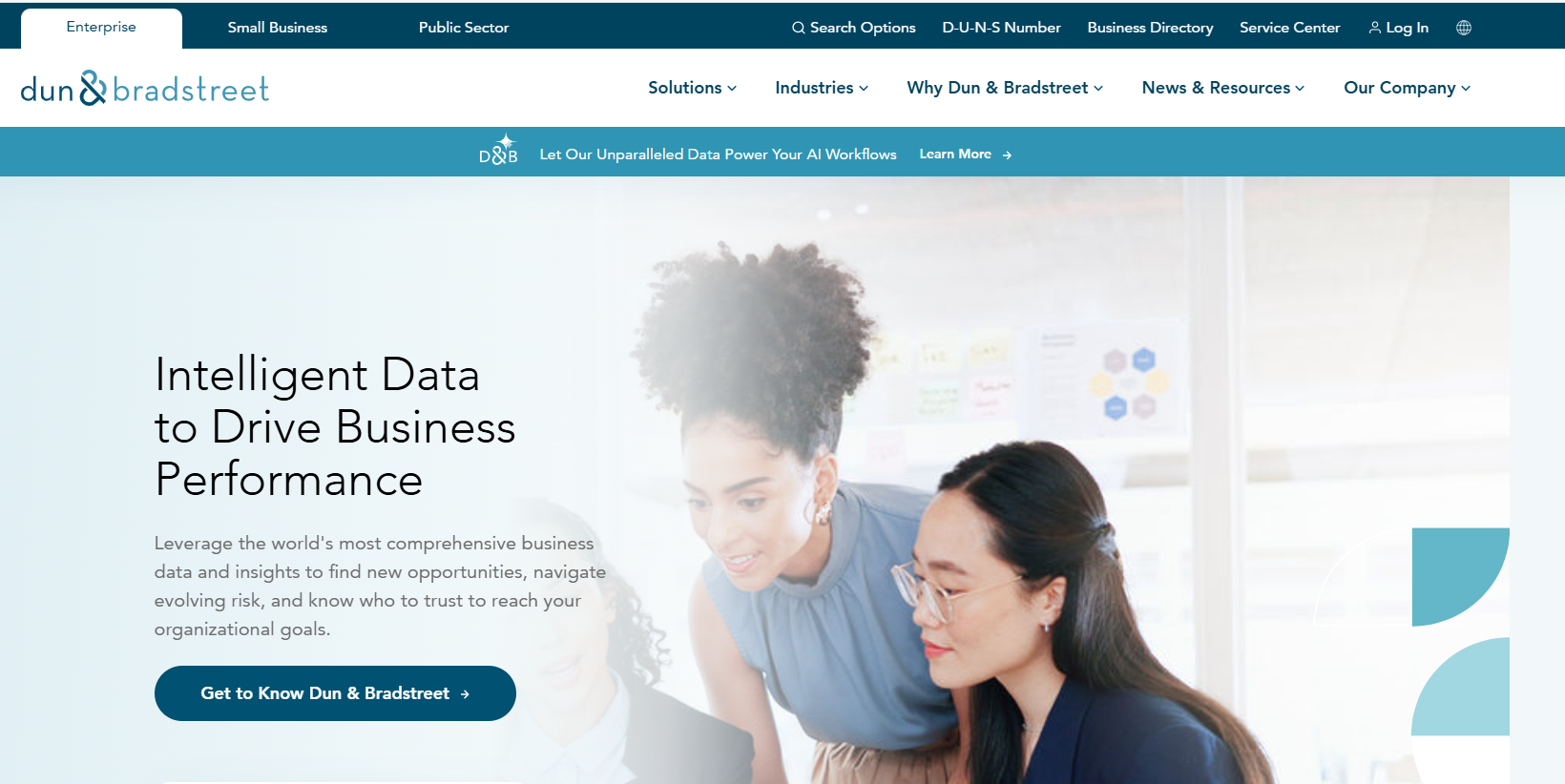 Dun & Bradstreet: Comprehensive Overview (2026)
Dun & Bradstreet (D&B) is one of the world’s longest-established providers of business credit data, corporate linkage intelligence, and global company information. Unlike Factiva—which focuses on editorial news—D&B delivers structured firmographic data, financial stress indicators, credit risk scores, supply-chain insights, and corporate family trees used widely in financial services, procurement, compliance, and enterprise risk management.
D&B maintains a global commercial database with hundreds of millions of company profiles, anchored by the well-known D-U-N-S® Number, a unique identifier used for supplier verification, B2B onboarding, sanctions checks, and corporate hierarchy mapping.
Organizations rely on D&B primarily for:
Credit risk assessment
Supplier due diligence
Corporate linkages & family trees
Trade payment behavior & predictive analytics
Procurement risk monitoring
Compliance reviews
This makes D&B a strong choice for teams that need risk-focused business intelligence rather than editorial news content.
D&B Strengths (Compared to Factiva)
Industry-Leading Business Credit Data
D&B provides widely used credit scores, risk indicators, financial stress ratings, and trade payment behavior, which Factiva does not offer.
Global Corporate Linkage & Family Tree Mapping
D&B’s D-U-N-S®-based hierarchy identifies parent companies, subsidiaries, branches, and cross-border groups—giving organizations visibility into multi-layer corporate structures.
Strong Supply Chain & Vendor Risk Insights
Procurement teams use D&B for supplier verification, financial stability checks, and risk monitoring, areas where Factiva has no capabilities.
Trade Payment & Predictive Analytics
D&B collects trade payment information from thousands of partners, offering insights into how companies behave financially—especially useful for credit and underwriting teams.
Enterprise Integrations & Ecosystem
D&B integrates with major enterprise tools including SAP, Oracle, Salesforce, Microsoft Dynamics, and numerous procurement and risk platforms.
D&B Weaknesses (Compared to Factiva)
Limited Editorial or News Content
D&B does not replace Factiva’s strength in global news, articles, or media-driven research.
Higher Pricing and Licensing Restrictions
D&B contracts are often costly, with strict data usage limitations, especially in downstream or multi-client applications.
Variable Data Freshness in Some Regions
D&B relies on multiple third-party sources and contributors, leading to inconsistencies in coverage depending on geography.
Less Transparency Into Data Sources
Compared to registry-first providers, D&B reveals less detail about where each data point comes from.
D&B vs Factiva — Comparison Table (2026)
Feature / Capability | Dun & Bradstreet (D&B) | Factiva |
|---|
Primary Focus | Credit data, risk insights, corporate linkages | Global news aggregation |
Company Profiles | Extensive global commercial database | Companies mentioned in news content |
Credit Scores & Risk Indicators | Yes | No |
Trade Payment Behavior | Yes | No |
Corporate Linkage & Family Trees | Yes | No |
Financial Statements | Partial (varies by market) | No |
Data Source Transparency | Moderate | Low |
News & Media Coverage | Limited | Extensive |
Integrations | SAP, Salesforce, Oracle, Dynamics | None |
Ideal Use Cases | Credit risk, supplier verification, corporate linkages, procurement | News monitoring & research |
Conclusion: Is Dun & Bradstreet a Good Factiva Alternative in 2026?
Dun & Bradstreet is a powerful Factiva alternative for organizations that prioritize credit data, supplier risk insights, and corporate hierarchy mapping. While it does not match Factiva’s editorial news coverage, D&B excels in risk intelligence, financial stress monitoring, and B2B due diligence.
Companies in procurement, finance, underwriting, and compliance often choose D&B when they need credit scoring, corporate linkage visibility, or vendor risk monitoring, not editorial news content.
Top 5 FAQs About Dun & Bradstreet as a Factiva Alternative (2026)
Why do companies choose Dun & Bradstreet instead of Factiva?
Organizations select D&B when they need credit risk scores, supplier verification, corporate family trees, and financial stability insights. Factiva focuses on news coverage, while D&B helps assess the financial health and risk profile of businesses.
Does Dun & Bradstreet provide credit scores and trade payment data?
Yes. D&B is known for its credit scores, predictive risk indicators, and trade payment behavior, all of which help companies evaluate whether a business is financially reliable.
Can D&B identify corporate ownership and group structures?
Yes. Through the D-U-N-S® Number system, D&B maps parent companies, subsidiaries, branches, and cross-border corporate hierarchies, offering visibility into global group structures.
Is Dun & Bradstreet useful for procurement, onboarding, and supplier risk checks?
Absolutely. D&B is widely used to verify suppliers, analyze financial stability, and monitor ongoing vendor risk, making it a strong tool for procurement and compliance teams.
Does Dun & Bradstreet offer news or media insights like Factiva?
No. D&B does not provide news aggregation or editorial content. It specializes in business credit data, risk intelligence, and corporate linkage mapping, not media monitoring.
3. Monetaiq Review (2026) — A Modern Factiva Alternative for Financial Intelligence, Digital Insights & Company Benchmarking
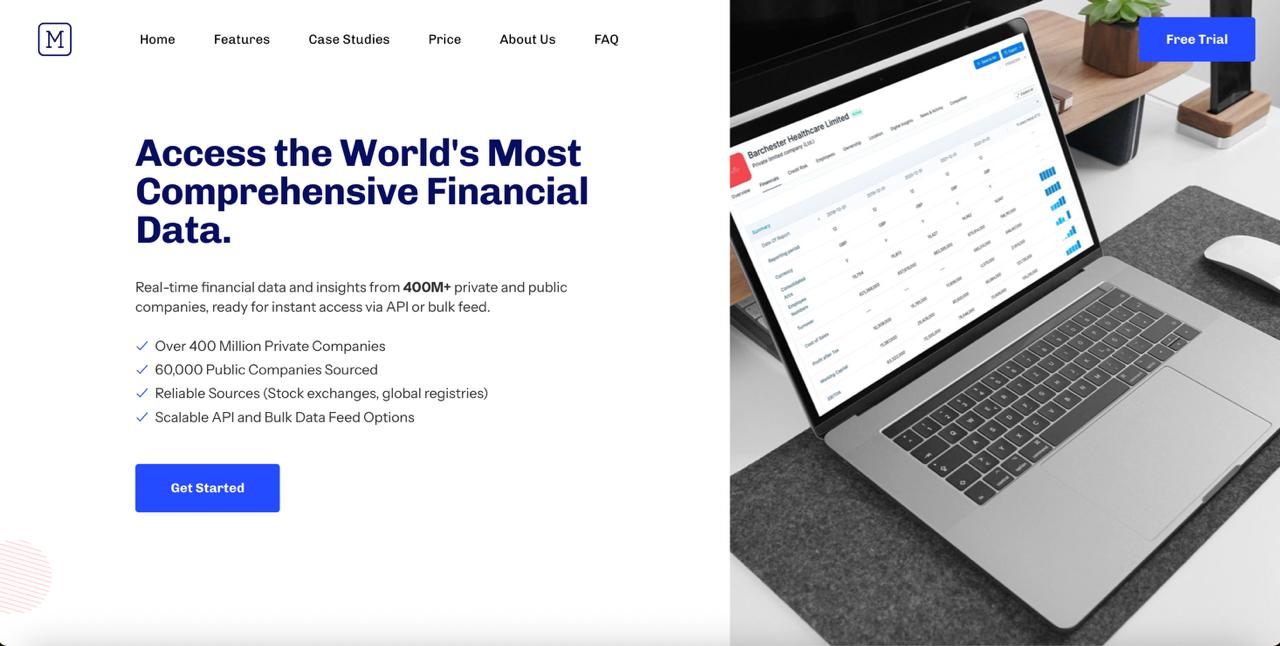
Monetaiq: Comprehensive Overview (2026)
Monetaiq is an emerging business intelligence platform focused on financial data, digital insights, online performance metrics, and company benchmarking. While Factiva centers on global news and editorial content, Monetaiq provides a more operational and analytics-driven view of companies by combining financial fundamentals, digital footprint data, traffic analytics, growth signals, and firmographic information.
The platform is built for teams that want insight into how companies operate, perform, and grow, rather than just how they appear in the media. Monetaiq aggregates structured financials, technology adoption signals, industry classification, website analytics, geographic traffic breakdowns, and competitive comparisons.
Organizations typically use Monetaiq for:
Company benchmarking & performance analysis
Market research & competitive intelligence
Evaluating digital presence & technology usage
Identifying high-growth businesses
Supporting data-driven commercial decisions
This makes Monetaiq a strong Factiva competitor for teams that prioritize financial performance and digital intelligence over news coverage.
Monetaiq Strengths (Compared to Factiva)
Financial Intelligence Combined With Digital Insights
Monetaiq blends financial datasets with website performance, traffic metrics, engagement signals, and tech stack details, offering a broader view of company health than news-based tools like Factiva.
Strong Competitive Benchmarking Capabilities
Users can compare companies across revenue, growth patterns, digital reach, industry benchmarks, and online engagement, enabling deeper analytical workflows.
Digital Footprint & Web Traffic Metrics
The platform includes insights such as:
Traffic volumes
Traffic geography
Acquisition channels
User engagement
Technology adoption
These metrics help teams evaluate market visibility and digital maturity.
Easy-to-Use Interface for Market & Competitor Research
Monetaiq delivers clear dashboards designed for analysts, product teams, and commercial leaders.
Centralized Company Profiles With Multi-Source Data
Profiles combine financials, digital analytics, industry data, and firmographics into a unified view, making it easier to understand overall company performance.
Monetaiq Weaknesses (Compared to Factiva)
No Editorial News or Media Coverage
Monetaiq does not offer articles, news mentions, or media monitoring like Factiva.
Less Depth in Corporate Ownership & UBO Data
While strong on financials and digital insights, Monetaiq does not provide the level of ownership or group structure mapping offered by registry-first platforms.
Limited Credit Risk Intelligence
Monetaiq is not positioned as a credit or risk assessment tool, unlike specialized platforms such as D&B.
Fewer Enterprise Integrations Than Legacy Providers
Compared to older data vendors, its integration ecosystem is still expanding.
Monetaiq vs Factiva — Comparison Table (2026)
Feature / Capability | Monetaiq | Factiva |
|---|
Primary Focus | Financial intelligence + digital insights | News & editorial coverage |
Financial Data | Yes | No |
Digital Traffic & Web Analytics | Yes | No |
Technology & Web Stack Data | Yes | No |
Competitive Benchmarking | Strong | Limited |
Ownership / UBO Information | Limited | No |
Corporate Linkage Mapping | Partial | No |
News & Media Monitoring | No | Yes |
Ideal Use Cases | Benchmarking, growth analysis, digital market research | News research, PR monitoring |
Conclusion: Is Monetaiq a Good Alternative to Factiva in 2026?
Monetaiq is a compelling alternative to Factiva for teams seeking financial visibility, digital insights, and strategic benchmarking, rather than media coverage. It provides a deeper understanding of how companies perform and grow, supported by traffic analytics, revenue indicators, website metrics, and technology insights.
While it cannot replace Factiva for news monitoring, Monetaiq offers stronger value for teams that need data-driven perspectives rather than editorial content—especially in product strategy, market research, competitive intelligence, and commercial planning.
Top 5 FAQs About Monetaiq as a Factiva Alternative (2026)
What makes Monetaiq a strong alternative to Factiva?
Monetaiq delivers financial data, digital insights, and company performance analytics, whereas Factiva is focused on news and media content. Teams choose Monetaiq when they need measurable business indicators rather than editorial reporting.
Does Monetaiq include detailed financial information?
Yes. Monetaiq provides structured financial data, revenue indicators, profitability metrics, and other performance benchmarks useful for evaluating company health and growth.
Can Monetaiq show website traffic and digital presence metrics?
Yes. Monetaiq offers insights into traffic volumes, acquisition channels, user geography, and online engagement, helping users understand a company’s digital footprint.
Is Monetaiq useful for competitive and market analysis?
Yes. The platform is designed for comparing companies by financial strength, digital performance, engagement trends, and technology adoption, making it ideal for market research and competitive intelligence.
Does Monetaiq provide ownership, UBO, or corporate structure data?
No. Monetaiq is focused on financial and digital performance. It does not specialize in shareholder records, UBO transparency, or corporate linkage mapping, which are covered by other platforms.
4. S&P Capital IQ Review (2026) — A Powerful Factiva Competitor for Financial Data, Valuation Models & Market Intelligence
S&P Capital IQ: Comprehensive Overview (2026)
S&P Capital IQ is one of the most widely used platforms for financial data, equity research, credit analysis, market intelligence, and valuation modeling. While Factiva specializes in news and editorial content, Capital IQ focuses on hard financials, market data, corporate filings, ownership structures, analyst forecasts, and private company fundamentals.
The platform is used extensively by investment banks, asset managers, private equity firms, consulting companies, and corporate finance teams for tasks such as:
Building valuation models
Analyzing company financials
Benchmarking performance against peers
Screening private and public companies
Evaluating creditworthiness
Tracking mergers, acquisitions, and market transactions
Capital IQ offers deep financial transparency, advanced screening tools, a robust Excel plugin, and access to S&P’s industry-standard credit ratings and research.
This makes S&P Capital IQ one of the strongest Factiva competitors for teams looking for financial, market, and investment-focused intelligence rather than news aggregation.
S&P Capital IQ Strengths (Compared to Factiva)
Industry-Leading Financial Data & Fundamentals
Capital IQ provides detailed financial statements, key ratios, forecasts, restated filings, segment breakdowns, and forward-looking estimates—far beyond anything available in Factiva.
Advanced Equity & Credit Analysis Tools
Users gain access to S&P Global Ratings, credit risk models, financial stress indicators, bond data, and credit benchmarks relied on across global capital markets.
Exceptional Screening & Valuation Capabilities
Capital IQ allows highly granular screening across billions of data points, including:
Valuation multiples
Revenue segments
Industry filters
Ownership
Debt structure
Private market signals
M&A and deal activity
Factiva does not offer analytical or quantitative screening.
Excel Plugin for Financial Modeling
The Capital IQ Excel add-in is widely used to automatically pull live data into valuation models, financial comps, and pitchbooks—critical for investment workflows.
Deep Public & Private Company Coverage
Capital IQ includes rich datasets on private companies, an area where Factiva is limited to news mentions.
S&P Capital IQ Weaknesses (Compared to Factiva)
No News Aggregation Capabilities
Capital IQ does not provide Factiva-style editorial news, media monitoring, or global article coverage.
Very High Cost for Enterprise Licenses
Pricing is significantly higher than most competitors, making it less accessible to smaller firms.
Limited Focus on Small Businesses in Emerging Markets
Coverage on micro-companies and emerging-market SMEs can be lighter than registry-first platforms.
Less Transparency Into Source-Level Registry Data
While highly accurate, Capital IQ does not always disclose the specific registry source for each data point the way some registry-first providers do.
S&P Capital IQ vs Factiva — Comparison Table (2026)
Feature / Capability | S&P Capital IQ | Factiva |
|---|
Primary Focus | Financials, market data, valuations, credit analysis | News & editorial coverage |
Financial Statements | Extensive & detailed | No |
Equity Research & Forecasts | Yes | No |
Credit Ratings & Risk Indicators | Yes (S&P Global Ratings) | No |
Deal & M&A Data | Yes | No |
Ownership & Corporate Structure | Yes | Limited |
Excel Modeling Tools | Yes | No |
News Coverage | Limited | Extensive |
Ideal Use Cases | Investment banking, asset management, equity research, corporate finance | Media monitoring, PR, editorial research |
Conclusion: Is S&P Capital IQ a Good Alternative to Factiva in 2026?
S&P Capital IQ is an excellent Factiva alternative if your priority is financial depth, market intelligence, credit insights, and valuation analysis. It provides extensive datasets and modeling tools used across the global financial industry.
While Capital IQ cannot replace Factiva for news coverage, it far surpasses Factiva in terms of financial transparency, quantitative analysis, ownership visibility, and investment-grade intelligence.
For teams in investment banking, private equity, corporate finance, equity research, credit risk, and strategy, Capital IQ is one of the most powerful platforms available in 2026.
Top 5 FAQs About S&P Capital IQ as a Factiva Alternative (2026)
What makes S&P Capital IQ different from Factiva?
Capital IQ focuses on financial data, company fundamentals, market intelligence, and credit ratings, while Factiva specializes in global news and editorial articles. Capital IQ is used for financial decision-making, not media monitoring.
Does S&P Capital IQ provide full financial statements?
Yes. Capital IQ offers complete historical financials, restated filings, segment data, ratios, and analyst estimates—used heavily in equity research and corporate finance.
Does Capital IQ include credit ratings and risk scores?
Yes. It provides S&P Global credit ratings, debt structure details, credit benchmarks, and risk indicators used across capital markets.
Is S&P Capital IQ suitable for company screening and peer benchmarking?
Yes. Capital IQ allows detailed screening across thousands of variables, making it one of the strongest tools for comps analysis, valuation comparisons, and peer benchmarking.
Does S&P Capital IQ offer news coverage like Factiva?
No. Capital IQ is built for financial and market intelligence, not news aggregation. Teams needing media monitoring still rely on tools like Factiva.
5. Zephira.ai Review (2026) — A Developer-First Factiva Alternative for Real-Time Registry Data, KYB & Company Intelligence
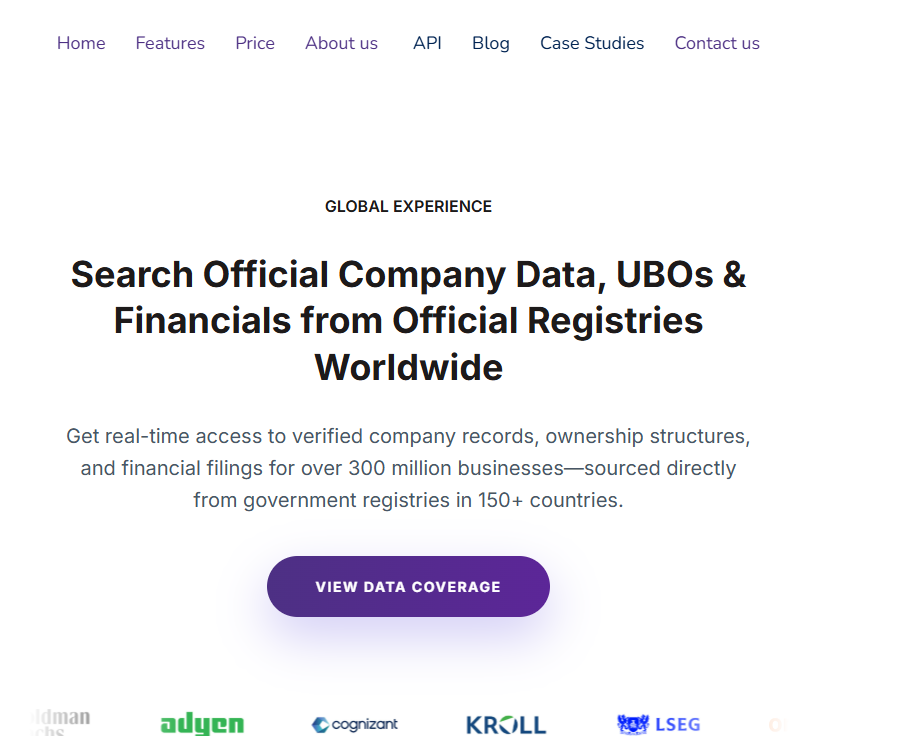
Zephira.ai: Comprehensive Overview (2026)
Zephira.ai is a developer-first API platform built for companies that need real-time access to registry-sourced company data, including legal details, ownership structures, financial metrics, tax identifiers, and KYB-related information. Unlike Factiva—which aggregates global news—Zephira.ai focuses purely on verified company intelligence delivered through a fast, scalable API.
Designed for product teams, fintechs, onboarding platforms, and compliance systems, Zephira.ai provides clean, standardized data directly from 100+ government registries. Its primary use cases include:
KYB automation & business verification
Embedding company data into products & platforms
Real-time enrichment of onboarding flows
Ownership & corporate structure intelligence
Financial and operational insights for risk scoring
Zephira.ai emphasizes speed, accuracy, and developer experience, making it a strong Factiva alternative for organizations that need machine-readable company data rather than news content.
Zephira.ai Strengths (Compared to Factiva)
Real-Time Developer API for Registry Data
Zephira.ai delivers verified company data directly into applications, with fast response times and unified formats—something Factiva does not offer.
Registry-Sourced Company Information
All core data—legal status, registration numbers, tax IDs, addresses, shareholder information—is sourced from official government registries rather than media publications.
Built for KYB, Risk, and Onboarding Automation
Teams use Zephira.ai to automate:
Business verification
Compliance checks
Supplier onboarding
Continuous monitoring
Factiva is not designed for these workflows.
Ownership & Shareholder Intelligence
The platform identifies shareholders, legal owners, and connections between entities, enabling deeper visibility into business structures.
Easy Integration & Developer Experience
Clear documentation, modern endpoints, and flexible pricing make it suitable for SaaS companies, fintechs, and compliance tools needing plug-and-play data.
Zephira.ai Weaknesses (Compared to Factiva)
No News or Editorial Coverage
Zephira.ai does not provide any media content, press articles, or news alerts.
Limited Market Research and Industry Reports
The platform is focused on structured data and does not include analyst commentary or market publications.
Not Built for Manual Analysts or Researchers
It is designed for integration and automation, not for heavy manual research or browsing.
No PR or Media Monitoring Capabilities
Teams requiring brand tracking or market sentiment will still need Factiva or similar tools.
Zephira.ai vs Factiva — Comparison Table (2026)
Feature / Capability | Zephira.ai | Factiva |
|---|
Primary Focus | API-based registry data & KYB intelligence | News aggregation & media coverage |
Data Source | 100+ government registries | 32,000+ editorial sources |
Real-Time API | Yes | Limited |
KYB & Company Verification | Strong | None |
Financial Data | Yes (structured) | No |
Ownership & Shareholder Insights | Yes | No |
Corporate Linkage Data | Partial | No |
News & Media Monitoring | No | Yes |
Ideal Use Cases | Product enrichment, onboarding automation, compliance, risk | News research, PR, editorial insights |
Conclusion: Is Zephira.ai a Strong Factiva Alternative in 2026?
Zephira.ai is an excellent Factiva alternative for companies that need real-time, registry-verified company intelligence, not news. It excels in KYB automation, onboarding workflows, compliance checks, and embedding company data directly into digital products.
While Factiva remains valuable for news and editorial monitoring, Zephira.ai serves an entirely different purpose—providing accurate, machine-readable data for fintechs, SaaS products, compliance platforms, and enterprise applications that require rapid verification and structured intelligence.
If your goal is to automate KYB processes, enrich internal systems, or power data-driven features, Zephira.ai delivers capabilities that Factiva does not.
Top 5 FAQs About Zephira.ai as a Factiva Competitor (2026)
How does Zephira.ai compare to Factiva?
Zephira.ai provides real-time, registry-sourced company data via API, while Factiva focuses on news articles and media content. Zephira.ai is built for automation and KYB workflows, not editorial monitoring.
Can Zephira.ai verify companies and support KYB processes?
Yes. Zephira.ai performs instant business verification, including legal status checks, registration numbers, tax IDs, and ownership information sourced from official registries.
Is Zephira.ai suitable for onboarding and compliance automation?
Yes. Its API-first architecture allows companies to embed real-time verification and enrichment into onboarding flows, compliance systems, and risk engines.
Does Zephira.ai provide ownership and shareholder details?
Yes. Zephira.ai identifies shareholders, legal owners, and connections between entities, offering deeper visibility into corporate structures.
Does Zephira.ai offer news or media monitoring like Factiva?
No. Zephira.ai delivers structured company intelligence, not editorial content. Teams that require news and press coverage still rely on platforms such as Factiva.
6. AlphaSense Review (2026) — A Research-Focused Factiva Competitor for Market Intelligence, Analyst Reports & AI-Driven Search
 AlphaSense: Comprehensive Overview (2026)
AlphaSense is a leading AI-powered market intelligence and research platform used by financial institutions, consulting firms, and corporate strategy teams to discover insights across millions of documents.
While Factiva aggregates global news, AlphaSense goes much further by indexing analyst reports, broker research, SEC filings, earnings transcripts, market commentary, and industry publications, all searchable through advanced semantic AI.
The platform is designed to help teams:
Identify trends, risks, and opportunities
Perform competitive and market analysis
Search across equity research and earnings calls
Analyze industry themes and narratives
Monitor companies, sectors, and markets over time
AlphaSense has become a central tool for analysts who need faster, deeper research and AI-driven synthesis, making it one of the strongest Factiva competitors in the research intelligence category.
AlphaSense Strengths (Compared to Factiva)
AI-Powered Search Across Premium Research Content
AlphaSense analyzes millions of documents—including broker research, filings, transcripts, presentations, and industry reports—using advanced semantic and NLP models.
Access to Premium Analyst & Broker Research
Depending on licensing, users can access equity research, investment-grade insights, and proprietary financial analysis from leading institutions. Factiva does not offer this depth.
Powerful Expert Call Libraries
AlphaSense provides access to expert interviews and call transcripts, which are highly valuable for due diligence, thematic research, and industry analysis.
Strong Monitoring & Alerting Capabilities
Users can set alerts on companies, sectors, products, themes, or financial topics and receive high-quality research summaries—not just news mentions.
Ideal for Strategy, Market Research & Investor Intelligence
The platform is used heavily by:
AlphaSense Weaknesses (Compared to Factiva)
Limited Editorial News Content
While AlphaSense includes selected premium news sources, it does not match Factiva’s breadth of global news coverage.
High Licensing Costs for Premium Research
Access to broker research and expert networks can become expensive, especially for smaller organizations.
No Verified Registry or Compliance Data
AlphaSense does not offer company registration details, financial statements from registries, UBOs, or corporate linkages.
Less Suitable for Operational or Risk Workflows
It is designed for strategic research, not KYB, compliance, supplier checks, or risk scoring.
AlphaSense vs Factiva — Comparison Table (2026)
Feature / Capability | AlphaSense | Factiva |
|---|
Primary Focus | Market intelligence, research, AI search | Global news aggregation |
Equity Research & Broker Reports | Yes | No |
Earnings Transcripts & Filings | Yes | Limited |
Expert Call Transcripts | Yes | No |
AI Semantic Search | Strong | Limited |
Registry Data, Ownership, UBOs | No | No |
News Coverage Breadth | Moderate | Extensive |
Use Cases | Research, strategy, market intelligence | News, PR, media monitoring |
Conclusion: Is AlphaSense a Good Factiva Alternative in 2026?
AlphaSense is an excellent alternative to Factiva for teams that prioritize deep research, market intelligence, and AI-powered search rather than traditional news monitoring.
It delivers far more analytical content—including earnings transcripts, broker research, filings, and expert interviews—making it ideal for investment teams, consultants, and strategic researchers.
However, it is not a replacement if you require:
Registry data
Ownership and UBO information
KYB or compliance workflows
News-focused PR or media monitoring
AlphaSense is a high-value tool when insight depth matters more than editorial breadth.
Top 5 FAQs About AlphaSense as a Factiva Alternative (2026)
What is the main difference between AlphaSense and Factiva?
AlphaSense is built for research and market intelligence, offering access to analyst reports, earnings transcripts, filings, and expert calls. Factiva focuses on news articles, media content, and press coverage.
Does AlphaSense include analyst and broker research?
Yes. AlphaSense provides access to premium equity research and broker insights (depending on licensing), which is not available in Factiva.
Can AlphaSense analyze filings and earnings call transcripts?
Yes. AlphaSense indexes 10-Ks, 10-Qs, annual reports, investor presentations, and earnings call transcripts, allowing fast discovery through AI-driven search.
Is AlphaSense suitable for strategic, financial, and market analysis?
Yes. It is widely used by investment teams, consulting firms, corporate strategy departments, and market intelligence analysts to evaluate industry trends and competitive positioning.
Does AlphaSense provide company verification or registry data?
No. AlphaSense does not include registry-sourced company data, UBO information, shareholder structures, or KYB verification. It is focused on research content, not compliance or onboarding workflows.
7. Morningstar Direct Review (2026) — A Factiva Competitor for Investment Research, Fund Analytics & Portfolio Intelligence
 Morningstar Direct: Comprehensive Overview (2026)
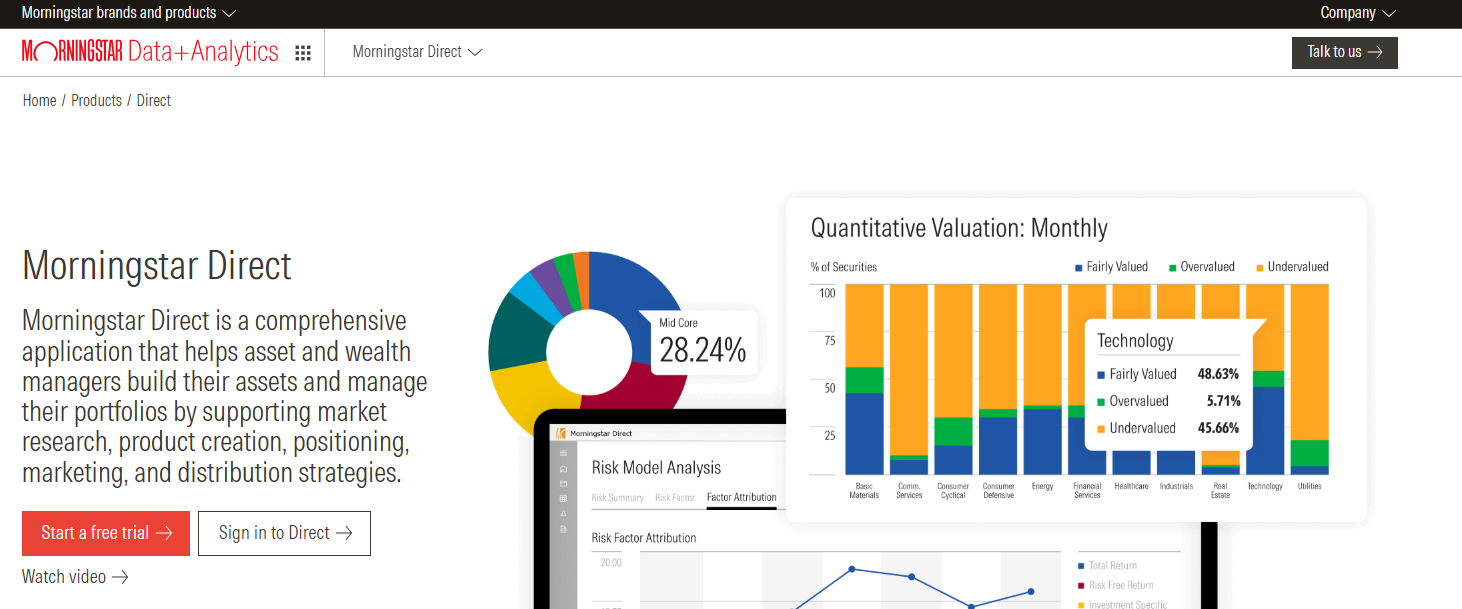
Morningstar Direct is a leading investment research and analytics platform focused on fund performance, portfolio analysis, asset-level data, and investment-grade research.
While Factiva delivers global news and editorial content, Morningstar Direct provides deep financial insight into mutual funds, ETFs, equities, indexes, and portfolio structures, making it essential for analysts and asset managers.
The platform is widely used by:
Asset managers
Wealth management firms
Investment analysts
Pension funds
Portfolio managers
Institutional investors
Its strengths lie in fund analytics, risk modeling, ESG scoring, and investment research, offering a level of depth far beyond what news-centric tools like Factiva can provide.
Morningstar Direct Strengths (Compared to Factiva)
Industry-Leading Fund & Investment Research
Morningstar Direct provides detailed coverage of mutual funds, ETFs, SMAs, indexes, and model portfolios — including performance, volatility, holdings, and fee structures.
Advanced Portfolio Analysis & Risk Modeling
Users can analyze portfolios using:
This analytical depth is not available in Factiva.
ESG Ratings & Sustainability Data
Morningstar’s Sustainability Ratings provide insights into ESG risk, controversies, and corporate responsibility.
Global Equity & Market Intelligence
Beyond funds, Morningstar includes full financials, valuation metrics, and market data for public companies worldwide.
Strong Visualizations & Reporting Tools
The platform provides professional-grade charts, performance reports, portfolio summaries, and comparison dashboards.
Morningstar Direct Weaknesses (Compared to Factiva)
No News Aggregation or Editorial Coverage
Morningstar Direct does not offer Factiva-style news feeds, media content, or global journalism.
Limited Corporate Ownership & Registry Data
It does not include UBOs, shareholder breakdowns, or corporate linkage information.
Primarily Designed for Investment Use Cases
The platform is not suited for compliance, KYB, onboarding, supplier checks, or risk verification workflows.
Higher Pricing for Institutional Licenses
Morningstar Direct is priced for professional financial teams, making it less accessible to smaller organizations.
Morningstar Direct vs Factiva — Comparison Table (2026)
Feature / Capability | Morningstar Direct | Factiva |
|---|
Primary Focus | Investment research, fund analytics, portfolio intelligence | News & media coverage |
Fund Performance Data | Extensive | No |
Equity & Market Data | Yes | Limited |
ESG Ratings | Yes | No |
Portfolio Analysis Tools | Yes | No |
Ownership / Registry Data | No | No |
News Coverage | Limited | Extensive |
Ideal For | Asset managers, investment analysts, wealth teams | News researchers, PR teams, media monitoring |
Conclusion: Is Morningstar Direct a Good Factiva Alternative in 2026?
Morningstar Direct is a strong alternative to Factiva if your focus is investment analysis, fund performance, ESG scoring, or portfolio research. It offers detailed financial datasets, modeling tools, and global investment insights that Factiva cannot provide.
However, Morningstar is not a substitute for news monitoring or editorial intelligence. It excels in financial evaluation, not media coverage.
For investment teams, wealth management firms, and institutional analysts, Morningstar Direct offers far more actionable insights than Factiva for fund research, portfolio construction, and market analysis.
Top 5 FAQs About Morningstar Direct as a Factiva Alternative (2026)
What is the main difference between Morningstar Direct and Factiva?
Morningstar Direct focuses on fund performance, portfolio analytics, and investment research, while Factiva provides news, articles, and media coverage. They serve different analytical needs.
Does Morningstar Direct provide data on mutual funds and ETFs?
Yes. Morningstar Direct offers comprehensive insights into mutual funds, ETFs, SMAs, indexes, and model portfolios, including returns, holdings, fees, and risk metrics.
Can Morningstar Direct be used for portfolio analysis?
Yes. It provides advanced tools for performance attribution, risk decomposition, factor exposure, and peer benchmarking, widely used by investment teams.
Does Morningstar Direct include ESG and sustainability ratings?
Yes. Morningstar’s ESG ratings offer visibility into environmental, social, and governance risks, as well as controversies and sustainability profiles.
Does Morningstar Direct offer registry or ownership data like some other platforms?
No. Morningstar Direct does not include registry-sourced data, shareholder information, UBOs, or corporate linkage. Its focus is investment analytics, not compliance or company verification.
8. Inven Review (2026) — A Factiva Competitor for Deal Sourcing, Market Mapping & Private Company Intelligence
Inven: Comprehensive Overview (2026)
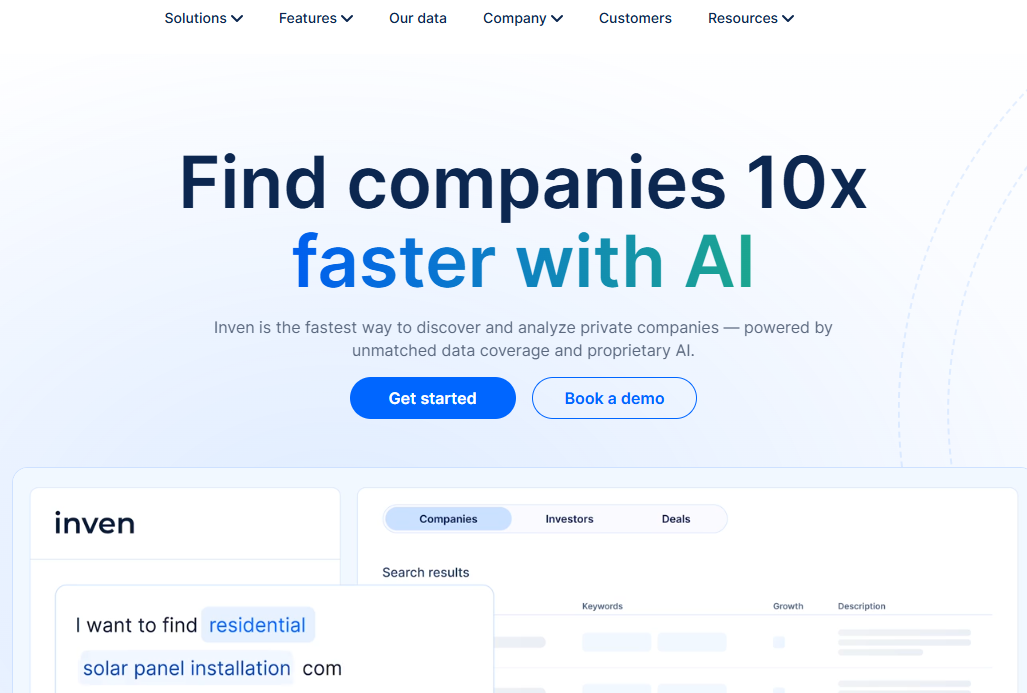
Inven is a rapidly growing deal sourcing and private company intelligence platform used by private equity firms, venture capital funds, investment banks, and corporate development teams.
While Factiva focuses on global news, Inven helps users identify high-potential companies, map markets, and uncover investment opportunities using proprietary matching algorithms and structured company data.
The platform combines technology-driven workflows with curated datasets to support:
Deal origination
Market mapping and segmentation
Private company discovery
Investment screening and qualification
Outbound sourcing
Inven’s strength lies in identifying relevant companies even in niche or fast-emerging sectors, making it a strong Factiva alternative for teams seeking actionable insights rather than editorial content.
Inven Strengths (Compared to Factiva)
Built for Deal Sourcing and Market Mapping
Inven specializes in surfacing investment-ready private companies, something Factiva cannot do through news alone.
Strong Discovery & Matching Algorithms
Its AI-driven search helps analysts uncover companies by:
This makes it highly effective for thematic sourcing.
Deep Focus on Private Companies
Inven provides structured data on private firms that often have little or no media coverage—an area where Factiva is weak.
Collaboration Tools for Investment Teams
The platform includes built-in features for:
Clean, Modern Interface for Research Teams
The UX is designed for speed, helping analysts build market landscapes and target lists quickly.
Inven Weaknesses (Compared to Factiva)
No News or Editorial Content
Inven does not include articles, press releases, or global news feeds.
Limited Compliance or KYB Capabilities
It does not provide registry data, legal verification, UBOs, or risk scoring.
Primarily Focused on Investment Use Cases
The platform is not built for PR teams, journalists, or corporate communications.
Smaller Dataset Than Large Data Aggregators
Its coverage — while high quality — may be narrower than legacy financial databases depending on region or industry.
Inven vs Factiva — Comparison Table (2026)
Feature / Capability | Inven | Factiva |
|---|
Primary Focus | Deal sourcing, market mapping, private company discovery | News aggregation, press coverage |
Private Company Intelligence | Strong | Limited |
Market & Sector Mapping | Yes | No |
Analyst Collaboration Tools | Yes | No |
Registry, Legal or KYB Data | No | No |
News & Media Monitoring | No | Extensive |
Ideal For | PE/VC, corporate development, growth teams | PR, media teams, editorial research |
Conclusion: Is Inven a Good Factiva Alternative in 2026?
Inven is an excellent alternative to Factiva if your goal is deal sourcing, market mapping, or identifying private companies.
It offers powerful discovery capabilities for investors who need to build target lists, analyze emerging markets, or review potential acquisition and partnership opportunities.
However, Inven is not a substitute for news research or media monitoring. It excels in investment workflows—not editorial content.
For private equity, venture capital, growth equity, and corporate development teams, Inven delivers actionable intelligence that Factiva cannot.
Top 5 FAQs About Inven as a Factiva Alternative (2026)
How does Inven differ from Factiva?
Inven focuses on deal sourcing and private company discovery, while Factiva provides news, articles, and global media coverage.
Is Inven good for identifying private companies?
Yes. Inven is designed specifically to surface private, emerging, and niche companies that often have limited media visibility.
Can Inven support deal origination workflows?
Yes. It includes tools for screening, tagging, collaboration, and pipeline management, making it ideal for PE, VC, and corporate development teams.
Does Inven offer registry-based or KYB data?
No. Inven is not a compliance or verification tool; it focuses on discovery and market research, not legal validation.
Does Inven include news content like Factiva?
No. Inven does not aggregate news or media coverage. Teams that need editorial intelligence still rely on platforms like Factiva.
Full Comparison Table — Factiva vs Top 8 Competitors (2026)
Below is a unified, high-level comparison table summarizing the strengths and positioning of each platform.
Platform | Primary Focus | Strengths | Weaknesses | Best For |
|---|
Global Database | Registry data, UBOs, financials, corporate linkages | First-party data, 600M+ profiles, 378M+ linkages, UBO mapping, global filings, flexible licensing | Not a news platform | Compliance, KYB, due diligence, enterprise data enrichment |
Dun & Bradstreet (D&B) | Credit risk, commercial data | Global DUNS system, credit scores, enterprise integrations | Rigid licensing, reliance on third-party sources | Credit teams, procurement, enterprise risk |
Monetaiq | Financial & digital intelligence | Traffic data, digital metrics, financial benchmarks, competitive analysis | No UBOs, no news, not built for compliance | Marketing intelligence, strategy, benchmarking |
S&P Capital IQ | Financials, valuations, credit ratings | Extensive financial data, forecasts, credit ratings, Excel plugin | High cost, no news | Investment banks, PE/VC, equity research |
Zephira.ai | API-first registry data & KYB | Real-time API, global registry coverage, ownership insights, tax IDs | No news, no editorial content | Developers, fintechs, onboarding/KYB automation |
AlphaSense | Market intelligence & research | AI search, filings, transcripts, analyst reports, expert calls | No registry data, limited ownership intel | Strategy teams, analysts, consulting firms |
Morningstar Direct | Fund analytics & portfolio research | Fund performance, ESG ratings, portfolio tools | Not a news or registry system | Asset managers, wealth teams, institutional investors |
Inven | Deal sourcing & private company discovery | Market mapping, private company data, collaboration tools | No news, no KYB | PE/VC, corporate development, deal teams |
Factiva | News & editorial coverage | 32,000+ news sources, real-time global coverage, PR/communications use cases | No financials, no registry data, no ownership insights | PR teams, media monitoring, communications |
Final Conclusion — The Best Factiva Alternatives for Different 2026 Use Cases
The landscape of business intelligence has changed dramatically, and Factiva is no longer the only option for research teams seeking corporate insights, market intelligence, or company-level data. While Factiva remains strong for news, press coverage, and editorial monitoring, its limitations in financial data, company verification, ownership intelligence, and analytics have opened the door for modern alternatives.
The eight platforms reviewed in this article each excel in different areas:
Global Database is the strongest option for registry-sourced intelligence, UBOs, financial filings, and global corporate linkages, making it ideal for compliance, due diligence, and company research across 200+ jurisdictions.
Dun & Bradstreet (D&B) remains a longstanding choice for credit risk, business identity data, and commercial credit scores, particularly for enterprise clients needing risk intelligence.
Monetaiq excels at financial performance analysis, digital insights, website traffic analytics, and competitive benchmarking, bridging the gap between financial data and digital footprint visibility.
S&P Capital IQ remains dominant for deep financial data, credit ratings, valuations, forecasts, and market intelligence, making it the preferred platform for investment teams.
Zephira.ai is built specifically for developers, delivering real-time registry data, KYB verification, legal identifiers, and ownership structure intelligence through a fast and flexible API.
AlphaSense leads in AI-powered market intelligence, indexing research reports, filings, transcripts, and expert calls—ideal for strategy teams, consultants, and investment analysts.
Morningstar Direct is unmatched for fund performance, portfolio analytics, ESG scoring, and investment research, serving asset managers and financial institutions.
Inven offers powerful tools for deal sourcing, market mapping, and private company discovery, especially for private equity, venture capital, and corporate development teams.
The Bottom Line
There is no single “best” Factiva competitor. The right choice depends on your primary use case:
Registry & legal data → Global Database, Zephira.ai
Credit & risk → Dun & Bradstreet
Digital footprint & financial insights → Monetaiq
Investment-grade financials & valuations → S&P Capital IQ
Research intelligence & analysts reports → AlphaSense
Fund analytics & portfolio research → Morningstar Direct
Deal sourcing & private markets → Inven
Organizations increasingly combine multiple intelligence layers—registry data, financials, digital signals, ownership, and research content—to form a complete view of a company. Factiva alone cannot cover these needs, which is why businesses are shifting toward more specialized, purpose-built platforms.
Global FAQ — Factiva Competitors, Alternatives & Company Intelligence Tools (2026)
What is the best alternative to Factiva in 2026?
There is no single replacement for Factiva because platforms specialize in different areas.
For news and media coverage, Factiva still leads.
For registry data and corporate intelligence, Global Database and Zephira.ai are stronger options.
For financials and valuations, S&P Capital IQ is unmatched.
For research reports and transcripts, AlphaSense is the preferred choice.
Which Factiva competitor offers the most accurate company data?
Platforms that source data directly from official government registries—such as Global Database and Zephira.ai—provide the highest data accuracy. These platforms deliver verified legal information, UBOs, registry filings, financial statements, and corporate structures.
What is the best Factiva alternative for financial analysis and valuations?
S&P Capital IQ is the strongest tool for financial statements, forecasts, equity research, and valuation modeling.
Morningstar Direct is preferred for fund and portfolio analytics.
What tools can replace Factiva for market intelligence and research?
AlphaSense is the top alternative for teams needing AI-powered search across analyst reports, earnings transcripts, filings, expert calls, and industry commentary.
It offers deeper research capabilities than a news-only tool.
What is the best Factiva alternative for KYB, compliance, and company verification?
If your priority is verifying businesses, retrieving registry data, checking ownership, or conducting due diligence, the strongest alternatives are:
Global Database (registry data, UBOs, filings, corporate linkages)
Zephira.ai (developer-first KYB API)
Factiva does not provide this type of data.
Which Factiva competitor is best for private equity and deal sourcing?
For investment sourcing, market mapping, and identifying private companies, Inven is the top choice. It offers deal pipelines, market segmentation, and discovery features tailored for PE/VC workflows.
Does Factiva offer company financials or registry information?
No. Factiva does not provide:
What is the best Factiva alternative for digital insights and website analytics?
Monetaiq is ideal for teams that need:
Are there Factiva alternatives that integrate with CRM or compliance systems?
Yes.
Global Database integrates with HubSpot, Salesforce, and Microsoft Dynamics.
Zephira.ai provides API integrations for onboarding, KYB, and risk systems.
S&P Capital IQ integrates with Excel for financial modeling workflows.
Factiva offers limited integration capabilities outside of news delivery.
How do I choose the right Factiva competitor for my organization?
It depends on your primary use case:
Use Case | Best Alternatives |
|---|
News & editorial monitoring | Factiva |
Registry data, UBOs, filings | Global Database, Zephira.ai |
Financials & valuations | S&P Capital IQ |
Fund analytics & ESG | Morningstar Direct |
Market intelligence & research | AlphaSense |
Digital insights & benchmarking | Monetaiq |
Deal sourcing & private markets | Inven |
Choosing the right platform starts with understanding whether you need news, financials, registry data, market research, or investment intelligence.

 Global Database: Comprehensive Overview (2026)