What BRIS Actually Is (And Isn’t)
BRIS stands for Business Registers Interconnection System. It was established by EU Directive 2012/17/EU and went live on 8 June 2017.
The key word is interconnection. BRIS is not a database. It does not store company data centrally. Instead, it connects the national business registers of all 27 EU member states, plus Iceland, Liechtenstein, and Norway, through a single access point: the European e-Justice Portal.
When you search for a company on BRIS, your query is routed to the relevant national register in real time. The register returns whatever basic data it holds. BRIS passes it through.
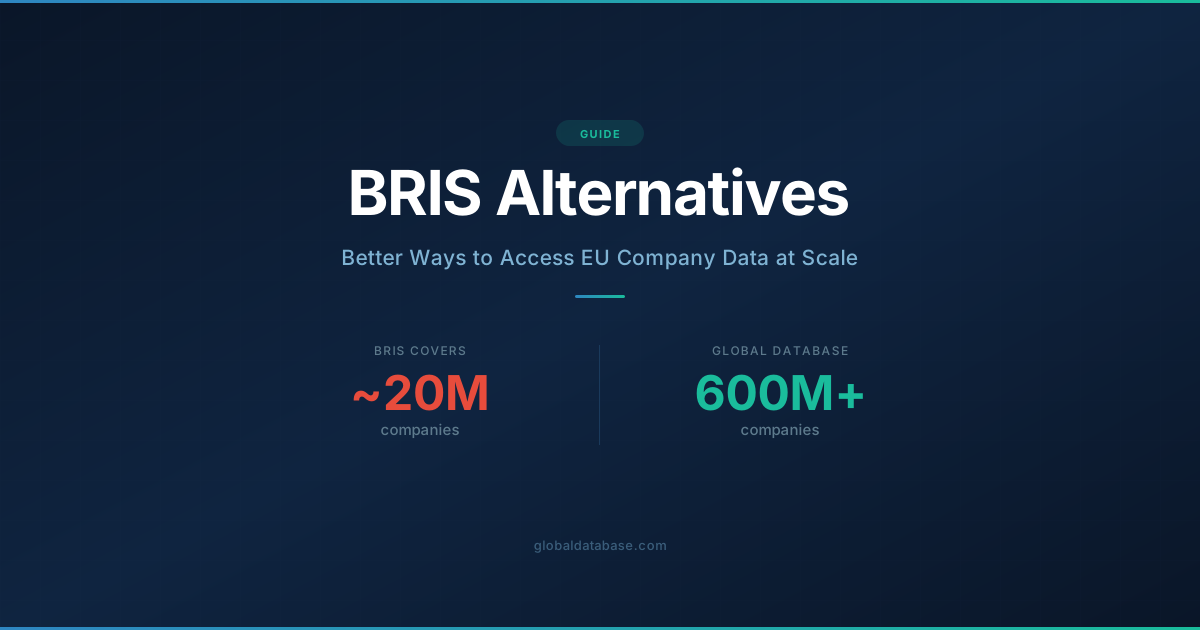
What BRIS covers: Approximately 20 million limited liability companies across the EU and EEA. Public and private limited liability companies, branches registered in other member states, and European Companies (Societas Europaea).
What BRIS returns: Company name, legal form, registered office, registration number, EUID (European Unique Identifier), company status (active, dissolved, in liquidation), and links to available filings in the national register.
What BRIS does not return: Financial statements, revenue, ownership structures, beneficial owners, group hierarchies, credit data, employee counts, industry classifications, or contact information.
Understanding this distinction is important. BRIS was built as a transparency tool for the single market. It confirms that a company exists and where it is registered. It was never designed to be a business intelligence platform.
The Benefits of BRIS
Before examining the limitations, it is worth recognising what BRIS does well. For certain use cases, it remains the right tool.
Benefit | Details |
|---|---|
Free to access | No registration or subscription required. Anyone can search via the e-Justice Portal at no cost. |
Legally authoritative | Data comes directly from official national business registers. It carries legal weight. |
Pan-EU coverage | Covers all 27 EU member states plus Iceland, Liechtenstein, and Norway through a single entry point. |
Multilingual interface | The e-Justice Portal is available in all official EU languages. Search criteria and service descriptions are translated. |
Standardised identifiers | Every company in BRIS receives a European Unique Identifier (EUID), which includes the member state, register of origin, and company number. |
Regulatory foundation | Built on Directive 2012/17/EU and Commission Implementing Regulation (EU) 2015/884. This gives BRIS institutional credibility and longevity. |
Cross-border notifications | BRIS facilitates automated notifications between registers regarding cross-border mergers and branch registrations. |
For a compliance analyst who needs to confirm a single company’s legal existence in another EU country, BRIS is efficient and reliable. The problems begin when the task gets more complex.
7 Limitations of BRIS for Enterprise Use
BRIS was designed as a transparency layer for the EU single market. The following limitations are not flaws in design. They are boundaries that become visible when enterprise teams try to use BRIS for workflows it was never built to support.
No Financial Data
BRIS does not return financial statements, revenue figures, balance sheets, profit and loss accounts, or any quantitative financial data. While some national registers hold financial filings, BRIS does not surface them through its search interface.
For teams running vendor assessments, credit checks, or market sizing, this means BRIS cannot serve as a primary data source. You would need to visit each national register individually and, depending on the country, pay for access to financial documents.No Ownership or Beneficial Ownership Data
BRIS does not provide shareholder information, corporate group structures, or ultimate beneficial owner (UBO) data. The EU has a separate system for beneficial ownership — BORIS (Beneficial Ownership Registers Interconnection System) — but access to BORIS has been severely restricted since the 2022 Court of Justice ruling that the general public should not have unrestricted access to beneficial ownership registers.
For KYB verification, AML compliance, and enhanced due diligence, ownership data is essential. BRIS cannot support these workflows.No API Access
BRIS is accessible only through the e-Justice Portal web interface. There is no public API, no programmatic access, and no way to integrate BRIS data into internal systems, CRMs, compliance platforms, or automated workflows.
This is the single biggest barrier for enterprise teams. Any process that requires checking hundreds or thousands of companies must be done manually, one lookup at a time.No Bulk Search or Export
BRIS supports individual company searches only. There is no batch processing, no bulk upload of company lists for verification, and no export functionality for search results.
For onboarding teams processing large volumes of entities, or data teams building enrichment pipelines, this makes BRIS operationally unusable beyond occasional spot checks.Limited to EU and EEA Countries
BRIS covers the 27 EU member states plus Iceland, Liechtenstein, and Norway. It does not cover:
United Kingdom (post-Brexit, UK Companies House is separate)
• Switzerland
• United States
• Asia-Pacific
• Middle East
• Africa
• Latin America
For any organisation with global operations, supply chains, or client bases, BRIS can only address one region. Cross-border due diligence that spans EU and non-EU jurisdictions requires additional data sources.Inconsistent Data Depth by Country
Each national register decides what information it shares through BRIS and how much of it is available for free. Some countries (such as Denmark and the Netherlands) provide relatively rich data. Others return only the minimum required fields.
This inconsistency means the same BRIS search can yield detailed results for a German company and almost nothing for a company registered in another jurisdiction. There is no standardisation of data depth across the system.No Monitoring or Alerts
BRIS is a point-in-time lookup tool. Once you close the search result, there is no way to track changes to a company’s status, directors, registered address, or filings.
Ongoing monitoring — knowing when a company in your portfolio changes status, enters insolvency, or updates its directors — requires a system designed for continuous surveillance. BRIS does not offer this.
💡 Did You Know?
BRIS covers approximately 20 million limited liability companies across the EU and EEA. Global Database covers over 600 million companies across 400 government registries worldwide, including full financial statements, ownership structures, and real-time monitoring.
When BRIS Is the Right Tool
BRIS is not the wrong tool for every job. It is the right tool for a specific set of tasks:
One-off company existence checks. You need to confirm that a specific company is registered in an EU member state. BRIS gives you a definitive answer from the official source.
Quick legal form verification. You need to confirm whether an entity is an AG, GmbH, SA, SRL, or another legal form. BRIS provides this in the original language with a translated description.
EUID lookup. You need the European Unique Identifier for a company, for example to cross-reference with another EU system. BRIS is the authoritative source.
Occasional cross-border checks. A procurement team verifying a single foreign supplier once a quarter. A legal team confirming a counterparty’s registration before signing a contract.
If your needs fit these patterns, BRIS is free, authoritative, and sufficient. The moment your needs expand — to scale, depth, automation, or global coverage — you need a different approach.
Why Registry-Sourced Data Platforms Solve What BRIS Can’t
The core problem with BRIS is not the data quality. The data is official. The problem is the delivery mechanism. BRIS was designed for individual citizens and businesses to look up a single company. It was not designed for teams processing thousands of entities across multiple jurisdictions.
Legacy data providers like D&B and Moody’s offer broad coverage but at enterprise price points, with data that is often aggregated through intermediaries rather than sourced directly from government registries. That adds latency, cost, and opacity to your data supply chain.
Registry-sourced data platforms take a different approach. They connect directly to government business registers, extract the official data, and standardise it into a single, consistent format accessible via API, web platform, and bulk export.
Global Database is built on this model. The platform sources data directly from over 400 government registries worldwide, covering more than 600 million companies. Here is how it addresses each of the seven limitations above:
Capability | BRIS | Global Database |
|---|---|---|
Financial data | Not available | Full financial statements, P&L, balance sheets, standardised and comparable across jurisdictions |
Ownership and UBO | Not available | Shareholder structures, group hierarchies, and beneficial ownership reconstructed from filings and cross-border disclosures |
API access | Not available | Real-time REST API for integration into CRMs, compliance platforms, and data pipelines |
Bulk processing | Not available | Bulk search, batch verification, and bulk export of company data |
Geographic coverage | EU + EEA only (30 countries) | 400+ government registries worldwide including UK, US, APAC, Middle East, Africa, and LATAM |
Data standardisation | Varies by country | Standardised company profiles with unified industry codes (NAICS, NACE, SIC), consistent financial formats, and normalised legal forms |
Monitoring and alerts | Not available | Real-time monitoring of company status changes, director changes, filings, and insolvency events |
Coverage Comparison: BRIS vs Global Database
The following overview illustrates the difference in geographic scope between BRIS and a registry-sourced data platform like Global Database.
Region | BRIS | Global Database |
|---|---|---|
EU 27 Member States | ✓ Covered | ✓ Covered |
Iceland, Liechtenstein, Norway | ✓ Covered | ✓ Covered |
United Kingdom | ✗ Not covered | ✓ Covered |
Switzerland | ✗ Not covered | ✓ Covered |
United States | ✗ Not covered | ✓ Covered |
Asia-Pacific | ✗ Not covered | ✓ Covered |
Middle East | ✗ Not covered | ✓ Covered |
Africa | ✗ Not covered | ✓ Covered |
Latin America | ✗ Not covered | ✓ Covered |
Total registries | ~30 national registers | 400+ government registries |
Total companies | ~20 million | 600+ million |
Side-by-Side: What You Get from a BRIS Lookup vs a Global Database Profile
The following comparison uses Siemens AG as an example to illustrate the difference in data output between a BRIS lookup and a Global Database company profile.
Data Point | BRIS Output | Global Database Output |
|---|---|---|
Company name | Siemens Aktiengesellschaft | Siemens Aktiengesellschaft |
Legal form | AG (Aktiengesellschaft) | AG (Aktiengesellschaft) |
Registered office | Munich, Germany | Munich, Germany |
Registration number | HRB 6684 | HRB 6684 |
EUID | DE.HRB.6684.MUEN | DE.HRB.6684.MUEN |
Company status | Active | Active |
Revenue | — Not available | ✓ Available (annual, standardised) |
Financial statements | — Not available | ✓ P&L, balance sheet, cash flow |
Employee count | — Not available | ✓ Available |
Industry classification | — Not available | ✓ NAICS, NACE, SIC codes |
Shareholders | — Not available | ✓ Full shareholder structure |
Ultimate parent | — Not available | ✓ Group hierarchy mapped |
Beneficial owners | — Not available | ✓ Reconstructed from filings |
Subsidiaries | — Not available | ✓ Global subsidiary tree |
Directors and officers | — Not available | ✓ Current and historical |
Web, email, phone | — Not available | ✓ Available |
Technology stack | — Not available | ✓ Available |
Monitoring and alerts | — Not available | ✓ Real-time changes tracked |
API access | — Not available | ✓ REST API |
Bulk export | — Not available | ✓ Available |
Note: The BRIS output reflects the standard data returned through the e-Justice Portal. Actual availability may vary by member state. The Global Database output reflects a standard company profile available via the platform and API.
How to Choose the Right Approach
The right data source depends on what you are trying to accomplish. The following framework maps common use cases to the most appropriate tool.
Use Case | Best Tool | Why | Complexity |
|---|---|---|---|
One-off company verification | BRIS | Confirm a single EU company exists and is active | Low |
KYB / AML compliance at scale | Global Database | API-driven verification with ownership, UBO, and monitoring across jurisdictions | High |
Sales prospecting and market mapping | Global Database | Firmographic filtering, industry codes, financials, and contact data for list building | High |
Cross-border due diligence | Global Database | Global coverage, group structures, and beneficial ownership across EU and non-EU jurisdictions | High |
Regulatory reporting | BRIS + Global Database | BRIS for official EUID references; Global Database for enriched data and automated reporting | Medium |
The key question is not whether BRIS is good or bad. It is whether BRIS is sufficient for your specific workflow. For most enterprise teams, the answer is no — not because BRIS fails, but because it was designed for a different purpose.
BRIS and the Future of EU Company Data
The European Commission has acknowledged many of the limitations described above. Several regulatory initiatives are underway to expand what BRIS can do and what data is available cross-border.
Digitalisation Directive II (DigiD II)
Adopted in 2024, DigiD II significantly expands the scope of EU business registers. Key changes include broader disclosure requirements (extending beyond limited liability companies to include partnerships), the introduction of EU Company Certificates (EUCC) for cross-border use, a “once-only” principle to reduce duplicate filings, and measures to improve the reliability and mutual recognition of register data across member states.BORIS (Beneficial Ownership Registers Interconnection System)
BORIS is designed to link national beneficial ownership registers across the EU, similar to how BRIS links business registers. However, following the 2022 CJEU ruling restricting public access to beneficial ownership data, BORIS has been significantly limited. Once GDPR-related issues are resolved, it is expected to function as a more complete system. Until then, access remains restricted to authorities and parties with demonstrated legitimate interest.What This Means in Practice
These regulatory developments are moving in the right direction. But implementation timelines are measured in years. DigiD II provisions will be transposed into national law over the next several years. BORIS access remains uncertain.
For enterprise teams that need comprehensive, standardised, cross-border company data today — not in 2028 — registry-sourced data platforms remain the practical solution.
Frequently Asked Questions
What data does BRIS provide?
BRIS provides basic company identification data: company name, legal form, registered office, registration number, EUID, and company status. Some member states make additional data available through BRIS, such as links to filed documents, but this varies by country. BRIS does not provide financial data, ownership structures, or beneficial ownership information.Is BRIS free to use?
Yes. Searching for companies through the e-Justice Portal is free. However, accessing detailed documents or filings from some national registers may involve charges, depending on the country and the type of document requested.Can I access BRIS via API?
No. BRIS is accessible only through the e-Justice Portal web interface. There is no public API for programmatic access. Enterprise teams that require API-based company data access need to use commercial data providers like Global Database.Does BRIS include financial data?
No. BRIS does not surface financial statements, revenue, profit and loss accounts, or balance sheet data. Financial filings are held by national registers and must be accessed separately, often for a fee.Does BRIS cover UK companies?
No. Since Brexit, the United Kingdom is no longer part of BRIS. UK company data is available through Companies House. To access UK company data alongside EU data in a single platform, a commercial provider with global coverage is required.What is the difference between BRIS and national business registers?
National business registers are the primary, authoritative sources of company data in each EU member state. BRIS is an interconnection layer that routes your search to the relevant national register and returns the result through a single interface. BRIS does not hold data itself; it passes through data from national registers.âWhat is BORIS?
BORIS (Beneficial Ownership Registers Interconnection System) is a separate EU system designed to link national beneficial ownership registers. Following a 2022 Court of Justice ruling, public access to beneficial ownership data was restricted. BORIS is operational but access is currently limited to authorities and parties with legitimate interest.Can BRIS be used for KYB or AML compliance?
BRIS can support basic company existence verification, but it lacks the data depth required for full KYB or AML compliance. Effective compliance workflows require ownership data, financial information, sanctions screening, and ongoing monitoring — none of which BRIS provides.How often is BRIS data updated?
BRIS retrieves data in real time from national registers. The data is as current as the national register itself. However, update frequency varies by country. Some registers update in real time; others process filings with a delay of days or weeks.What is the best BRIS alternative for enterprise teams?
Registry-sourced data platforms that connect directly to government business registers offer the most complete alternative. Global Database, for example, sources data from over 400 government registries worldwide, provides full financial statements, ownership structures, and real-time monitoring, and delivers it all via API, web platform, and bulk export.
Next Steps
BRIS serves an important role in the EU’s digital single market. For basic, one-off company verification, it remains useful and free.
But if your team needs financial data, ownership structures, API access, global coverage, or ongoing monitoring, BRIS cannot deliver.
Global Database connects directly to over 400 government registries worldwide, covering 600+ million companies with full financial statements, ownership data, and real-time monitoring — all accessible via API, web platform, or bulk export.