How to Automate Know Your Business (KYB) Checks
Manual KYB checks cost compliance teams 40–60 minutes per company. Multiply that by hundreds of onboarding requests per month, and you have an expensive bottleneck that slows revenue and burns analyst time on repetitive lookups.
Automated KYB solves this. It replaces manual registry searches, document chasing, and spreadsheet-based tracking with a single API call that returns verified company data in seconds.
This guide breaks down how automated KYB works, what to look for in a solution, and how to implement it without ripping out your existing compliance stack.
What Is KYB Automation?
KYB automation uses technology to verify a business entity's identity, legal status, ownership structure, and risk profile — without manual intervention.
Instead of an analyst logging into multiple government registries, cross-referencing documents, and manually compiling a report, an automated KYB system pulls that data programmatically.
The core steps it replaces:
Company identification — matching a business name to an official registry record
Legal status verification — confirming active registration, incorporation date, legal form
Director and shareholder extraction — identifying who controls the business
UBO identification — tracing ownership chains to find the ultimate beneficial owner(s)
AML screening — checking individuals and entities against sanctions lists, PEP databases, and adverse media
Risk scoring — assigning a risk level based on jurisdiction, industry, ownership complexity, and screening results
When done manually, this process takes days. Automated, it takes seconds.
Why Manual KYB Fails at Scale
Manual KYB works when you onboard five companies a month. It breaks when you onboard fifty.
Here's where it falls apart:
Speed kills deals. A corporate client waiting three weeks for compliance approval will go to your competitor who clears them in two days. Every day of delay is revenue at risk.
Inconsistency creates liability. When different analysts apply different standards to the same type of check, you get uneven risk coverage. One analyst might catch a shell company. Another might not. The regulator doesn't care which analyst reviewed the file.
Registry access is fragmented. A single cross-border onboarding might require checking registries in the UK (Companies House), Germany (Handelsregister), and the US (Secretary of State filings). Each has a different format, different language, different access method. Manual lookups across 10+ jurisdictions don't scale.
Data goes stale. A company verified six months ago may have changed directors, shifted ownership, or been dissolved. Manual processes rarely include ongoing monitoring because there's no bandwidth for it.
What to Look for in an Automated KYB Solution
Not all KYB automation is created equal. The market is full of platforms that claim automation but still rely on cached, third-party data that's weeks or months old.
Here's what matters:
Data Source: Registry vs. Aggregated
This is the single most important distinction.
Some providers pull data from intermediary databases — companies that collect and resell registry information. This introduces a delay. The data might be days, weeks, or months behind the official record.
First-party providers connect directly to government registries. When you run a check, you're querying the same source a regulator would use. The data is current, traceable, and audit-ready.
For compliance workflows, this matters. Regulators increasingly expect evidence of where your data came from. A registry-sourced record with a clear audit trail holds up better than a cached profile from an unknown third party.
Uptime and Reliability: The Hidden Risk of Live Registry Connections
Here's something most KYB vendors won't tell you: government registries go down. Often.
These are government-run systems. They have maintenance windows, unexpected outages, format changes, and API-breaking updates. A vendor that makes live calls to a registry every time you run a check is exposing your onboarding pipeline to the reliability of a government IT department in whichever country you're verifying.
When a registry goes offline — and it will — your onboarding stops. Your compliance team can't verify the company. Your sales team can't close the deal. Your customer waits.
The smarter architecture is a provider that has already collected, standardised, and stored the registry data on their own infrastructure. When you make an API call, you're hitting a commercial-grade database with guaranteed uptime — not a government server in a foreign jurisdiction that may or may not be online.
This doesn't mean the data is stale. A good provider refreshes their database continuously as registries update. But the critical difference is that your verification request doesn't depend on whether the Romanian commercial register or the Brazilian Receita Federal happens to be responsive at that exact moment.
Look for providers that can commit to a 99.9% uptime SLA. If they can't, ask why.
Data Delivery: API vs. Bulk
Most teams default to API integration. It's the obvious choice for automated onboarding — a company enters your pipeline, an API call fires, the data comes back.
But there's a second model worth considering: bulk data delivery.
With bulk delivery, the provider sends you the full dataset (or a filtered subset) on a scheduled basis — daily, weekly, or monthly. You load it into your own infrastructure. Every verification call hits your internal database, not an external API.
Why does this matter?
Speed. An internal database lookup takes milliseconds. An external API call, even a fast one, takes hundreds of milliseconds plus network latency. At high volumes, the difference compounds.
Control. You own the uptime. You own the latency. You decide when the data refreshes. No dependency on a third-party API being available when you need it.
Cost predictability. Bulk pricing is typically a fixed fee per delivery. No per-call metering. No surprise invoices when onboarding volume spikes.
Offline capability. Your verification process works even if the provider's API is temporarily unreachable.
Bulk delivery isn't for everyone. It requires internal infrastructure to store and query the data. But for high-volume onboarding environments — payment processors, marketplaces, large fintechs — it's often the more resilient architecture.
The best providers offer both models, so you can use the API for real-time onboarding and bulk feeds for internal enrichment, portfolio monitoring, or batch processing.
Coverage: Global vs. Regional
If you only operate in one country, a regional provider may suffice. But most regulated businesses deal with international counterparties.
Look for coverage that matches your actual onboarding footprint. A solution covering 200+ countries is more future-proof than one limited to the US, UK, and EU.
Pay attention to depth, too. "Coverage" of 200 countries means little if half of them only return a company name and registration number. You need financial data, ownership structures, directors, and UBO chains — not just a record that the company exists.
UBO Identification
Ultimate Beneficial Owner (UBO) identification is where most KYB solutions fall short.
Finding the registered shareholders is easy. Tracing ownership through multiple layers of holding companies, trusts, and nominee structures across jurisdictions — that's the hard part.
Your solution should be able to:
Map multi-layer ownership structures automatically
Identify natural persons at the end of the chain
Flag complex structures that require enhanced due diligence
Show percentage ownership at each level
If your KYB tool can't trace beyond the first layer of shareholders, you're not actually identifying UBOs.
API-First Architecture
If you're automating KYB, you need an API. Full stop.
A web platform is useful for manual lookups and ad hoc research. But real automation means your onboarding system, CRM, or compliance platform can trigger a KYB check programmatically — no human clicking through a dashboard.
Look for:
RESTful API with clear documentation
Modular endpoints (company search, profile, directors, shareholders, financials)
Standardised response format across all jurisdictions
Webhook support for ongoing monitoring
The goal is to embed KYB checks into your existing workflow, not build a new one around the tool.
Ongoing Monitoring
KYB isn't a one-time event. Regulations like AMLD6 and FinCEN's beneficial ownership rule require ongoing monitoring — not just a check at onboarding.
Your solution should alert you when:
A company changes its directors or shareholders
A new UBO appears or an existing one changes their stake
The company's legal status changes (dissolved, struck off, in liquidation)
A director or UBO appears on a sanctions list
Without this, you're building compliance on a snapshot. And snapshots go stale.
How to Implement Automated KYB: A Step-by-Step Approach
You don't need to replace your entire compliance stack overnight. Most teams implement automated KYB in phases.
Phase 1: Automate Company Identification and Legal Status
Start with the highest-volume, lowest-complexity step: confirming that the company exists and is legally active.
Connect your onboarding form to a company search API. When a prospect enters their company name or registration number, the API returns the official registry record — legal name, registration number, VAT/TAX ID, EIN, LEI, address, incorporation date, industry, status, and website.
This eliminates the most common manual task and gives your compliance team a verified starting point.
Phase 2: Add Director and Ownership Data
Once company identification is automated, layer in director, ownership, and group structure data.
At onboarding, automatically pull:
Current directors and officers with appointment dates and status
Registered shareholders with share types, values, and UBO flags
The ultimate parent entity to understand where the company sits in a corporate hierarchy
Full group structure mapping — parent companies, subsidiaries, and the complete corporate tree
This gives your analysts a pre-populated company profile instead of a blank form. They spend their time reviewing the data, not collecting it.
Phase 3: Integrate AML Screening
With company and ownership data flowing automatically, connect your AML screening tool.
The individuals identified in Phase 2 — directors, shareholders, UBOs — are automatically screened against:
Global sanctions lists (UN, EU, OFAC, HMT)
PEP databases
Adverse media sources
Positive hits get flagged for human review. Clean results move through automatically.
Phase 4: Enable Ongoing Monitoring
The final layer is continuous monitoring. Set up alerts for changes in company data — new directors, ownership shifts, status changes — so your compliance team catches material changes without running periodic manual reviews.
This is where you move from reactive compliance (reviewing files when they come up for renewal) to proactive compliance (acting on changes as they happen).
How Global Database Automates KYB
Global Database is a first-party data provider that connects directly to 400+ official government registries across 200+ countries. The platform covers 600M+ company profiles and provides automated KYB through a modular API.
Here's how it fits the framework above:
Registry-sourced data. Every company record comes directly from an official government registry. No intermediary databases. No stale caches. Each record includes source attribution, filing references, and timestamps for full auditability.
99.9% uptime — independent of government registries. Global Database collects and stores registry data on its own infrastructure, hosted by Hetzner in Germany — one of Europe's most established and reliable data centre operators. When you make an API call, you're querying Global Database's servers, not a government registry endpoint. This means your onboarding pipeline doesn't break when a registry goes offline for maintenance or unexpectedly changes its API. If a registry is temporarily unavailable, Global Database serves the most recent verified record and runs a fresh check as soon as the registry comes back online.
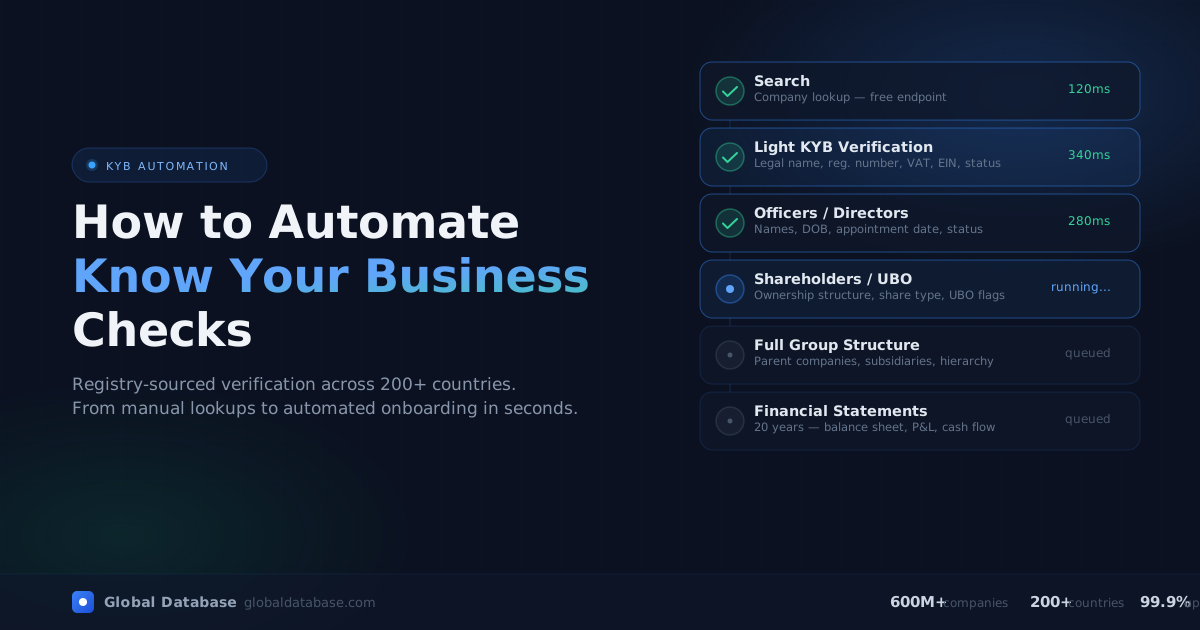
Modular KYB API. The API is organized into endpoints that map to each step of the KYB process:
Search — company search and lookup (free search)
Light KYB Verification — legal name, registration number, VAT/TAX ID, EIN, LEI, address, incorporation date, industry, status, logo, and website
Officers / Directors — names, date of birth, registered address, gender, appointment date, and status
Shareholders / UBO — name, number of shares, share type, value, UBO status, date of birth, and registered address
Ultimate Parent — returns the top-of-tree parent entity with key identifiers (name, registration/VAT ID, country, revenue)
Full Group Structure — corporate linkage mapping: parent companies, subsidiaries, and full hierarchy tree
Financial Statements — up to 20 years of balance sheet, P&L, cash flow, KPIs, and financial ratios
Each endpoint can be called independently or combined into a single onboarding workflow. The Search endpoint is free, so you can integrate company lookup into your onboarding flow at zero cost and only pay when you pull verification data.
Global ownership mapping. With 378M+ corporate linkages, Global Database traces ownership chains across borders — through holding companies, subsidiaries, and complex structures — to identify the natural persons behind the entity.
Standardised output. Whether you're verifying a GmbH in Germany, an LLC in Delaware, or a Limited in the UK, the API returns data in a consistent format. No per-country parsing logic. No separate integration per jurisdiction.
Bulk data delivery. For teams that want full control over speed and reliability, Global Database offers bulk data feeds with daily, weekly, or monthly refresh cycles. You receive the complete dataset — or a filtered subset by country, industry, or entity type — loaded directly into your own infrastructure. Every verification call hits your internal database. Zero external dependencies. This is the preferred model for payment processors, large fintechs, and any environment where latency and uptime are non-negotiable.
Flexible integration. Data is accessible via API, web platform, Chrome extension, or bulk export. Most compliance teams start with the API for automated onboarding, use the platform for manual research, and evaluate bulk delivery as onboarding volume scales.
Common Mistakes When Automating KYB
Automating Bad Data
Speed doesn't help if the underlying data is wrong. An automated check that returns a six-month-old ownership structure is worse than a slow manual check that returns the current one — because the automated result creates false confidence.
Always verify the data source. Ask the provider: where does this data come from? How often is it refreshed? Can you trace it back to the registry?
Ignoring Cross-Border Complexity
A KYB solution that works perfectly in the UK but can't handle a parent company in Singapore and a subsidiary in Brazil isn't automating your real workflow. It's automating the easy part.
Map your actual onboarding footprint before choosing a provider. Where are your clients incorporated? Where are their parent companies? Where are the UBOs based?
Treating KYB as a Compliance Checkbox
KYB data has value beyond compliance. The same company profiles, financial data, and ownership structures that power your KYB checks can also support:
Credit risk assessment
Supplier due diligence
Market intelligence and prospecting
Portfolio monitoring
If you're paying for the data, use it across the business. Don't silo it in compliance.
Getting Started
If you're running manual KYB checks today, the fastest path to automation is connecting to a registry-sourced API and replacing your highest-volume manual step first.
Global Database offers a KYB API with pay-per-call pricing starting at $0.10 per company verification. Full profiles with financials and ownership start at $1.00.
You can request API access or book a walkthrough at globaldatabase.com.
Regulations Driving KYB Automation in 2026
KYB isn't optional. And the regulatory bar is rising.
AMLD6 (EU) expanded the definition of money laundering offences and increased penalties for non-compliance. It also strengthened requirements around beneficial ownership transparency, making manual UBO identification increasingly risky.
FinCEN Beneficial Ownership Rule (US) now requires millions of US companies to report their beneficial owners to FinCEN. This creates a new verification layer for any business onboarding US entities.
UK Economic Crime and Corporate Transparency Act gave Companies House new powers to verify and challenge company information. It introduced identity verification requirements for directors and persons of significant control.
MiCA (EU) brought crypto-asset service providers under formal KYB requirements for the first time, expanding the pool of regulated entities that need automated verification workflows.
The direction is clear: more entities need to be verified, more ownership data needs to be traced, and regulators expect the data to be accurate, current, and auditable. Manual processes can't keep pace with this trajectory.
Frequently Asked Questions
What is KYB automation?
KYB automation is the use of technology — typically APIs connected to company registry databases — to verify a business entity's legal status, ownership structure, directors, and risk profile without manual intervention. It replaces the process of analysts individually searching government registries, collecting documents, and compiling verification reports by hand.How long does an automated KYB check take?
An automated company verification typically returns results in seconds. The exact time depends on the depth of the check — a basic company status lookup is near-instant, while a full profile with ownership chains, financial data, and AML screening may take a few seconds longer. Compare this to manual KYB, which typically takes 40–60 minutes per company.What is the difference between KYB and KYC?
KYC (Know Your Customer) verifies individual people — their identity, address, and risk profile. KYB (Know Your Business) verifies business entities — their legal existence, ownership structure, directors, financial health, and the individuals who ultimately control them. KYB often includes KYC as a sub-step, since identifying and verifying UBOs requires individual-level checks.Why does data source matter for KYB automation?
Data sourced directly from government registries is more current, traceable, and audit-ready than data resold through intermediaries. Regulators increasingly expect organisations to demonstrate where their verification data came from. Registry-sourced data provides a clear chain of custody — from the official filing to your compliance record.What happens if a government registry goes offline during a KYB check?
If your provider makes live calls to registries, your check fails when the registry is down. Providers that store registry data on their own infrastructure can serve the most recent verified record even during registry outages, then refresh the data once the registry comes back online. This is why uptime guarantees matter — they indicate the provider doesn't depend on government infrastructure for every API call.Can I store KYB data on my own servers?
Yes. Some providers offer bulk data delivery — daily, weekly, or monthly exports that you load into your own database. This gives you full control over uptime, latency, and query speed. It's particularly useful for high-volume environments like payment processors or marketplaces where external API dependency creates risk.What industries require KYB checks?
KYB is required for banks, fintechs, payment processors, insurance companies, crypto-asset service providers, investment firms, and any regulated entity that onboards corporate customers. It's increasingly adopted by non-regulated businesses too — marketplaces, SaaS platforms, and procurement teams — for supplier verification and counterparty risk management.How much does automated KYB cost?
Pricing varies by provider and model. API-based solutions typically charge per verification call — ranging from $0.10 for a basic company search to $1.00+ for a full profile with financials and ownership. Bulk data delivery is usually priced as a fixed fee per delivery cycle. Enterprise contracts with volume commitments can reduce per-unit costs significantly.