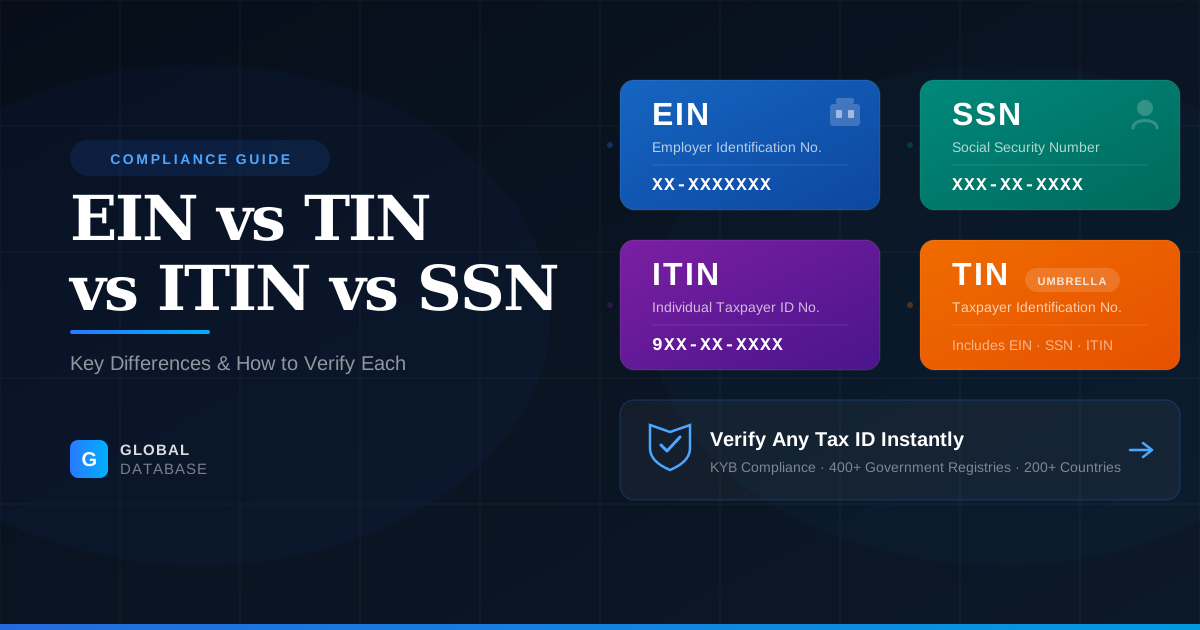
Four acronyms. Four different purposes. One guide that covers what each tax ID means, who needs it, and how to verify them for business onboarding and KYB compliance.
If you've ever stared at a government form asking for a "Taxpayer Identification Number" and wondered which number to enter, you're not alone.
The U.S. tax system uses multiple identification numbers — TIN, EIN, ITIN, and SSN — each designed for a different type of taxpayer. For individuals, the confusion usually ends once you figure out which one applies to you. But for businesses onboarding clients, verifying vendors, or running compliance checks, understanding all four is essential.
This guide breaks down each number, explains who needs what, and shows how to verify tax IDs — whether you're filing paperwork or building a compliant onboarding process.
What Is a TIN (Taxpayer Identification Number)?
A TIN is not a specific number. It's an umbrella term the IRS uses for any identification number that tracks taxpayers on federal returns and tax documents.
Think of it as the parent category. Every SSN, EIN, and ITIN is a type of TIN. When a form asks for your "TIN," it's asking for whichever number applies to your situation — whether that's a personal Social Security Number or a business Employer Identification Number.
The IRS recognizes five types of TINs:
SSN — Social Security Number (individuals)
EIN — Employer Identification Number (businesses)
ITIN — Individual Taxpayer Identification Number (foreign individuals)
ATIN — Adoption Taxpayer Identification Number (temporary, for adoptions)
PTIN — Preparer Tax Identification Number (paid tax preparers)
For most business owners and compliance teams, the first three — SSN, EIN, and ITIN — are the ones that matter day-to-day.
TIN is the umbrella. EIN, SSN, and ITIN are all types of TIN. Every EIN is a TIN, but not every TIN is an EIN.
What Is an EIN (Employer Identification Number)?
An EIN is a nine-digit number the IRS assigns to businesses, trusts, estates, and other entities for tax reporting. It follows the format XX-XXXXXXX (for example, 12-3456789). The first two digits indicate which IRS campus processed the application.
You'll also see it called a Federal Employer Identification Number (FEIN) or Federal Tax ID Number. They're the same thing.
An EIN serves the same purpose for a business as an SSN does for a person. It identifies the entity on tax filings, bank accounts, license applications, and payroll documents.
Who needs an EIN?
Any business that hires employees, operates as a corporation or partnership, files excise or payroll taxes, or opens a business bank account needs an EIN. Multi-member LLCs need one regardless. Even sole proprietors without employees often apply for an EIN to separate personal and business finances and protect their SSN.
How to get an EIN
The fastest route is the IRS online application at irs.gov. You'll get your EIN immediately after completing the form. The applicant must have a valid SSN or ITIN. If you're an international applicant without either, you can fax or mail Form SS-4. Fax takes about four business days. Mail takes up to four weeks.
There is no cost. The IRS issues EINs for free.
Once assigned, an EIN is permanent. It never expires and is never reused.
What Is an ITIN (Individual Taxpayer Identification Number)?
An ITIN is a nine-digit number the IRS issues to individuals who have U.S. tax filing obligations but are not eligible for a Social Security Number.
It follows the same format as an SSN (XXX-XX-XXXX) but always begins with the number 9. ITINs are specifically for people like nonresident aliens, foreign nationals with U.S. income, and dependents or spouses of U.S. citizens who can't get an SSN.
What an ITIN does NOT do
This is where people get tripped up. An ITIN does not authorize you to work in the United States. It does not make you eligible for Social Security benefits. It does not qualify you for the Earned Income Tax Credit. It exists purely for federal tax compliance.
How to get an ITIN
Apply by completing IRS Form W-7 and submitting it with a federal tax return and proof of identity and foreign status. You can mail it, bring it to an IRS walk-in office, or go through an IRS-authorized Acceptance Agent.
Processing takes 7 to 11 weeks. And unlike an EIN, ITINs can expire — they become invalid if not used on a federal tax return for three consecutive years.
What Is an SSN (Social Security Number)?
An SSN is the most common TIN in the United States. It's a nine-digit number in the format XXX-XX-XXXX, issued by the Social Security Administration (SSA) — not the IRS — to U.S. citizens, permanent residents, and temporary residents with work authorization.
Originally created to track earnings for Social Security benefits, the SSN has become the default identifier for individuals across the tax system, banking, employment, and government services.
For business purposes, sole proprietors without employees can use their SSN as their tax ID. But once you hire staff, form a corporation, or want to establish separate business credit, you'll need an EIN.
You can only have one SSN. If you hold an ITIN and later become eligible for an SSN, the ITIN is deactivated and your records are merged.
EIN vs TIN vs ITIN vs SSN: Side-by-Side Comparison
| TIN | EIN | ITIN | SSN | |
|---|---|---|---|---|
| What it is | Umbrella term for all tax IDs | Business tax identifier | Individual tax ID for non-SSN-eligible people | Personal tax ID for U.S. citizens and residents |
| Who gets it | Everyone (individuals & businesses) | Businesses, trusts, estates, nonprofits | Nonresident aliens, foreign nationals, certain dependents | U.S. citizens, permanent residents, authorized workers |
| Issued by | IRS or SSA (depends on type) | IRS | IRS | Social Security Administration (SSA) |
| Format | Varies by type | XX-XXXXXXX | 9XX-XX-XXXX | XXX-XX-XXXX |
| Application | Depends on type | Online (instant), fax, or mail Form SS-4 | Form W-7 by mail or in person (7-11 weeks) | Form SS-5 via SSA |
| Expires? | Depends on type | No — permanent | Yes — if unused for 3 consecutive tax years | No — permanent |
| Cost | Free | Free | Free | Free |
| Authorizes work? | Depends on type | N/A (business entity) | No | Yes |
Which Tax ID Do You Need?
The answer depends on two things: whether you're an individual or a business, and your U.S. residency status.
Yes → You need an SSN for personal taxes.
Yes → You need an ITIN.
Yes → You need an EIN.
You can use your SSN, but consider getting an EIN to protect your personal information.
What Happens If You Use the Wrong Tax ID
Using the wrong number on a form isn't just an inconvenience. It triggers real consequences.
Rejected tax filings. The IRS will reject returns that don't match the correct TIN for the entity type. A business filing with an SSN instead of an EIN can be flagged immediately.
Delayed refunds. Mismatched tax IDs slow down processing. What should take weeks can stretch into months.
IRS penalties. Filing with an incorrect or missing TIN can result in backup withholding at 24% on payments, plus additional penalties for non-compliance.
B-Notice triggers. If you file a 1099 with a TIN that doesn't match IRS records, you'll receive a B-Notice requiring correction. Repeated mismatches can lead to fines of $310 per form.
Failed bank applications. Banks verify tax IDs when opening business accounts. A mismatch between your business name and EIN will get your application rejected.
Failed KYB checks. For companies running compliance checks on vendors or clients, an invalid or mismatched EIN is a red flag. It can stall onboarding, trigger enhanced due diligence, or block the business relationship entirely.
Foreign founders often confuse ITIN and EIN requirements. You do not need an ITIN to get an EIN for your business. You can apply for an EIN by faxing Form SS-4 and writing "Foreign" where it asks for SSN/ITIN.
How to Verify an EIN or TIN
Knowing the difference between these tax IDs is one thing. Verifying that a business actually has a valid one is another — and it's a critical step in any compliance workflow.
Here are the main methods:
1. IRS TIN Matching Program
The IRS offers a TIN Matching service for authorized payers who need to validate name-and-TIN combinations before filing 1099s. It's free but limited — you need to register through IRS e-Services, and it only runs during specific filing windows. Not built for real-time onboarding.
2. SEC EDGAR Database
For publicly traded companies, you can search SEC filings on EDGAR to find EINs disclosed in annual reports (10-K) and other filings. Free and authoritative, but only covers public companies — which leaves out the vast majority of businesses.
3. State Secretary of State Databases
Most states maintain business entity databases where you can search by company name and find registration details. Some include EINs, many don't. Coverage and data quality vary wildly by state.
4. Request Form W-9 Directly
You can ask a vendor or business partner to provide their TIN via Form W-9. It's standard practice and most businesses comply. But this relies on self-reported data — it doesn't independently verify anything.
5. Automated KYB Verification Platforms
For companies that onboard dozens or hundreds of businesses, manual verification doesn't scale. Automated platforms cross-reference EINs and business registration data against government registries in real time, flagging mismatches, invalid numbers, and inactive entities instantly.
Global Database is one such platform — sourcing company data directly from official government registries across 200+ countries. It verifies EINs, TINs, and local registration numbers as part of a broader KYB and AML compliance workflow, with audit trails and source references for every record.
For a detailed comparison of verification tools, see our guide: Top 5 EIN Verification Tools: The 2026 KYB Guide.
Why Tax ID Verification Matters for KYB Compliance
If you work in compliance, risk, or business onboarding, tax ID verification isn't optional — it's a regulatory requirement.
Under the Customer Due Diligence (CDD) Rule, financial institutions and related businesses must collect and verify a business entity's legal name, address, and Taxpayer Identification Number (typically an EIN) as part of Know Your Business (KYB) checks.
The Bank Secrecy Act (BSA) and USA PATRIOT Act further require that companies verify the businesses they work with to prevent money laundering, terrorist financing, and other financial crimes.
In practical terms, this means:
An invalid EIN is a red flag. If a company can't produce a valid EIN, or the EIN doesn't match IRS records, it could indicate a shell company, identity theft, or fraudulent entity.
EIN verification alone isn't enough. A valid EIN confirms the business exists in IRS records. But full KYB compliance also requires verifying the legal name, registration status, address, ownership structure, and Ultimate Beneficial Owners (UBOs).
Ongoing monitoring matters. A business that was compliant at onboarding can change. Ownership can shift, status can lapse, or sanctions can be imposed. Periodic re-verification is part of maintaining compliance.
EIN/TIN verification is one piece of KYB. Combine it with registration status checks, UBO identification, and sanctions screening for a complete compliance picture.
Beyond the U.S.: Tax IDs Around the World
EIN, TIN, ITIN, and SSN are all U.S.-specific identifiers. But every country has its own system for registering and identifying businesses. If you operate internationally or onboard clients across borders, you need to verify entities far beyond IRS records.
Some examples:
| Country | Business Identifier | Equivalent to |
|---|---|---|
| United Kingdom | Company Registration Number (CRN) | EIN |
| European Union | VAT Identification Number | EIN (for tax purposes) |
| India | PAN (Permanent Account Number) | TIN |
| Germany | Handelsregisternummer (HRB) | EIN |
| Australia | Australian Business Number (ABN) | EIN |
| Canada | Business Number (BN) | EIN |
| Japan | Corporate Number (法人番号) | EIN |
The challenge for global businesses is that no single government database covers all of these. Each country maintains its own registry with its own data formats, access rules, and update schedules.
This is why companies running cross-border KYB checks use platforms like Global Database, which connects to 400+ government registries across 200+ countries — giving compliance teams a single source for verifying business identities worldwide, not just in the U.S.
Need to Verify a Business EIN or Tax ID?
Global Database verifies EINs, TINs, and company registration numbers against official government registries in real time. One platform. 200+ countries. Audit-ready results.
Try Global Database →