If you have ever sat in a vendor meeting and heard the phrase "we integrate directly with government registries in real time," you have heard a marketing line, not a technical architecture.
The instinct behind it is correct. Registry-sourced data is the gold standard for KYB, AML, and supplier verification. Regulators want it. Auditors expect it. Buyers in financial services and procurement now ask for source attribution and timestamps on every record. There is no serious challenger to government registries as the system of record for legal entities.
The implementation, however, is where most vendors quietly fall apart. Building a verification or enrichment product on top of live registry calls — making an HTTP request to Companies House, the SAT, or the Registro Mercantil every time someone needs a record — is operationally unworkable for anyone running at enterprise scale. The registries themselves are the bottleneck.
This article breaks down exactly why, and what the practical alternative looks like.
The five problems with live registry integration
Every vendor evaluating their data architecture eventually hits the same five constraints. They are structural, not solvable by better engineering on the buyer's side.
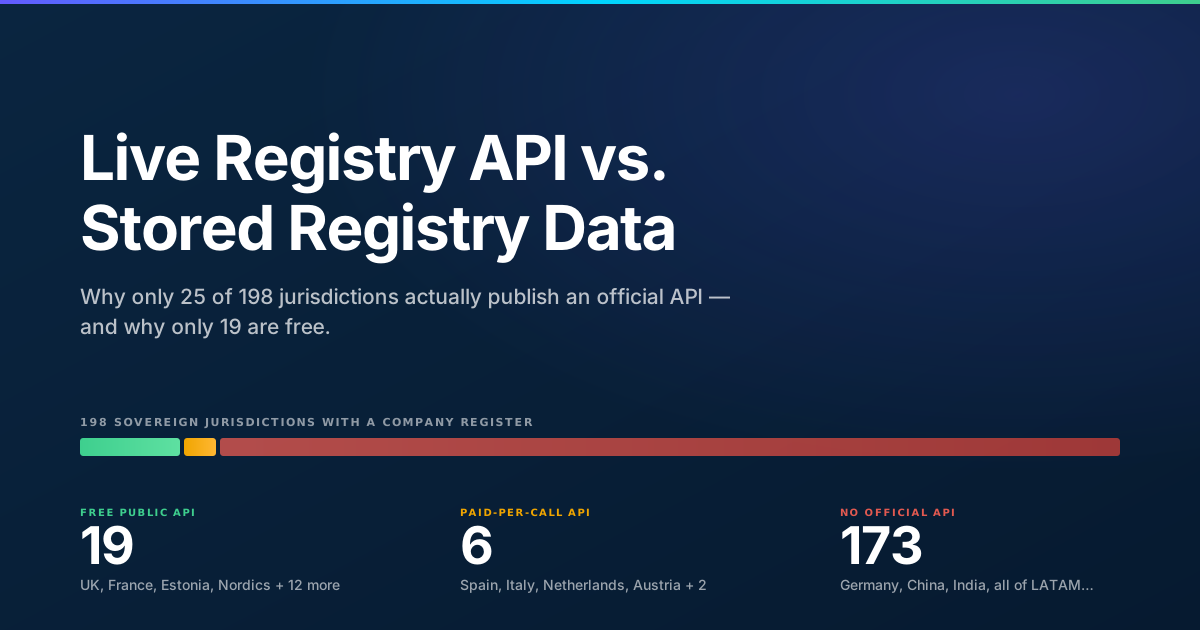
Out of 198 sovereign jurisdictions worldwide that maintain a company register, only 25 publish any kind of official API — about 1 in 8. Just 19 publish a free public API. The remaining 173 — roughly nine out of every ten — restrict access to web portals, monthly bulk files, paid PDF retrieval, or accredited intermediaries only. The US has no federal register at all. Canada has 14 fragmented ones. Germany, China, India, most of Latin America, most of the Middle East, and almost all of Africa publish nothing programmatic.
The UK Companies House API caps usage at 600 requests per five minutes per application key. Higher limits are granted in modest increments on request — typically doubled to 1,200. A bulk onboarding run across a 50,000-entity portfolio is not a five-minute job; it is a multi-day operation if every record must be fetched live. Most other national APIs are slower and tighter.
Government registries are state-funded systems. Their priorities are statutory compliance and public access, not enterprise uptime. Endpoints move, schemas change, authentication regimes get rewritten, and downtime windows are common. UK Companies House, the most mature registry API in the world, still has visible threads from developers reporting outages in the official forum. Smaller registries — particularly in emerging markets — can be offline for days.
A UBO chain frequently runs through three, four, or more jurisdictions. Even if every registry along the chain had a perfect API, you would still have to make sequential calls into incompatible schemas, normalise the data, match entities by name across languages, and resolve identifiers that simply do not exist as foreign keys. Live integration cannot solve corporate-linkage mapping. That is a data engineering problem, not an API problem.
Even when an API exists, the work has only just started. Each registry has its own authentication scheme, its own credit-balance or invoicing model, its own schema, its own retry semantics, its own audit-trail requirements, and its own holiday calendar. The buyer's team has to design — per registry — a complete workflow that calls the API, handles the payment, retrieves the data, captures the receipt, recovers from failure, and stores the audit log. Twenty-five registries is twenty-five integration projects, twenty-five vendor relationships, and twenty-five surfaces to maintain forever.
Problem 01 in detail: the registry API map is mostly empty
The simplest way to understand the live-integration problem is to look at a map of where APIs actually exist. We maintain a complete jurisdiction-by-jurisdiction reference here: Business Registry API Access by Country: The Global 2026 Map. The picture outside Europe is harsher.
Reading that chart, a few realities become uncomfortable:
- The United States has no federal company registry. Each of the 50 states maintains its own Secretary of State database. Independent developers have documented that most of these — Texas, New York, Florida, and others — have no public API. California launched an official SOS developer portal in the past year, the first major state to do so. The rest are ASP.NET forms with ViewState, CAPTCHA, and silent rate limits.
- Canada has 14 separate registries — one federal and 13 provincial/territorial — each with its own access rules. See our deep-dive on Canadian business registry search across federal and provincial systems for the full breakdown.
- Across the Middle East, large APAC markets, and most of LATAM, business registry data is published through portals that require manual lookups — sometimes in person, often in the local language only, and frequently behind paid extracts.
If your verification workflow needs to cover companies in 100+ countries, the live-API approach has a hard ceiling. There are 25 jurisdictions globally where an official registry API exists. Beyond country number 25, there is nothing to integrate against.
And of those 25, only 19 are free
"Has an API" and "the data through that API is free" are two different things. Of the 25 jurisdictions worldwide with an official registry API, only 19 publish company data without per-call charges. The other six — Spain, Italy, Netherlands, Austria, Saudi Arabia, and South Africa — operate paid-per-record models. The API is the access mechanism; the data behind it is metered.
One caveat applies across the board: "free" almost always means free access to structured company records — name, number, status, type, registered address, directors, submission history. Retrieval of document images — annual returns, accounts, memoranda, certified extracts — is typically paid, even in the most open jurisdictions. The UK Companies House charges nothing for the core record but applies fees for certified documents. Ireland's CRO Open Data Portal is free for company records but pay-per-call for document retrieval. Switzerland's Zefix is free for the register extract but CHF 50 for the certified version. The free-vs-paid split below tracks the structured-record API.
- United KingdomCompanies House
- IrelandCRO Open Data Portal
- FranceSirene + INPI RNE
- DenmarkCVR
- SwedenBolagsverket
- NorwayBrønnøysundregistrene
- FinlandPRH / YTJ
- Estoniae-Business Register
- CzechiaARES
- PolandKRS
- SwitzerlandZefix REST
- UkraineEDR
- AustraliaASIC + ABR
- New ZealandCompanies Office + NZBN
- SingaporeACRA via data.gov.sg
- JapangBizINFO (METI)
- South KoreaOPENDART
- TaiwanGCIS
- United StatesSEC EDGAR (federal, listed cos only)
- SpainCORPME apified — €9.02 + VAT / nota simple
- ItalyInfoCamere — variable per document
- NetherlandsKVK API — tiered, local presence required
- AustriaFirmenbuch — EU eID + per-record fee
- Saudi ArabiaWathq — credentials-gated, billed
- South AfricaCIPC APIVerse — partner-gated, billed
25 jurisdictions out of 198 with an official registry API · 173 have no API at all · Verified May 2026
The paid registries are not edge cases. Spain, Italy, and the Netherlands together represent some of the largest economies in continental Europe. The Spanish nota simple costs €9.02 + VAT per company extract. Italian InfoCamere charges fluctuate by document type. Dutch KVK is tiered. Saudi Arabia's Wathq is credentials-gated and billed.
The per-record cost is the visible part of the problem. The harder part — the part that turns a paid API from a unit-cost question into a project-cost question — is the workflow the buyer has to build around it: pre-funded credit balances with each registrar, per-call cost attribution, spend guardrails, internal pricing logic, six separate VAT registrations, and per-record receipt storage. That work is the substance of Problem 05 below, where it sits alongside every other piece of per-registry plumbing the buyer has to ship before the integration is usable.
Problem 02 in detail: latency and rate limits
Even where APIs exist, the throughput is rarely engineered for enterprise volumes. Companies House — widely regarded as the best-built registry API globally — applies a hard limit:
That last figure is the one nobody warns you about. Building one full integration — schema mapping, error handling, retry logic, monitoring, compliance review — takes a cross-functional team somewhere between one and three months. Multiply that across the 100+ registries you would need for full global coverage and you are looking at years of engineering effort just to keep the connections alive, before you write a single line of product code.
And response times in the wild are nothing like the cached-CDN speeds developers expect from a modern SaaS API. National registries frequently return profiles in 2–8 seconds, and that excludes downstream calls for filings, officers, and ownership documents. For a real-time onboarding flow, that latency budget is unworkable.
Problem 03 in detail: uptime is not their job
This is the one that gets glossed over in vendor pitches. Government registries are not run as commercial services. They have no enterprise SLA. They have planned maintenance windows that are announced in legalese on websites that few engineers read. Schema changes ship without deprecation notices. Authentication can be tightened overnight in response to scraping incidents elsewhere.
The UK Companies House developer forum has open threads with engineers asking "is the API down?" on a recurring basis. The UK is, again, the best-case scenario. In jurisdictions where the registry runs on infrastructure shared with broader government services, downtime windows of hours or days happen routinely — particularly around fiscal-year changes, regulatory transitions, or tax filing deadlines when registries are flooded.
If your customer onboarding, supplier verification, or payment authorisation flow depends on a live response from a foreign government registry, you are inheriting their uptime profile. That is not a risk an enterprise compliance team can absorb.
Problem 04 in detail: cross-jurisdiction joins are impossible live
This is the biggest one, and it is rarely discussed because it is technical rather than commercial. Live integration cannot answer the questions that matter most for compliance.
Take a real example. You are onboarding a UK-incorporated supplier. Its shareholder is a Dutch holding company. The Dutch holding company is owned by a Cayman Islands entity. The Cayman entity has two directors who also serve on the boards of three other entities, one in Singapore and two in the BVI. The ultimate beneficial owner is a natural person resident in Switzerland.
To resolve that chain live, you would need to:
- Call the UK API to retrieve the supplier's shareholders.
- Parse the Dutch shareholder name — which the UK record stores as free text, not a foreign key.
- Search the Dutch KVK for the holding company, hoping the name matches exactly.
- Retrieve the Dutch shareholder data — which is frequently stored only in filed PDFs, not in the API.
- OCR or manually parse the PDFs to find the Cayman entity name.
- Query the Cayman registry (which has no API and requires paid manual lookup).
- Match the directors to entities in three further jurisdictions.
- Cross-reference Switzerland's commercial register (Zefix) for the UBO declaration.
That is eight sequential operations across five jurisdictions, four different schemas, two languages, one OCR step, and at least one manual retrieval. There is no way to make that happen during a customer's onboarding session. It has to be pre-computed — meaning the data has to be stored, joined, and indexed in advance.
Corporate linkage, group structure, and UBO resolution are fundamentally graph problems. Graph problems require all the nodes to be present in one place. Live API integration gives you one node at a time — that is the wrong shape for the work.
Problem 05 in detail: every registry is a separate integration project
This is the problem buyers underestimate the most. The other four problems describe what the registry world looks like from outside. Problem 05 describes what it looks like once you are inside it, trying to do the work.
An API existing is not a deliverable. A working integration is. The distance between the two is where teams quietly lose six to twelve months of engineering time per registry — and where the operating cost of running a live-API approach keeps growing long after launch.
Here is what has to be built, per registry, for every jurisdiction in scope:
1. A bespoke authentication layer
UK Companies House uses an API key per application. France's INPI requires an account, OAuth flow, and per-environment credentials. Switzerland's Zefix issues credentials by email request. Sweden's Bolagsverket runs OAuth2 with separate scopes per dataset. Saudi Arabia's Wathq runs on issued service accounts. The Netherlands' KVK requires a contract, a local entity, and customer onboarding. Estonia uses national eID. Spain's CORPME requires a commercial conversation with api@corpme.es and custom client development.
There is no shared standard. Each integration starts with reading a different authentication document and building the equivalent of a small SDK that nobody else can reuse.
2. A payment and billing workflow — for the six paid registries
For Spain, Italy, Netherlands, Austria, Saudi Arabia, and South Africa, the API call is only half the workflow. Each request triggers a charge against a pre-funded balance or invoiced account. The team has to build:
- A pre-funding mechanism with each registrar's finance department, including treasury approvals to keep balances topped up
- Per-call cost attribution so each registry charge ties back to the customer, business unit, or onboarding case that triggered it
- Spend guardrails so a buggy retry loop or a sudden volume spike does not generate a five-figure surprise invoice
- Internal pricing logic deciding whether to pass per-call costs through to your end customer, absorb them, or cap them per onboarding
- VAT handling per registrar's jurisdiction — six separate VAT registrations and reclaim positions to maintain
- Receipt storage, because each invoice is a tax document that has to be retrievable for years
None of that is the company-verification product. It is a registry billing engine — a side project that has to ship before the actual product can launch.
3. An error and retry layer that knows each registry's failure modes
UK Companies House throws a 429 when its 600-requests-per-five-minutes ceiling is hit, with a Retry-After header that the team has to honour. France's INPI returns 502s during nightly maintenance windows. Germany's Handelsregister (when scraped, since there is no official API) silently inserts CAPTCHAs after a few hundred sequential requests. Italy's InfoCamere periodically returns successful HTTP 200s with empty payloads when their backend is under load. Each registry has its own catalogue of half-broken states, and the team has to build per-registry handlers for all of them — plus the dashboards and alerting that make those failures visible to support before customers notice.
4. A per-registry data normalisation layer
UK Companies House returns directors with separate first-name, surname, and middle-name fields. France's Sirene returns the legal representative as a single concatenated string with the role appended in French. Estonia returns a normalised ID code. Spain returns names in title case with conjunctions ("y", "de la") that have to be handled. Czechia returns Cyrillic transliterations of foreign directors. The team has to design a target schema and write twenty-five separate adapters that map each registry's payload into it — and maintain those adapters every time a registry changes its response format, which they do without notice.
5. A complete audit trail per call
Compliance frameworks — AMLD6, the EU AML Single Rulebook, FinCEN's CDD rule, FCA SYSC — require that the verification decision be reproducible. The team has to store, per call: the request payload, the response payload, the timestamp, the data source, the source-registry record version, the user or system that initiated the call, and the registry's official receipt. Per registry. Forever. This is non-negotiable for regulated buyers and it is a substantial storage and retrieval problem that does not appear in any API documentation.
6. Ongoing maintenance — forever
None of the above is one-time work. Every registry updates its schema, rotates its credentials, deprecates endpoints, and changes its rate limits on its own schedule. A team running a live-API approach across 25 jurisdictions is operating 25 separate ongoing integrations, each with its own changelog to monitor, its own forum to follow, and its own incident response process. The marginal cost of "we should also cover Singapore" is not a quick win — it is another permanent engineering surface the team has to keep alive.
The buyer's instinct is to compare the unit cost of registry calls against a stored-data subscription. The real comparison is the cost of running an internal team that exists to maintain twenty-five registry integrations forever — versus paying a vendor whose entire engineering org is already organised around that work.
A single, normalised dataset — refreshed daily from 400+ government registries
Global Database ingests registry data directly from source, stores it in dedicated cloud infrastructure across Google Cloud and Hetzner Germany, and exposes it through one schema across 200+ countries. Every record carries source attribution and a "last updated" timestamp. New filings are typically reflected within 24 hours. No rate-limit math. No registry-by-registry parsing. No outages to inherit.
What "stored and refreshed" actually looks like
The alternative to live integration is not what most engineers picture when they hear the word "database." A modern registry data infrastructure is closer to a streaming ETL pipeline with a data warehouse behind it, plus an enrichment layer, plus a delivery layer.
Here is what the architecture has to handle to be worth the investment:
1. Daily ingestion from source
Each registry has its own update cadence and delivery format. UK Companies House publishes daily bulk products and a streaming API. Ireland's CRO publishes daily open data. Singapore's ACRA, Belgium's CBE, and New Zealand's Companies Office publish monthly. Some registries publish only on request, in CSV, in the local language.
The job is to pull from each in their native format, on their native schedule, and standardise the output every day. Global Database runs this ingestion against 400+ registries continuously. When updates arrive, they are processed automatically the same day.
2. OCR and digitisation of financial filings
This is the part most data vendors skip. A huge proportion of registry filings — particularly financial statements in continental Europe, Asia, and Latin America — are submitted as scanned PDFs, not structured data. The UK's iXBRL financials are the exception, not the rule.
For these to be useful in a database, they have to be OCR-processed, then parsed against the local accounting taxonomy, then mapped to a standard schema so a Spanish balance sheet looks the same shape as a German one. We do this automatically on every new filing. If the entity already exists in the database, the record is updated. If it does not, a new entity is created.
3. Enrichment, not just ingestion
Raw registry data is the floor, not the ceiling. A registered name, number, and address tell you the entity exists. They do not tell you whether it is risky to engage with, who is really behind it, or what it owes whom. Every record in Global Database is enriched at ingest with corporate linkage mapping, ownership graphs, credit scoring, sanctions and PEP screening, financial ratios, industry classification, employee estimates, and decision-maker contacts — built from the same registry data, processed in advance, available as a single response.
4. Multi-region infrastructure for uptime
If the goal is to fix the uptime problem registries impose, your own infrastructure has to be more reliable than theirs. Global Database runs on Google Cloud and on dedicated Hetzner infrastructure in Germany, with failover between the two. Customer-facing APIs are decoupled from registry ingestion entirely, so a national registry being down has no effect on customer query response times.
The honest comparison
This is what the two approaches look like side-by-side, with no marketing varnish.
| Capability | Live registry calls | Stored + refreshed daily |
|---|---|---|
| Country coverage | ~50% of jurisdictions, max | 200+ countries |
| Response latency | 1–8s per record, per registry | ~300ms, normalised |
| Uptime dependency | Inherits each registry's uptime | Independent of registry uptime |
| Rate limits | Hard, per-registry, low | Set by your delivery agreement |
| Corporate linkage / UBO chains | Not feasible in real time | Pre-computed, returned in one call |
| Schema consistency | Different per country, per language | One schema across all jurisdictions |
| Financial statement data | Often PDF-only, not structured | OCR + digitised at ingest |
| Source attribution | Implicit (the call itself) | Source + timestamp on every field |
| Engineering effort to maintain | 1–3 months per registry, ongoing | None — handled by the data provider |
"But isn't live data fresher?"
This is the natural objection, and it deserves a direct answer. In theory, a live API call returns the freshest possible state of the registry. In practice, here is what actually happens to "freshness" once registries are in the loop:
- Registries themselves lag. A director appointment in many EU countries is filed within weeks, not days. A live API call retrieves whatever the registry has, which is rarely what happened yesterday.
- Most use cases do not need real-time. Onboarding, supplier verification, periodic KYB refresh, sanctions screening — none of these require sub-day latency. They require known freshness with a timestamp on the record, which is exactly what stored-and-refreshed delivers.
- Where event-driven freshness matters, it is solved by webhooks or change feeds — not by live calls. Global Database emits update events when monitored entities change. You react to the event; you do not poll the registry hoping to catch it.
The "freshness" argument for live integration is almost always a theoretical advantage that does not survive contact with a real production workload.
Where stored registry data still has to be done well
Storing the data is not the end of the problem. It is the start of a different one. A stored dataset is only as good as:
- Refresh cadence. Daily is the minimum acceptable standard for serious KYB use. Anything less risks the kind of stale-data failure the FCA has fined firms for. We refresh daily from source.
- Source attribution. Every field must carry the registry it came from and the date it was last verified. Regulators want to see provenance, not just data. Every Global Database record carries this.
- Entity matching. When new data arrives, you must correctly resolve it to existing entities, or create new ones cleanly. Get this wrong and you fragment ownership chains. Get it right and you build them automatically.
- Schema standardisation. A Spanish balance sheet and a German one look nothing alike on paper. They must look identical in your API response. This is real engineering work, not a setting.
- Delivery flexibility. Some teams want REST API. Some want bulk files. Some want webhooks. Some want all three. A serious provider supports all three.
Three delivery models. Same registry-sourced data underneath.
One endpoint, 200+ countries, normalised schema. Plug into your onboarding, CRM, or risk engine.
Explore the API →Daily delta files or full snapshots, delivered to your S3, GCS, or SFTP. For teams that want full control of the data.
Request bulk pricing →Search, verify, and monitor companies through the Global Database web app. No engineering setup required.
Start exploring →The decision, plainly
If you are running a single-country product in the UK or Ireland with low volume, building directly against the registry API is a defensible choice. You will manage rate limits, absorb the occasional outage, and live with the latency. It can work.
For anything broader than that — multi-country coverage, enterprise SLA requirements, UBO and corporate-linkage workflows, or compliance audits that demand source-attributed records across hundreds of jurisdictions — live integration is not a viable architecture. The registries themselves prevent it.
The model that works is the one this article has been describing: registry data ingested directly from source, refreshed daily, OCR-processed where needed, enriched, joined across borders, and delivered through whichever channel fits your workflow. That is what Global Database is.
Out of 198 sovereign jurisdictions worldwide that maintain a company register, only 25 publish any kind of official API — and only 19 do so freely. The remaining 173 jurisdictions are accessible only through web portals, bulk monthly files, accredited intermediaries, or paid PDF retrieval. Among the registries that do publish an API, many restrict access to local applicants, require national eID, charge per call, or expose only a subset of the underlying data.
Not all of them. Of the 25 jurisdictions worldwide with an official registry API, 19 publish company data free of charge — including the UK, Ireland, France, Estonia, the Nordics, Switzerland, Australia, Singapore, and Japan. The other six — Spain, Italy, the Netherlands, Austria, Saudi Arabia, and South Africa — charge per record retrieved through the API. A Spanish nota simple via the CORPME apified service costs €9.02 + VAT per company. Beyond the unit cost, the paid model also forces buyers to build pre-funded credit accounts, per-call cost attribution, spend guardrails, internal billing pass-through, and per-record audit storage for tax purposes. The data has a price tag and a billing workflow attached.
Government registries are funded as statutory services, not enterprise products. They apply strict rate limits — UK Companies House caps usage at 600 requests per five minutes per application — and individual record retrieval typically takes 1 to 8 seconds. Many registries also throttle dynamically during peak filing periods, and most return data in inconsistent schemas requiring per-country parsing.
Not in practice. The US has no federal company registry — each of the 50 states maintains its own system, and most have no public API. Canada has 14 separate registries. Large parts of Latin America, the Middle East, APAC, and several European jurisdictions publish registry data only through web portals. A global KYB workflow built on live APIs has a hard ceiling of 25 jurisdictions — the count of countries worldwide that publish any official registry API at all.
UBO resolution is a graph problem: it requires traversing ownership relationships across multiple jurisdictions, sometimes through 4 to 6 layers. Live API calls return one entity at a time, in inconsistent schemas, with shareholder names stored as free text rather than foreign keys. Resolving a cross-border chain in real time would require sequential calls into multiple registries, language translation, and PDF parsing — none of which can complete during a normal onboarding session. Graph problems require all the data to be present in one place.
Modern registry data infrastructure refreshes daily from source. Global Database ingests updates from 400+ government registries every day, with new filings and corporate changes typically reflected within 24 hours. Each record carries a source attribution and a timestamp showing the last update, so consumers always know how fresh a field is. For event-driven workflows, change feeds and webhooks notify subscribers the moment monitored entities are updated — eliminating the need to poll a slow registry.
A significant share of financial filings — particularly in continental Europe, Asia, and Latin America — are submitted as scanned PDFs rather than structured data. Global Database OCR-processes these documents at ingest, then maps them against local accounting taxonomies and normalises the output to a single cross-border schema. This means a Spanish balance sheet and a German one return in identical structures, ready for cross-jurisdiction analysis.
A full end-to-end integration — schema mapping, error handling, retry logic, monitoring, and compliance review — typically takes a cross-functional team between 1 and 3 months per registry. Multiplied across the 100+ registries needed for comprehensive global coverage, that is years of engineering effort just to maintain the connections, before any product code is written. This is why most teams that need global coverage end up using a managed data provider.
A registry integration is never "done." Each registry maintains its own authentication scheme, schema, error semantics, rate-limit policy, and update cadence — and each of those changes on its own schedule, usually without notice. For paid registries (Spain, Italy, Netherlands, Austria, Saudi Arabia, South Africa) there is also a permanent billing workflow to operate: pre-funded credit balances with each registrar, per-call cost attribution, spend guardrails, internal pricing pass-through logic, six separate VAT positions to maintain, and per-record receipt storage. The cumulative effect is that a team running live integrations across 25 jurisdictions is operating 25 separate ongoing engineering surfaces in addition to whatever their actual product is.
Global Database operates on Google Cloud and on dedicated Hetzner infrastructure in Germany, with failover between environments. Customer-facing APIs are decoupled from registry ingestion, so a national registry being down has no impact on customer query latency or availability. The system is designed to be independent of upstream registry uptime — the inverse of how live-integration vendors operate.
Yes. Global Database supports three delivery models built on the same registry-sourced dataset: REST API for real-time lookups, bulk file delivery (daily deltas or full snapshots, delivered to S3, GCS, or SFTP) for teams that want full control of the data, and the Global Database web platform for users who do not need an engineering integration. Bulk delivery is the standard choice for large compliance teams running internal pipelines.
For a low-volume, single-country product — particularly in the UK, where Companies House has the best-built registry API in the world — building directly against the live API is a defensible choice. You will manage rate limits, absorb occasional outages, and live with the latency, but it can work. For multi-country coverage, UBO and corporate-linkage workflows, enterprise SLA requirements, or compliance audits demanding source-attributed records, live integration is not a viable architecture and a managed registry data provider is the practical alternative.