Ask a large language model whether a specific company is active, who its directors are, or who ultimately controls it, and you will get a confident answer. Ask it about a company it has never seen — a three-year-old GmbH in Frankfurt, a private limited company in Manchester — and you will often get a confident answer too. The model does not know that it does not know. It predicts the most plausible continuation, and a plausible continuation of "the registration number is" looks exactly like a real registration number.
This is a manageable quirk in a chatbot. It is a structural liability in an AI agent — a system that acts on its own outputs. An agent that onboards a supplier, screens a counterparty, or pre-fills a credit assessment based on an invented filing status has not made a small error. It has made a decision on fabricated evidence, at machine speed, with no human in the loop to catch it.
The fix has a name: grounding. But grounding is only as good as the data underneath it, and most of what the industry calls "company data" cannot ground anything — because it cannot be traced back to a source. This guide covers how to ground AI agents in official company data: what grounding actually is, why the source tier matters more than the technique, and the seven design decisions that separate an auditable agent from an articulate one.
In short, the seven decisions are:
- Treat company data as a tool call, never as model knowledge.
- Resolve entities on canonical keys — registration number plus jurisdiction, not names.
- Return structured records with a fixed, cross-jurisdiction schema.
- Make "not found" a first-class answer the agent must report, not fill.
- Attach provenance to every field — source registry, filing date, retrieval date.
- Solve freshness structurally — stored and perpetually refreshed, not fetched live per call.
- Keep grounding alive with change monitoring, so filings re-trigger assessment.
What grounding actually means — and what it does not fix
Grounding an AI agent in company data means connecting every entity-level claim the agent makes — status, officers, ownership, financials — to a record retrieved from a verifiable source at task time, so that each answer can be traced to a specific registry filing rather than generated from the model’s training memory.
Grounding is the practice of connecting a model’s output to a verifiable source of information, so that answers are anchored in retrieved data rather than in the model’s training memory. Retrieval-augmented generation (RAG) is the best-known technique, but it is one technique, not the definition: grounding can equally be achieved through tool calls and structured data lookups. For company data, the tool-call form matters most — the agent queries a database mid-task and receives typed fields, not prose passages.
The distinction is worth pausing on, because most readers arrive equating grounding with RAG. RAG retrieves passages — chunks of text ranked by semantic similarity — and asks the model to read them. That fits documents: policies, contracts, filings as prose. Company facts are not prose. A filing status, a director appointment, a shareholding percentage are discrete, typed values with exactly one correct answer per entity, and similarity search is the wrong retrieval primitive for them: it can surface the record of a similarly named company and the model will read it just as fluently. For entity data, the right primitive is the exact-match structured lookup — a tool call keyed on identifiers, returning fields, with no interpretive step in between. Use RAG for the documents; use tool calls for the facts.
Two clarifications keep this honest. First, grounding reduces hallucinations; it does not eliminate them. No current architecture gets to zero. What grounding adds — and what makes it viable in regulated workflows — is traceability: when every claim links to a retrieved record, the remaining errors are detectable and attributable. Second, grounding shifts the burden, it does not remove it. An agent grounded in wrong data will faithfully repeat wrong data, with a citation attached. That is why the rest of this article is about the data, not the model.
Figure 1. One question — "Is Meridian Trading GmbH active, and who controls it?" — answered two ways. The ungrounded path produces fluent, unverifiable claims; the grounded path retrieves a record and inherits its provenance.
Not all company data can ground an agent
The grounding literature treats "connect the model to a verified source" as the end of the story. For company data, it is the beginning, because the market sells four very different things under one label.
Tier 1 is the registry itself — Companies House, the Handelsregister, the Kamer van Koophandel, a Secretary of State. This is the primary record: the legal filing, made by the company, held by the state. Everything else is derived from it. (For a full breakdown of what registries hold and how access models differ by country, see our guide to government registry data.)
Tier 2 is registry-sourced data: records collected directly from Tier 1 and stored with their provenance intact — which registry, which filing, which date. The chain of custody is one link long.
Tier 3 is the aggregated feed: data bought from other vendors, merged, and re-sold. The records may be accurate, but the chain of custody blurs. When one vendor buys from another who bought from a third, "where did this field come from and when was it last refreshed?" stops having a clean answer. An agent can retrieve such a record; it cannot cite it in any meaningful sense.
Tier 4 is scraped and AI-generated data: fields harvested from websites or inferred by models to fill coverage gaps. There is no filing behind these values at all. Grounding an agent in AI-generated data is circular — you are anchoring one model’s output in another model’s guess.
Figure 2. The chain of custody. The agent sits one hop from the registry, and the same provenance fields ride the record at every step — which is what lets the agent cite its source.
The practical rule: grounding quality cannot be added downstream. No amount of retrieval engineering turns a Tier 4 field into evidence. If the workflow must survive an audit question — and every compliance, KYB, and credit workflow must — the data layer has to sit at Tier 1 or Tier 2.
How to ground AI agents in official company data: seven design decisions
What follows is the implementation core. None of it requires exotic infrastructure — it requires discipline about seven decisions that most agent builds get wrong by default.
1. Treat company data as a tool call, never as knowledge
The foundational rule: the model’s parametric memory is not a data source for company facts. Every entity-level claim — status, officers, ownership, financials — must originate from a lookup executed at task time. In practice this means giving the agent a company-data tool (a REST endpoint or an MCP server) and instructing it, in the system prompt, that company facts may only come from tool results. The Model Context Protocol has become the standard way to expose such tools to agents across Claude, ChatGPT, Copilot, and custom frameworks, which makes this pattern portable rather than bespoke.
"But my agent already has web search"
This is the most common objection to decision 1, and it deserves a direct answer, because search-based grounding is the default in most agent stacks. Web search is grounding — but it grounds the wrong shape of question. A search tool retrieves pages ranked by relevance to a query. A company lookup retrieves a record matched to an identifier. Different operations, different failure modes.
Point a search-grounded agent at Meridian Trading GmbH and it will find the company’s own website, a directory listing, perhaps a news mention. It will not find the filing. Registry records overwhelmingly sit behind search forms that crawlers never reach, and are not published as indexable pages — the primary record is, for practical purposes, invisible to a search engine. So what comes back is prose about the company rather than the company’s record, and the model has to read and summarise that prose. Summarisation is generation. You have reintroduced the model’s judgement at precisely the point you were trying to remove it.
Three things break specifically. There is no canonical key, so nothing confirms the agent found the right Meridian Trading rather than a namesake in another jurisdiction — the resolution step in decision 2 has nowhere to land. There are no typed fields: the word "active" appearing on a webpage is not status: active from a filing, and the difference is invisible to the model. There is no provenance: a URL and a fetch timestamp tell you where the agent read something and when, not who filed it or on what date. Citing a page is not citing a source.
The honest converse: search is the right tool for everything that genuinely lives in prose — adverse media, litigation coverage, news, reputational signals. A serious agent uses both. The rule is simply not to ask a relevance engine to answer an identity question.
2. Resolve entities on canonical keys, not names
Names are the single largest source of silent grounding failures. Company names are duplicated across jurisdictions, abbreviated inconsistently, and translated freely. The canonical key for a legal entity is the registration_number plus the jurisdiction — a UK company number with GB, an HRB number with its register court, a SIREN with FR. The agent’s first job on any task is to resolve a name mention to that key pair, and to treat ambiguous resolution (multiple candidates, fuzzy match below threshold) as a failure state, not a coin flip. Tax identifiers can serve as validated secondary keys — formats differ by country, which is a solved problem if the data layer validates them per jurisdiction (see our global tax ID formats reference).
3. Return structured records with a fixed schema
Agents reason better over typed fields than over prose. A grounded lookup should return a stable schema — legal name, number, status, address, officers, beneficial owners, latest accounts — that is uniform across jurisdictions, so the agent’s logic does not fork per country. This is also where hallucination re-enters through the back door if you are careless: if the tool returns a free-text blob, the model summarises it, and summarisation is generation. Structured in, structured through.
4. Make "not found" a first-class answer
This is the decision that separates grounded agents from decorated ones. When the lookup returns nothing — the company does not exist, the jurisdiction is not covered, the match is ambiguous — the tool must return an explicit not_found status, and the agent must be instructed to report it as such. The failure mode to design against is the silent fallback: the tool comes back empty, and the model quietly answers from memory anyway, because that is what a language model does with a gap. In compliance workflows, "we could not verify this entity" is not a degraded answer. It is frequently the most valuable answer the system can produce, because it is the one that triggers escalation.
5. Attach provenance to every field
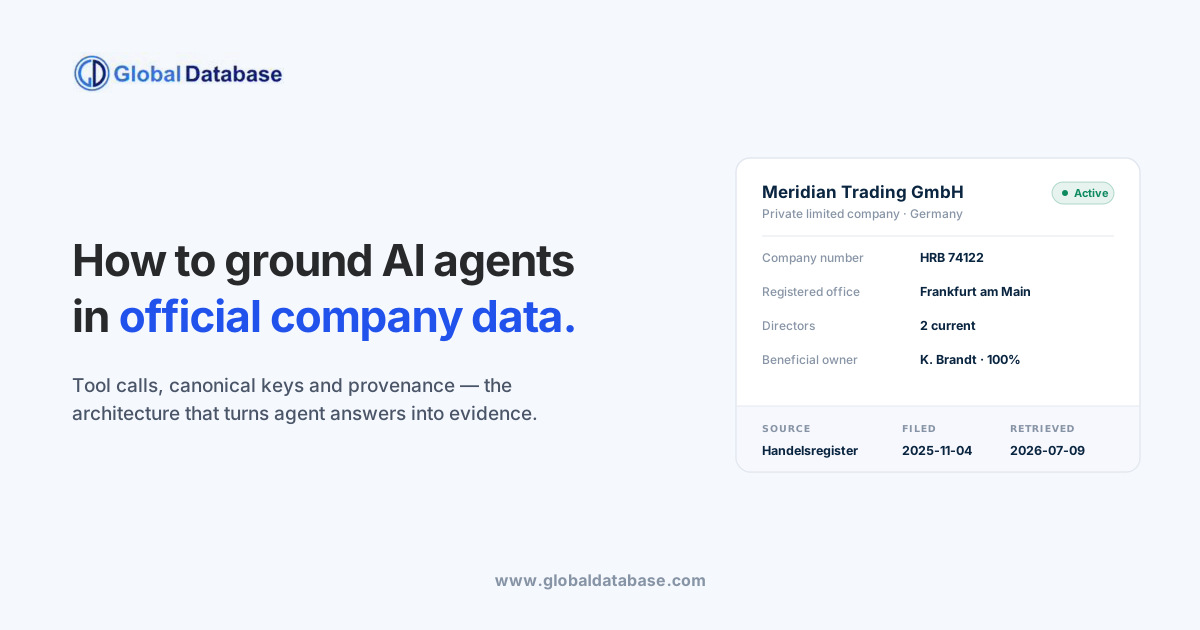
A record that can ground an agent has two halves: the facts, and the proof of where the facts came from. The proof half is a small set of fields — source_registry, registry_reference, filing_date, retrieved_at, collection_method — that costs almost nothing to carry and changes everything about what the output is. Without it, the agent’s answer is an assertion. With it, the answer is evidence: a reviewer, an auditor, or a regulator can trace any claim to a specific filing on a specific date. Provenance is also what makes the agent’s residual errors detectable — a wrong answer with a citation can be checked; a wrong answer without one can only be believed or disbelieved.
Figure 3. Anatomy of a record that can ground an agent. The provenance block is what turns an answer into evidence. Illustrative payload — field names simplified for clarity.
6. Solve freshness structurally, not per call
Agents change the economics of data freshness. A human analyst makes a handful of lookups a day; an agent fleet makes thousands per hour. The naive answer — hit the official registry live, at call time, for every lookup — collapses at exactly this point. Many registries have no API at all. Those that do impose rate limits designed for human traffic. Registry downtime becomes agent downtime. And a live call returns only today’s snapshot — no history, which means no way to answer "what did we know, and when?" after the fact.
The architecture that survives agent workloads is stored and perpetually refreshed: registry data collected on a continuous schedule, held in a uniform schema, served at database speed, with historical versions preserved. The agent gets millisecond reads and a consistent contract; the audit function gets point-in-time reconstruction; and freshness becomes a measured property of the layer — visible in retrieved_at — rather than a hope attached to each call.
Figure 4. Live-only retrieval versus stored-and-refreshed, dimension by dimension. Both start from official registries; they differ in whether the data survives the call.
7. Keep the grounding alive with change monitoring
Everything above grounds a decision at a moment in time. But companies do not hold still after onboarding: directors resign, ownership transfers, statuses lapse — and each of those events arrives as a new filing in the registry. A lookup-only architecture leaves the agent grounded in the world as it was on the day of the check. The complete design closes the loop: the data layer watches registries for new filings against the entities in your portfolio, and a material change — officer, ownership, status — triggers the agent to re-run its assessment. This turns grounding from a gate into a standing state, and it is the same shift regulators describe as ongoing due diligence: monitoring instead of periodic review. Monitoring endpoints are a standard part of the verification stack — we cover the pattern alongside lookup, ownership, and financials endpoints in our guide to the five essential APIs for automating KYB and compliance workflows.
Putting it together: a worked example
The success payload is Figure 3 — no need to repeat it. Two things the figure does not show are the call itself and, more importantly, the miss:
// The lookup, keyed on canonical identifiers — never on a name
GET /companies/lookup?jurisdiction=DE&company_number=HRB74122

// The miss is an explicit result, never an empty body
{ "match": "not_found",
   "query": { "jurisdiction": "DE", "company_number": "HRB99999" } }
The rest of the work happens in the system prompt — four lines carry most of the weight:
1. Company facts (status, officers, ownership, financials) may only
   come from tool results in this conversation — never from memory.
2. Before any lookup, resolve the entity to company_number +
   jurisdiction. If resolution is ambiguous, ask — do not pick.
3. On match: "not_found", answer exactly "I could not verify this
   entity" and stop. Do not describe the company.
4. Every entity claim in your answer must name its source_registry,
   filing_date, and retrieved_at.
That is the whole trick. The payload carries the evidence; the prompt forbids the model from manufacturing any; and the not-found branch is a scripted sentence rather than a gap.
How Global Database solves this
The layer described above, already built
Registry-direct collection, stored with source and filing dates intact, refreshed daily — Model B in Figure 4, in production.
Request a demo →THE LAYER
| SOURCES | 400+ government registries |
| COVERAGE | 200+ jurisdictions |
| PROFILES | 600M+ companies |
| REFRESH | Daily |
| PER RECORD | source_registry, filing_date, retrieved_at |
Why regulators will force this architecture anyway
If the engineering argument does not settle it, the regulatory calendar will. Two frameworks are converging on the same requirement from different directions.
The EU AI Act’s obligations for high-risk AI systems become enforceable on 2 August 2026. Systems used for creditworthiness assessment sit explicitly in the high-risk category, and the obligations include data governance, logging, and traceability — the ability to show what data a system relied on and where it came from. An agent that assesses counterparty risk on data with no provenance has a documentation problem it cannot fix retroactively.
The EU’s AML package — the AMLR and AMLD6, applying from 10 July 2027 — carries forward the long-standing requirement that customer due diligence rest on reliable, independent sources, now as a directly applicable EU regulation with a dedicated supervisor. "Reliable and independent" is, in practice, a description of government registries. When a supervisor asks where a verification came from, "from the registry, filing reference attached, retrieved on this date" ends the conversation. "From our AI system" starts one.
Put together: an AI agent performing KYB or credit work in Europe will need to demonstrate both that its data governance is sound (AI Act) and that its sources are reliable and independent (AML package). A registry-sourced data layer with provenance fields satisfies both with the same architecture. Nothing else does.
What grounding cannot do
Two boundaries, stated plainly, because they shape the architecture around the data layer.
Registries do not hold everything an agent needs. Sanctions designations, adverse media, litigation records, and PEP status live outside company registers, in different sources with different reliability profiles. A registry-grounded agent is grounded for entity facts — existence, status, officers, ownership, accounts — and those facts are the anchor the other checks attach to. But screening still requires its own grounded sources; registry data narrows the question to the right entity, it does not answer every question about that entity.
Registry depth varies by jurisdiction — and the agent must know what its layer cannot see. Filing requirements, financial disclosure, and above all beneficial ownership access differ sharply across countries: since a 2022 Court of Justice of the EU ruling struck down general public access to UBO registers, access in much of the EU has been restricted to parties with a legitimate interest, and the AML package now rebuilds access on that basis. The practical consequence for agent design is the same principle as not-found, one level up: coverage gaps must be explicit, machine-readable facts about the data layer — "UBO data not available for this jurisdiction" — so the agent reports the gap instead of papering over it. A grounded agent that overstates its own coverage is hallucinating about its data layer instead of about the company.
Failure modes to design against
Inverting the question — how would a grounded agent still fail? — surfaces four patterns worth engineering against explicitly.
Silent fallback to memory. The most common and most dangerous. The tool errors out or returns empty, and the model answers anyway. Mitigation: hard instruction plus output validation — any entity-level claim in the final answer must map to a field in a tool result, or the answer is rejected.
Entity confusion. The agent grounds correctly — on the wrong company. Same name, different jurisdiction; parent instead of subsidiary; the dissolved namesake instead of the live entity. Mitigation: canonical keys (decision 2) plus a confirmation step that surfaces the resolved number and jurisdiction before downstream reasoning proceeds.
Stale grounding. The record was true when collected and false at decision time — a director resigned, an ownership transfer filed, a status changed. Mitigation is structural freshness (decision 6): daily refresh cycles and a retrieved_at field the agent can reason about, so staleness is visible instead of invisible.
Aggregator recursion. The subtlest one. As more vendors patch coverage gaps with model-generated fields, an agent grounded in an aggregated feed may be citing another AI’s output without anyone having decided that. The only defence is upstream: know the tier of every source in the layer, and keep Tier 4 out of any field an agent will act on.
A useful lens for all four: the goal of grounding is not an agent that is always right. It is an agent whose answers can always be checked. Which raises the obvious question — checked how?
How to test that an agent is actually grounded
Grounding is a property you verify, not a feature you enable. The test design is simple and most teams skip it.
Build a golden set with traps in it. Assemble a fixed evaluation set of company questions in three groups: real entities your data layer covers, real entities it does not cover, and — the part almost nobody does — fabricated entities that do not exist anywhere: invented names with plausible-looking registration numbers in real jurisdictions. The fabricated group is the direct probe for the silent-fallback failure mode, because a language model will happily describe a company that was never incorporated. The only acceptable output on every trap is the scripted "could not verify" response; any biographical detail about a fake company is a hard failure, regardless of how the agent scores elsewhere.
Trace every claim, not just the verdict. For the real entities, do not grade answers on overall correctness — grade them on attribution. Parse each entity-level claim in the agent’s output and check it maps to a field in a tool result from the same run, with the provenance details quoted accurately. An answer that is factually right but contains one claim with no corresponding tool field is a grounding failure: the model got lucky from memory, and luck does not survive distribution shift.
Re-run on every change — including the vendor’s. Model upgrades shift behaviour without any change on your side, and so do prompt edits and tool schema changes. The golden set runs on each of them, and the fabricated-entity pass rate is the number to watch: it is the earliest indicator that a new model version has become more willing to fill gaps. A grounded agent is not something you shipped; it is something your last evaluation run says you still have.
Get the data layer
Get the data ready-built for AI agents. One registry-sourced layer, three channels:
BULK DATA FEEDS
For data and platform teams building grounding infrastructure in-house
Full jurisdictions or filtered segments, every record carrying its source registry and timestamp.
MCP SERVER
For engineering teams building custom AI agents
Direct tool-call access to lookups, ownership, and financials from any MCP-compatible agent framework.
CONNECTORS
For compliance and ops teams — no build required
Add the Global Database connector and the assistants your team already uses — Claude, ChatGPT — answer from registry records.
Frequently asked questions
What does it mean to ground an AI agent in company data?
Grounding means connecting an AI agent’s answers to a verifiable data source instead of letting the model answer from training memory. For company data, a grounded agent looks up each entity in a registry-sourced database through a tool call and cites the record it retrieved — including the source registry and retrieval date — rather than predicting a plausible answer.
Does grounding eliminate AI hallucinations completely?
No. Grounding significantly reduces hallucinations and, just as importantly, makes the remaining errors traceable: every claim links back to a specific record. No current technique eliminates hallucinations entirely, which is why grounded systems also need explicit not-found handling and human review paths for high-stakes decisions.
What is the difference between RAG and tool-call grounding for company data?
Retrieval-augmented generation (RAG) retrieves text passages from a document store and passes them to the model as context. Tool-call grounding has the agent query a structured database and receive typed fields — company number, status, officers, filing dates. For company data, structured tool calls are usually the better fit, because entity records are structured facts, not prose.
What counts as official company data?
Official company data originates in government registries: incorporation records, filing histories, statuses, registered addresses, officer appointments, beneficial ownership registers, and filed annual accounts. Data that has been web-scraped, self-reported, or inferred by a model is not official, because there is no government filing behind it that an auditor can check.
Why is aggregated company data risky for grounding AI agents?
Aggregated feeds are often bought and re-sold between vendors, which dilutes provenance: the original registry, filing date, and refresh date become unclear or are lost. An agent grounded in such data can retrieve a record but cannot prove where it came from or how old it is — which defeats the audit purpose of grounding in regulated workflows.
What identifiers should an AI agent use to look up a company?
The canonical key is the official registration number plus the jurisdiction — for example, a UK company number with jurisdiction GB, or a German HRB number with its register court. Names are ambiguous and duplicated across countries; registration numbers are not. Tax identifiers such as VAT numbers can serve as secondary keys where formats are validated per country.
How should an AI agent handle a company it cannot find?
It should return an explicit not-found result and say so. The single most dangerous failure mode is a silent fallback to model memory, where the agent fills the gap with a plausible invention. Not-found is a legitimate, machine-readable answer — in compliance workflows it is often the most important answer, because it triggers escalation.
What provenance fields should a grounded company record include?
At minimum: the source registry, the registry reference for the underlying filing, the filing date, the date the record was retrieved or refreshed, and the collection method. These fields turn an agent’s answer from an assertion into evidence — a reviewer can trace any claim back to a specific government filing on a specific date.
How does grounding help with EU AI Act and AMLD6 compliance?
The EU AI Act’s requirements for high-risk AI systems — which apply from 2 August 2026 — include data governance and traceability obligations, and the EU’s AML package (AMLR and AMLD6, applying from 10 July 2027) requires due diligence based on reliable, independent sources. An agent grounded in registry-sourced data with provenance fields produces exactly the audit trail both frameworks anticipate.
Can I ground AI agents in Global Database data via API?
Yes. Global Database provides registry-sourced company data — over 600 million company profiles collected from more than 400 government registries across 200+ jurisdictions, refreshed daily — through a REST API suited to agent tool calls, as bulk files for teams building their own data layer, and through an online platform for human review.